
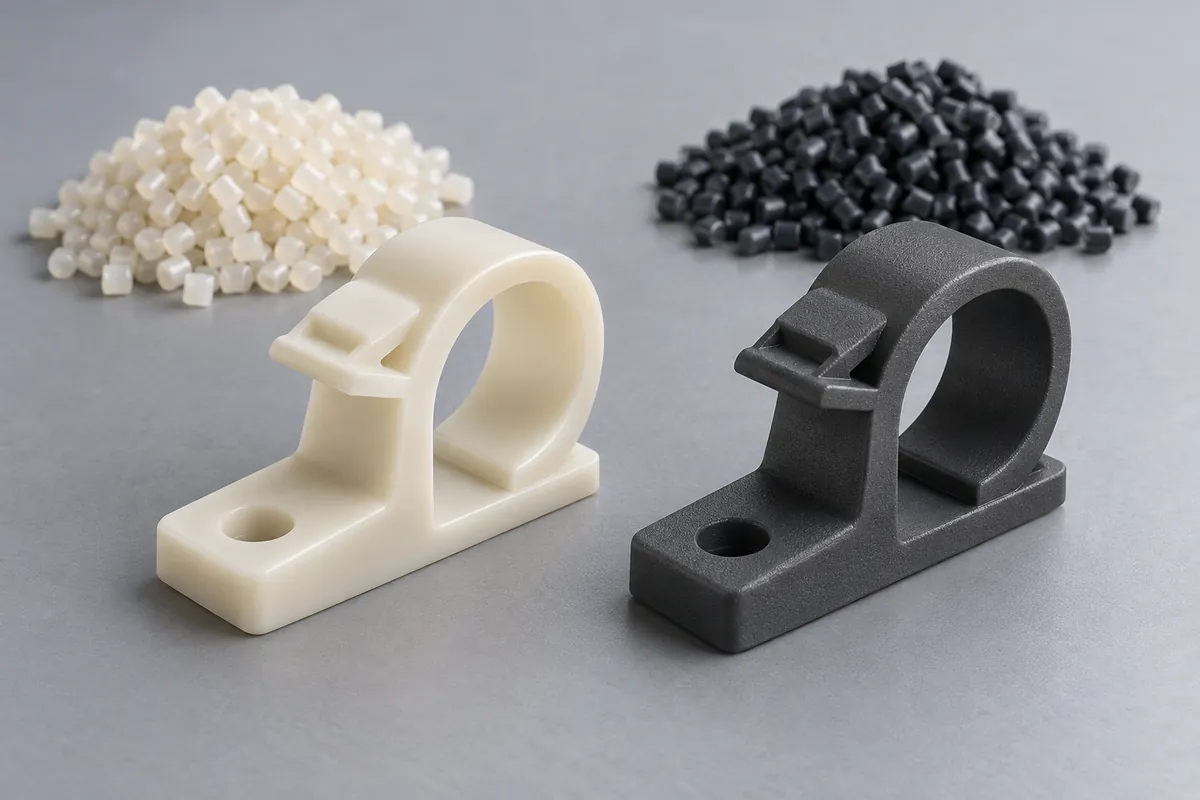
A clip needs enough flexibility to assemble and enough resistance to remain engaged. That combination makes “use the stronger plastic” an incomplete material specification. A higher catalog strength does not tell you whether the proposed beam can accommodate its required displacement, survive its release sequence or retain its function after exposure.
Compare identified resin grades in a defined clip geometry, not just filled and unfilled labels. Start with the assembly movement and retained function. Then ask which material data and part tests are needed to support the choice. This guide is a clip-specific decision process; our glass-filled nylon guide covers the broader material and molding background.
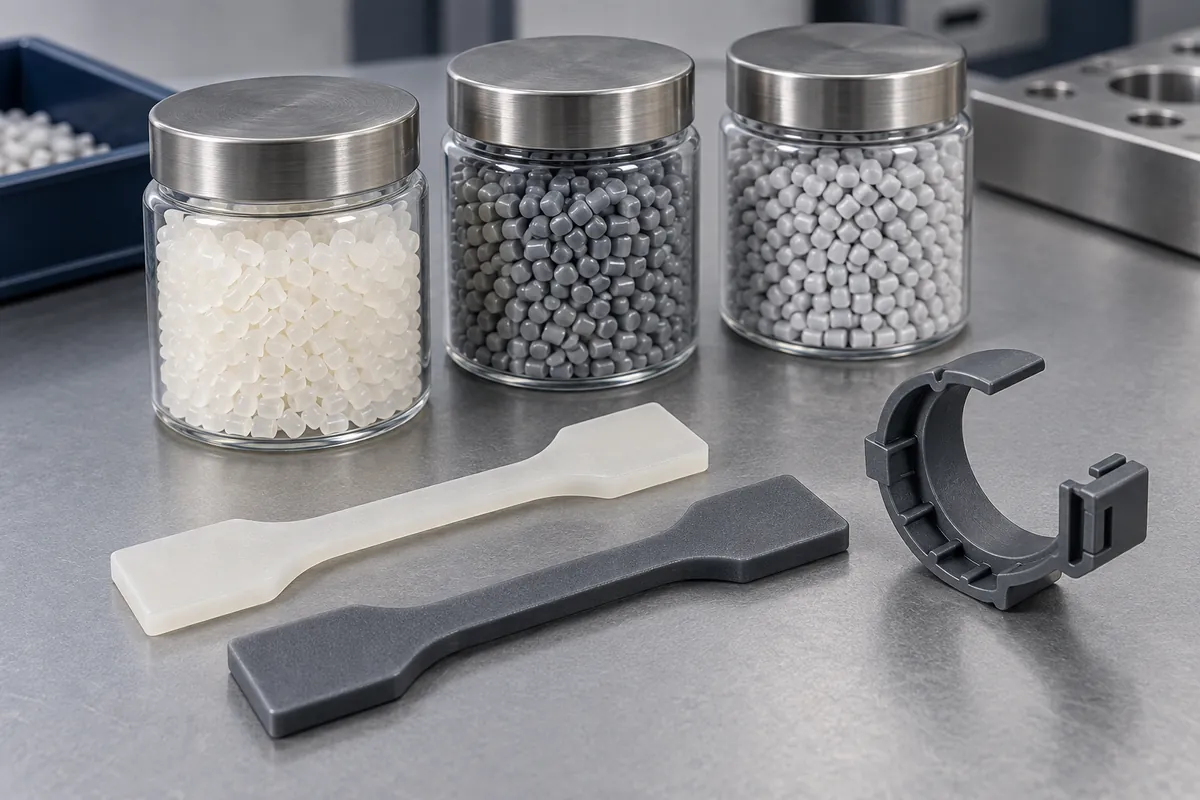
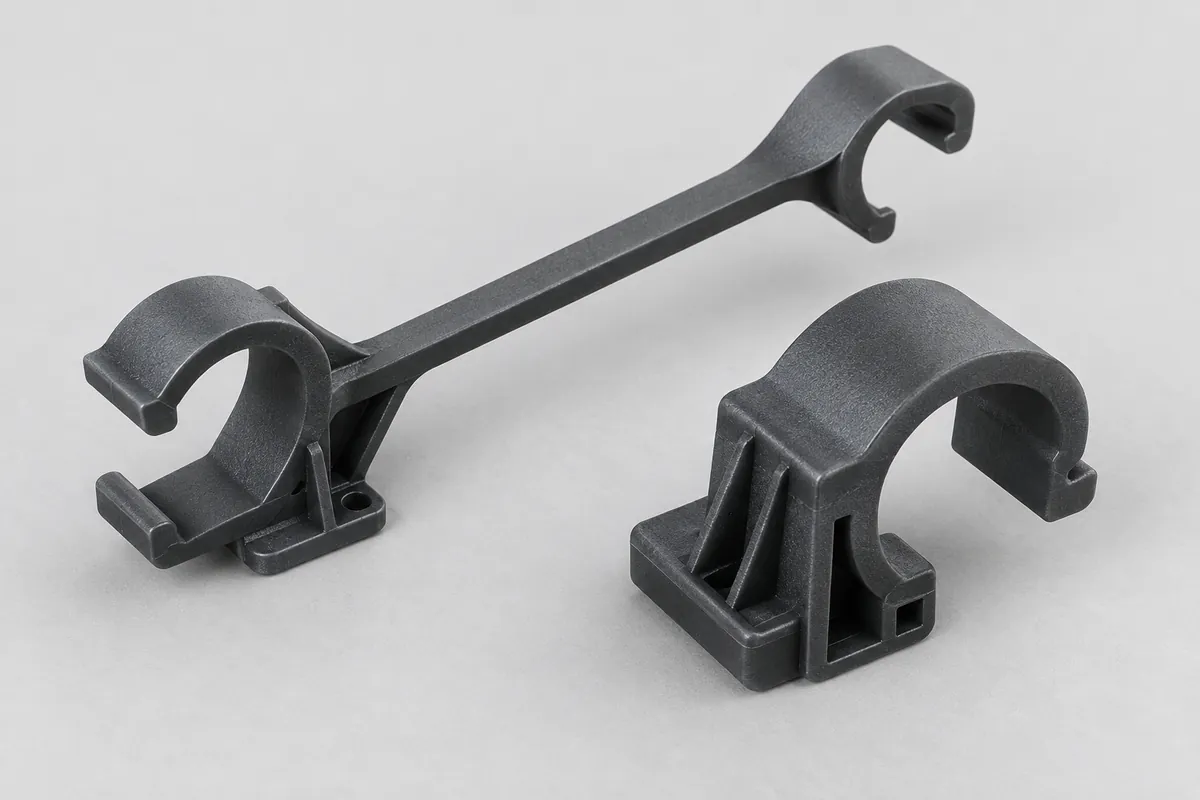
All images in this article are newly AI-generated illustrations of engineering concepts, not photographs of a customer project or evidence of completed testing.
Decide What Is Fixed in the Comparison
If the geometry is already released, a material substitution must work within the existing interfaces and permitted drawing changes. If the design is still open, each candidate may need a different flexible length or section. Those are two different purchasing questions: an interchangeable resin substitution versus a redesigned assembly.
For a hypothetical service-cover clip, keep the mating window, required overlap and access envelope visible. A resin that looks attractive in a short, stiff latch may be less appropriate when the arm has to deflect substantially. Conversely, a compliant material that assembles easily still needs to satisfy the retained-load requirement.
Do not assume that adding glass makes every snap-fit unsuitable or that choosing an unfilled grade makes every beam safe. The allowable response belongs to a particular grade, condition and geometry. Ask the material supplier which design data apply rather than inferring repeated bending capability from a tensile strength headline.
Read the Conditions Beside the Property Values
Build a short candidate record containing the supplier, full grade designation, reinforcement, color or additive restrictions and the data revision. Check the specimen condition and test conditions attached to each property. Two numbers presented in the same column may not describe equivalent material states.
For moisture-sensitive grades, ask which material and specimen conditions correspond to assembly and service. For a temperature-dependent application, request relevant data at the intended conditions. If the required information is unavailable, mark that uncertainty as a validation need; do not silently replace it with a room-temperature value.
Separate stiffness, allowable deformation, repeated-operation behavior and long-term retention in the review. They answer different questions. A single pass/fail ranking that blends them into one score can obscure a candidate that meets the structural requirement but needs a geometry change to assemble.
The Molding Proposal Is Part of the Material Decision
With a reinforced grade, review how the proposed filling pattern relates to the flexible arm and its root. BASF's molding simulation tutorial explains that injection location can change filling, fiber orientation and warpage. That is a reason to review the part's flow pattern, not permission to assign a universal strength reduction or preferred gate position.
Ask whether a potential weld line lies in a functionally sensitive region and whether the selected material model represents the relevant behavior. The clip gate and weld-line review treats this as a design comparison. Neither a colorful simulation image nor a visually smooth surface demonstrates the completed clip's performance.
Make substitutions visible in the quotation. Changing the reinforcement level, approved color package or resin source may alter the configuration that was reviewed. Define who can approve such changes and what evidence is required. A purchasing description that says only “nylon clip” leaves too much unspecified for controlled supply.
| Question | Information to request | Decision affected |
|---|---|---|
| Can it accommodate assembly? | Applicable deformation data, condition and actual beam geometry. | Keep or revise the flexible region and interference. |
| Will it retain the required function? | Relevant long-term and environmental evidence. | Exposure and retained-function test scope. |
| Can the molded configuration be reproduced? | Grade identity, gate concept, process and change controls. | Trial approval and production documentation. |
Use Trials to Resolve a Specific Uncertainty
A practical comparison holds the important common requirements constant and records every intentional change. If two resins need different geometries, evaluate them as two complete candidates. If the purpose is to isolate a material effect, agree a suitable comparison method rather than treating unlike assemblies as interchangeable data points.
Keep specimen conditioning and manufacturing identity attached to the result. Use representative molded samples for the relevant release decision. A printed prototype can help check access or fit, but its success should not be reported as qualification of an injection-molded grade and flow pattern.
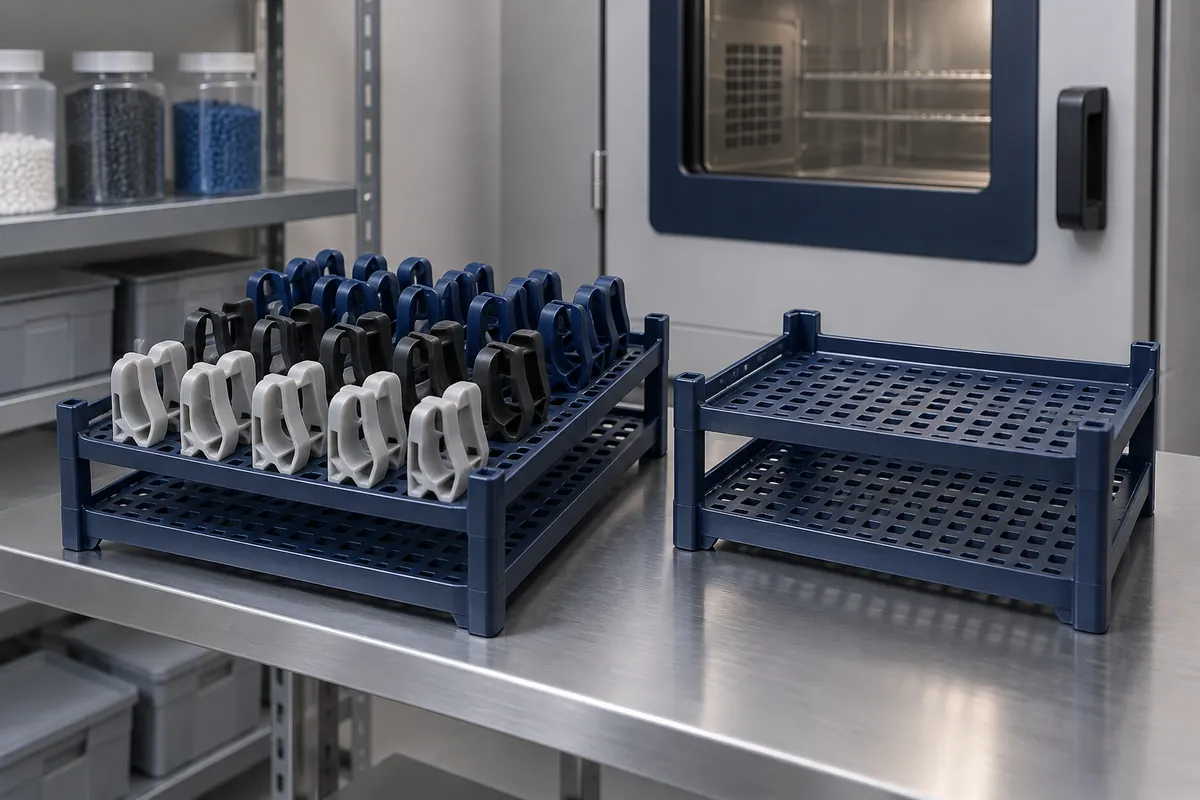
Bring the candidate selection into the cycle-test plan and the sustained-retention review. These checks establish different parts of the evidence package. Do not use a passing first insertion as a substitute for either requirement.
For custom injection-molded clips, send your approved grade if one exists, or identify the material choice as an open decision. Request a clip quote with a material-review scope. The quotation should say what is proposed, what still needs approval and which validation activities are included.