
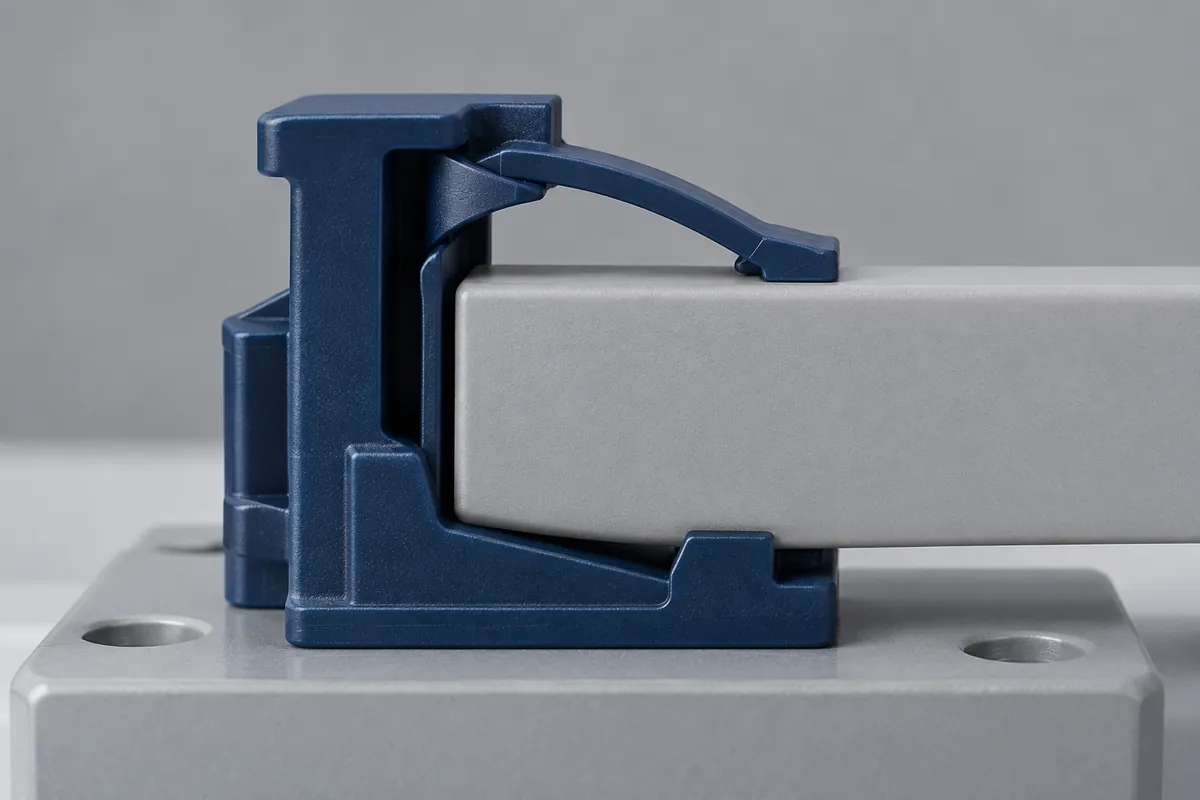
A plastic clip can assemble cleanly and resist an initial pull, yet still need a separate long-term review. A loaded cable may keep pulling on the retainer. A cover may hold the beam away from its free position for months. Those situations ask different questions from whether a newly molded clip survives one assembly.
Define what remains imposed during service: a load, a displacement or a combination. Then decide which retained function must be checked after exposure. This distinction makes the difference between a useful validation plan and a vague request to “test the clip for creep.”
All images in this article are newly AI-generated illustrations of engineering concepts, not photographs of a customer project or evidence of completed testing.
Creep and Stress Relaxation Are Different Boundary Conditions
Covestro's long-term mechanical properties guide distinguishes increasing deformation under constant stress from decreasing stress under constant strain. These are creep and stress relaxation respectively. Temperature and time affect the response, so short-term material data cannot by itself define long-term retention.
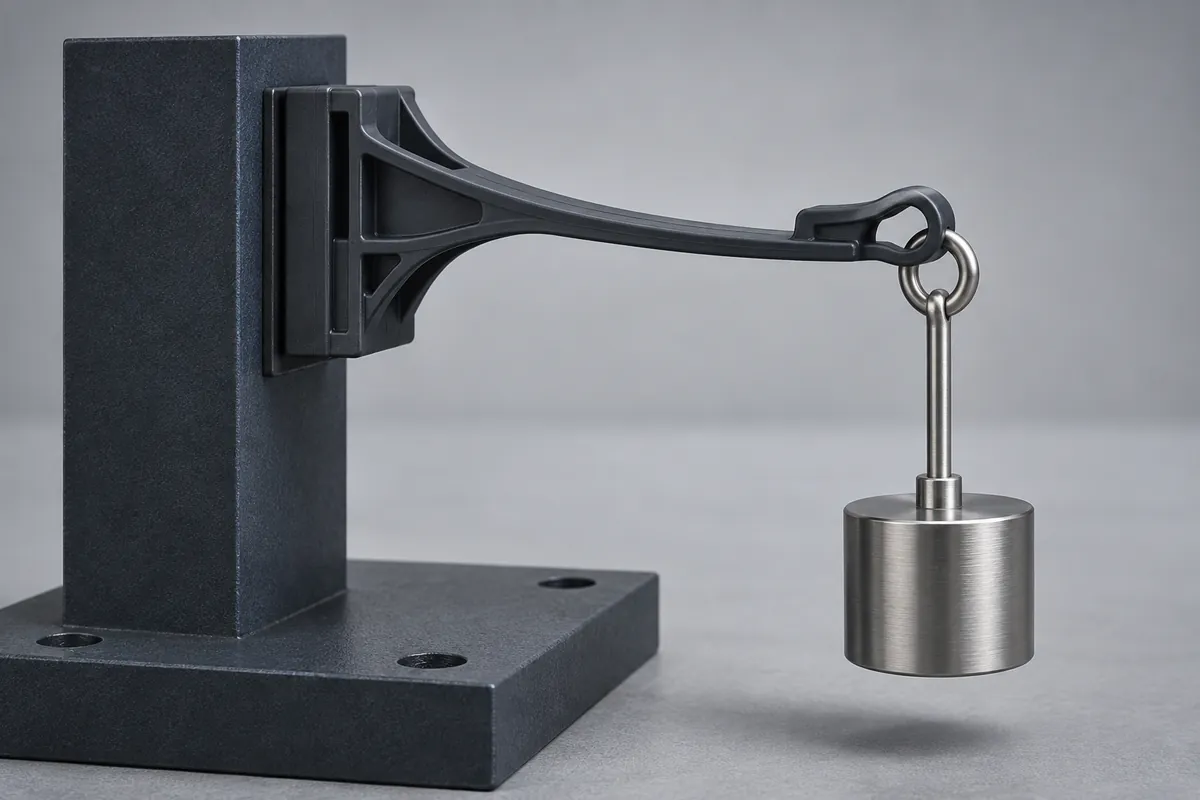
For a clip carrying an external load, ask whether movement gradually consumes the engagement clearance. For a clip held at a set deflection by its mating part, ask whether the contact force changes while the displacement remains constrained. A real assembly can contain both effects as contact surfaces move and load paths change.
A retaining hook may also rely on geometric overlap rather than continuous spring pressure. Lower contact force does not automatically mean that the hook has disengaged. Conversely, a hook can remain visibly engaged while no longer meeting a required clamping or anti-rattle function. Write down the function before choosing the measurement.
Describe the Service Exposure as a Sequence
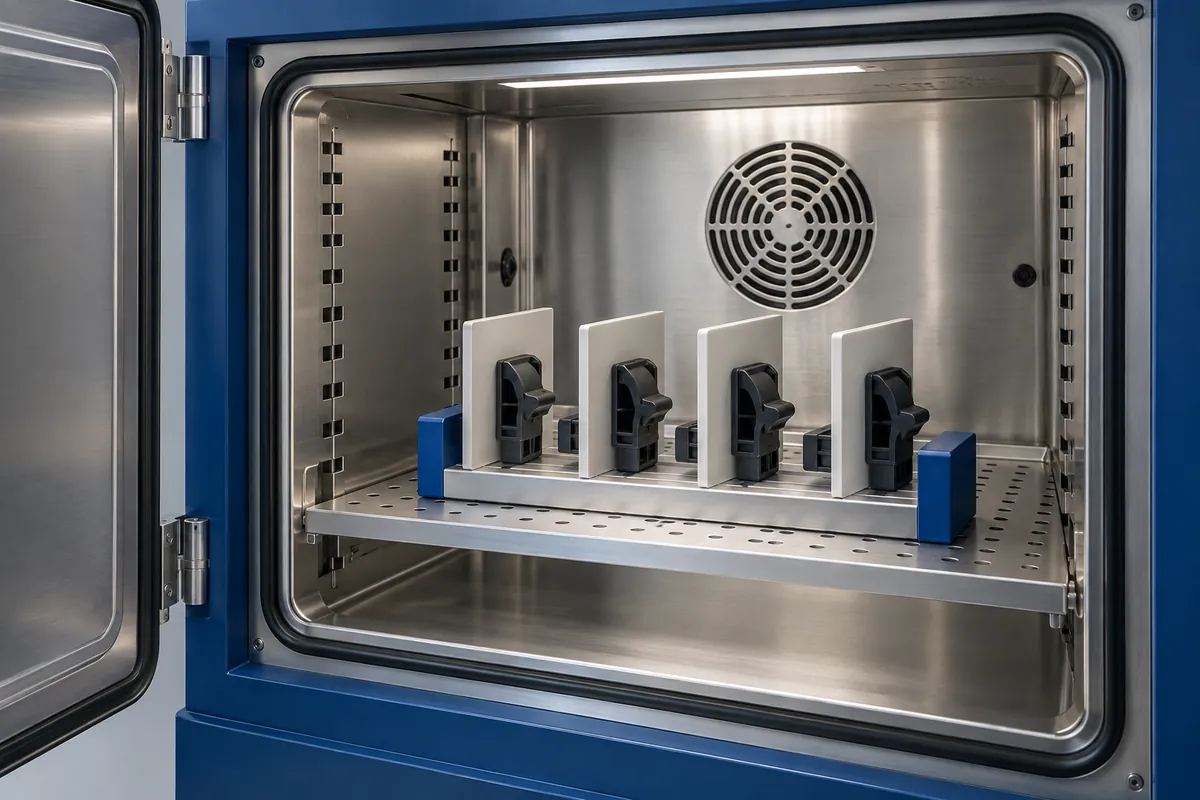
Consider a hypothetical retainer inside equipment that is shipped unassembled, snapped into place during installation and then exposed to operating heat. The relevant history is not simply “high temperature.” It includes the condition during assembly, the engaged dwell and the state in which the eventual inspection is performed.
Specify whether the service load is continuous, intermittent or removed during shutdown. Describe the relevant temperature range and any moisture or chemical exposure that the material owner considers important. Do not add arbitrary extreme conditions just because a chamber can achieve them; the exposure should answer a defined requirement.
Also record the mating component. Its stiffness, dimensional change and tolerances help determine the clip's imposed displacement. Testing a clip against an ideal rigid block may be appropriate for a screening comparison, but that is not automatically a validation of the finished assembly. Label the purpose of the fixture.
Measure the Function Before and After Exposure
Useful observations may include remaining overlap, free-position change, contact force where relevant, visible damage and resistance to a specified withdrawal action. Select measurements that correspond to the product's requirements. A photograph of an intact clip is not a substitute for a required retained-force check.
Decide whether each observation is taken while the assembly is still at the exposure condition, immediately after unloading or after an agreed recovery period. These are different specimen states. If a test report omits the interval and condition, the reader cannot reliably compare its result with another batch.
Where a pull test damages the clip, allocate separate samples for intermediate and final checks, or explicitly justify a sequential method. Repeatedly pulling the same assembly apart to inspect it can change the very condition being studied. Keep the sample allocation attached to the test plan rather than improvising it at the machine.
| Use condition | Plan to define | Evidence to retain |
|---|---|---|
| Sustained external load | Load direction, support, exposure and allowed movement. | Movement and engagement observations at agreed intervals. |
| Held deflection | Mating geometry, imposed displacement and relevant contact function. | Required force or function at the defined specimen state. |
| After release or recovery | Unloading sequence, recovery interval and measurement condition. | Free geometry, damage and separately defined reassembly behavior. |
A Development Comparison Is Not a Service-Life Claim
Comparing two concepts under one controlled exposure can identify a promising direction. It does not establish an arbitrary number of years in service. Any accelerated-life interpretation needs an appropriate model, material evidence and a qualified method owner; a hotter, shorter test is not automatically equivalent to a cooler, longer one.
Keep geometry, exact resin grade and manufacturing history attached to every specimen group. If both the material and beam geometry change, the comparison evaluates a new configuration. It cannot isolate the effect of glass reinforcement or beam length without a more deliberate experimental design.
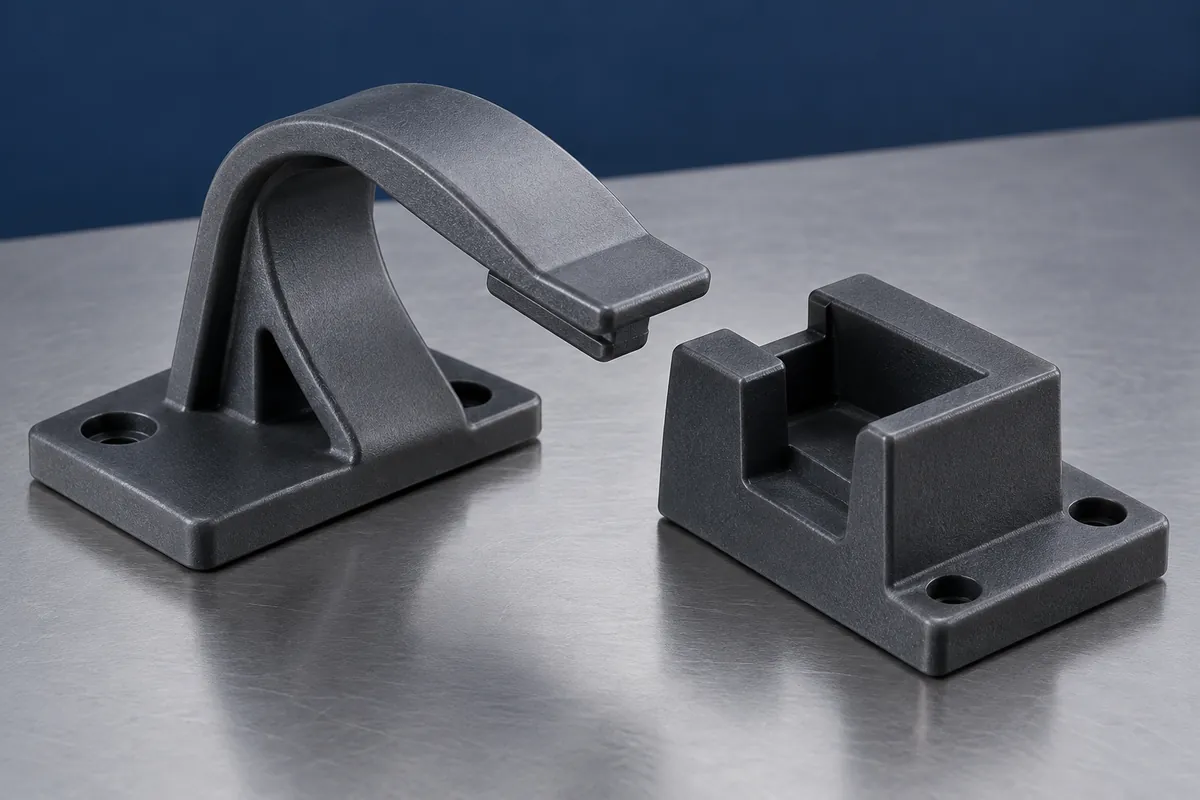
The releasable snap-fit study provides a conceptual comparison and blank validation fields, not measured outcomes. Use the flexible-clip resin review when selecting candidate grades, and keep repeated operation as a separate part of the approval plan.
When requesting custom injection-molded retainers, include the retained function, mating drawing and service exposure with the CAD. Discuss a quote with a defined retention-review scope. Any specialist exposure testing, fixtures or life assessment should be explicitly included or excluded in the offer.