
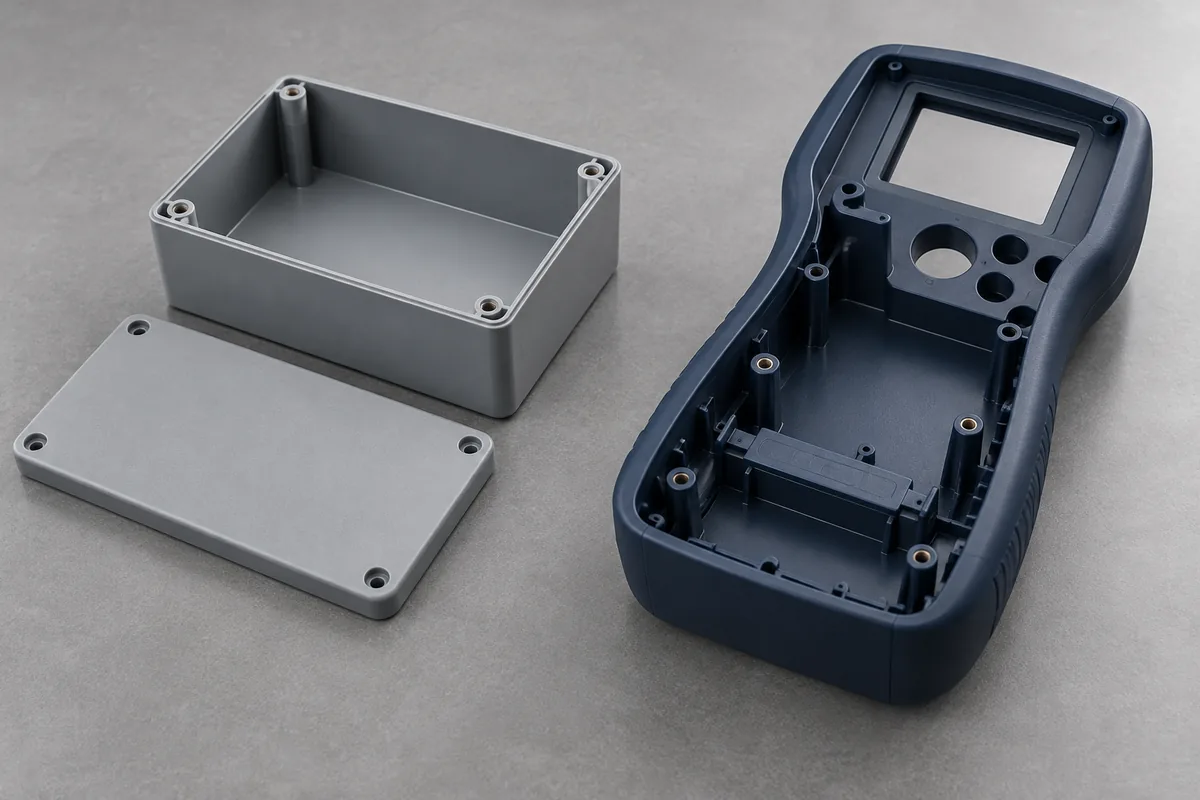
The first sensor prototype fits inside a catalog box. Then the connector moves, the board needs an adapter plate, and a cable opening becomes a second machining operation. The box still works, but the purchasing question has changed: are you buying an enclosure, or repeatedly paying to make an unsuitable enclosure fit?
Move toward custom injection molding when the required geometry, repeat demand and assembly benefits justify a dedicated tool—not simply because the design looks more professional. A modified stock enclosure can remain the sensible production choice when its standard envelope and internal features suit the application. There is no universal order quantity at which custom molding wins.
Product design illustrations. Final geometry, materials and acceptance criteria are project-specific.
First distinguish a modified box from a custom molded part
A modified stock enclosure starts with an existing product. Openings, printing or other agreed work are added to it. A custom molded enclosure starts with dedicated geometry and tooling. It can incorporate a particular board arrangement, locating features and external form, but those features must also be manufacturable and inspectable.
Bud Industries' enclosure FAQ makes this same practical distinction between modifying a standard enclosure and creating a custom one. That distinction matters more than the word “custom” on a quotation. Ask whether the price includes a catalog component plus operations, a newly tooled housing, or a mixture of the two.
Identify the compromises you are actually paying for
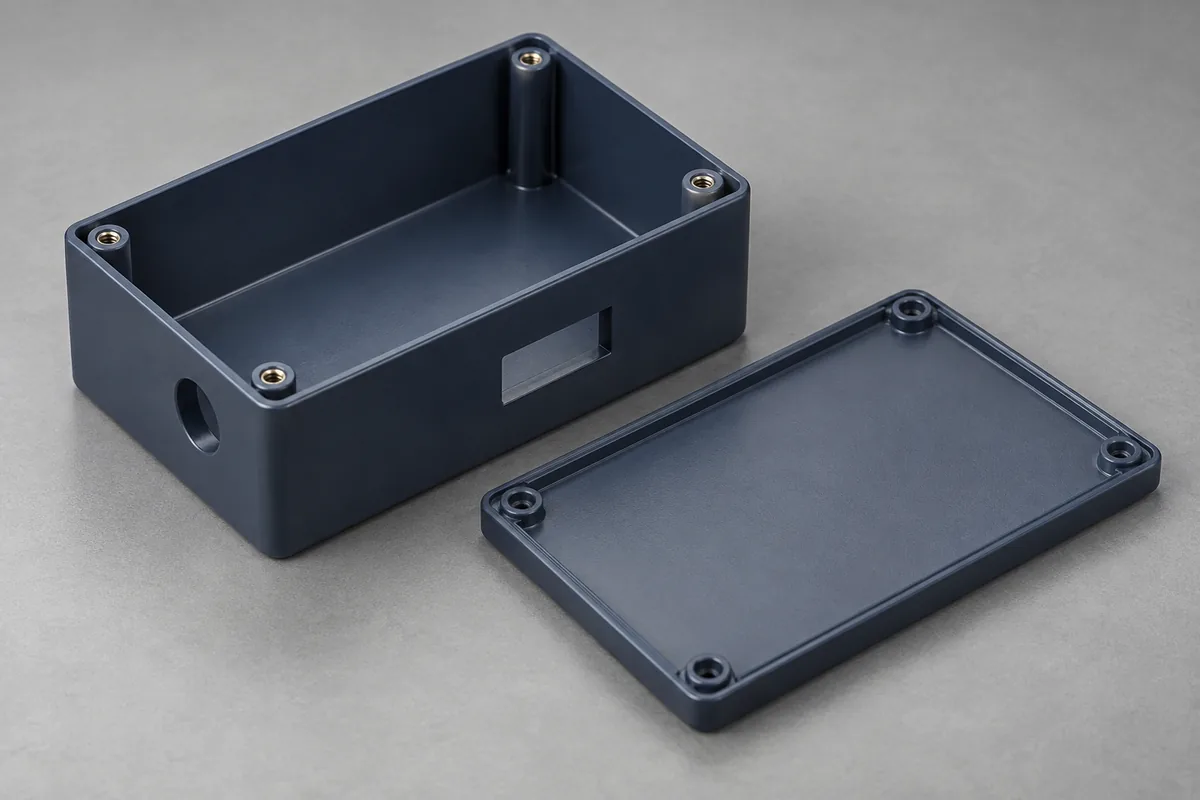
List the extra items and operations required by the stock option: board spacers, an adapter plate, an internal bracket, cutouts, deburring, cleaning and assembly checks. Include only work that would genuinely disappear in the proposed molded design. A dedicated housing does not automatically remove printing, fasteners, inserts or inspection.
Then consider what cannot be solved by adding an opening. A board may be constrained by the available internal width, or a handheld device may need a shape incompatible with the catalog box. Those are functional design reasons to consider new tooling. Conversely, a connector-window change alone may not justify redesigning every enclosure feature.
Use the actual assembly as the comparison boundary. If a custom housing requires a PCB redesign, revised test fixture and new packaging, these are part of the transition. A lower plastic-piece price can be outweighed by changes elsewhere. Our PCB and connector alignment guide helps identify the interfaces that should remain fixed during this review.
| Decision | Modified stock enclosure | Custom injection-molded enclosure |
|---|---|---|
| Geometry | Check the standard envelope, internal bosses and permitted modifications. | Review integrated features, draft, parting line and mold release. |
| Up-front work | Include setup, modification fixtures and assembly changes. | Include tooling, development samples, inspection fixtures and approval work. |
| Unit cost | Include the box, modification, cleaning and retained assembly items. | Include molding, secondary operations, hardware and comparable packing. |
| Change risk | Check catalog availability and the effect of supplier product changes. | Check drawing maturity, tool-change scope and control of tool ownership. |
Build a break-even comparison without inventing a volume threshold
For an initial screening, define the additional fixed cost of the molded route and the difference in comparable delivered unit cost. If the molded route has a lower unit cost, a simple break-even quantity is additional fixed cost divided by per-unit saving. Use supplier quotations for both inputs. If there is no positive saving, this calculation does not produce a cost-based switch point.
This arithmetic is not the entire business case. It leaves out financing, demand timing, design changes, inventory exposure and the consequences of delayed qualification. Run a conservative demand case as well as the sales forecast. Keep an annual estimate separate from a purchase commitment; a tool justified by several years of uncertain demand carries a different risk from a released production order.
Check the design freeze before the tool decision
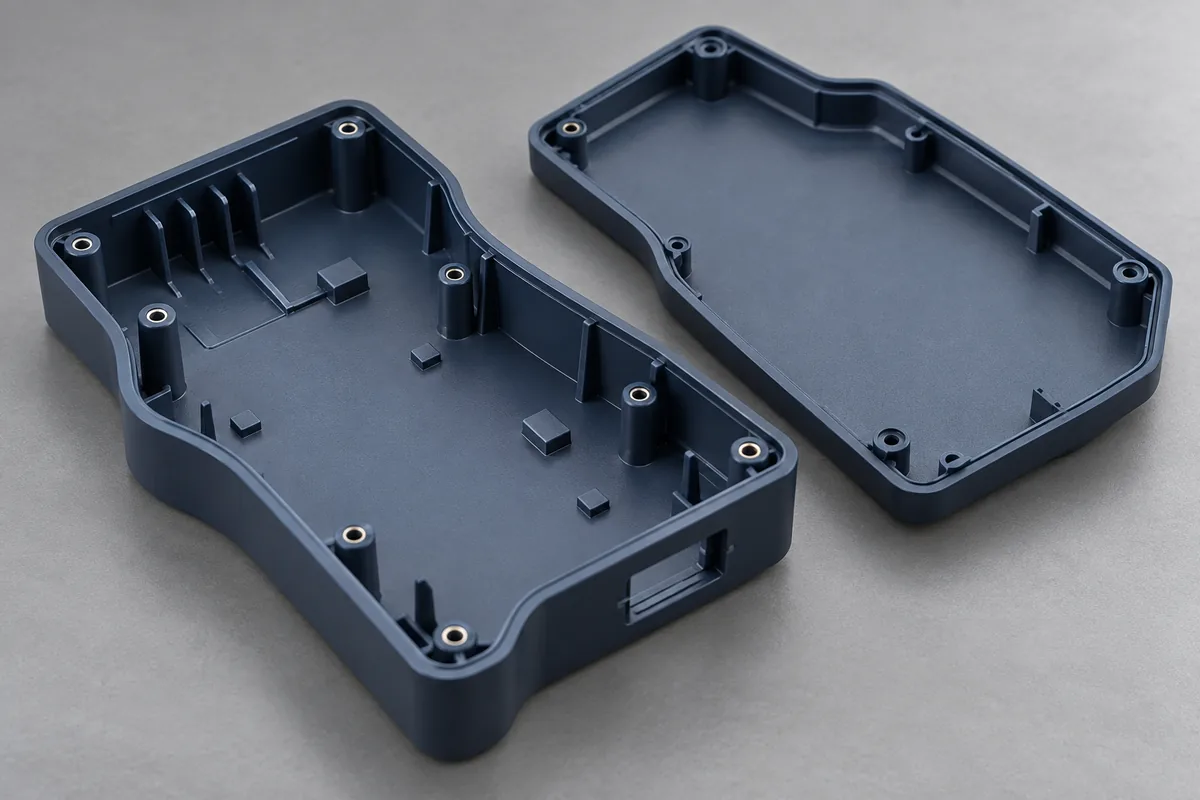
Confirm board outline, connector position, display, fastening method and the mating lid revision. An unresolved connector family can change the opening, internal support and user-access envelope together. Do not treat an early rendering as a production drawing simply to get a tooling price.
Ask the molder which decisions can remain adjustable and which would force substantial tool work. Replace vague “future proofing” with named possible changes and their boundaries. A replaceable tool feature may be worth discussing, but its feasibility, maintenance and cost need an actual tooling proposal.
Carry the acceptance requirements into the new route
A catalog enclosure's published rating does not transfer to a newly designed housing. Nor does a material designation certify a complete product. Define any environmental, electrical or assembly qualification separately, and assign responsibility for it. Compare the delivered scope, not an unqualified custom part against a fully specified stock assembly.
Agree visible-surface requirements, lid fit, board location and packaging before approving samples. New tooling does not eliminate cosmetic tradeoffs; see the enclosure appearance acceptance guide for a practical way to define them. Keep identified samples and approval records linked to the final drawing.
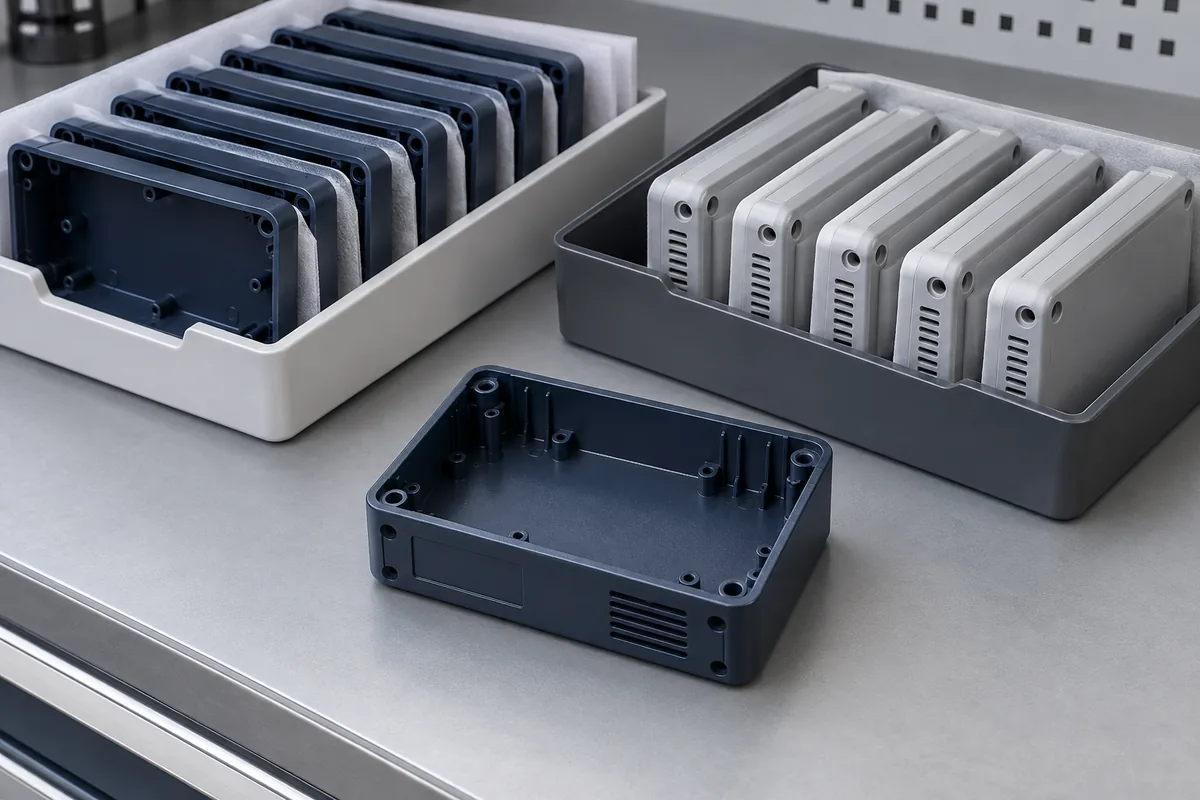
The best switch point is therefore a decision, not a magic quantity: the design is stable enough, the useful features are defined, the cost comparison is credible and the approval route is funded. If those conditions are not yet met, retain the stock option while closing the uncertainties. For the broader geometry checklist, use our existing plastic enclosure design guide.
Turn the review into a defined molding scope
Explore our custom injection-molded electronic enclosures and the related illustrative engineering study. Send the drawing revision, counterpart details, intended use and the decisions still open. Development samples and production approval should have separate, agreed deliverables.