
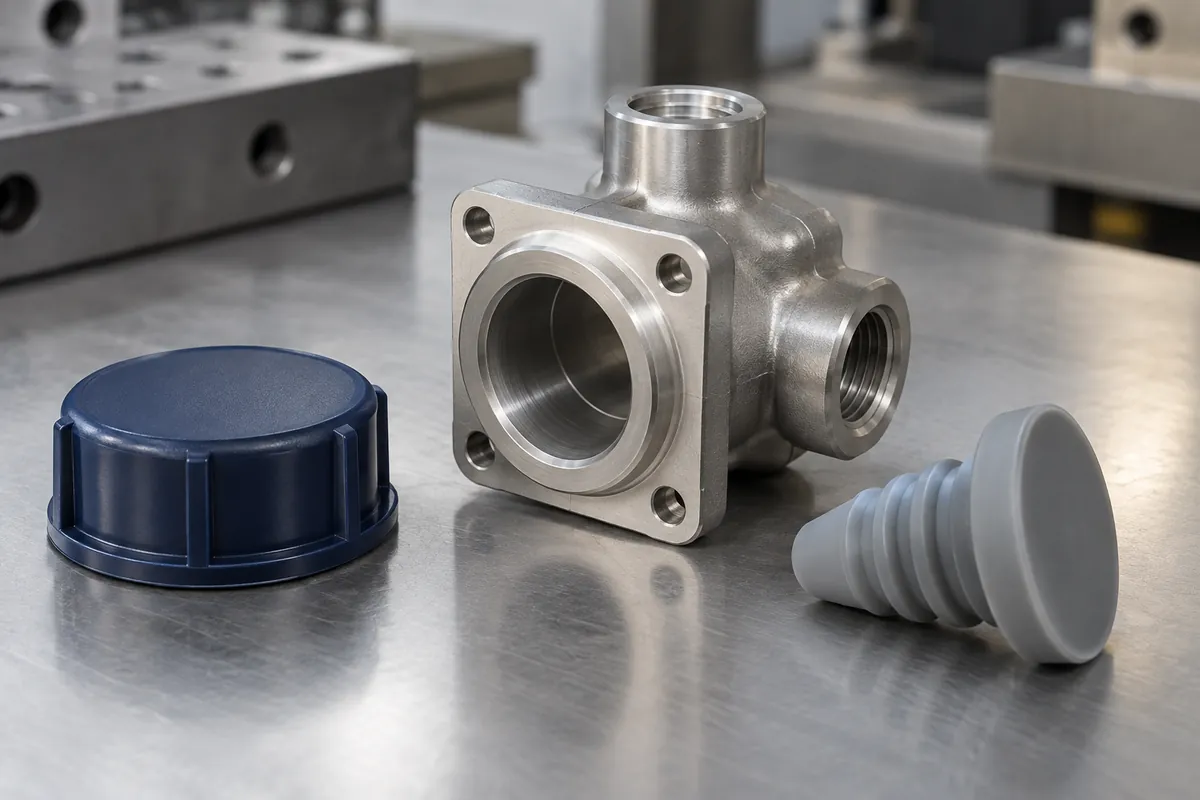
A cap that stays on during transport is not automatically suitable for a finishing process. A masking plug that tolerates a particular process may also be unnecessary for an ordinary shipping application. The similar shapes can hide different material, fit, cleanliness and removal requirements.
Specify the protection job before selecting the protector. Shipping protection and process masking can overlap, but one should not be used as shorthand for the other. This guide concerns custom industrial caps and plugs; it does not assign temperature, chemical-resistance or sealing ratings to an unspecified design.
Product design illustrations. Final geometry, materials and acceptance criteria are project-specific.
Follow the component through its route
Write the sequence from installation to removal. A shipping cap might pass through packing, storage, transport and receiving. A masking plug might pass through surface preparation, application, cure or another process-specific sequence. Identify where the protector is present and where it has already been removed.
Include transitions, not just the most obvious stage. Cleaning before coating, cooling before removal or storage while fitted can matter to the intended function. The point is to describe the actual route with the process owner, not to assume that the protector experiences every step shown on a general factory flowchart.

Define what must remain protected
For shipping, the requirement may concern exposed edges, dirt entry or handling contact. For masking, identify the exact surface boundary that must remain uncoated or otherwise protected. A plug that covers the opening may still leave a nearby face exposed, so show the boundary on the drawing rather than relying on a verbal description.
Decide whether the protector is allowed to contact a finished or functional surface. If a seal land, thread or cosmetic area must remain untouched, mark it. The design then needs to reconcile retention with that contact restriction. “Fits tightly” is not a complete solution if it marks the wrong surface.
Use the actual process conditions
Supply temperature history, dwell, relevant chemicals and the part's state during exposure. A family-level temperature claim is not an approval for a particular cap under load. If a process has repeated cycles, define the intended reuse and how the protector will be assessed between cycles.
Caplugs distinguishes continuous and intermittent exposure information in its masking material reference. That distinction is a reminder to check the applicable condition, not a reason to copy a catalog limit onto a different custom part. Confirm current exact-grade information with the material supplier and validate the intended application.
| Question | Shipping protector | Process mask |
|---|---|---|
| Main job | Protect a component through agreed handling and storage. | Protect a defined surface through a specified process. |
| Exposure | Transport and storage environment, packing and duration. | Process temperature, chemistry, sequence and reuse if required. |
| Removal | Access and removal at the receiving or assembly step. | Removal stage, edge condition and potential residue. |
| Evidence | Fit, retention, surface condition and handling checks. | Masking boundary, process compatibility and post-removal condition. |
Inspect what happens after removal
The part's job is not complete merely because it remains attached. Inspect the protected surface and the protector after the agreed sequence. Record loose fragments, residue, coating damage or other application-specific unacceptable conditions. Define what counts as a defect before reviewing the samples.
If a protector is reused, specify how it is cleaned, inspected and retired. A reuse claim without a defined cycle, inspection rule and exposure history is difficult to verify. One successful application does not establish an unlimited number of uses.

Do not default every masking application to thermoplastic injection molding
Some process conditions may require an elastomer or another manufacturing route. If the requirement points toward silicone, the material form and suitable molding process still need review. A silicone masking part is not automatically an LSR injection-molding project just because both use the word silicone.
FECISION's LSR molding service can be discussed where that process is appropriate, but this page does not claim that a standard thermoplastic cap replaces a qualified high-temperature mask. Keep alternatives separately quoted and technically justified.
Make a two-use requirement explicit
If the same part must serve as both a process mask and a shipping protector, list both sequences and the order in which they occur. Determine whether its fit and cleanliness after processing remain suitable for transport. Do not assume that satisfying either requirement separately proves the combined route.
Use the RFQ checklist to capture the scope and the quality guide to define acceptance. A clearly bounded protection job gives the supplier a useful engineering target and gives purchasing a fair basis for comparing proposals.
Turn the review into a defined molding scope
Explore our custom injection-molded protective caps and plugs and the related illustrative engineering study. Send the drawing revision, counterpart details, intended use and the decisions still open. Development samples and production approval should have separate, agreed deliverables.