
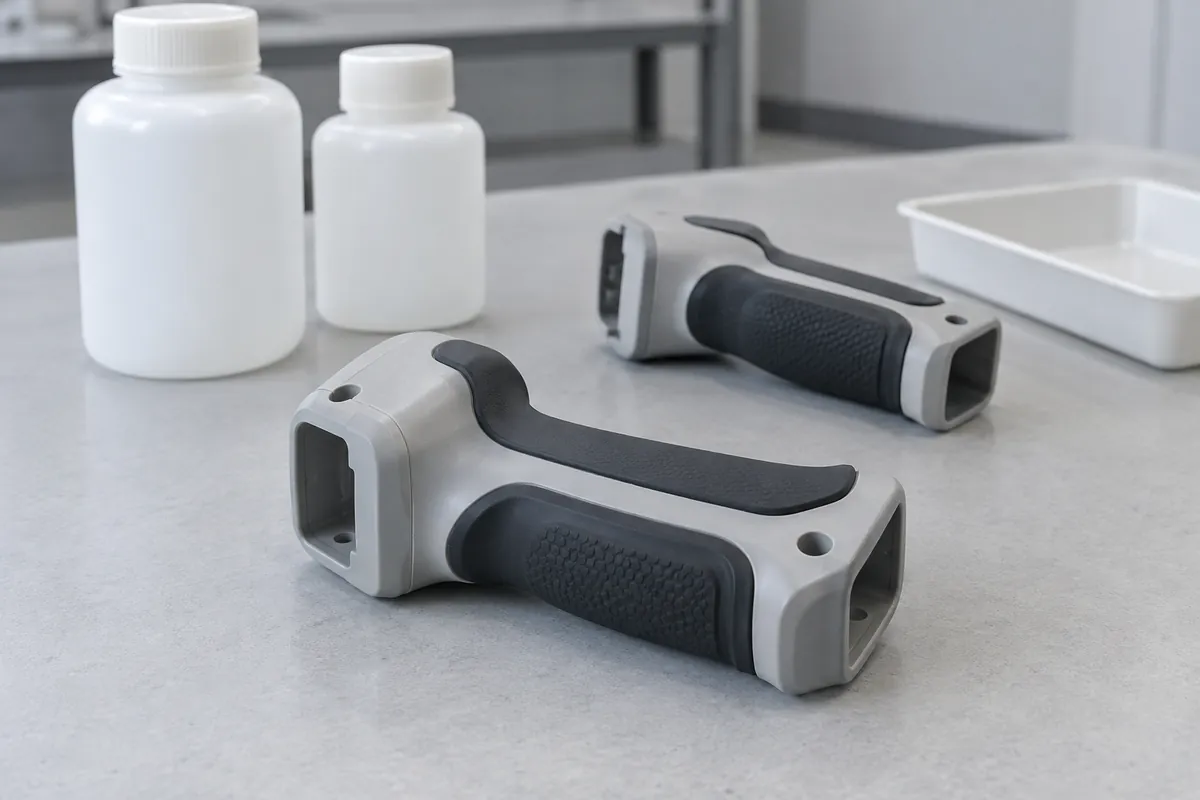
A grip may be selected for its initial feel and then spend its working life being wiped, rinsed or exposed to residues. That creates a second material-selection question: does the finished component remain acceptable under the cleaning procedure the product actually requires? The phrase “chemical resistant” cannot answer it without identifying the chemical, exposure and acceptance criteria.
Cleaning compatibility is a relationship between a specified product, a material configuration and a defined procedure. It is not a general property that can be approved once for every cleaner. The discussion below explains how to investigate that relationship before purchasing an overmolded grip. It does not validate disinfection effectiveness, sterilization, biocompatibility or medical-device compliance; those are separate requirements for the responsible specialists. No passing exposure result is claimed here.
All images in this article are newly AI-generated illustrations of engineering concepts, not photographs of a customer project or evidence of completed testing.
The Cleaning Instruction Is Part of the Engineering Input
Provide the cleaner's product name and current formulation or technical documentation where available. Record whether it is supplied ready to use or diluted, which surfaces are exposed and whether the procedure is a wipe, splash, soak or another defined contact. Include rinsing, drying and any residue-removal steps that the actual instructions require.
List relevant contact duration, temperature and repetition rather than writing “normal cleaning.” If these inputs have not been decided, identify the person who will define them. An accelerated exposure may be useful for screening, but its relationship to intended use needs review; a longer soak is not automatically a validated substitute for repeated wiping.
This connection matters when a product's instructions are written after material selection. If the instructions introduce a cleaner or procedure that the evaluation never considered, the material decision and the use requirement no longer share the same basis. Bringing product documentation into the review early can reveal that mismatch while the design is still open to change.
A Material Recommendation Is a Starting Point, Not a Finished-Part Result
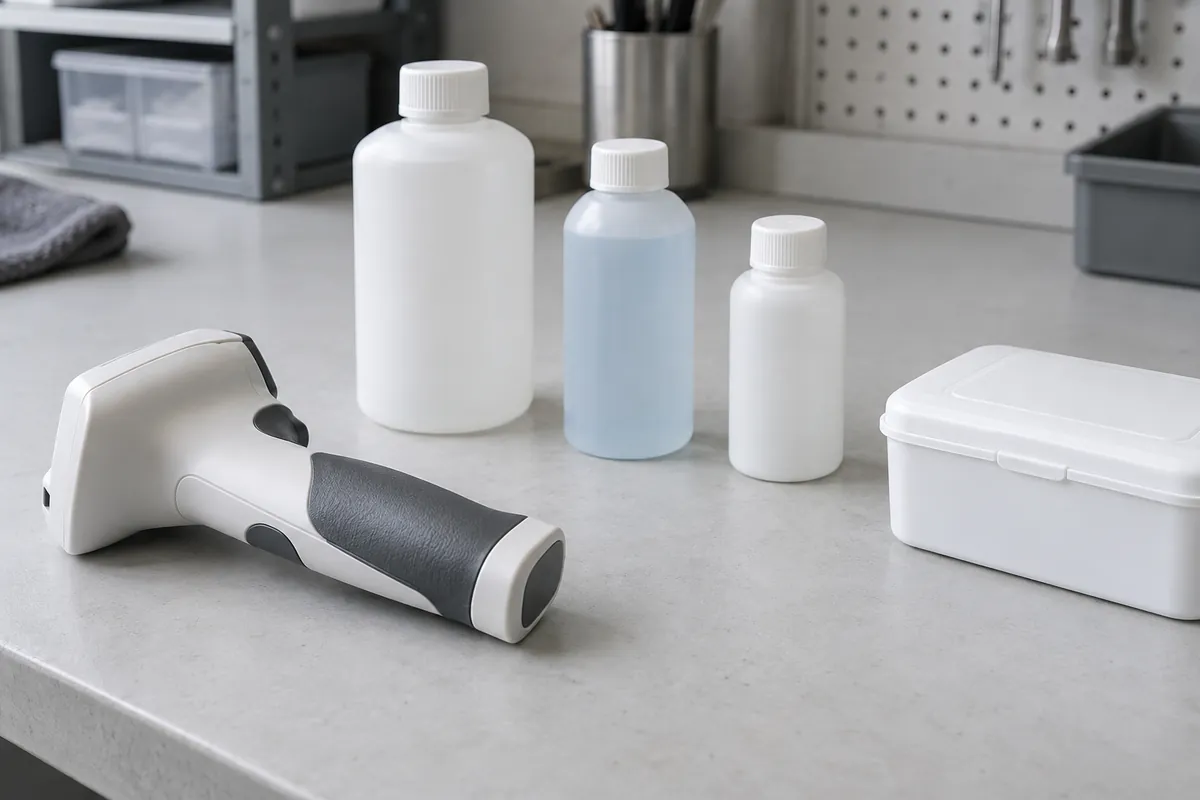
Give the material supplier the substrate grade, overmold grade, color formulation and exposure details. KRAIBURG TPE's product-property resources distinguish chemical-resistance requirements across its materials. Treat manufacturer guidance as a way to select candidates for review, not as blanket approval for every compound or finished grip.
Request the basis and limits of any compatibility recommendation. If information concerns a test plaque, a different concentration or only the elastomer, identify that gap. Keep the complete assembly in view: acceptance of a soft-material coupon does not establish the condition of the substrate, interface, color or adjacent components.
Screening and qualification therefore serve different purposes. Screening helps decide which candidates deserve more work and which questions require clarification. Finished-part evaluation investigates the selected configuration against the project's requirements. Treating an early compatibility recommendation as final approval collapses those stages and leaves uncertainty hidden inside a purchasing decision.
Design the Comparison Before Exposing the Samples
| Plan item | Define before testing | Record in the report |
|---|---|---|
| Agent and exposure | Product, concentration, contact procedure and recovery interval. | Actual preparation and executed sequence, including deviations. |
| Specimens and comparison | Grades, revision, quantities and unexposed references. | Identified specimens with baseline and later observations. |
| Acceptance | Required checks, limits and decision owner. | Individual outcomes, open questions and release decision. |
Keep agents separate unless the intended procedure actually combines or sequences them. Follow the cleaner's safety instructions and use a competent test facility for hazardous substances. This article is not an instruction to mix chemicals or improvise an exposure procedure.
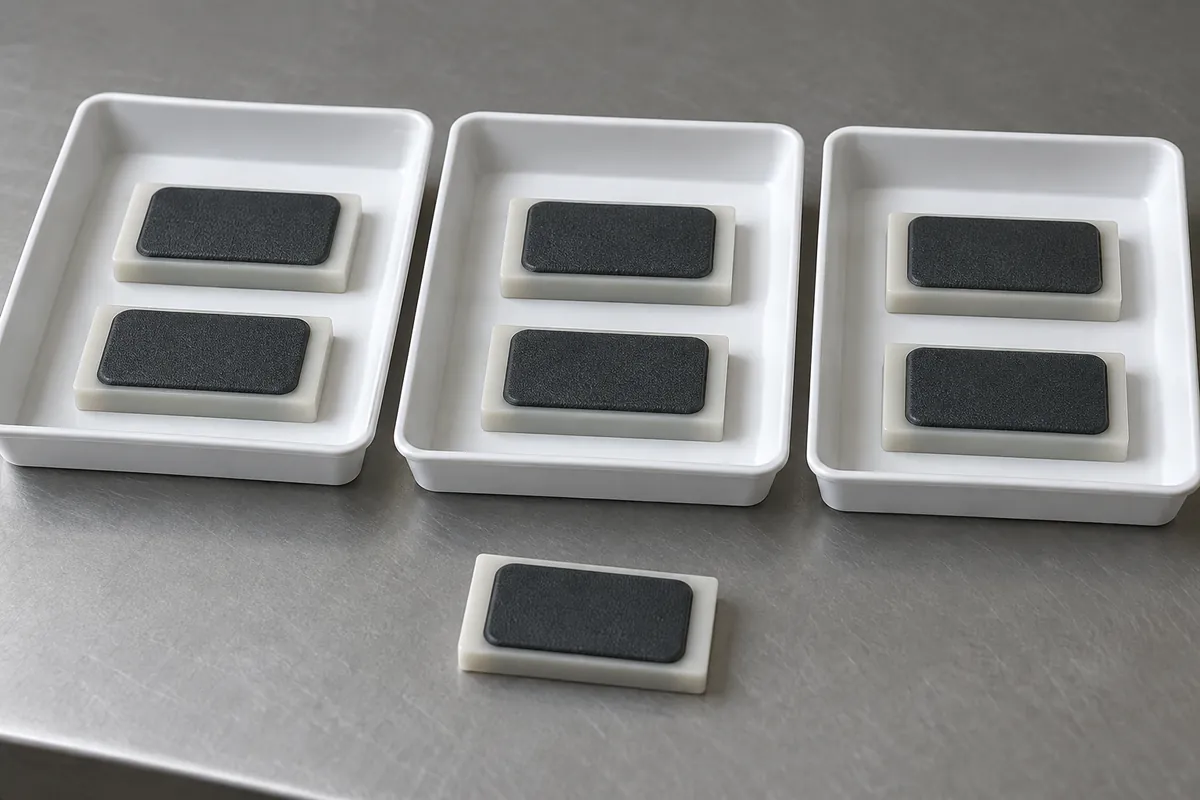
A baseline observation is valuable because it describes the specimen before the event being investigated. Without it, a later cosmetic concern may be difficult to distinguish from an existing molding mark. Likewise, an unexposed comparison sample helps the team interpret observations without assuming every difference arose from the cleaner. The purpose is a clearer comparison, not an automatic claim that any one control arrangement proves service life.
Appearance, Feel and Retention Should Not Share One Vague Verdict
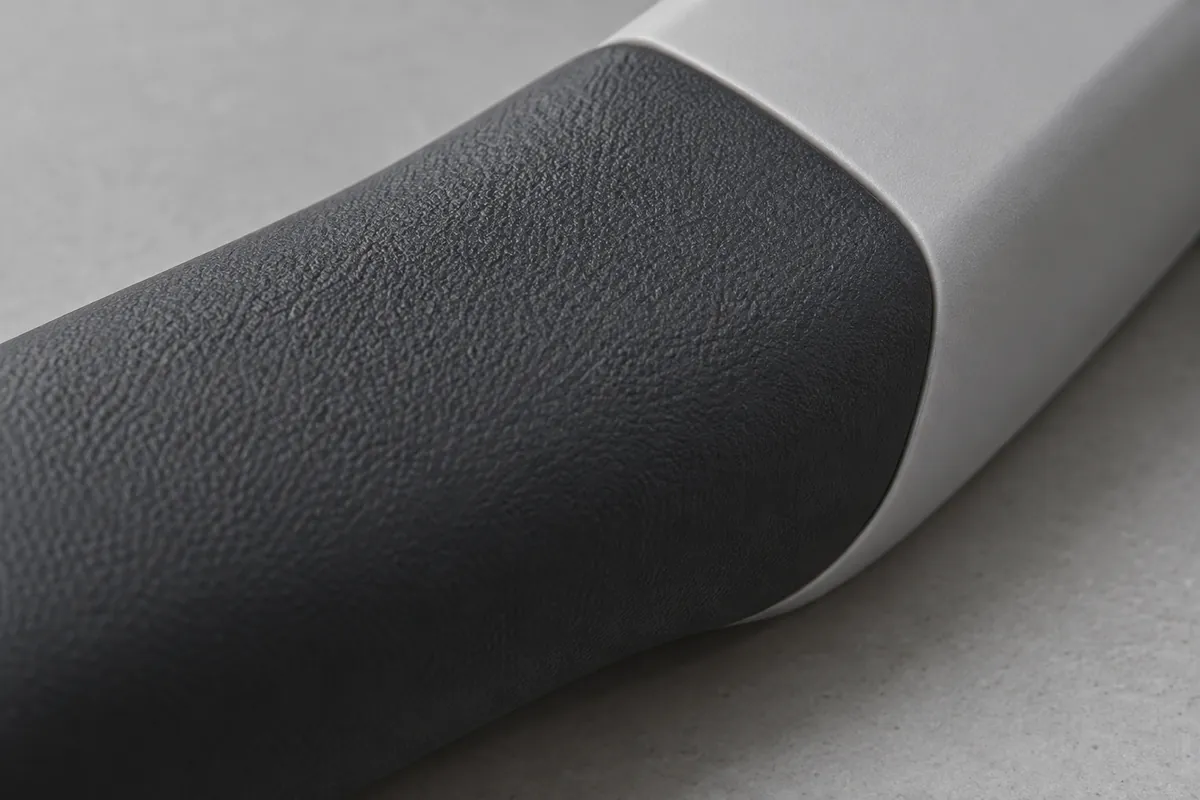
Ask what change would make the grip unacceptable. Depending on the product, the review may address surface tack, visible cracking, discoloration, dimensional change, loss of fit or edge lifting. These are candidate observations, not a claim that every cleaner produces these effects or that every product needs every test.
Define how each selected item will be assessed. For photographs, agree lighting and viewing conditions. For dimensions or mass, define the measurement timing and preparation. For feel, document a consistent evaluation procedure and distinguish subjective comments from objective limits. Retain unexposed comparison specimens so the team can separate exposure effects from pre-existing appearance differences.
If retention after exposure matters, include the bond or retention test method in the plan. Record whether the test occurs wet, after drying or after a specified recovery interval. Do not let the laboratory choose an unrecorded interval that later becomes an unexplained purchasing requirement.
The assessment should also distinguish a recorded change from its acceptability. A difference can be real without violating the product requirement, while a subtle change may be important in a critical interface. That judgment belongs to defined criteria and the responsible reviewer. An overall “looks fine” statement cannot carry the same meaning for an exposed cosmetic panel and a grip edge with a specific retention requirement.
Approval Should Follow the Tested Configuration
Summarize the tested configuration and approved cleaning procedure in the release record. Identify excluded agents or conditions. Passing one exposure plan does not authorize a stronger concentration, a different branded cleaner or an unlimited number of cleaning cycles. Changes need review by the responsible product and materials teams.
Keep this decision alongside the grip material and hardness selection and the sample approval record. Ask the supplier to price any external testing, extra specimens and report preparation explicitly; these should not be assumed part of a standard molding price.
For repeat purchasing, the useful output is an intelligible boundary: which material and part revision were reviewed, which procedure was evaluated and which changes reopen the decision. That boundary lets sourcing request the same approved scope again. It also keeps a narrowly supported compatibility conclusion from becoming a broader marketing claim that the evidence cannot justify.
For custom overmolded components, send FECISION the CAD, material candidates and actual cleaning instructions. We coordinate a review of the proposed manufacturing and evaluation scope without treating an untested pairing as approved.