
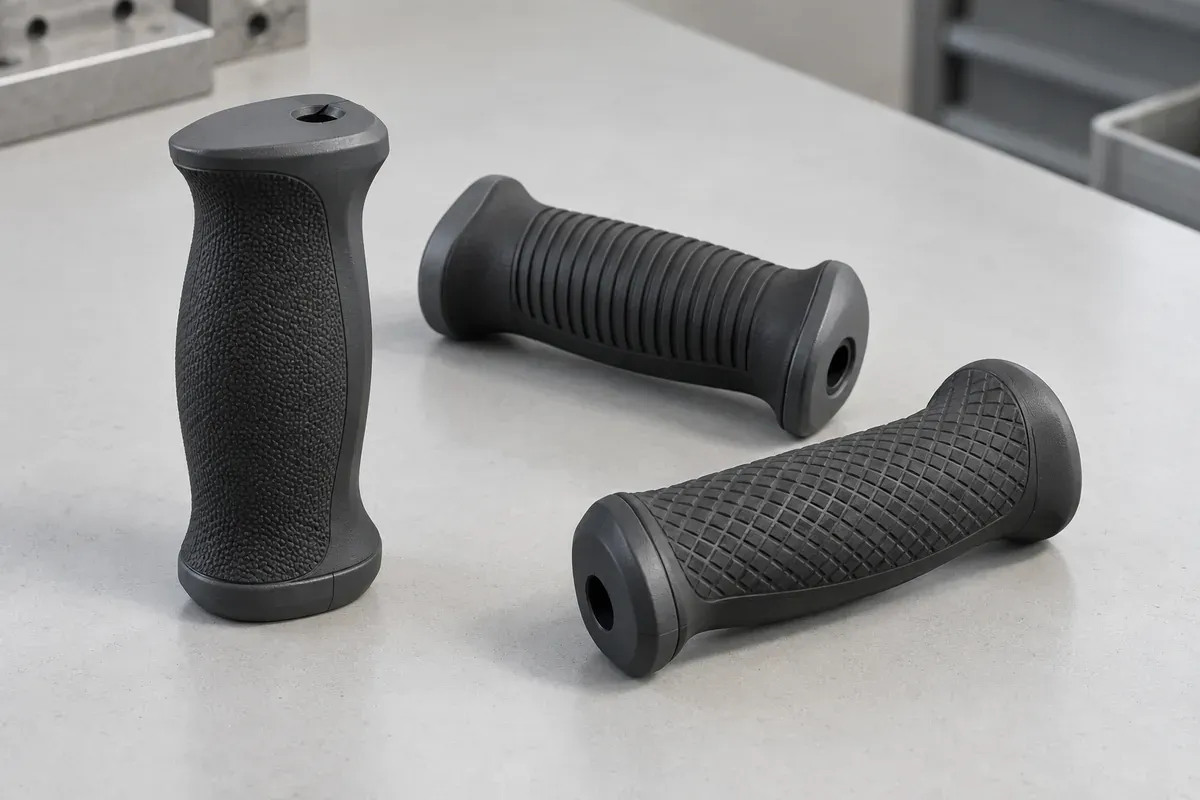
“Make the grip softer” sounds like a material instruction, but it may actually describe several different preferences. One buyer means more cushioning, another wants a less slippery surface, and a third dislikes a sharp transition between the rigid shell and the grip. Choosing a lower hardness number before resolving that ambiguity can move the specification without solving the product problem.
Shore hardness is a material input, not a complete description of a handle. The buyer ultimately approves a geometry, surface and material combination used in a particular task. For custom overmolding, it is more useful to compare viable combinations deliberately than to search for a universally ideal hardness. The approach below supports that decision without claiming a particular grip improves safety or comfort.
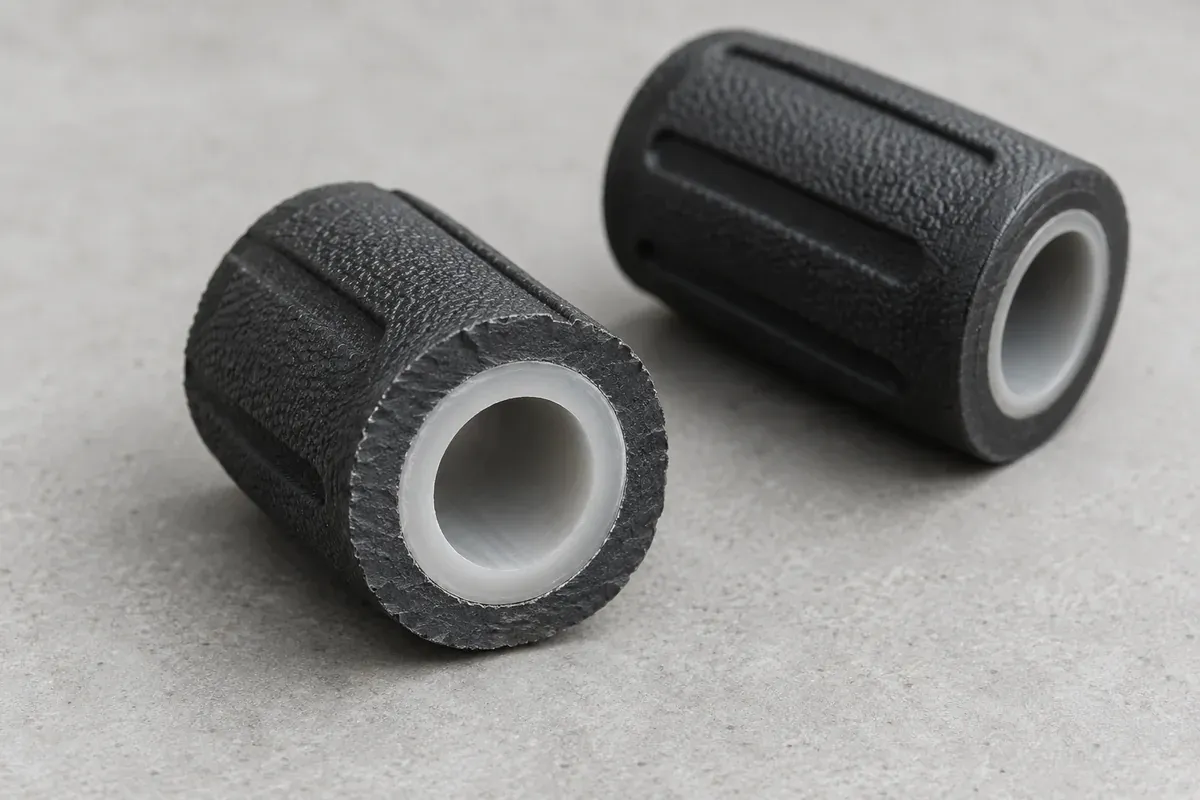
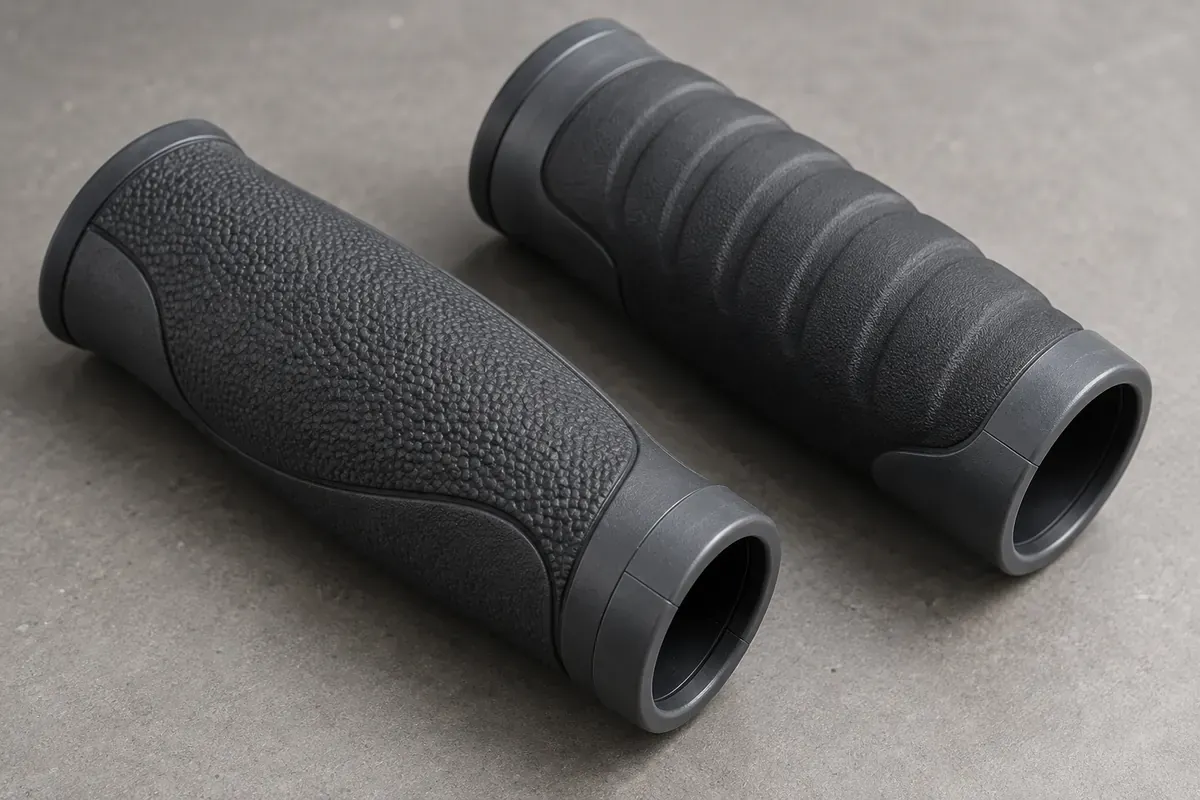
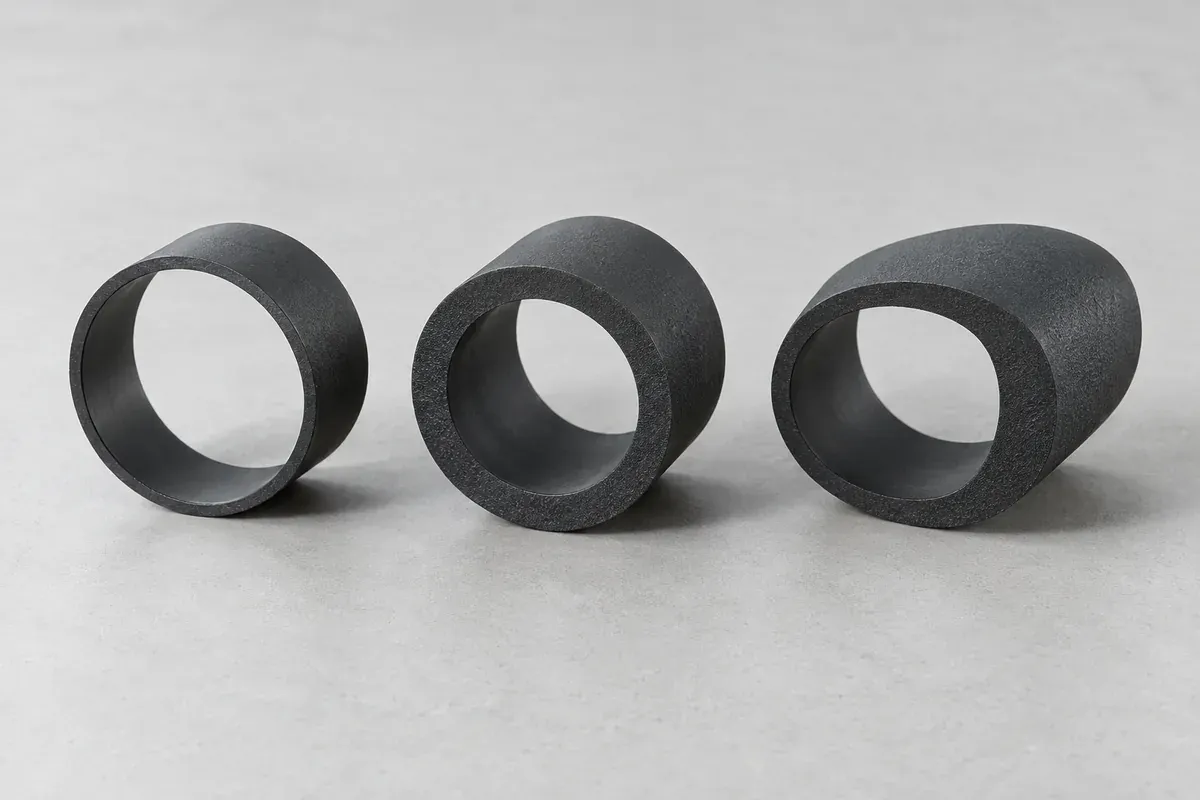
All images in this article are newly AI-generated illustrations of engineering concepts, not photographs of a customer project or evidence of completed testing.
“Soft” Only Becomes Useful in the Context of a Task
State what the handle operates, how it is supported and the expected contact conditions. A brief adjustment action is different from a sustained holding task. Record whether the evaluation is for dry contact, a particular glove, or an application-specific wet or contaminated condition. Do not add exposure conditions merely because another product's specification includes them.
Identify the intended grip region and the surfaces that must remain rigid for assembly or cleaning. Provide an existing reference product if available, but describe the desirable feature rather than asking a supplier to “match the rubber.” The reference may have a different substrate, layer thickness or material chemistry.
For a conceptual handheld instrument, the preferred feel while carrying it may differ from the preferred feel while adjusting a control. That is a reason to define the evaluation task, not a reason to declare one hardness correct. A sample review becomes more informative when observations describe the interaction: where the part is supported, where contact occurs and what the reviewer is trying to accomplish.
A Data-Sheet Number and a Finished Grip Answer Different Questions
Avient's overmolding material-selection guidance separates hardness, flexibility, friction, texture and layer thickness. These are not interchangeable measures of feel. Consequently, two candidate compounds with similar nominal hardness should still be evaluated in the intended geometry rather than assumed to produce the same grip.
Ask the material supplier for the current grade data sheet, specified hardness scale and stated measurement conditions. Have the test owner define how the project will check hardness, including whether a suitable test specimen is required. A reading taken arbitrarily on a thin curved finished surface should not be treated as directly comparable to every data-sheet value.
The distinction is useful when design reviews disagree. A purchasing team may correctly confirm that the supplied grade matches the order, while a product team correctly observes that the resulting handle does not feel like the reference. Those statements are not contradictory. Material identity and finished-part preference are separate questions, and the approval plan should contain a way to answer both.
Compare Candidates Without Changing Every Variable
| Selection field | Keep controlled or documented | Review question |
|---|---|---|
| Material | Exact grade, color, hardness scale and data sheet. | Is the candidate appropriate for the substrate and exposure? |
| Design | Shape, layer thickness and texture reference. | What changed besides the compound? |
| Evaluation | Task, contact condition and separate durability checks. | Is preference being mistaken for demonstrated performance? |
Compare a limited set of viable candidates first. If both geometry and material change, record them as a combined design alternative rather than attributing every difference to hardness. Keep sample codes, reviewer observations and the reason for selection together so the next team can reproduce the decision.
One useful development sequence is to hold the reference geometry constant while screening material candidates, then review selected geometry or texture changes with the shortlisted material. That is a comparison strategy, not a mandatory manufacturing sequence. Its value is explanatory: if everything changes at once, the team may choose a favorite sample but still not know which feature it needs to preserve in the production design.
Preference Is Useful Evidence, but It Is Not a Performance Claim
Write down what the evaluator must do and what will be observed. Possible project questions include whether the grip interferes with an adjacent control, whether its edge catches during the defined task, or whether cleaning changes its surface feel. Set pass criteria only where the responsible product team can justify and consistently assess them.
Separate subjective preference from measured performance. A preference survey does not prove slip resistance, reduced fatigue or injury prevention. If the product requires such performance, commission the relevant evaluation with an appropriate method and competent reviewer instead of deriving a claim from a durometer number.
It is also worth preserving disagreement rather than averaging it away immediately. If one evaluator favors the texture and another objects to an edge, those comments may concern different design features. Recording the reason gives engineering something actionable to review. A single overall rating can hide that distinction and encourage another material change when the actual concern is local geometry.
The Preferred Feel Still Has to Survive the Other Requirements
Shortlist grades with material-supplier guidance for the exact substrate. Do not select the preferred texture or softness first and assume compatibility can be fixed later. Include the bond or retention test requirements in the sample request, and define the actual agents in the cleaning validation plan.
The illustrative edge-retention study can help organize a geometry review, but it is not proof that a selected compound will pass. If the candidate changes after sampling, document which checks must be repeated rather than transferring approval automatically.
What the Final Purchasing Specification Should Preserve
Finish with the approved grade, color, drawing revision, texture reference, agreed hardness requirement and test basis. Identify the retained sample and any accepted deviations. State who may approve substitutions. This is more useful for repeat purchasing than a note saying “soft black TPE.”
Send FECISION the grip geometry, substrate grade, reference feel and intended contact conditions. We coordinate the candidate and sampling review with the assigned manufacturing partner.