
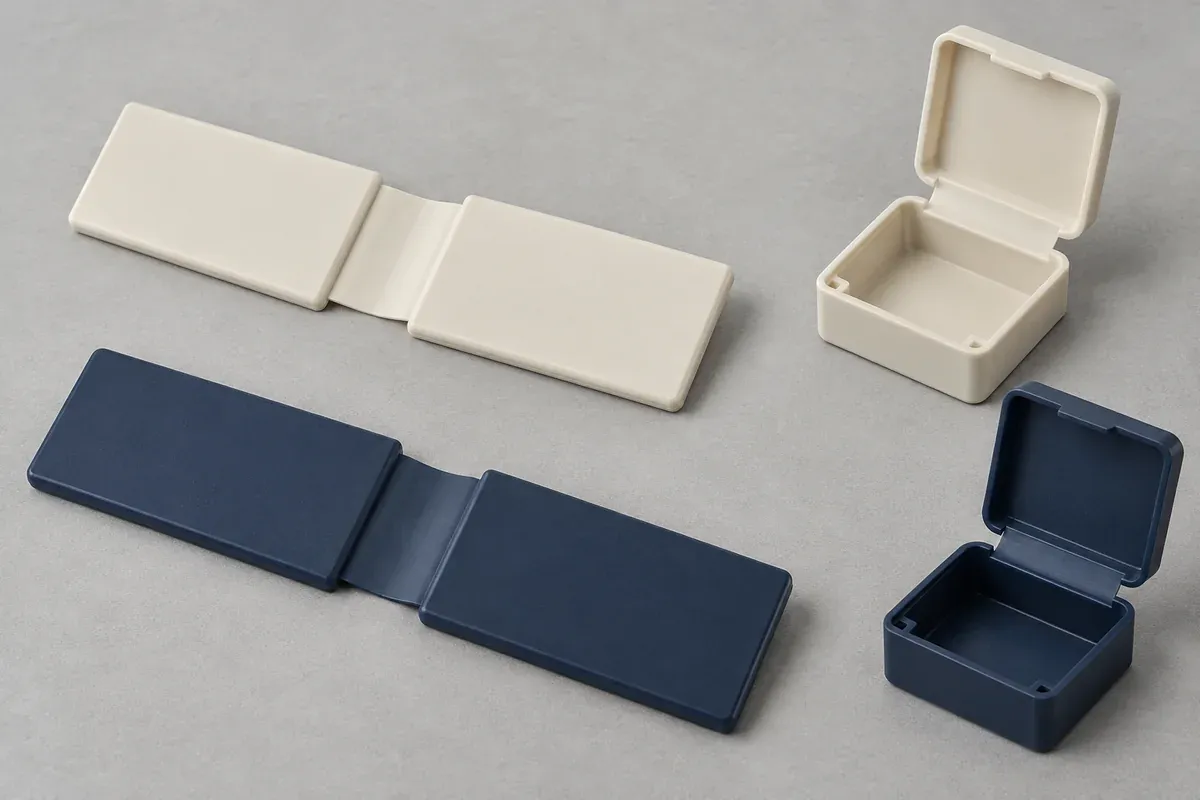
Product design illustrations. Final geometry, materials and acceptance criteria are project-specific.
Polypropylene and polyethylene are common starting families for integral plastic hinges, but the family name is not the final material specification. The exact grade must support the flexible web and the connected lid, frame or body. A hinge material selected without the rest of the part can solve one problem while creating another.
Consider a service flap whose latch must hold its closed position while the web bends during opening. The latch, frame and web share the resin but perform different jobs. A useful material review checks all three instead of approving a flexible test strip and assuming the assembled flap will behave the same way.
Begin with the intended opening sequence and the environment. Identify whether the part bends once, occasionally or repeatedly, and whether it remains folded for long periods. Keep those requirements visible when comparing candidate grades and molding proposals.
Screen exact grades rather than generic abbreviations
Protolabs' hinge design discussion identifies PP and PE as common candidates. That is a useful starting point, not evidence that every formulation in either family will perform identically in a thin flexure.
Ask for the exact material identity and relevant supplier guidance. Fillers, pigments and other formulation choices can change the question being evaluated. Do not approve a substituted grade solely because both purchase descriptions contain the same polymer abbreviation.
Keep the proposed grade connected to the molding process and specimen history. A hinge sample made from an available development resin is not automatically representative of the intended production compound, even when the outside dimensions match.
Balance flexibility with the connected structure
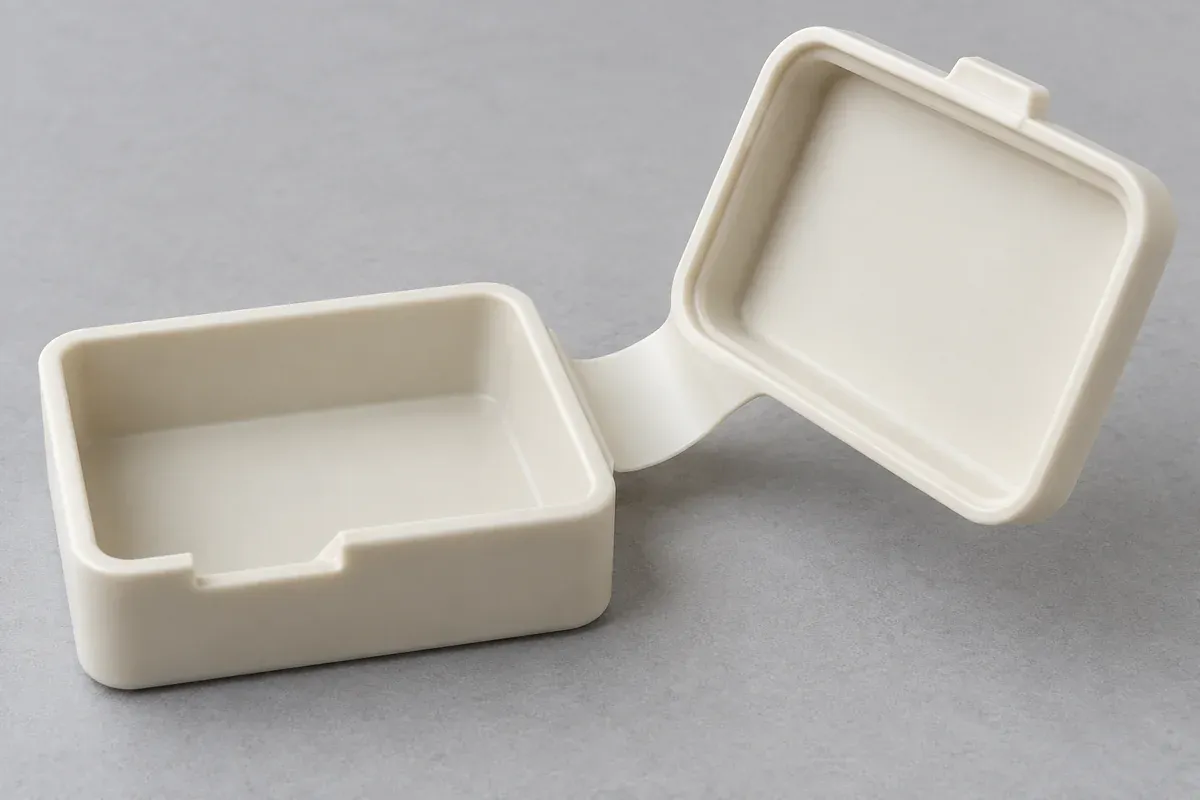
The lid may need sufficient stiffness to close a latch or maintain an opening shape. The frame may need to retain fasteners or locate another component. These functions remain part of material selection even if the hinge is the most conspicuous feature.
Review local geometry before compensating with a different material. A thick transition that concentrates bending or a frame that distorts during closure can affect the mechanism. Changing the resin does not remove the need to define those features.
The thickness and transition guide addresses the geometry review. Material and shape should be developed together, with proposed changes distinguished from demonstrated improvements.
Describe exposure in operational terms
Include temperature, cleaning agents, sunlight and other relevant conditions. State whether the exposure occurs while the hinge is folded, open or moving. A loose material specimen and a strained flexure can represent different application questions.
Avoid broad claims such as suitable for all outdoor use or unlimited cycles. If a particular exposure is important, ask for grade-specific evidence and a representative evaluation plan. Identify the owner of any finished-product qualification.
Consider storage and transport as well as use. If the molded part is shipped folded, define the folding and packing condition. If it is shipped open, include the space and handling requirements in the commercial comparison.
Preserve the process assumptions in the trial
Discuss gate location, filling direction and any approved first-fold procedure before sampling. Those details can influence the hinge configuration being evaluated. Do not change them between candidate trials without recording the change.
A trial with different geometry and a different material may be useful as a concept comparison. It cannot isolate which variable caused a result. Keep the distinction explicit when deciding what to carry into the next tool revision.
Measure relevant features in an agreed state and preserve sample identity. If multiple cavities are involved, the review may need to distinguish them. The necessary sampling plan belongs to the development objective, not to a universal number copied into every RFQ.
Make the approval decision broader than a bend demonstration
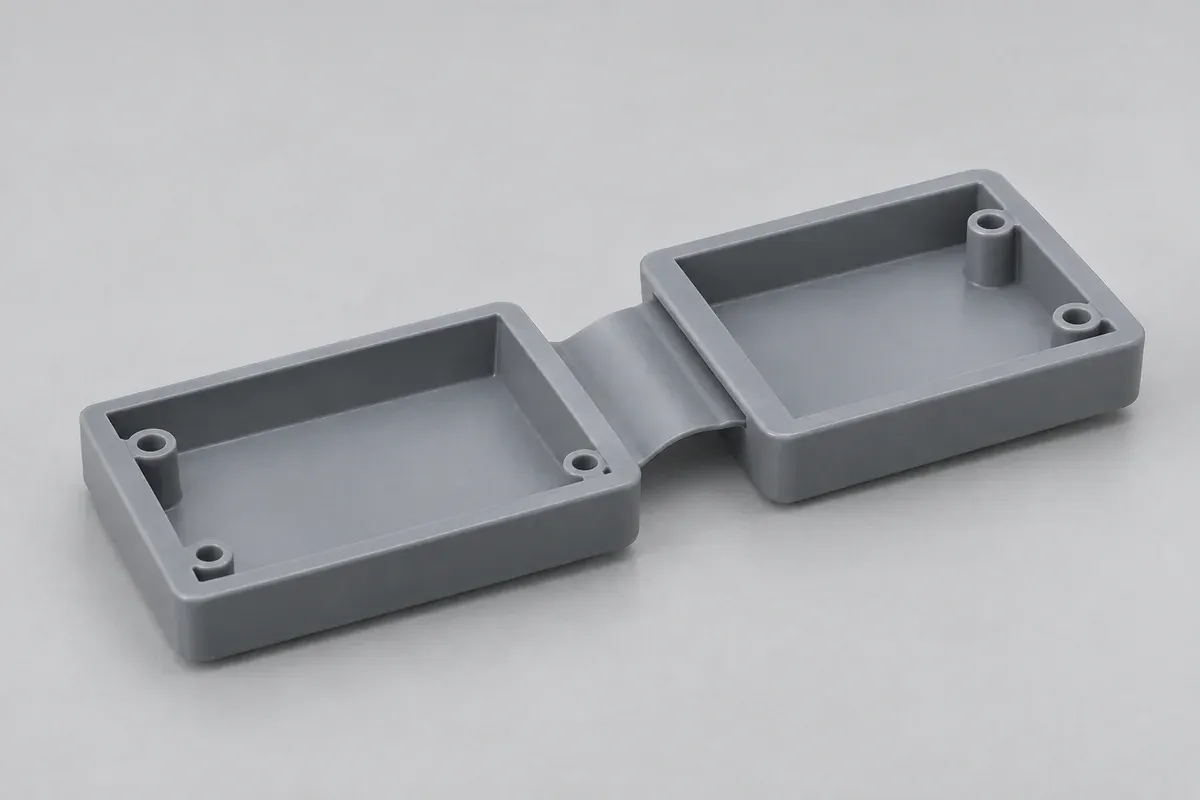
A successful first fold shows only that particular event under that condition. Evaluate the required opening range, connected-part function and any agreed repeated-use or exposure tests. The cycle-test planning guide provides a structure for those decisions.
For an initial quotation, list approved grades or identify material selection as an open engineering task. Include the required documentation and change-approval rules. That produces a defensible PP-versus-PE comparison without turning a common design preference into an unsupported guarantee.
Turn the review into a defined molding scope
Explore our custom injection-molded living-hinge parts and the related illustrative engineering study. Send the drawing revision, counterpart details, intended use and the decisions still open. Development samples and production approval should have separate, agreed deliverables.