
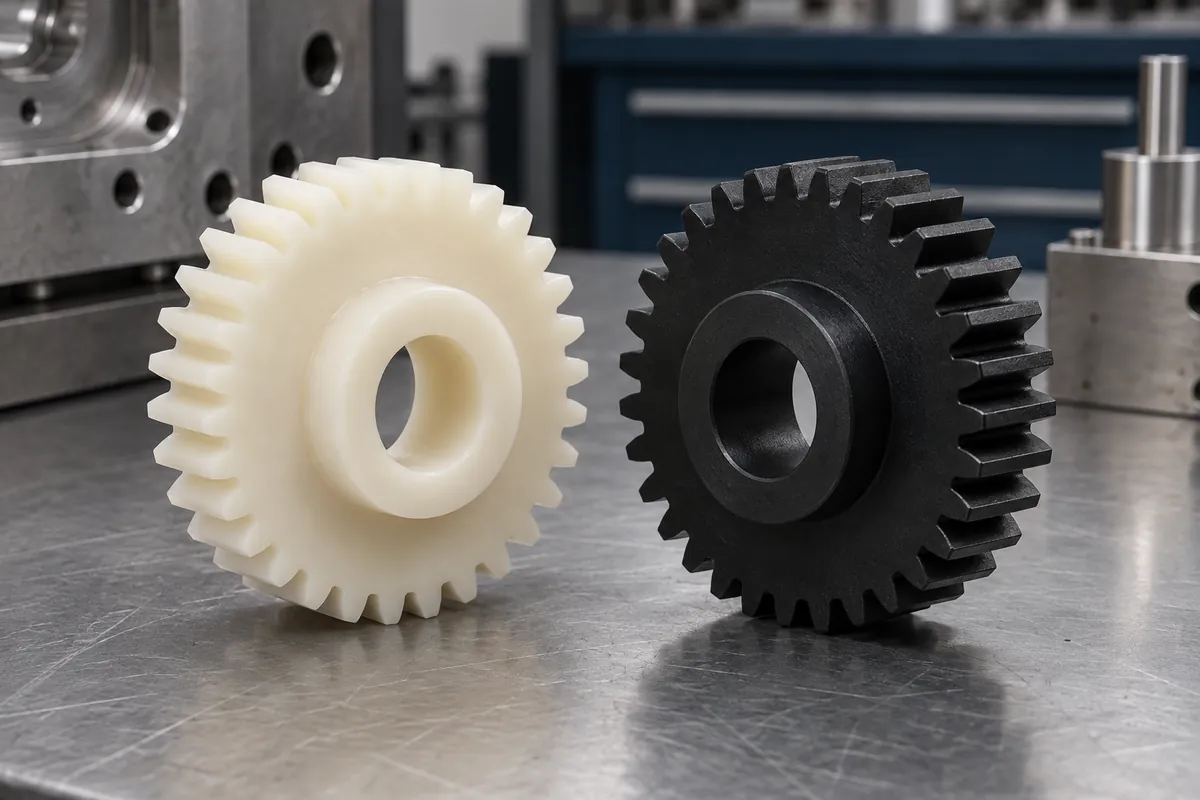
POM and nylon appear frequently in plastic-gear discussions, which makes “Which is better?” a tempting first question. It is also too broad. The answer can change with the exact grade, counterpart, moisture condition, lubrication, operating temperature and the way the gear is supported.
Compare candidate grades in the intended gear system, not resin-family names in isolation. A useful selection process connects material data to the required function and then identifies what must be checked on representative molded parts. This article is a screening framework, not a material approval or a torque-rating calculation.
Product design illustrations. Final geometry, materials and acceptance criteria are project-specific.
Start with the failure you need to avoid
List the functions that could make the gear unacceptable: excessive movement at reversal, tooth damage, wear, bore loosening, noise, binding or another project-specific outcome. Prioritize them using the actual application. A lightly loaded positioning mechanism and a repeatedly reversing drive may place different demands on the same nominal gear geometry.
Then define the conditions behind each requirement. “Low wear” needs a counterpart, load, speed, lubrication state and evaluation period. “Dimensionally stable” needs a relevant environment and a measurement reference. Without those details, a material comparison can reward whichever datasheet happens to use the most favorable test condition.
Make moisture condition part of the comparison
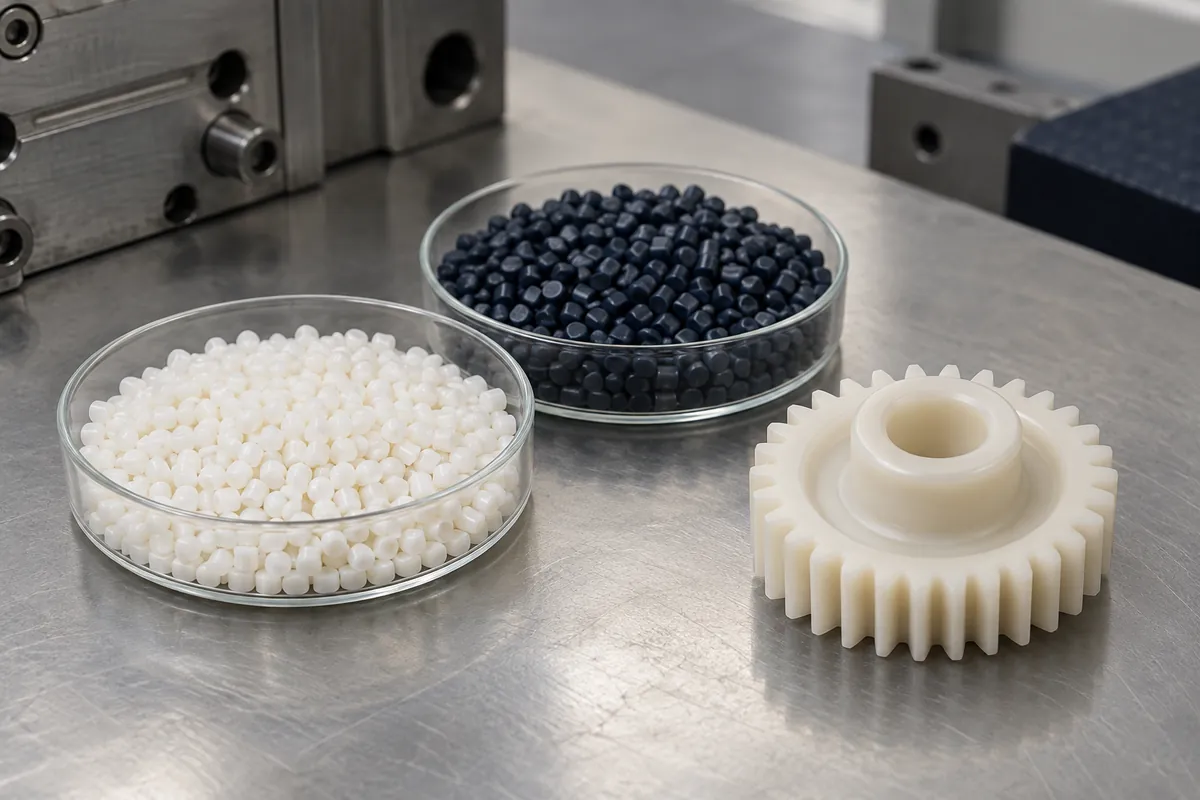
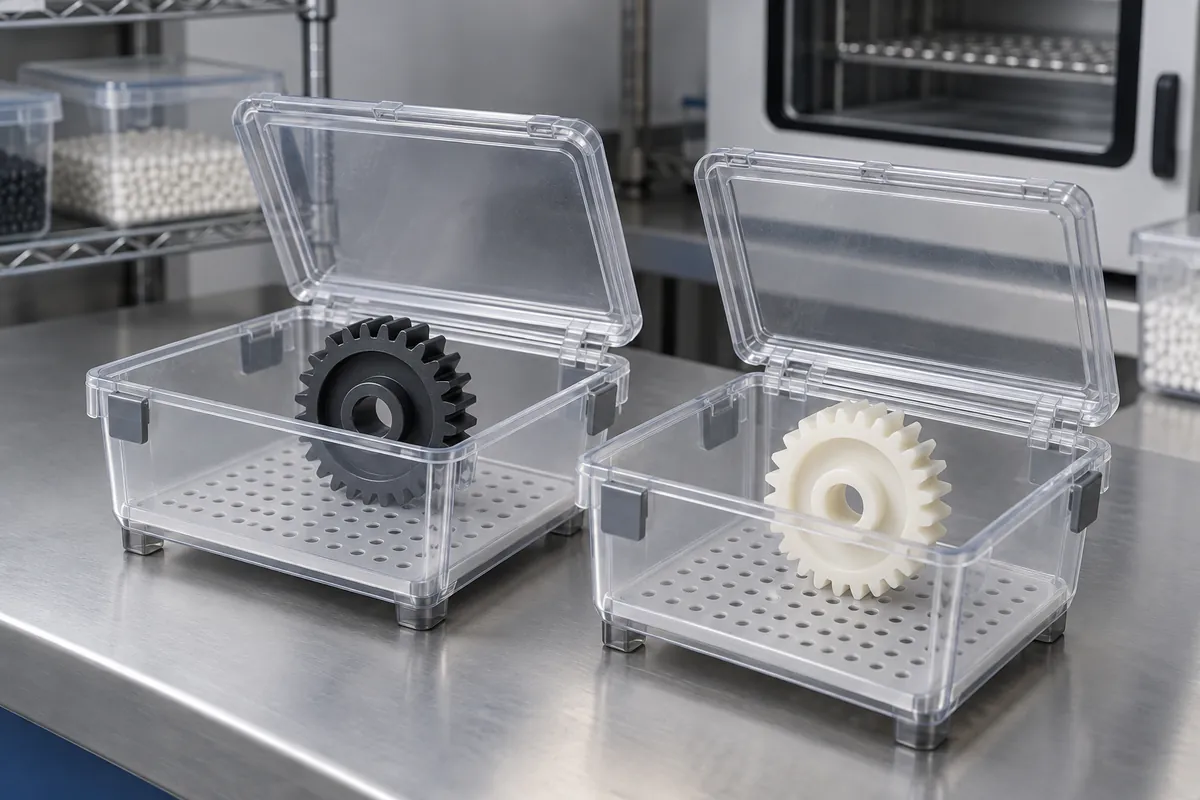
BASF's Ultramid technical brochure discusses moisture uptake and dimensional change in polyamides. For a nylon gear, the condition used for inspection and testing therefore needs to be stated. Do not compare a dry candidate with a conditioned one and attribute the entire difference to a family name.
Delrin's gear application information describes acetal homopolymer as a candidate for low-friction, wear-resistant gear applications. That does not make all POM formulations equivalent, nor does it mean the finished gear is insensitive to every environmental change. Check the grade data and the assembly tolerance relationship.
Agree when dimensions will be measured after molding and after any required conditioning. If shipping and service environments differ, consider both states in the design review. The part needs to assemble at the required stage and function later; choosing a favorable measurement moment does not solve a real fit problem.
The mating material changes the question
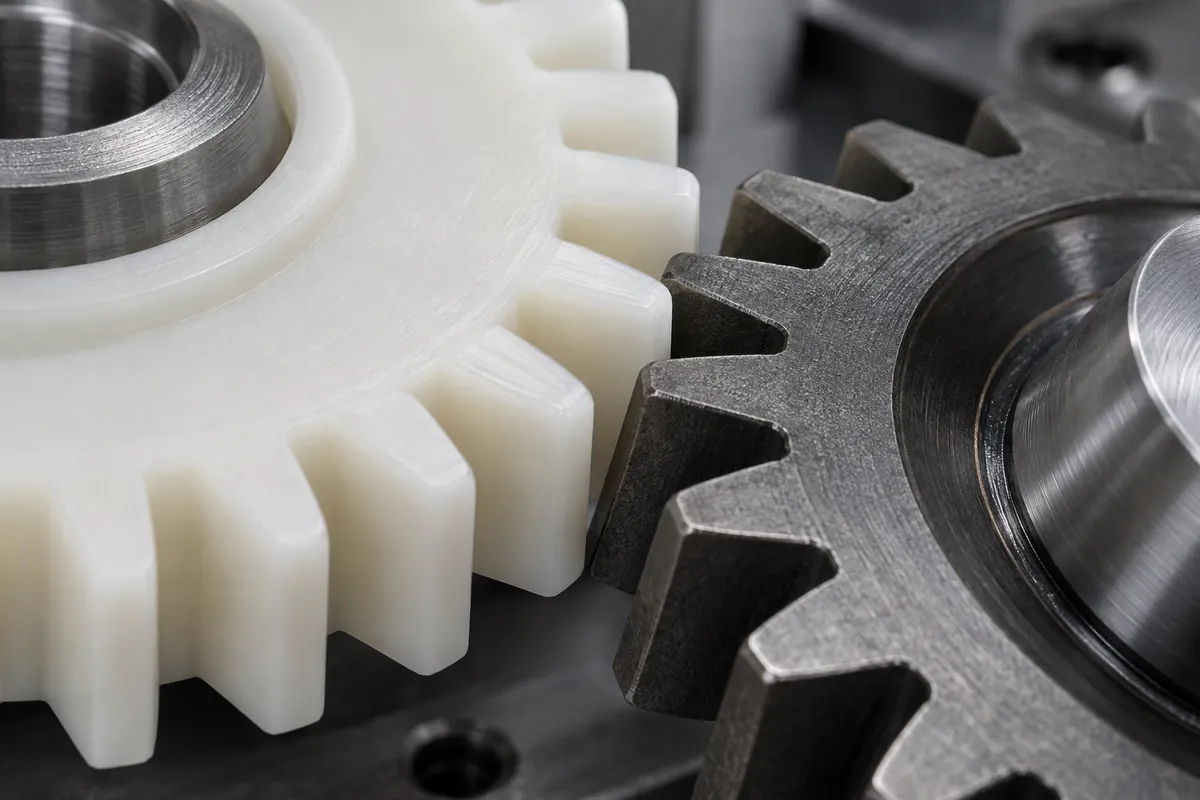
A gear runs against another surface, not against a datasheet. Record the counterpart material, surface condition and whether the mating member is another polymer or a metal. If lubrication is intended, identify the lubricant and application method. If it is prohibited, state the reason and the condition that the evaluation must reproduce.
The Delrin wear and friction guidance distinguishes wear-oriented material options. Treat these as candidates for application review, not evidence that changing one grade will automatically solve noise or wear. Geometry, alignment and the surrounding housing still matter.
| Question | Record for each candidate | Avoid |
|---|---|---|
| What is the material? | Manufacturer, exact grade, additives, color and data revision. | Treating all POM or all nylon as one formulation. |
| What state is tested? | Storage, conditioning and measurement environment. | Comparing unidentified dry and conditioned samples. |
| What does it run against? | Mating material, finish, support and lubrication. | Transferring a friction claim to a different pair. |
| What is acceptable? | Defined wear, fit, noise and damage criteria. | Selecting solely from tensile strength or a generic temperature value. |
Review molding before declaring a winner
A candidate that looks attractive on paper still needs a feasible gate, wall and ejection concept. Review the hub-to-web transition, tooth filling, gate vestige and any molded-in hardware. Changing the material can require a new process and tooling review; the first candidate's settings are not automatically a fair recipe for the second.
Keep the geometry common where the purpose is to compare materials. If a candidate needs a geometry change, record that as a separate configuration. Otherwise, an improved result cannot be attributed to the resin alone. The gate and hub review explains the related manufacturing decisions.
Use a staged decision
First screen grade data against the known requirements. Next review manufacturability and the tolerance relationships. Then evaluate identified molded samples using an agreed method. Do not skip from datasheet comparison to an advertised lifetime. Each stage closes a different uncertainty.
Keep the commercial comparison at the same boundary too. Ask whether each proposal includes the selected grade, specified conditioning, required reports and any secondary operation on the bore. A lower quoted part price may describe a different deliverable. If a grade substitution is proposed later, review the material and part evidence again rather than treating another POM or nylon designation as automatically interchangeable.
Record why a candidate was retained or rejected and which requirements remain open. If neither option is suitable, reopen the geometry, counterpart, lubricant or material search instead of forcing a choice. Our POM material overview and nylon molding page provide broader context; this gear decision still belongs to the actual application.
Turn the review into a defined molding scope
Explore our custom injection-molded plastic gears and the related illustrative engineering study. Send the drawing revision, counterpart details, intended use and the decisions still open. Development samples and production approval should have separate, agreed deliverables.