
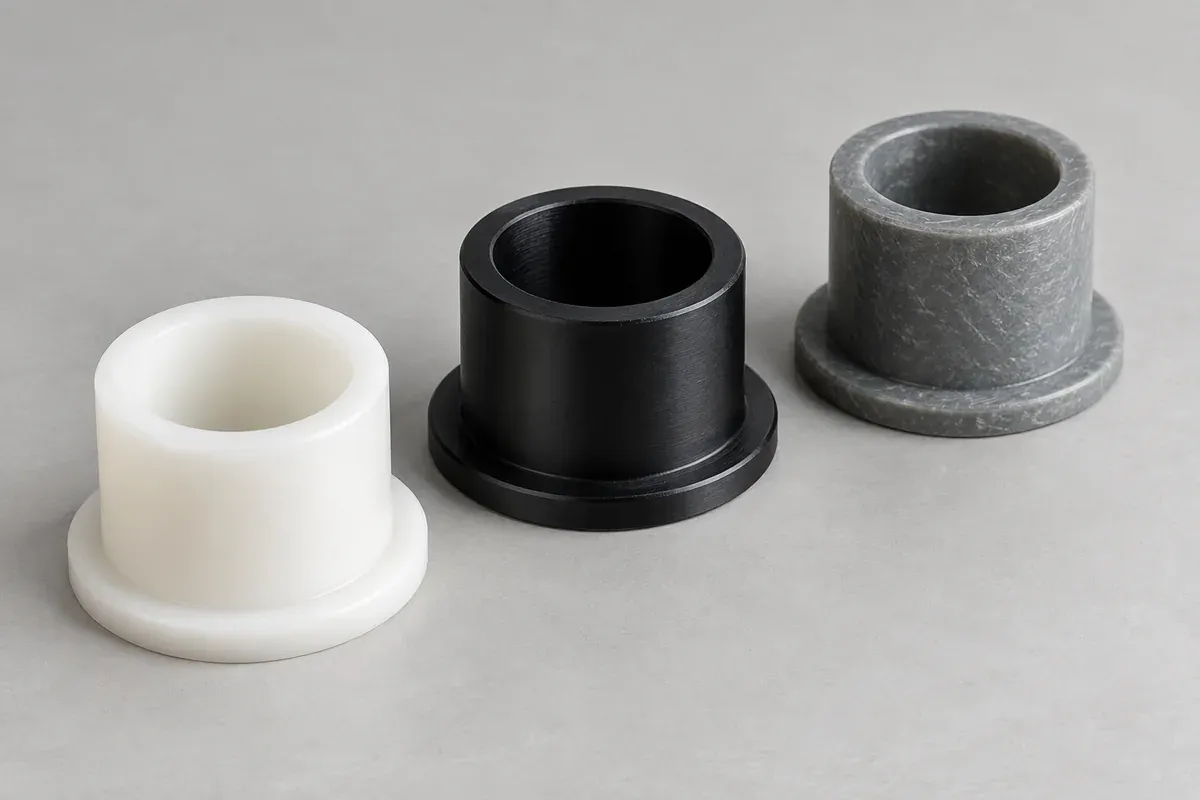
Product design illustrations. Final geometry, materials and acceptance criteria are project-specific.
A plastic bushing material cannot be chosen from friction alone. The part must fit its housing, leave the intended clearance around the shaft and survive the actual movement and exposure. A low friction value from a supplier chart does not establish those conditions for a different shaft, load or environment.
Start with the job: continuous rotation, small-angle oscillation, occasional adjustment or static guidance. Describe load direction, speed, dwell time, temperature and contaminants. Then compare exact resin grades. “Nylon” and “POM” identify families, not interchangeable bearing formulations with one set of approved limits.
Make dimensional behavior part of material selection
For example, compare a locating sleeve that moves only during installation with a pivot bushing that oscillates throughout use. They may share the same outside shape while requiring different counterface evidence and acceptance checks. Put the motion and installation state beside the material candidate in the review record.
POM is frequently considered for dimensionally stable mechanical parts, while nylon candidates require particular attention to moisture condition. Neither statement decides the fit of a finished bushing. Wall geometry, molding history, installation and the actual operating environment still need review against the drawing.
For nylon, identify whether dimensions are specified after a defined conditioning step or in another agreed state. Ask how that state relates to assembly and service. Comparing a dry sample with a conditioned sample while attributing the difference solely to nominal resin family can lead to the wrong clearance decision.
Our moisture and shaft-fit guide develops that question. It is better to resolve specimen state before tooling than to leave the buyer and supplier measuring different conditions under the same drawing note.
Filled does not simply mean better
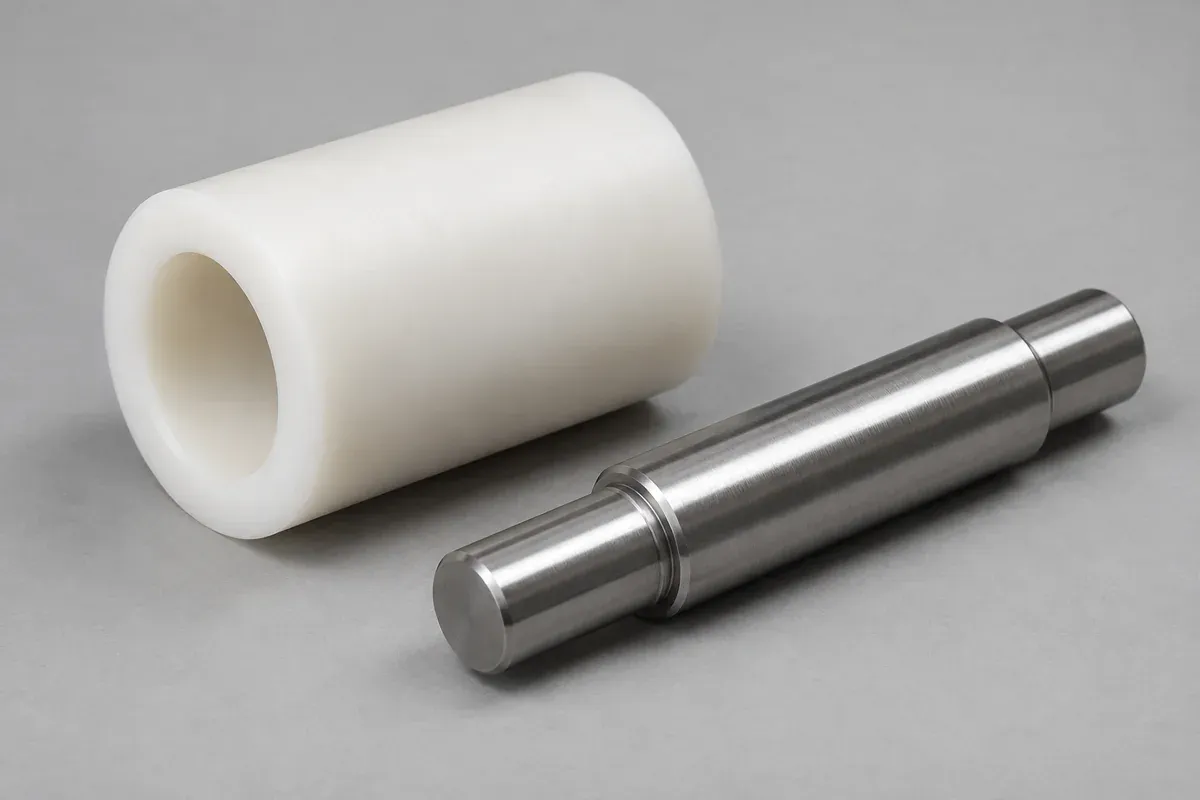
Reinforcement, friction modifiers and other additives serve different purposes. A glass-filled structural grade is not automatically a bearing grade, and a supplier's self-lubricating formulation should not be treated as an unfilled polymer with a generic additive percentage. Ask for the exact compound and application evidence.
Review what the grade may require from the shaft surface and counterface material. Wear is a property of a moving pair under conditions, not just a number belonging to a plastic pellet. Changing the shaft coating or lubrication regime can invalidate a comparison made under another setup.
igus publishes grade-specific bearing data with defined counterface and operating conditions. That is an example of the detail needed for screening; its proprietary material limits are not limits for every custom POM or nylon bushing.
Evaluate load and heat together
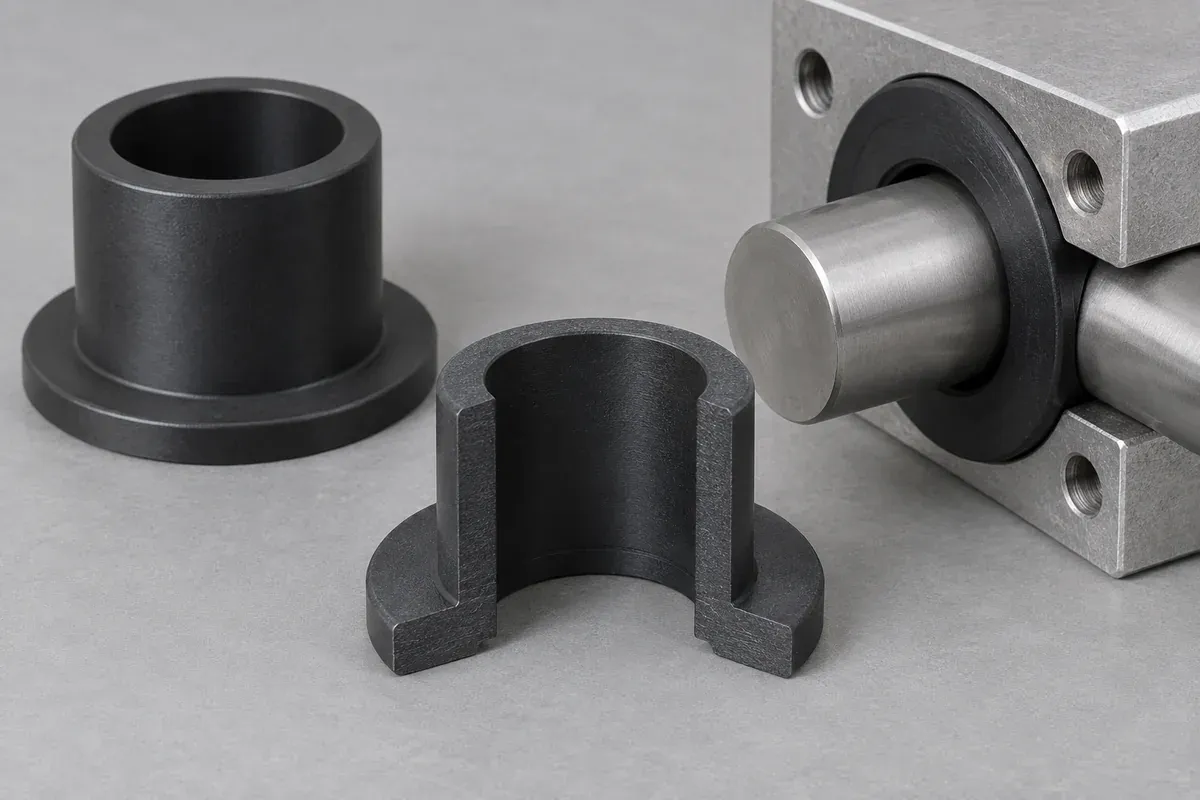
A candidate that withstands a static load may not suit the same load with sustained movement and frictional heat. Identify the contact arrangement, motion and means of dissipating heat. Short catalogue summaries rarely describe the full thermal condition of a bushing pressed into a thin plastic bracket.
Use a supplier's pressure and velocity guidance only with its stated assumptions. An intermittent pivot with long stationary loading is not identical to continuous rotation at the same average speed. Document the duty cycle instead of compressing the requirement into one convenient operating value.
Include chemical and cleaning exposure if relevant. A test on the loose material is useful screening evidence, but a loaded, installed part can present a different question. Do not describe a family as universally oil-resistant, maintenance-free or suitable for every outdoor condition.
Compare the installed configuration
Keep housing size, shaft revision, fit condition and inspection method consistent when reviewing candidate materials. If one sample is machined and another molded, identify that difference. If one is lubricated and another dry, they answer different application questions unless that difference is intentional.
The press-fit review explains why the loose bore should not be assumed to equal the working bore. Exact grade selection and installation allowance should be resolved together, rather than treating material substitution as a purchasing-only change.
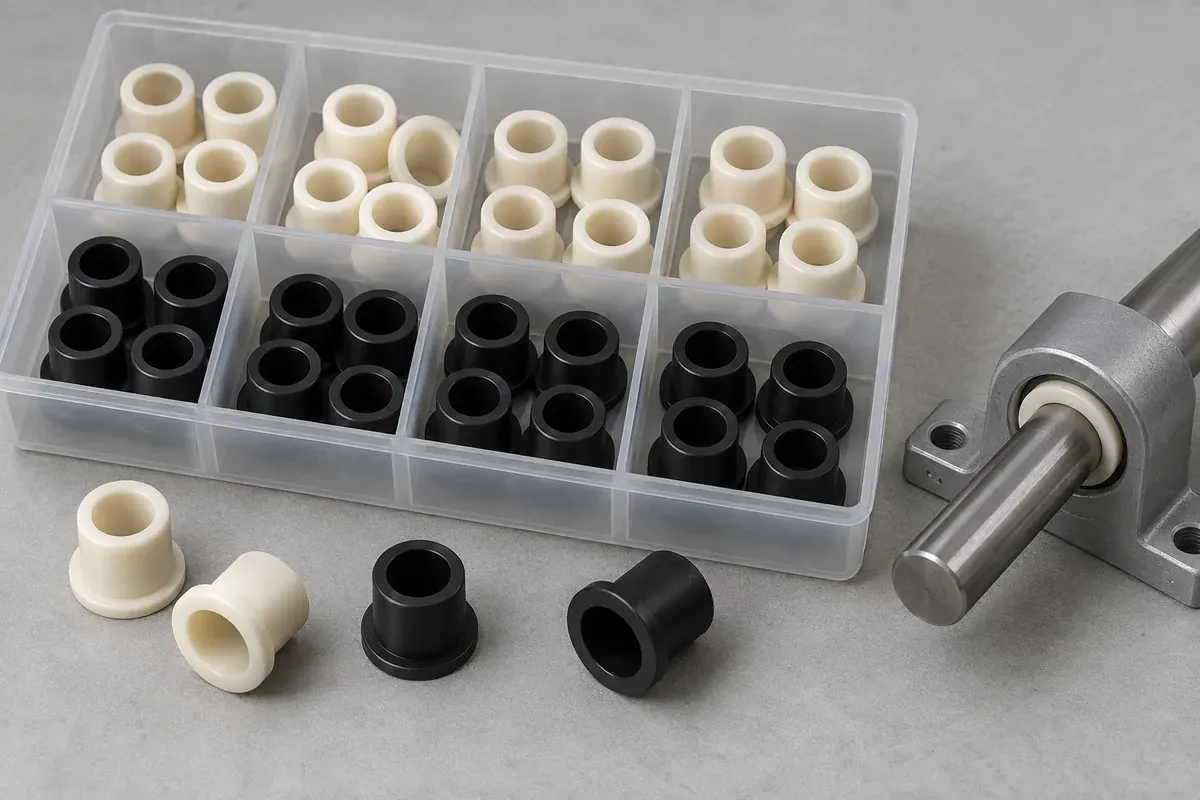
A useful short list identifies the reason each candidate remains: dimensional behavior, counterface evidence, process feasibility or another stated requirement. It also identifies missing evidence. Request a quotation for that defined scope, with any unresolved material selection recorded as an assumption rather than a guaranteed service-life claim.
Turn the review into a defined molding scope
Explore our custom injection-molded plastic bushings and the related illustrative engineering study. Send the drawing revision, counterpart details, intended use and the decisions still open. Development samples and production approval should have separate, agreed deliverables.