
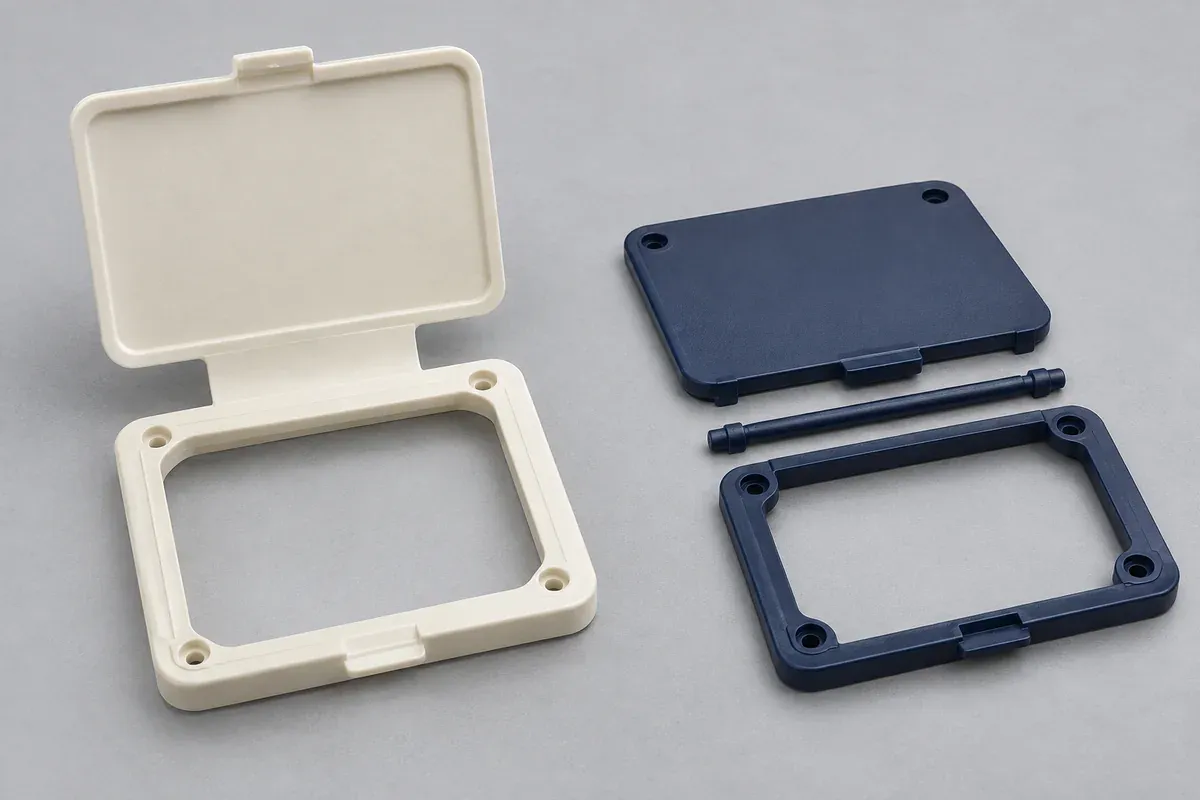
Product design illustrations. Final geometry, materials and acceptance criteria are project-specific.
A living hinge connects two sections through a thin flexible region of the same molded part. A pin hinge creates movement between separate features around a pivot. Both can keep a cover attached, but they distribute material, assembly work and failure risks differently.
Choose between them by describing the actual movement and service requirement. A cover opened once for installation is not the same application as one used repeatedly every day. Nor is a small protective flap equivalent to a lid that carries a significant external load.
Decide what the hinge must do
Identify the opening angle, required access and the position in which the cover normally remains. Include any accidental overtravel that the product must address. A hinge is only one part of that mechanism; a stop or latch may need to carry loads that should not be assigned to the flexible region.
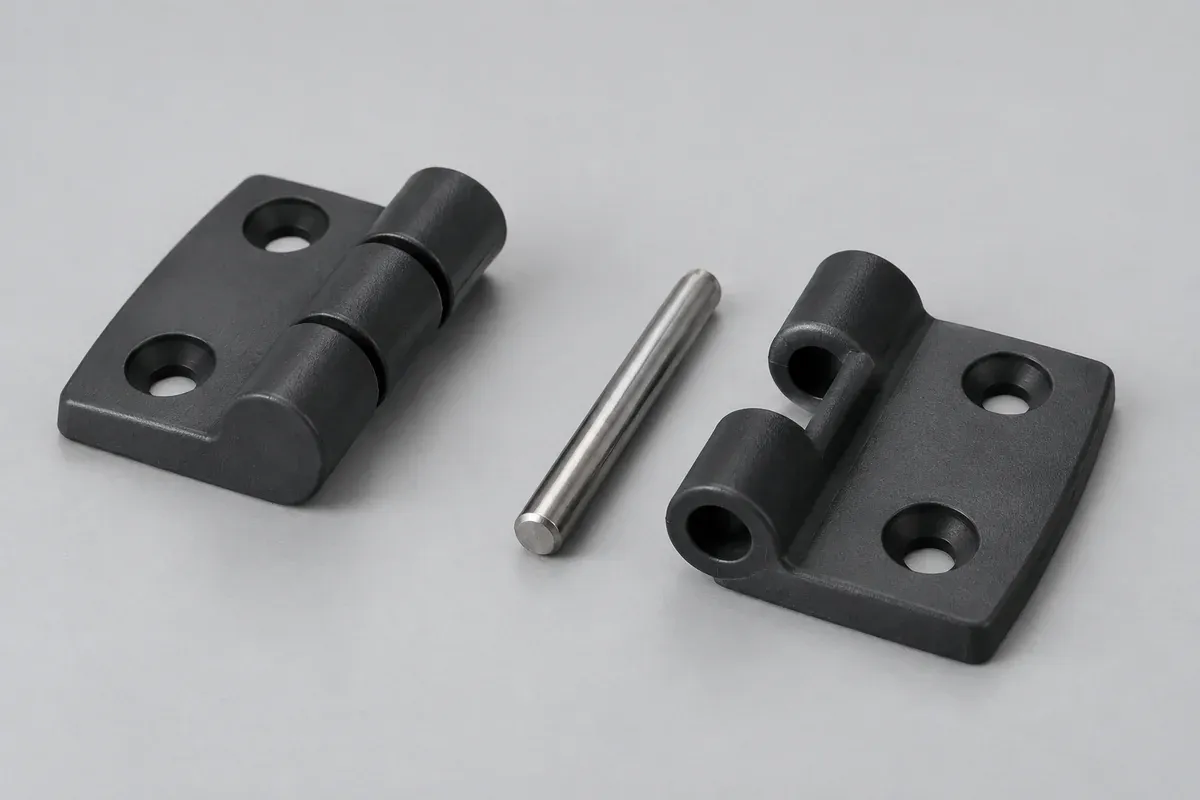
For a pin hinge, examine the pivot, bearing surfaces and axial retention. For a living hinge, examine the flexure, transitions and connected panels. Do not compare one fully defined mechanism with a simplified sketch of the other.
Protolabs' living-hinge overview describes the integral flexible connection. The selection here goes beyond that definition: the complete assembly and its verification requirements determine whether the concept suits your application.
Material selection affects the whole part
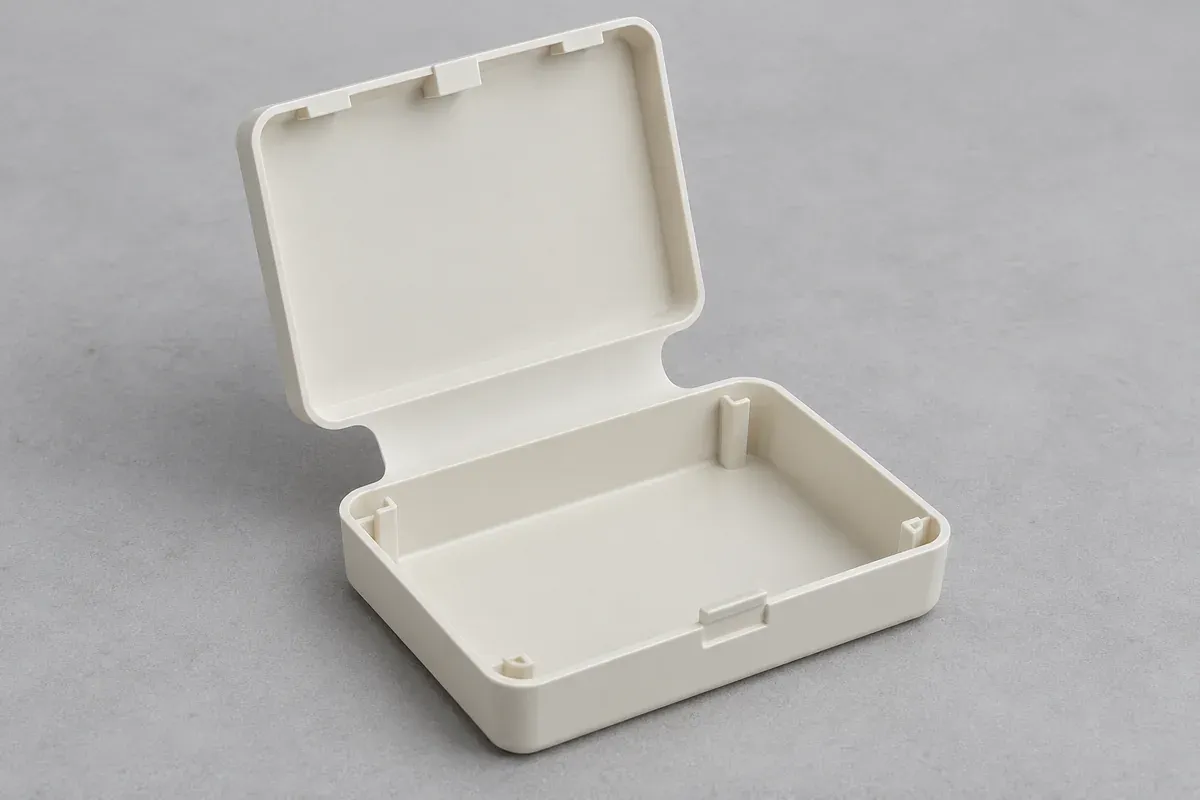
A living hinge requires a material and molding arrangement suitable for repeated bending where repeated use is intended. The thicker frame and lid must also provide their required stiffness, appearance and environmental behavior. A material that flexes readily is not automatically satisfactory for every connected feature.
A separate pin arrangement can allow the cover, frame and pivot to use different materials. That creates additional interfaces and supply items but may offer useful freedom. Review corrosion, wear, fit and any assembly restrictions as part of that alternative.
The PP and PE material guide focuses on integral molded designs. Its candidates should not be interpreted as a universal recommendation for load-bearing hinges or every exposure condition.
Count assembly and service operations
A one-piece part can remove a separate pin-installation step, but its tool, handling and first-fold procedure still need review. An integral connection may also affect nesting and packing because the part is molded in an open configuration.
A pin hinge requires a plan for installing and retaining the pivot. Check access, sequence and whether an operator can detect incomplete assembly. If service requires removing the cover, a deliberately removable pivot may offer a function the integral design cannot provide without damage.
Keep hinge motion separate from latch behavior
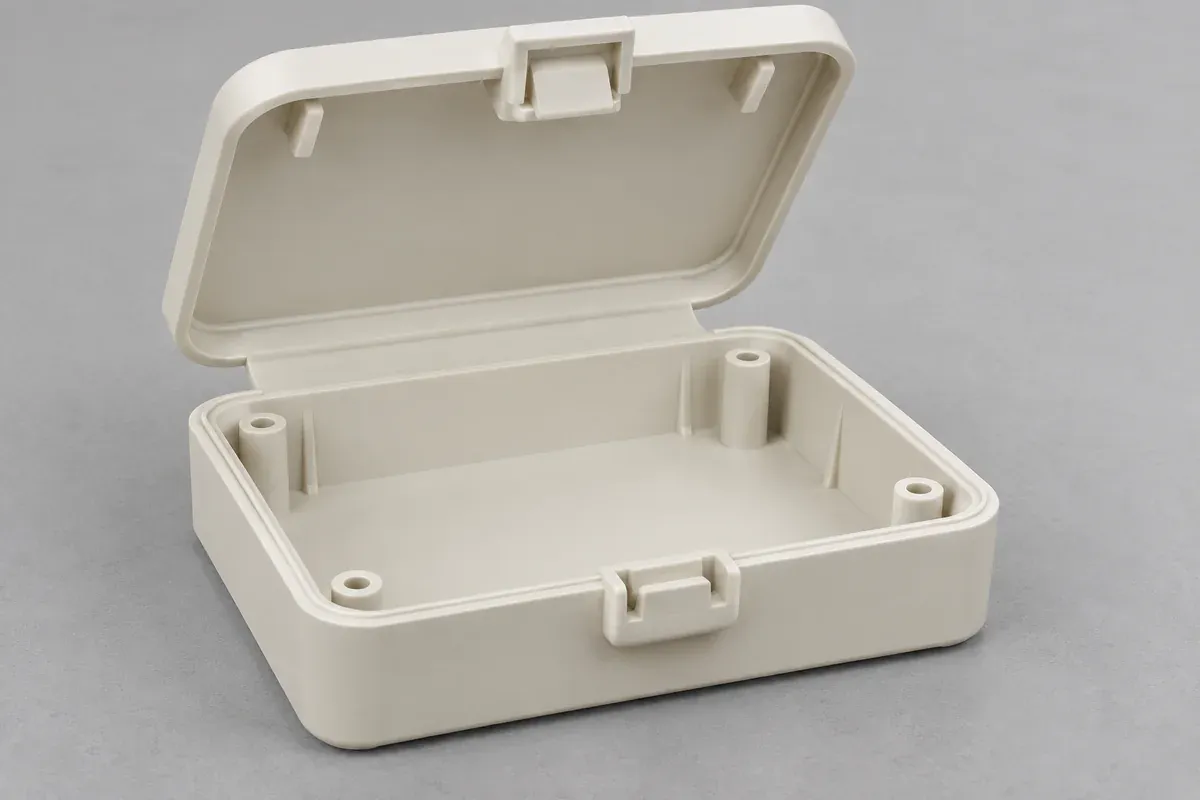
The force to release a latch is not the same as the force to bend a hinge. A cover can have acceptable hinge movement and an unsuitable closing latch, or the reverse. Test these functions separately before evaluating their combined operation.
Consider what happens when the cover reaches the intended open position. If a stop carries the load, define its contact and stiffness. If the hinge itself is expected to resist further motion, make that requirement explicit and obtain appropriate evidence.
Do not use an attractive opening animation as a life prediction. CAD motion demonstrates an intended geometric relationship, not fatigue, wear or resistance to misuse. The cycle-test guide explains how to turn the operating requirement into a proposed evaluation.
Compare the approved scope
Ask both alternatives to identify tooling, materials, assembly, samples, inspection and packing. Include what happens if the hinge geometry needs a revision after trials. The option with fewer loose parts does not necessarily have the lowest total development cost.
Keep decisions tied to the actual application. An integral hinge may be a good candidate when its material and motion suit the product. A pin hinge may be preferable when independent material choices or service removal matter more. Neither choice should be sold through an invented universal lifetime.
Send the cover and frame drawings together with the opening sequence, load expectations and approval criteria. That gives the molding review a concrete mechanism to assess instead of a generic request for a durable hinge.
Turn the review into a defined molding scope
Explore our custom injection-molded living-hinge parts and the related illustrative engineering study. Send the drawing revision, counterpart details, intended use and the decisions still open. Development samples and production approval should have separate, agreed deliverables.