
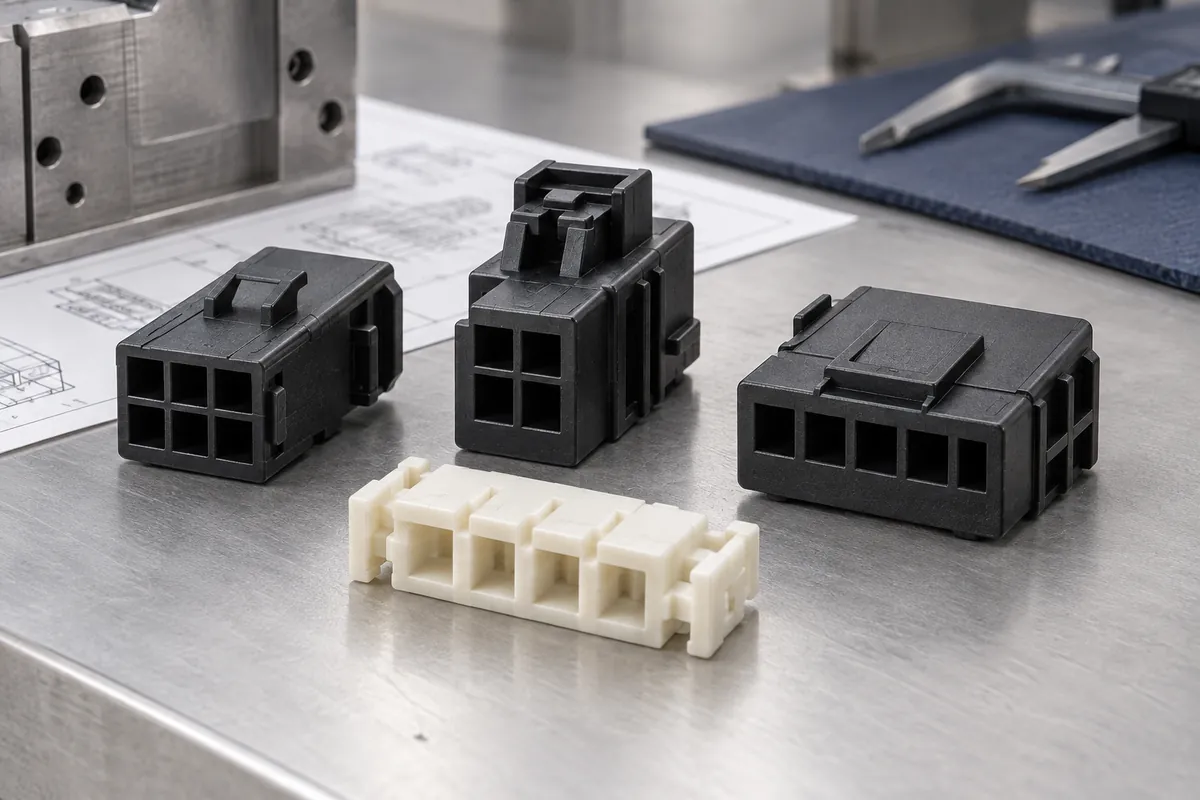
A connector-insulator quotation can look complete while leaving its most important interface undefined. The plastic drawing may identify an outside envelope, but the terminal assembly team works from a different revision. Purchasing then compares prices for parts that suppliers have interpreted differently.
Start the RFQ with the delivered item and its mating interfaces, not a generic request for a precision connector. A molded insulating body, a terminal carrier and an assembled electrical connector are different deliverables. This checklist is for custom injection-molded plastic parts; it does not assume that contacts, plating, cable assembly or finished-connector qualification are included.
Product design illustrations. Final geometry, materials and acceptance criteria are project-specific.
Define what arrives in the box
Give the molded part a controlled number and revision. Identify whether it is supplied empty, with customer-supplied inserts, with installed terminals or as part of another expressly agreed assembly. If the RFQ contains several pieces, state whether each quantity means individual components or matched sets. Otherwise, even a correct quotation may answer the wrong purchasing question.
Supply the native or neutral 3D geometry together with the dimensioned drawing. Where they disagree, name the controlling document and list the discrepancy for resolution. Do not leave a supplier to choose between a model aperture and a drawing dimension. Keep proposed manufacturing changes in a separate marked-up revision until the design owner accepts them.
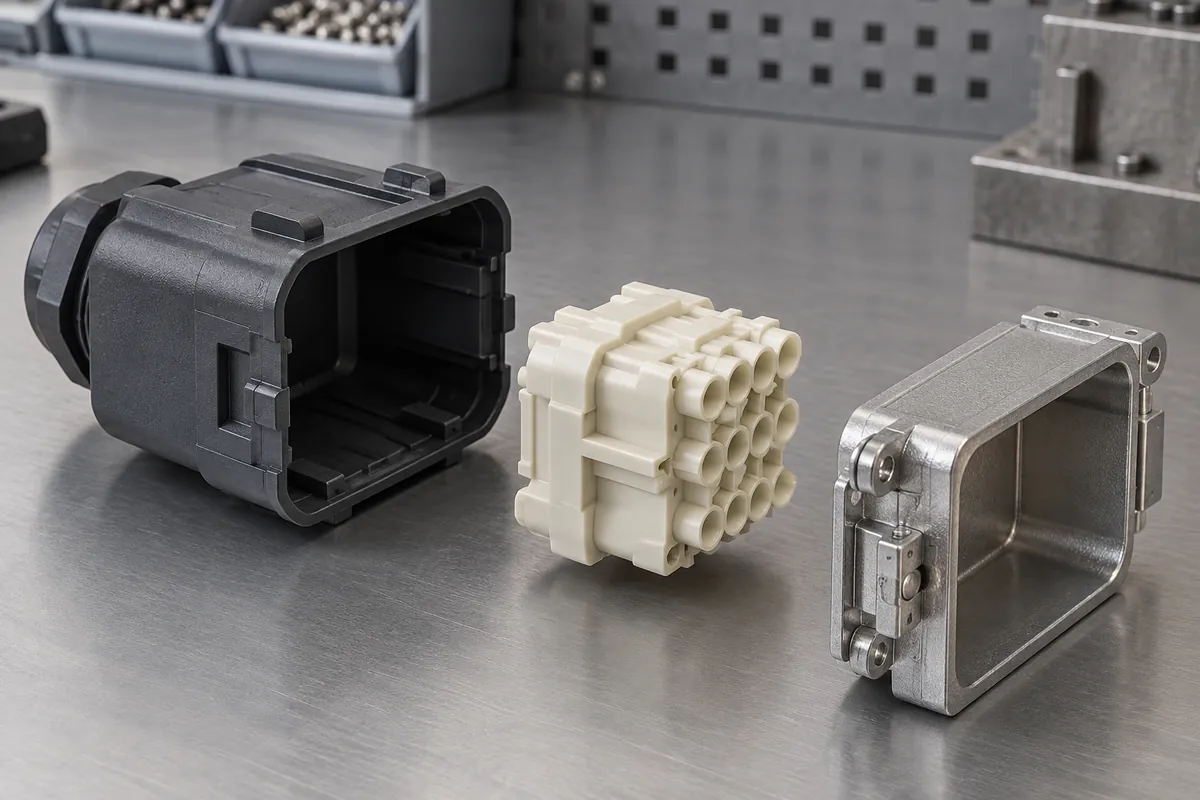
Send the counterpart, not just the plastic envelope
Include the terminal geometry, insertion direction, locking arrangement and the part that locates the carrier during assembly. The supplier needs to understand which surfaces locate the part and which only provide clearance. A small opening may be an assembly lead-in, a retention feature or a final contact-position feature; those functions should not receive the same inspection instruction by default.
Mark no-change interfaces clearly. Then identify features open to DFM review, such as draft on non-mating walls, gate location or support rib geometry. This creates useful design freedom without silently changing terminal engagement. Our connector molding design guide covers the broader geometry discussion; the RFQ should turn it into a controlled list of project decisions.
Describe exposure as a sequence
Instead of writing only “high-temperature plastic,” describe storage, terminal installation, board assembly if relevant, cleaning and service exposure. Record whether the part sees heat before or after terminals are installed, whether it is constrained during that event and which function must be preserved afterward. These details determine the evidence the buyer should request.
Material-family names are not an approval. Celanese's connector-material application guidance discusses thin-wall filling, warpage and soldering exposure as distinct requirements. Use exact-grade information and the actual application profile to screen candidates; do not copy a material marketing claim into a finished-part guarantee. If a grade has not been chosen, ask for separately identified alternatives.
| Input | Specify | Keep separate |
|---|---|---|
| Interface | Terminal and counterpart revisions; locating features; assembly sequence. | Proposed geometry changes that need design-owner approval. |
| Material | Exact grade if approved, color, exposure and applicable documentation. | Candidate-grade screening versus part or assembly qualification. |
| Inspection | Feature list, datums, sample condition, methods and report format. | Dimensional inspection versus electrical or sealing tests. |
| Supply | Trial quantity, first order, repeat demand, packing and destination. | Firm releases versus an uncommitted annual forecast. |
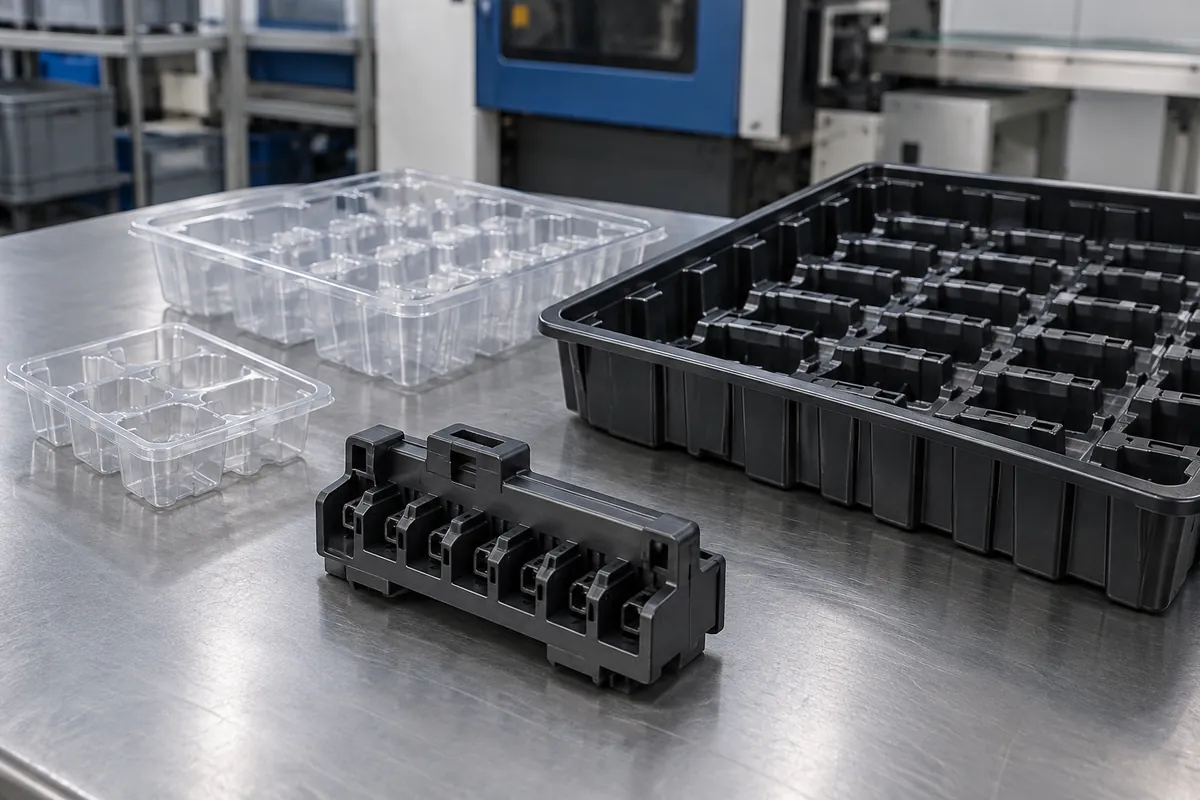
Specify the report before samples are made
A phrase such as “full inspection included” can hide different expectations. List the drawing characteristics that need recorded values, the cavity identification required and whether a mating-gauge result is additional evidence. Ask who owns any inspection fixture and who approves its design. Agree the part's condition and whether measurements are taken before or after the specified thermal or assembly sequence.
For repeated apertures, require enough identification to trace a result to a particular position on a particular part. An average pitch value does not explain the location of every terminal window. The pin-pitch and datum inspection guide shows how to distinguish local spacing, overall span and position relative to the assembly datum.
Make the commercial comparison follow the technical scope
Ask for tooling, trial work, reporting, gauges, production and any secondary work to be identified without double-counting included items. Keep customer review time outside the supplier's manufacturing duration unless expressly included. A shorter quoted lead time may simply start at a later approval event; clarify the starting condition before selecting a proposal.
Traceability requirements also affect the scope. State whether you need material-lot records, cavity identification, individual sample labels or shipment-level records. Do not ask for serial-level history if lot-level evidence satisfies the actual requirement, but do not accept a shipment date as a substitute for a required cavity link. Define the retention and retrieval expectations before placing the order.
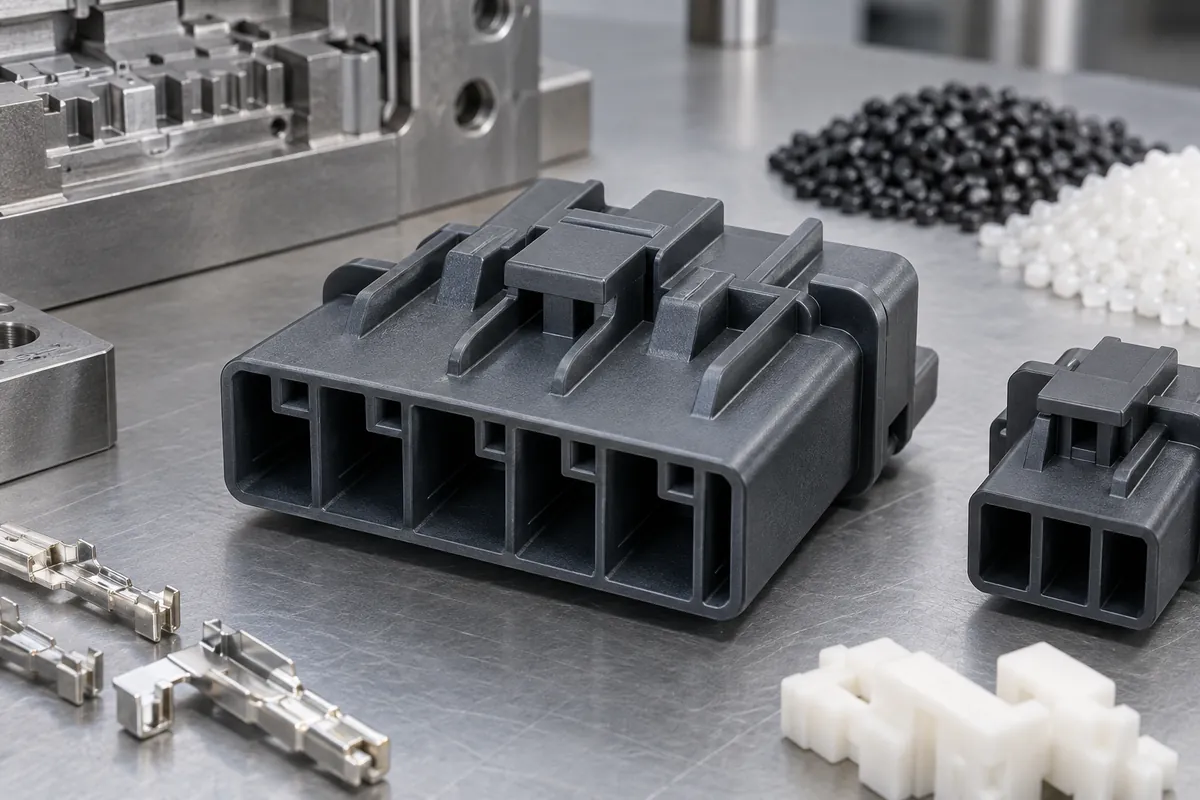
A quote-ready package does not require every decision to be final. It requires open decisions to be visible. Finish the RFQ with an assumptions register: item, proposed assumption, decision owner and point by which it must close. That turns follow-up questions into a manageable engineering review rather than a surprise change after tool construction.
Turn the review into a defined molding scope
Explore our custom molded connector insulators and terminal carriers and the related illustrative engineering study. Send the drawing revision, counterpart details, intended use and the decisions still open. Development samples and production approval should have separate, agreed deliverables.