
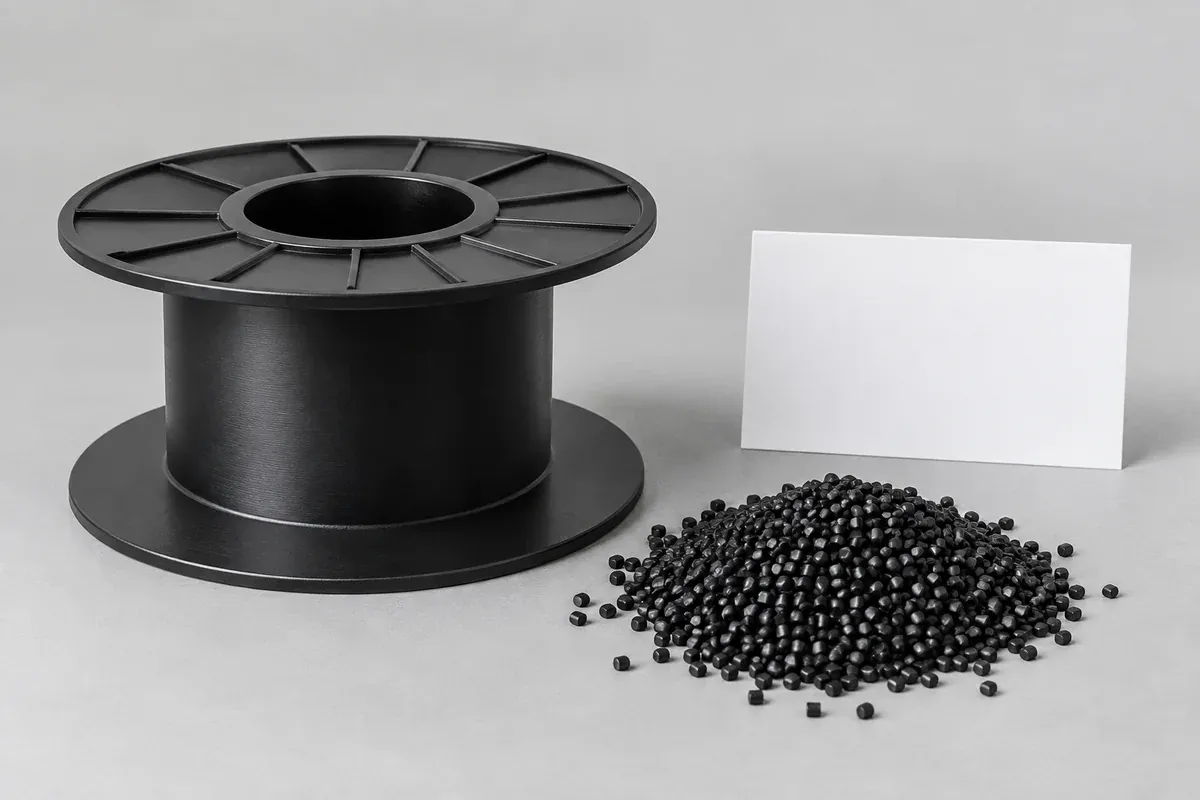
Product design illustrations. Final geometry, materials and acceptance criteria are project-specific.
A bobbin supplier can send an impressive material datasheet that still does not answer the buyer's question. The document may describe a related grade, a different color or properties measured under conditions that do not represent the component. Review the identity and scope before accepting the headline values.
For an electrical assembly, this review should involve the person responsible for material approval and product compliance. A molding buyer can collect and organize the records, but should not turn a supplier brochure into a declaration that the finished device is qualified.
Start with one controlled material designation
Record the manufacturer, complete grade name, reinforcement or modification where applicable, and the ordered color designation. Match that information across the quotation, approved drawing, purchase specification and sample report. Abbreviated family names make mismatches unnecessarily difficult to spot.
If the design permits more than one grade, list the approved alternatives explicitly and identify any restrictions. A phrase such as equivalent PBT leaves the equivalence criteria unresolved. An alternative should be evaluated against the actual component requirements before it reaches production.
Separate a technical datasheet from a batch identity record. The former describes a material and its stated test information; the latter helps connect supplied material to an identified lot. Neither document automatically substitutes for component inspection or downstream assembly evaluation.
Read classifications with their conditions attached
Where a recognized-material record is required, verify the current entry and its scope with the responsible engineer. Color, thickness and the particular characteristic being evaluated can matter. Do not crop those conditions away when transferring a value into a purchasing spreadsheet.
UL's Yellow Card overview describes recognized plastics information. The record concerns the listed material and conditions; it is not a certificate declaring every geometry molded from that material suitable for every electrical product.
Ask the product owner which documentation is actually needed for the intended application. Collecting every available declaration can obscure the important gap. Conversely, a familiar logo should not replace a check that the exact formulation and relevant conditions match the design.
Connect incoming resin to delivered components
Agree how material identity will be preserved through receipt, storage, drying and production. The required traceability depth depends on the order and quality agreement. State it before quoting so the supplier includes the necessary records and part identification.
Decide how colorants, permitted reprocessed material and substitutions are controlled. These are configuration questions, not details to settle informally after a shortage. If the approved specification excludes a material practice, the production order should carry that restriction clearly.
Keep sample and production records distinguishable. A prototype molded from an available candidate can support an early geometry discussion, but its material identity must remain visible. It should not become the reference for an approved production grade without an explicit review.
Check the relationship to the actual wall sections
Review the component drawing alongside the material evidence. The relevant molded sections include local features, not only the nominal barrel wall. If a material classification depends on a specified thickness range, the responsible designer must assess the actual geometry against that condition.
Consider the later process sequence as well. Winding, terminal installation, connection work and other assembly steps may introduce requirements not answered by a basic material sheet. Ask for the evidence appropriate to those steps rather than assuming a single thermal value covers them all.
The PBT, PA66 and PPS comparison provides a way to organize candidates. Use it to frame the questions, not as a substitute for the exact manufacturer's documentation or the product's approval requirements.
Keep the release package concise and traceable
A useful package links the approved material, component revision, production or sample identity and required inspection evidence. It also states who approves alternatives and which changes trigger reevaluation. This structure is more useful than a large folder of unrelated certificates.
If a required record is unavailable, list it as an open item and agree how it will be resolved. Do not fill the gap with an invented compliance statement. The buyer should be able to tell whether the material is approved, proposed or still under review.
Finally, connect document acceptance with the pre-winding component checks. Correct paperwork does not excuse damaged terminals or obstructed lead slots, just as good-looking parts do not establish their resin identity. Both forms of evidence belong in the release decision.
Turn the review into a defined molding scope
Explore our custom injection-molded coil bobbins and the related illustrative engineering study. Send the drawing revision, counterpart details, intended use and the decisions still open. Development samples and production approval should have separate, agreed deliverables.