
PP Filter Housing: Seal and Pressure Pilot Review
A molded filter housing needed a more controlled seal groove and better support around its fluid connection. Early development reported leakage and local deformation, prompting a review of the housing, O-ring and assembled pressure boundary.
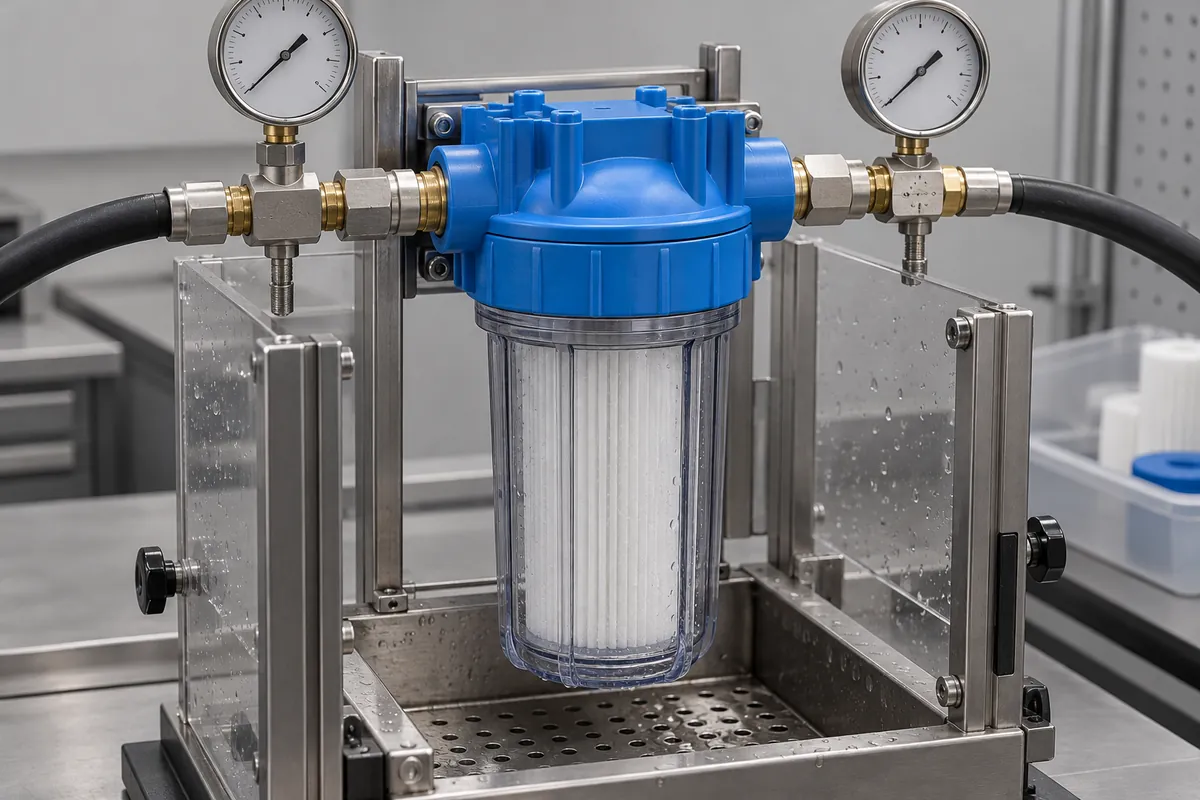
The later 1,000-piece pilot had completed specific dimensional and short water-pressure checks. A higher-pressure program was still in progress, so its target is not presented as a measured burst pressure or an approved operating rating.
1,000 pieces
Pilot quantity
50 assemblies
Sampled water-pressure check
0.6 MPa / 60 s
Recorded test condition
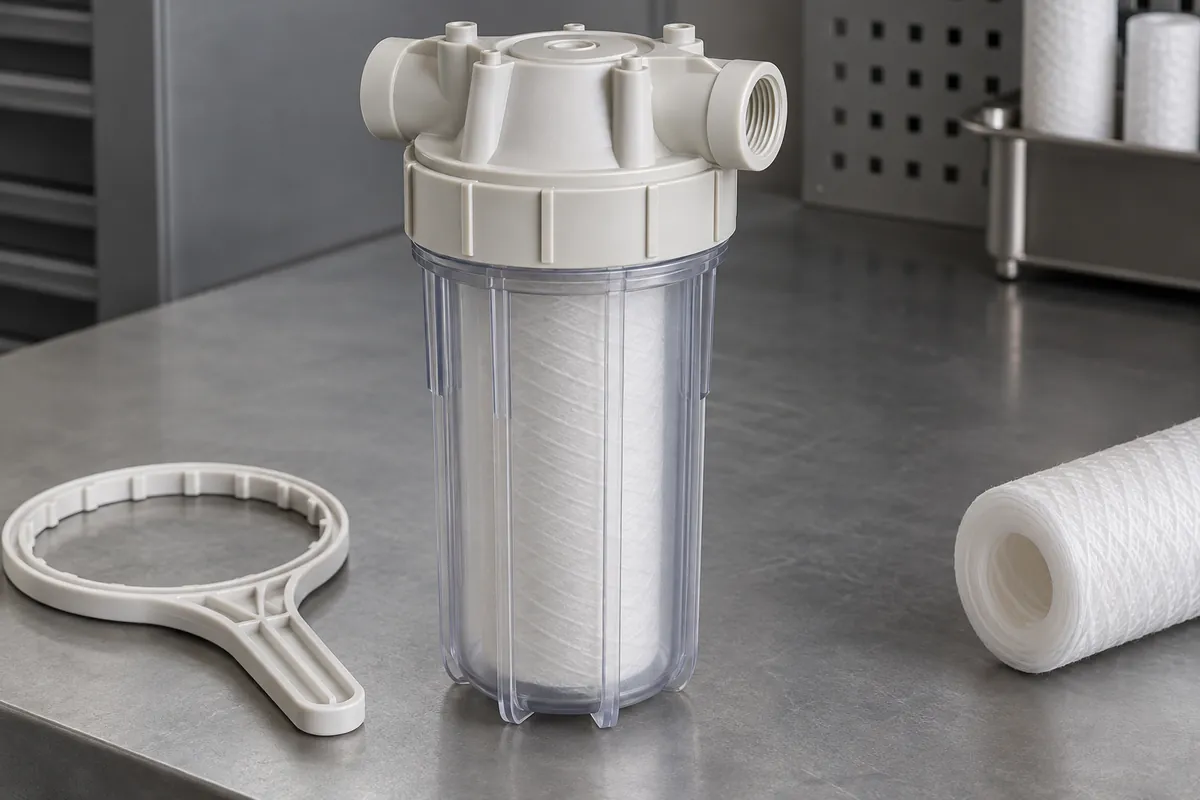
Project background
Component, scope and current phase
| Application | Filter body and closure for a defined cartridge assembly |
|---|---|
| Material | Natural PP; SABIC 575P identified in the project record |
| Nominal geometry | 80 mm body diameter and 120 mm height with specified fluid ports |
| Development focus | O-ring groove, port support and housing-wall geometry |
| Current phase | Pilot and pressure-development validation; not a fully qualified filtration system |
Engineering challenge
What the development work needed to resolve
The initial record identified leakage at 0.6 MPa and deformation during a higher-pressure check. The response needed to distinguish seal-interface behavior from housing stiffness rather than interpreting both observations as one material failure.
Cartridge fit and internal bypass are separate from external containment. The case does not treat a leak-free housing as evidence of contaminant-removal efficiency or complete filtration certification.
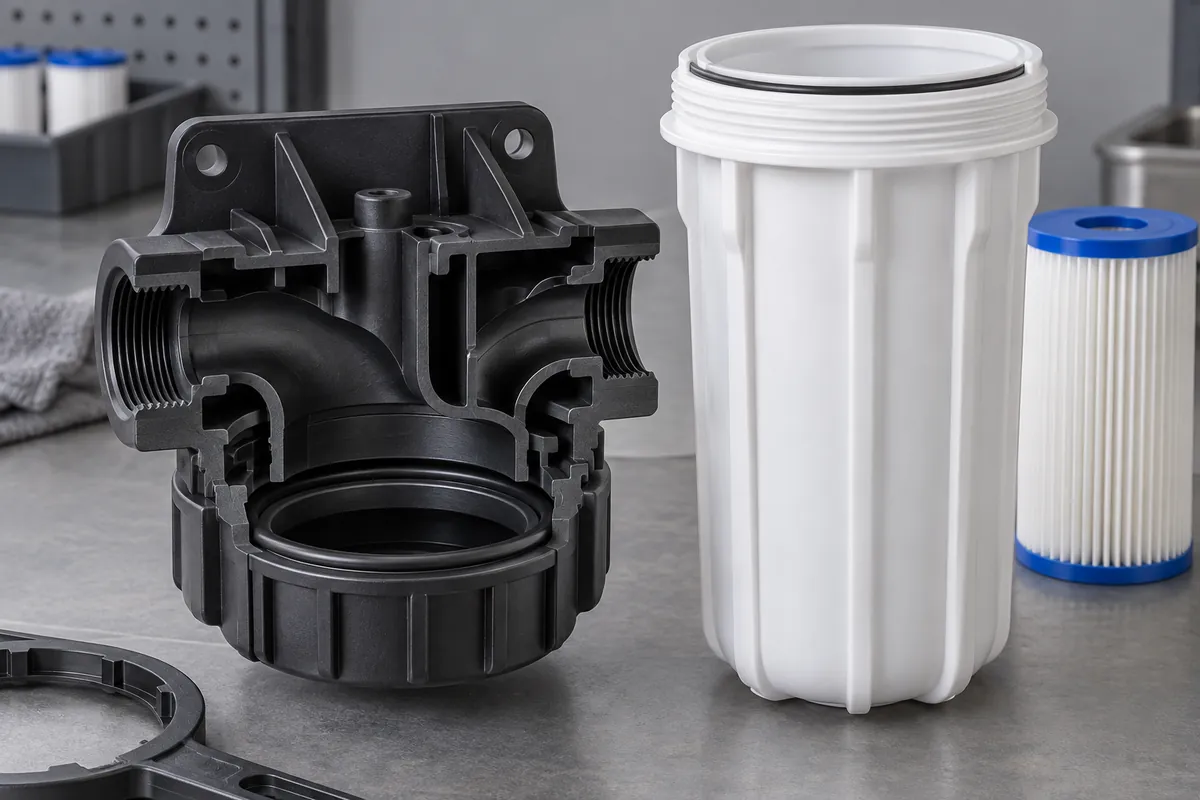
Manufacturing review
Changes and the verification approach
The recorded geometry changes included a revised O-ring groove, reinforcement around the port and a nominal wall increase from 3.0 to 3.5 mm. These changes were evaluated together with the selected seal and closure arrangement.
Pilot inspection recorded groove width and depth before the assembled water-pressure test. The supplied tooling description and thread-gauge terminology were inconsistent, so this public case does not claim a cavity count or a specific gauge method that has not been reconciled.
The project kept its 1.0 MPa development target open. No burst value is inferred from a specimen that had not completed a destructive test, and no lifetime pressure rating is calculated from the short pilot hold.
T0 · July 20
100 pieces
T1 · August 15
300 pieces
Pilot · September 20
1,000 pieces
Recorded observations
Results with their sample and test boundaries
Each result below applies to the stated specimens and configuration. Development, pilot and production checks are not combined into a single pass rate.
These are owner-supplied project summaries, not independently certified test reports.
| Check | Samples and conditions | Recorded observation | Interpretation boundary |
|---|---|---|---|
| O-ring groove | September 22 pilot sample; 20 specimens | Width 2.95–3.05 mm; depth 1.75–1.85 mm | Sampled dimensions for the revised groove |
| Assembled water-pressure check | September 25; 50 assemblies with O-rings; 0.6 MPa for 60 seconds | No leakage reported during the hold | Specific pilot check, not complete-lot pressure inspection |
| Higher-pressure development | Five specimens identified for the continuing program | Target not yet closed in the supplied record | No completed burst result or approved operating-pressure claim |
Release status
What is established and what remains open
As of October 7, the project remained in pilot validation. The short-duration water test is reported with its sample count and condition; higher-pressure work remains unfinished.
No FDA approval, drinking-water certification, complete filter efficiency or pressure-vessel qualification is inferred from the PP grade. The final system requires evidence matching its actual fluid, cartridge and operating conditions.
Published anonymously with the project owner's permission. Original test reports and project photographs were not supplied for this publication review. Images are product design illustrations; no customer or supplier identity is displayed.
Related guides
Plan the next component review
- Plastic Filter Housing Materials: PP, PA or PVDF?Compare PP, PA and PVDF for molded filter housings using the actual fluid, temperature, pressure cycle and sealing interfaces. Keep resin data separate from assembly ratings.
- Threaded vs Welded Plastic Filter HousingsCompare threaded and welded plastic filter housings through service access, sealing, joining control and complete assembly validation. Define the delivered configuration.
- O-Ring Grooves in Molded Filter Housings: Dimensions and CreepReview molded filter-housing O-ring grooves through seal size, gland geometry, surface condition, tolerances and assembly. Avoid universal squeeze values without an application.
- Leak, Proof and Burst Tests for Plastic Filter HousingsDistinguish filter-housing leak, proof-pressure and burst tests. Define medium, temperature, assembly, duration and sample scope without turning a short test into a service rating.
- Molding Threads in Filter Housings: Tooling OptionsDesign molded filter-housing threads with a defined thread form, sealing mechanism, tooling route, engagement and gauge plan. Review internal and external threads separately.
- Filter Cartridge-to-Housing Fit: Seals, Stops and Bypass PathsReview filter cartridge fit, end seals and internal bypass paths separately from external housing leakage. Define tolerance stacks, support and complete filtration validation.
Review your component and its mating assembly
Send the drawings, operating conditions, quantities and acceptance methods to define tooling, molding and inspection.