
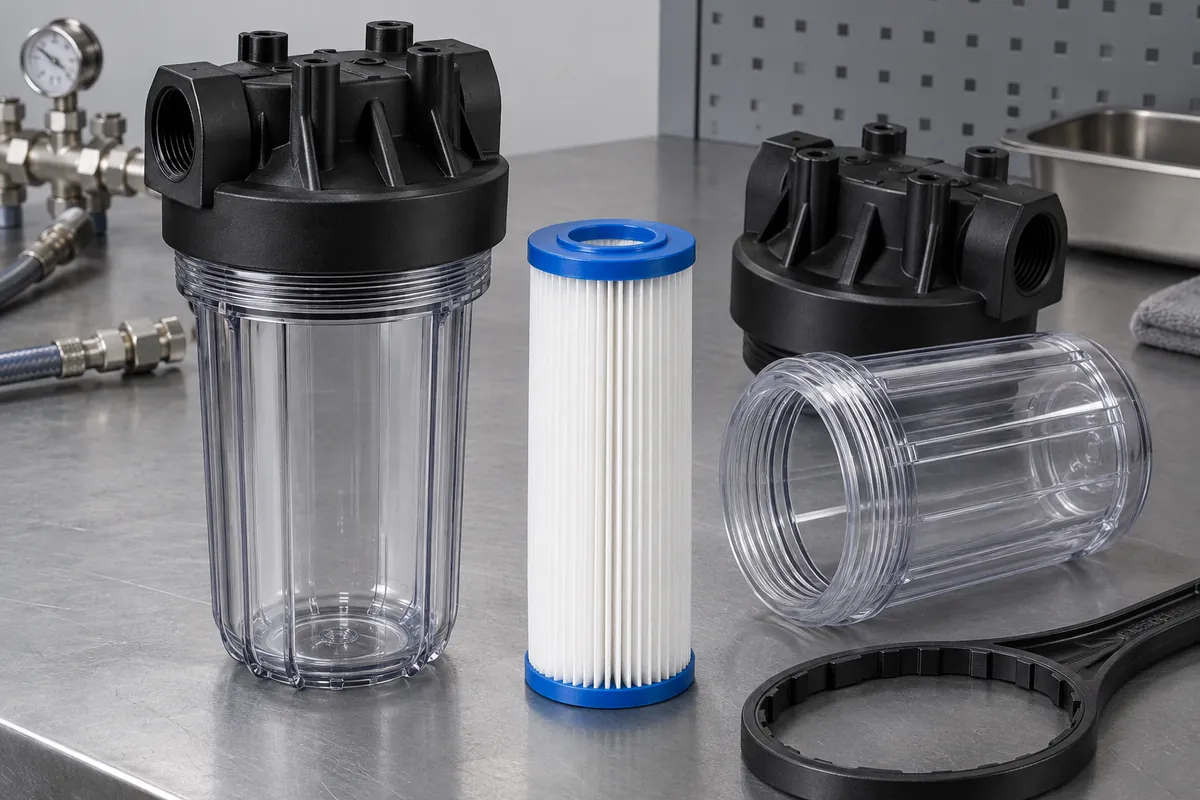
Product design illustrations. Final geometry, materials and acceptance criteria are project-specific.
A threaded filter housing can be opened, while a welded construction can remove a serviceable closure from the design. That difference affects maintenance, sealing and manufacturing, not just appearance. Decide whether the cartridge must be replaced and how the system will be serviced before choosing the closure route.
Start with the expected life of the housing and cartridge. If the entire assembly is disposable, a permanent joint may be appropriate after validation. If the cartridge is replaced repeatedly, a reusable closure needs controlled engagement, seal installation and maintenance instructions that suit the actual operating environment.
Separate the retention feature from the seal
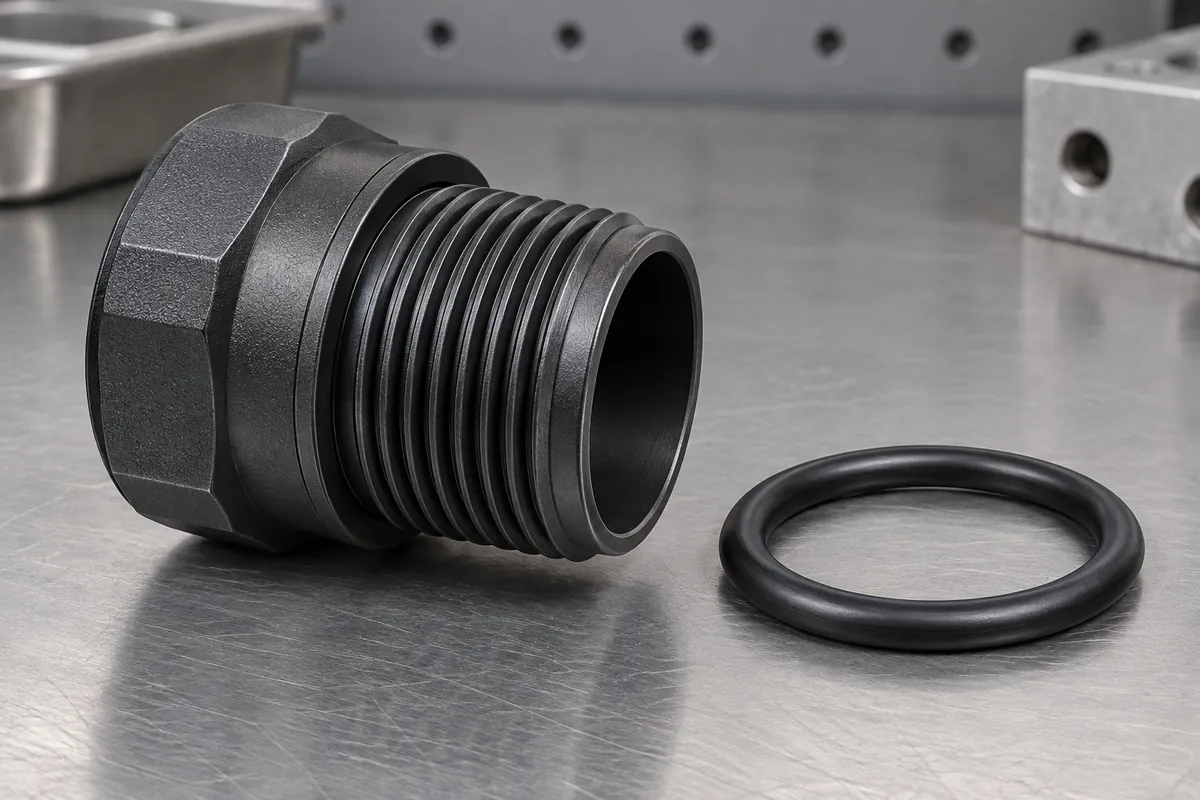
A thread may hold two sections together while an O-ring or gasket provides the fluid seal. These functions should be defined separately. Tightening the thread more aggressively is not a reliable substitute for correcting an unsuitable sealing groove, damaged elastomer or inconsistent seating face.
Identify whether any port connection seals on a face, a separate sealing element or a specified thread form. Similar-looking threads can have different purposes. The drawing and assembly specification should name the interface and its sealing mechanism rather than relying on a generic threaded-port description.
For the seal itself, the Parker O-Ring Handbook provides relevant design background. It does not replace a project-specific review of the molded closure, compound and operating conditions.
Treat welding as a controlled manufacturing operation
A welded design needs a compatible material combination, joint geometry and locating method. The two molded sections must arrive at the joining station in a condition that supports a repeatable process. A clean external seam is not enough to demonstrate a sound internal joint.
Define the permitted weld region and any flash or particle restrictions. Internal joining debris can be important in a fluid system even when it does not affect the external dimensions. If a joint closes off inspection access, decide which checks occur before assembly and how the parts remain traceable.
Record the approved joining method and relevant process controls. Changing between ultrasonic, thermal or another joining route is not merely a supplier preference when it changes the assembly configuration or evidence. Compare proposals against the same functional and cleanliness requirements.
Compare maintenance and failure consequences
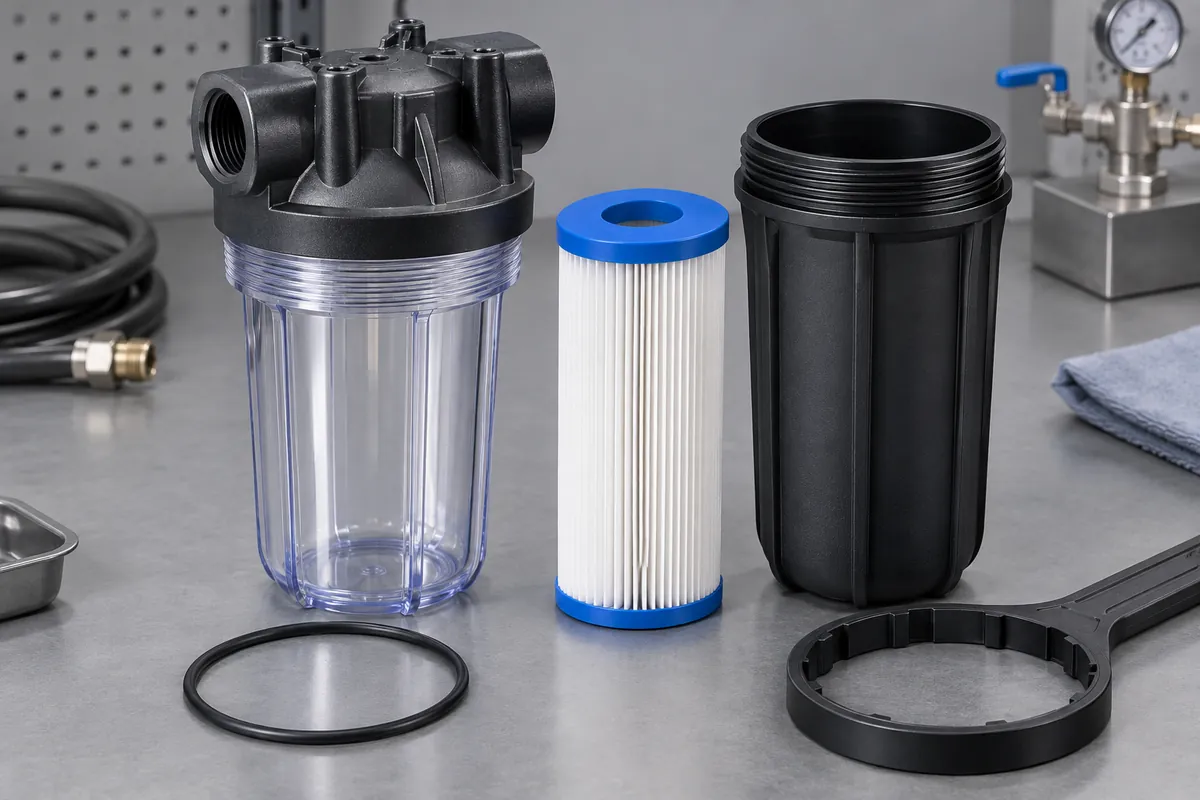
A reusable thread can be damaged by cross-threading, contamination or excessive tightening. Review the actual access available to a maintenance operator and whether the closure can be assembled incorrectly. Locating features and clear engagement may reduce errors more effectively than adding an arbitrary torque instruction.
A welded housing removes normal reopening but may make cartridge replacement or internal investigation impossible without destruction. That can be acceptable for a defined disposable assembly. It should be an explicit service decision rather than a late consequence of simplifying the molding design.
Consider how the housing is isolated and made safe before maintenance. The product and system teams should define the appropriate procedure for the application. Do not infer that an accessible thread makes a pressurized assembly safe to open or that a welded joint eliminates pressure-related hazards.
A closure decision also affects what happens after a rejected assembly. A threaded design may permit inspection and replacement of a seal, whereas a permanent joint may require the unit to be scrapped. Account for that development and service consequence without assuming that rework is always permitted for the intended application.
Validate the complete route
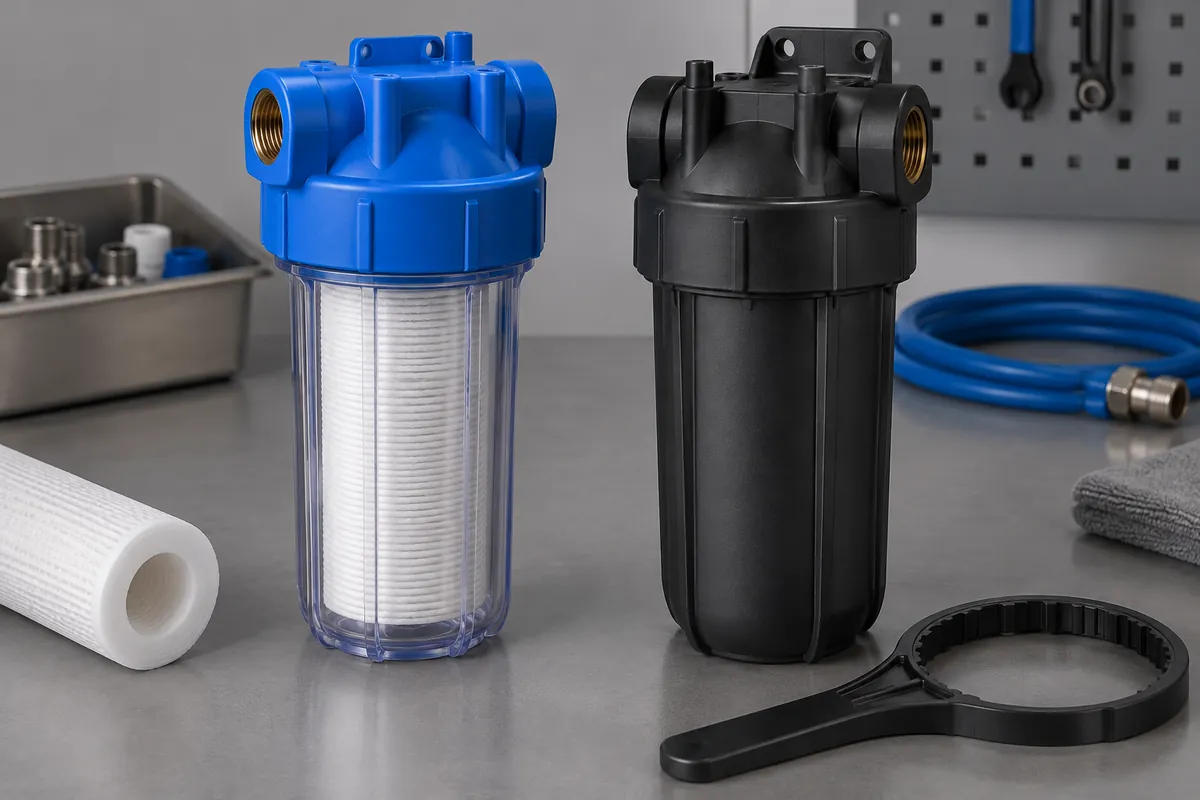
Test representative finished assemblies with the actual seals, cartridges and ports. Include relevant pressure cycling and environmental conditioning, not only an initial leak check. For a reusable closure, evaluate the agreed number of service operations with the intended assembly method.
Keep cartridge fit and bypass control in the review. A housing can be externally leak-free while allowing fluid to bypass the filtration element internally. The closure choice must preserve both external containment and the intended internal flow path.
Quote molding, joining or closure assembly, inspection and approval as a complete scope. This makes the trade-off between a serviceable and permanent construction visible without claiming one method is inherently cheaper, safer or more reliable for every filter application.
Discuss the component and its acceptance requirements
Explore our custom plastic filter housings and the related project case study. Send the current drawing, mating-part details, operating conditions and required quantities. We can review tooling, molding and inspection as a defined supply scope, with development samples and production approval kept separate.