
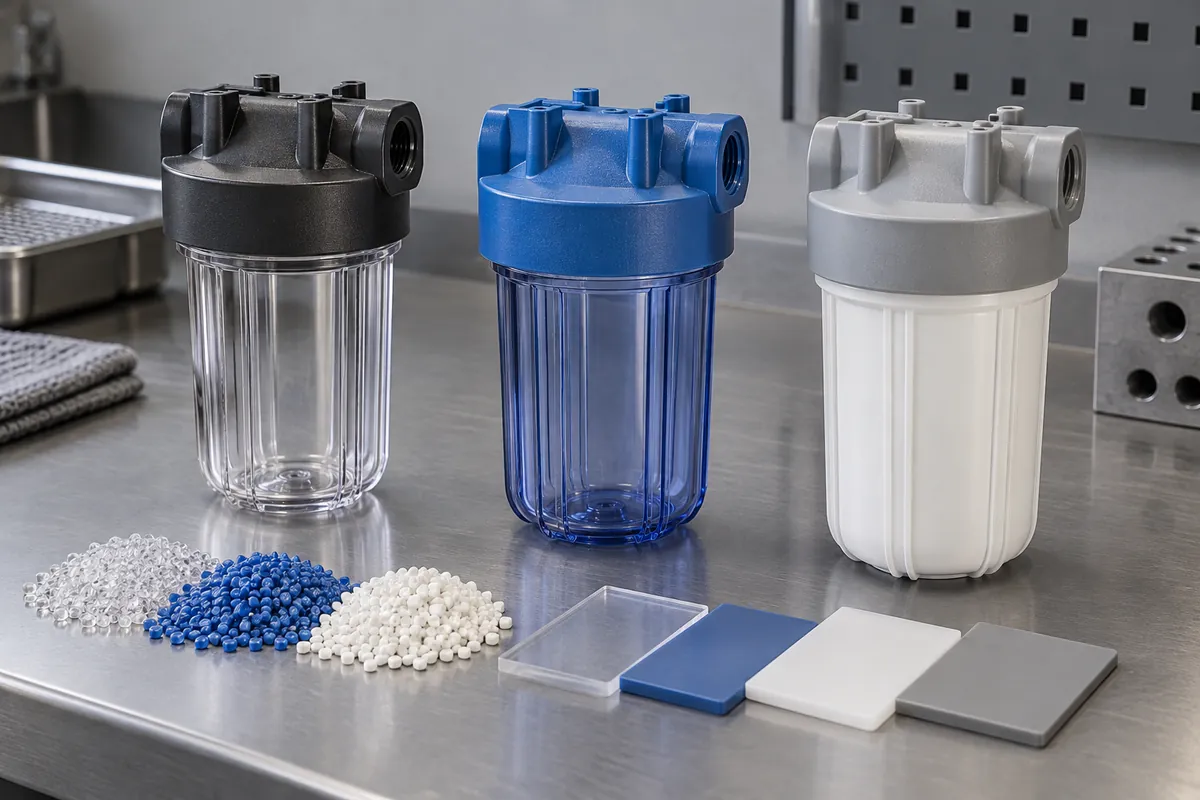
Product design illustrations. Final geometry, materials and acceptance criteria are project-specific.
A filter housing contains fluid, supports a cartridge and maintains several sealing interfaces. Choosing its polymer from a chemical-resistance label alone ignores how the housing is loaded and assembled. A suitable resin must work with the wall geometry, closure, ports and expected exposure throughout the intended service conditions.
Define the fluid completely, including concentration, contaminants and cleaning chemicals. Record temperature, normal pressure, transients, vacuum where relevant and maintenance frequency. A material comparison made before these conditions are known can rank candidates without answering whether any of them suit the actual system.
Start with exact grades rather than family names
PP can be a candidate for many molded fluid-handling components, but the family name does not establish a pressure rating or a contact approval. The grade, colorants, geometry and assembly require review together. Reinforcement or other additives can also change the properties and documentation relevant to the housing.
PA candidates need consideration of their conditioning and exposure behavior. Dimensions and mechanical response can depend on the specific grade and moisture condition. A threaded closure or cartridge seat should not be approved solely from a dry sample if its operating state will be different.
PVDF may be considered where its particular properties address a requirement, but it is not universally compatible with every chemical mixture. Arkema's chemical-resistance guidance explicitly treats exposure and operating conditions as part of the evaluation.
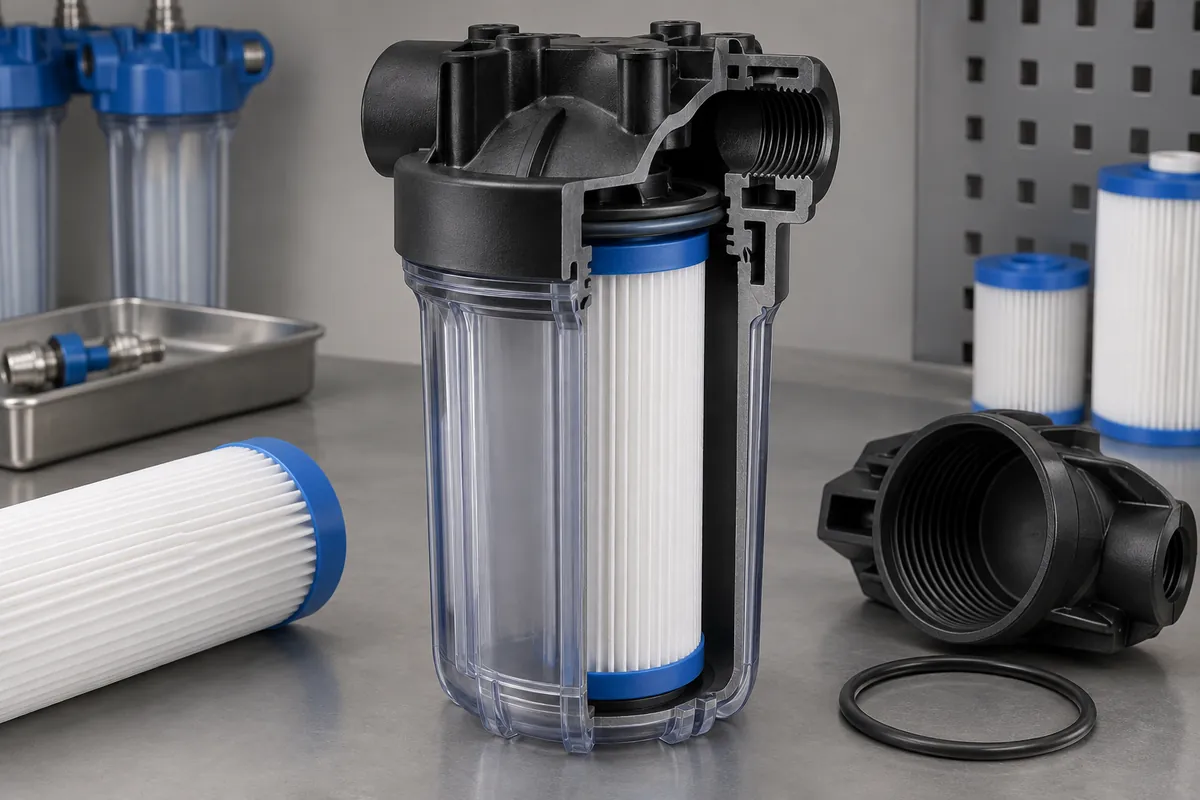
Connect material behavior to the structure
Pressure loads the housing and closure continuously or cyclically depending on the system. Local features such as a port boss or thread root can create a more demanding region than the nominal cylindrical wall. Review these areas rather than assuming a thicker overall wall resolves every structural concern.
Time under load matters for polymer assemblies. A short pressure test and a sustained operating requirement are different evaluations. The design team should define the relevant duration and temperature rather than extending a brief room-temperature result into an unlimited service statement.
Consider the sealing material at the same time. A compatible housing with an unsuitable O-ring is not a compatible assembly. Record the elastomer grade, lubricant and any adhesive or weld interface that contacts the fluid or influences the seal.
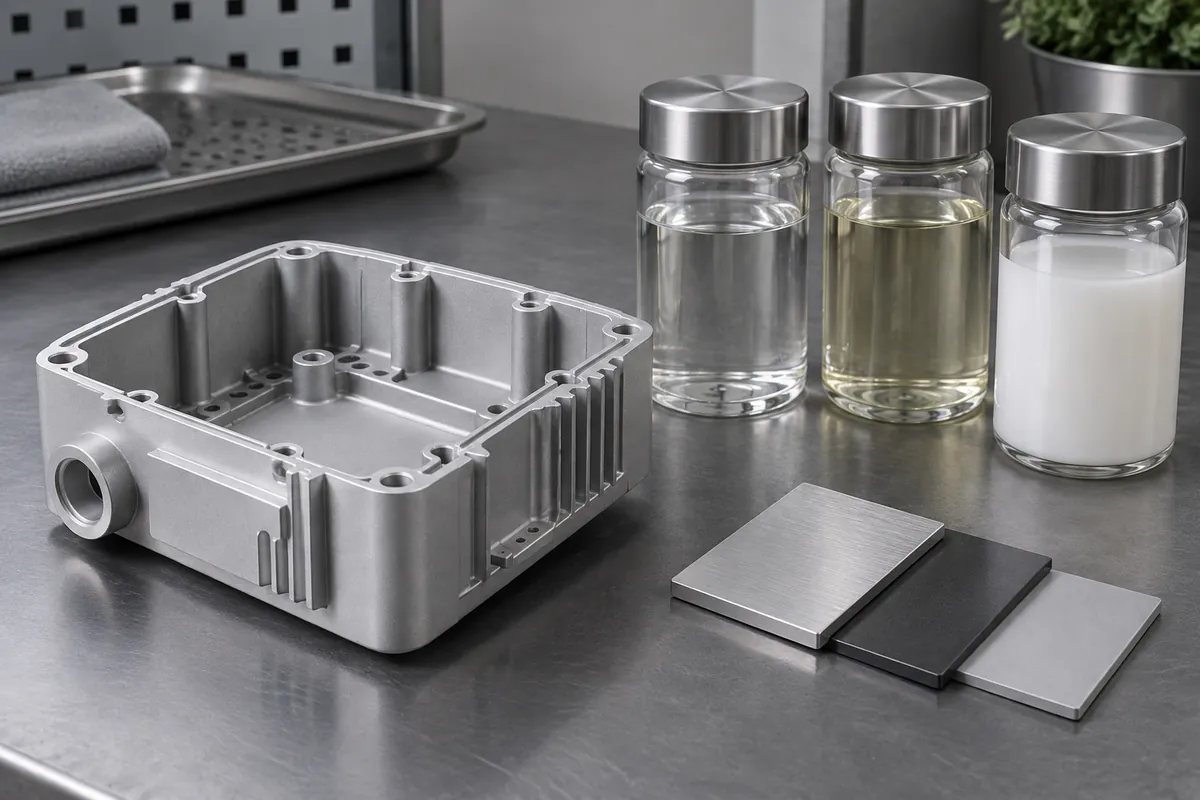
Evaluate manufacture and maintenance together
A candidate that suits the fluid still needs a feasible molding and assembly route. Review shrinkage, gate location, wall transitions and any joining method with the supplier. A change of resin can alter the closure fit or sealing groove even when the nominal CAD remains unchanged.
If the housing is opened for cartridge replacement, include repeated closure operation and the intended assembly method. Tool marks, cross-threading or an excessive tightening force can damage the interface. The material review should consider the practical maintenance process rather than an ideal one-time assembly.
For a permanently joined housing, define the joint evaluation and whether internal surfaces remain inspectable. Material suitability and joint suitability are separate questions. A leak-free sample does not by itself establish the pressure endurance or cleaning compatibility of the joined construction.
Consider a housing that is normally cool but periodically cleaned with a warmer solution. The cleaning step may govern material and seal selection even though it occupies little of the operating time. Include that sequence in the quotation and validation plan rather than specifying only the most common process temperature.
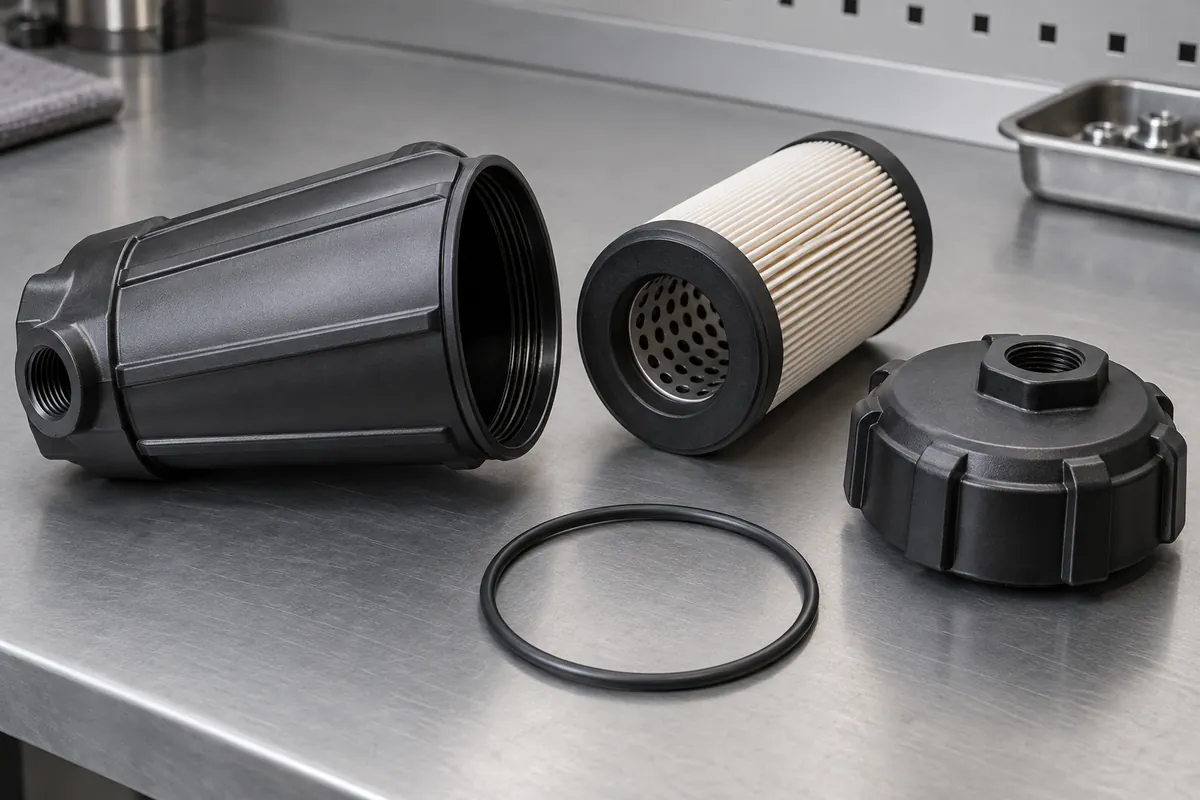
Make the approval statement match the evidence
Separate material declarations, housing pressure tests and complete filtration performance. A resin declaration does not certify the assembled filter, and a housing leak test does not establish contaminant removal. Each claim needs evidence covering the relevant delivered configuration and intended use.
Plan leak, proof and burst evaluations as distinct activities where required. Compare suppliers using the same tests and documentation scope so a nominally lower part price is not hiding unfinished qualification work.
Release the approved grade and operating boundary with the drawing. Any change to the fluid, cleaning process, seal or resin source should be assessed against that baseline. This produces a usable purchasing specification instead of an unsupported claim that a polymer is suitable for all filtration systems.
Discuss the component and its acceptance requirements
Explore our custom plastic filter housings and the related project case study. Send the current drawing, mating-part details, operating conditions and required quantities. We can review tooling, molding and inspection as a defined supply scope, with development samples and production approval kept separate.