
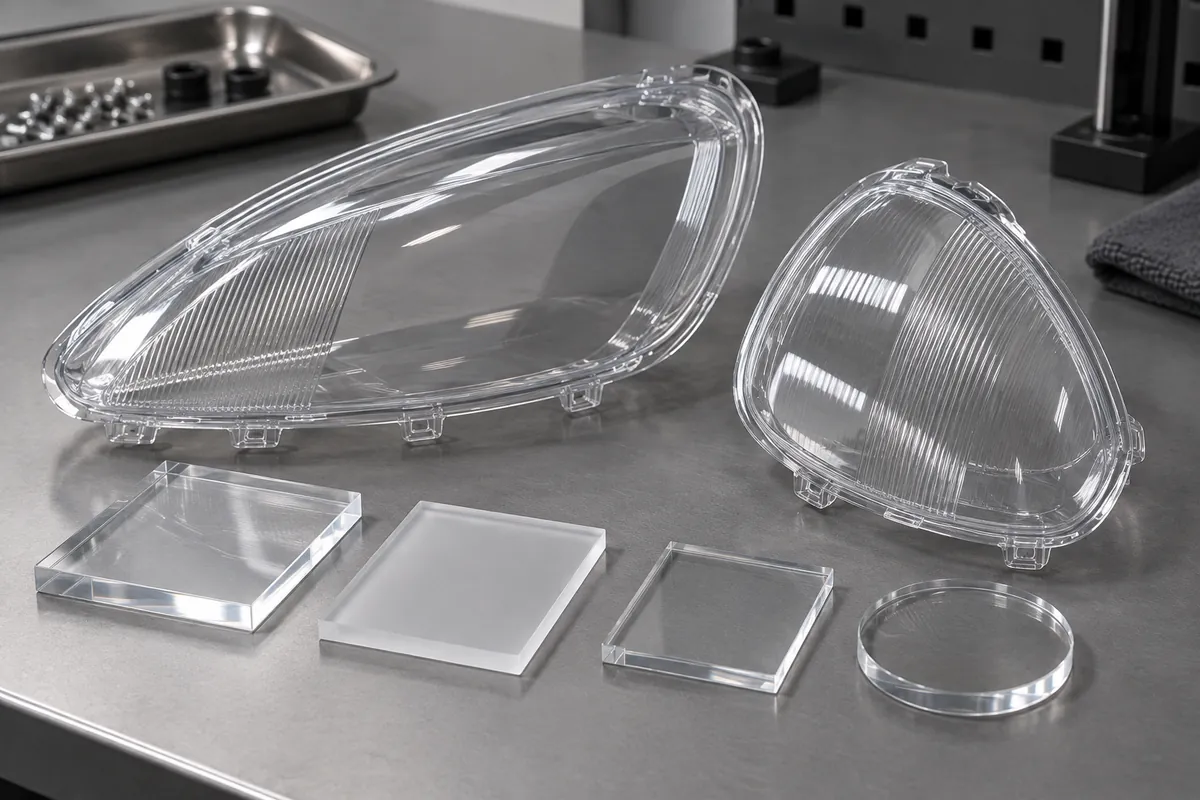
Product design illustrations. Final geometry, materials and acceptance criteria are project-specific.
PMMA and polycarbonate can both produce transparent molded parts, but transparency is only the beginning of an optical-material decision. A lens must transmit or shape light while surviving its assembly and operating environment. The correct choice depends on which optical and mechanical requirements the finished component actually has to meet.
Start by distinguishing an imaging lens, an illumination optic and a protective window. Their priorities can differ substantially. A material comparison should identify the clear aperture, wavelength range, temperature, impact exposure and any coating before ranking candidates by a generic property table.
Use grade data in its stated context
PLEXIGLAS 8N information describes a specific PMMA molding compound. Its published properties belong to the stated material and test conditions; they are not automatically measured values for a lens of a different thickness, surface shape or molding history.
For polycarbonate, choose a grade intended for the required optical and environmental duty. Impact behavior, heat exposure and processing characteristics should be checked against exact supplier data. The word polycarbonate does not establish that every grade is interchangeable in a lighting or imaging application.
Separate typical material values from drawing acceptance limits. A datasheet can support screening and simulation inputs, while the finished component needs its own measurement method and tolerance. Do not copy a typical transmission number into a guaranteed lens specification without a defined optical path and test arrangement.
Review molding and assembly stress
Transparent polymers can show optical effects associated with stress and processing history. Gate location, section changes and cooling deserve attention where the application is sensitive to those effects. A visually clear part can still require a more specific evaluation than ordinary cosmetic inspection.
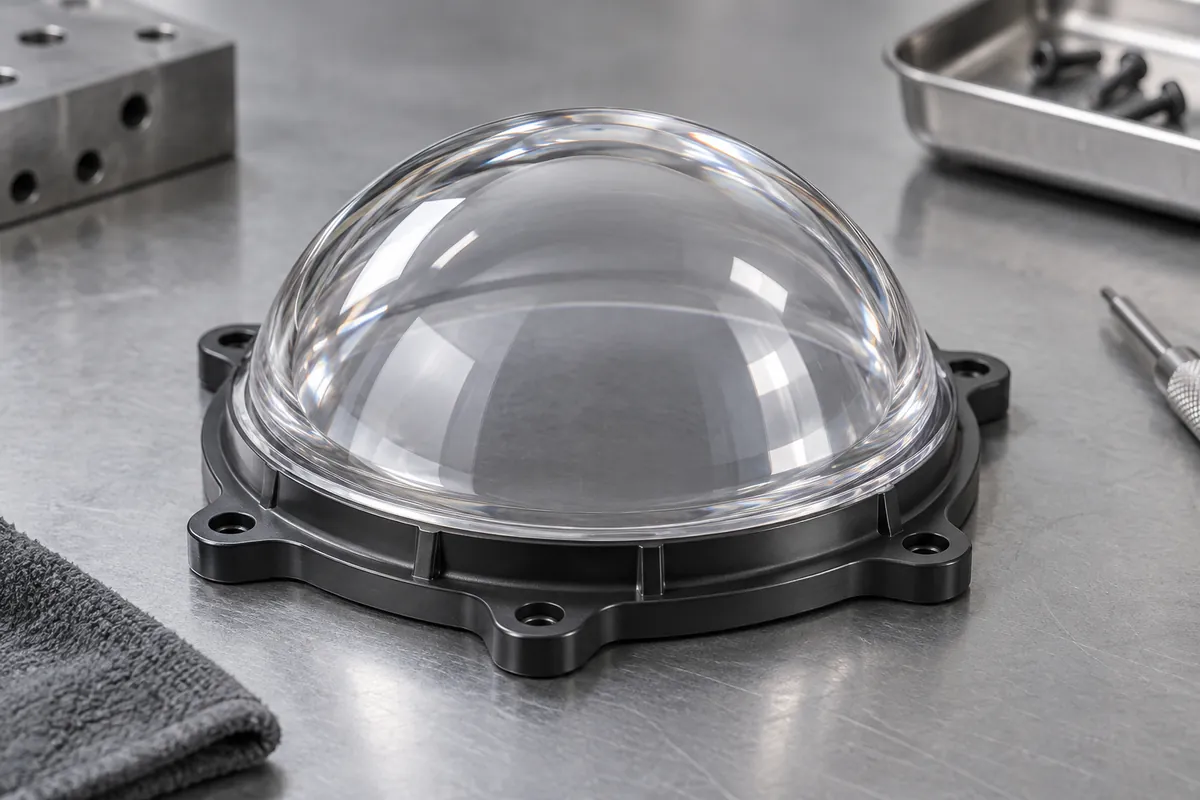
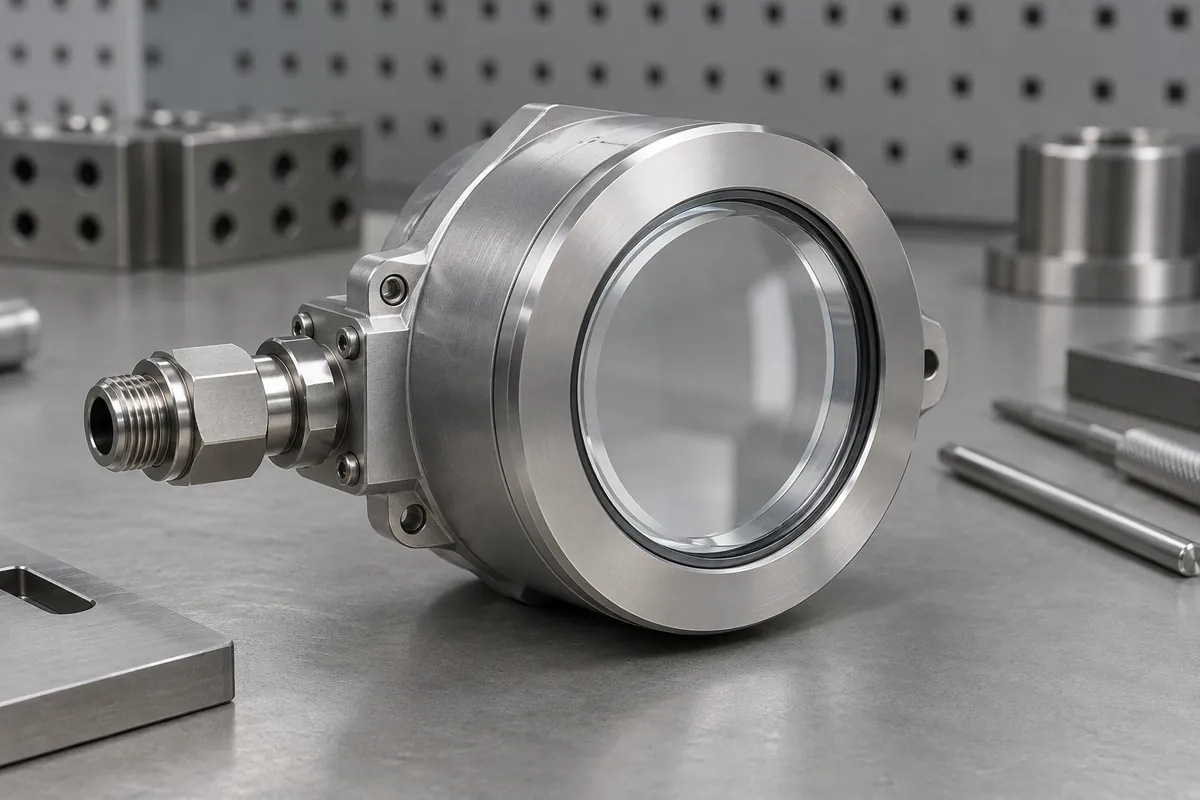
Assembly can add stress after molding. Clamps, press fits, adhesives and thermal mismatch may change the optical or mechanical condition. Review the mounted lens rather than assuming a good free-state sample will remain equivalent when constrained in a housing.
Covestro's guidance on molded-in stress in lenses provides relevant polycarbonate context. Use it to frame the process review, not to assign a universal stress limit to every optical part.
Include the environment and surface treatment
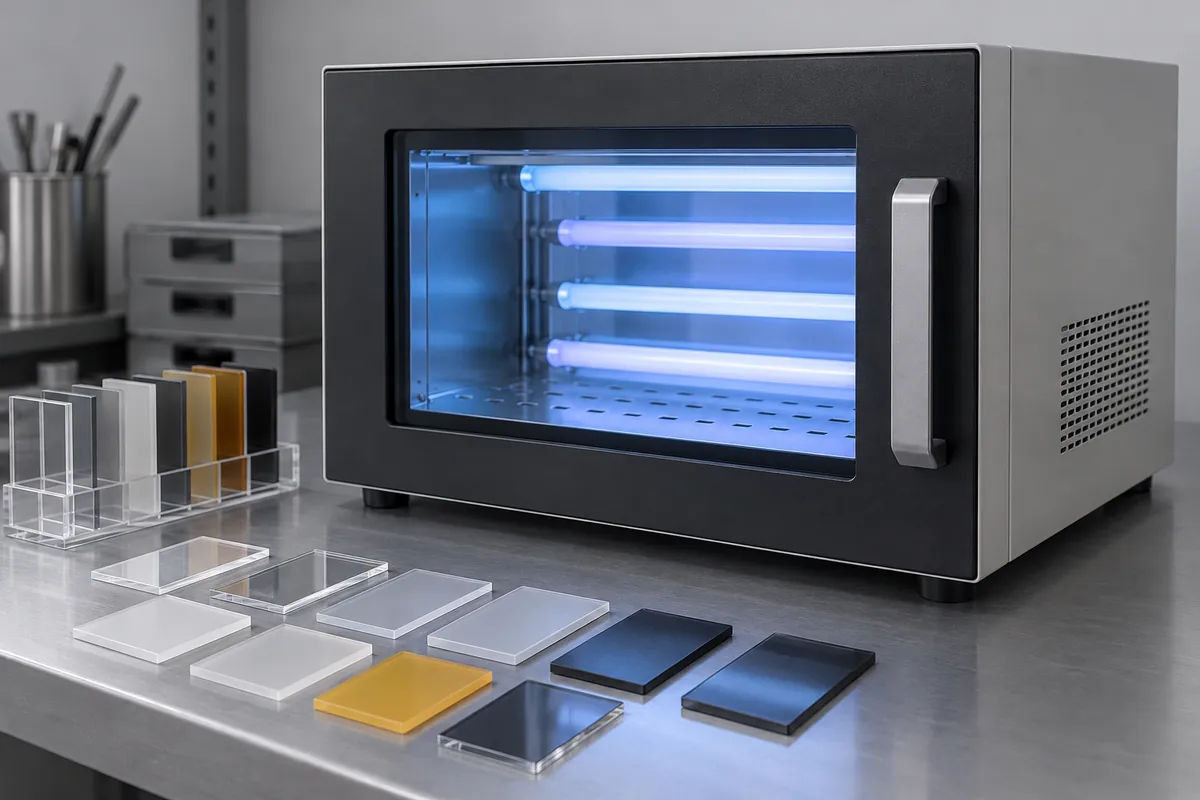
Cleaning chemicals, abrasion, outdoor exposure and operating temperature can drive the selection as strongly as initial optical properties. State the actual exposure sequence and required remaining function. A generic weather-resistant or chemical-resistant label is too broad to replace a grade-specific application review.
If a coating is needed, confirm compatibility with the resin, geometry and process. The coated component becomes the delivered configuration and may require different handling or testing. A coating that improves one surface property does not automatically establish every other optical or environmental requirement.
Evaluate packaging and handling as part of the supply route. A suitable molded lens can become unacceptable through contact damage before assembly. Specify which surfaces must remain untouched and how the parts will be separated, cleaned and inspected at receipt.
Consider the optical design again if a resin substitution changes refractive behavior. Keeping the same molded surface geometry does not necessarily preserve the same focal or illumination result. A replacement material may require a design adjustment and another system test even when its transparency and mechanical fit appear acceptable in an initial sample.
Validate the function that justifies the choice
Use separate methods for dimensions, surface appearance and optical performance. These outcomes are related but not equivalent. Passing an outside-diameter check does not establish focal behavior, and a favorable transmission result does not prove the absence of image distortion or unacceptable scatter.
Review haze and transmission with the intended detector geometry and wavelength conditions. If the lens is part of a lighting assembly, identify the source and alignment used for system testing rather than treating the lens as an independent emitter.
Release the chosen grade, process, surface treatment and assembly boundary together. Future substitutions should be reviewed against that complete baseline. The objective is a qualified optical component, not a universal conclusion that PMMA or polycarbonate is always the better transparent plastic.
Discuss the component and its acceptance requirements
Explore our custom plastic optics and the related project case study. Send the current drawing, mating-part details, operating conditions and required quantities. We can review tooling, molding and inspection as a defined supply scope, with development samples and production approval kept separate.