
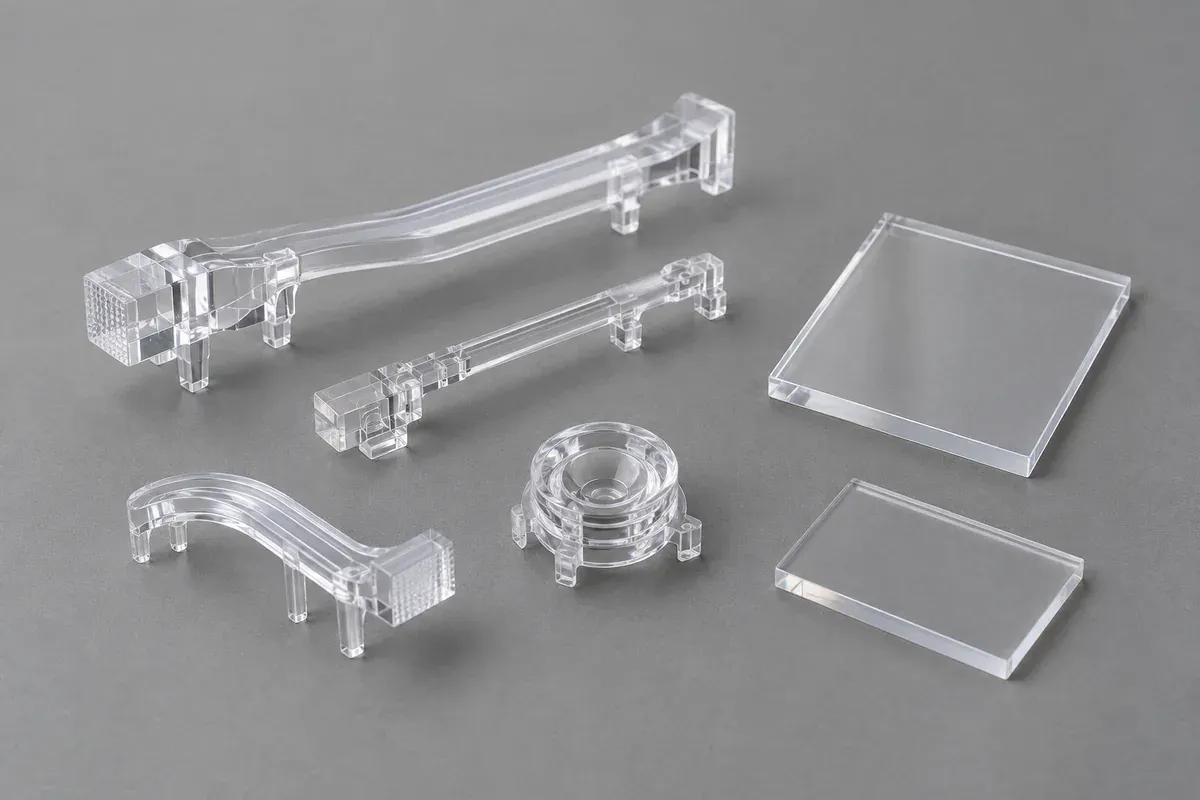
Two clear light pipes can look almost identical in an unlit sample tray while behaving differently in the assembled product. Their material grade, optical path, molded surface and operating environment all matter. Choosing between PMMA and polycarbonate by visual clarity alone leaves most of that decision unresolved.
Compare exact optical grades in the intended component, not two resin-family names in isolation. PMMA and PC are both candidates for molded light guides. The right selection depends on the optical task and the mechanical, thermal and exposure requirements attached to it. This article addresses that application; our broader PC versus acrylic comparison covers the general material background.
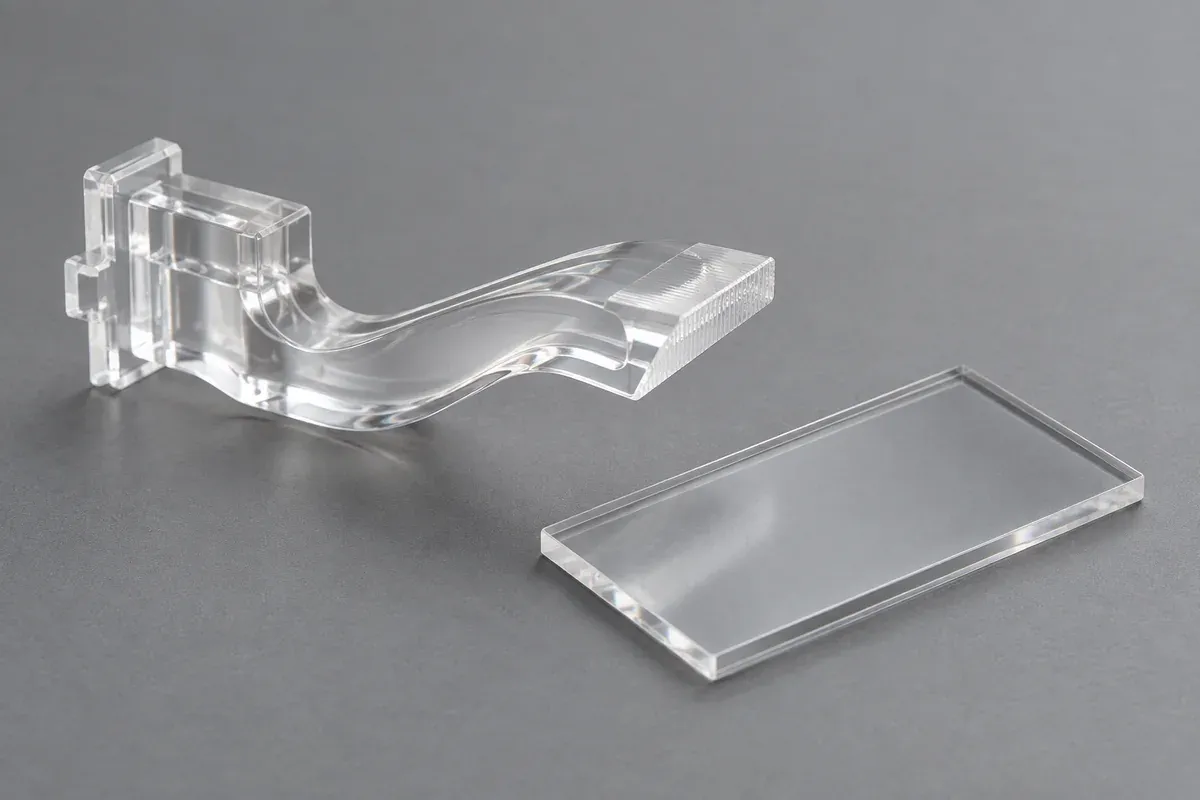
Product design illustrations. Final geometry, materials and acceptance criteria are project-specific.
Define what the material must do with the light
A status-indicator guide transports light to a defined exit. A diffuser deliberately redistributes it. Those functions can coexist in a designed part, but a highly diffusing grade should not be substituted for a clear guiding grade simply because both are sold for lighting. Specify where light should travel and where it should leave the component.
Röhm's lighting-material overview distinguishes light-guiding and light-scattering PMMA molding compounds. That is a useful reason to request the actual grade designation. A product-family brochure establishes available options; it does not demonstrate the output of your molded geometry.
Review the LED wavelengths, guide length, cross-section, transitions and surface treatment together. A transmission value from a thin plaque does not directly specify the brightness at a long or bent indicator exit. Use comparable test conditions when screening datasheets, and reserve assembled optical acceptance for representative components.
Identify where heat reaches the part
The relevant temperature is not necessarily the room temperature or the headline rating of the LED. Consider nearby components, enclosure heat buildup and the duration of operation. Also identify assembly exposures such as joining, cleaning or another process that occurs before the component reaches the customer.
Do not treat a heat-deflection value as a universal continuous-use temperature. The datasheet method, specimen, loading and the product's actual function need interpretation. A guide can remain intact yet move enough at its mounting interface to alter coupling. The acceptable condition must include function and fit, not merely absence of visible melting.
Covestro describes optical PC grades for LED lighting applications, including light guides. That supports considering suitable PC formulations, not approving every polycarbonate grade. Obtain the current grade documentation and agree the exposures to be evaluated before changing material.
| Requirement | Ask for | Avoid assuming |
|---|---|---|
| Light transport | Grade, wavelength-relevant data, specimen details and intended optical path. | A plaque transmission value equals assembled indicator brightness. |
| Heat exposure | Temperature profile, duration, part restraint and required function afterward. | A single thermal property is a finished-part operating guarantee. |
| Mechanical fit | Mounting loads, retention geometry and expected handling. | Changing resin leaves the mounting fit and mold shrinkage unchanged. |
| Cleaning and weather | Actual agents, application method, UV exposure and acceptance conditions. | All grades in a family share the same exposure resistance. |
Connect toughness to the real mounting load
A toughness advantage is useful only when it addresses a real failure mode. Consider installation force, accidental contact, panel flex and the shape of retaining features. A material comparison cannot rescue a mounting detail that imposes excessive strain or uses the optical stem as a lever.
Conversely, do not discard a candidate solely because another family has a more favorable generic impact reputation. A protected indicator with modest assembly loads may have a different priority from an exposed, repeatedly handled control. Review the exact geometry and duty with the material data instead of ranking all applications by one property.
Test the cleaning and outdoor conditions you intend to claim
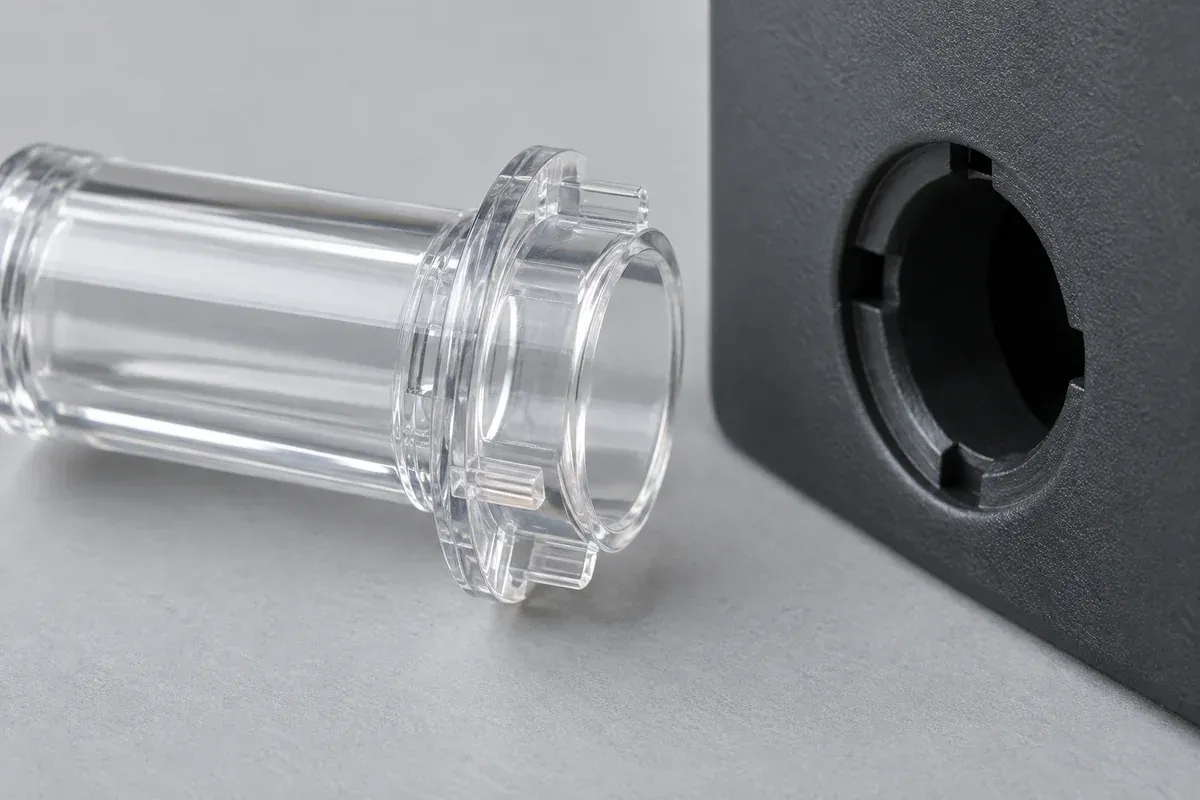
Specify the cleaning agent, concentration, contact time, wiping method and frequency relevant to the product. Include the assembled stress state when it can affect the outcome. A loose, unstressed sample immersed briefly in one liquid does not reproduce every cleaning operation on a tightly retained guide.
For outdoor exposure, request grade-specific information and define the required evaluation of color, clarity, appearance and function. Avoid turning a brand-level weathering statement into an unlimited service-life claim. Pigments, additives, part thickness and the actual optical path can change what the user sees.
Treat a resin change as a configuration change
Changing from PMMA to PC, or between grades of either family, can affect tooling and processing decisions as well as optics. Review filling, shrinkage, gate behavior, demolding and the critical mating features. Do not release a substitution with only a purchasing-line edit while leaving the approved sample definition unchanged.
Use the agreed molding and handling process for the comparison. Drying, contamination and surface damage can complicate interpretation. A scratched guide and an undamaged guide do not provide a clean material comparison even if their dimensions match.
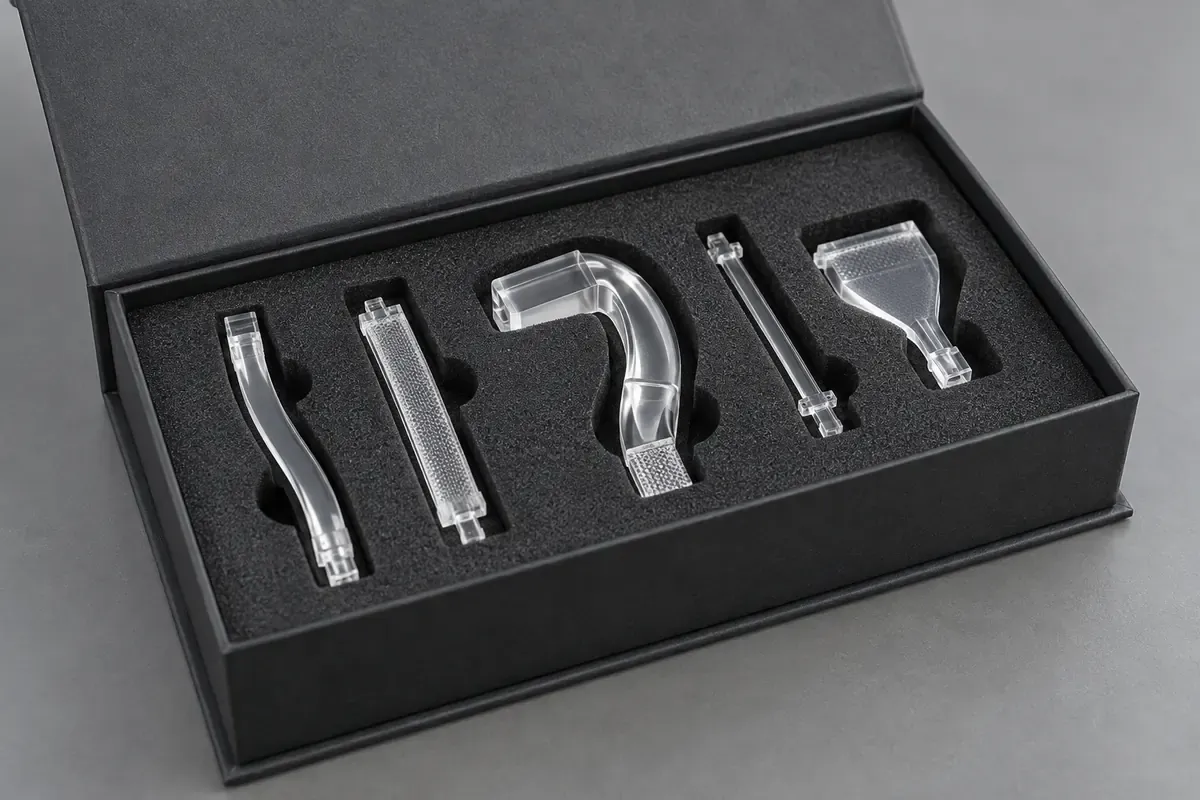
The final choice should connect the grade, drawing, molding process and acceptance evidence. Record which requirements each candidate meets, which remain open and what would trigger another review. Use our light-pipe sample acceptance guide to translate that decision into a reproducible evaluation. A controlled comparison is more useful than a universal declaration that one clear polymer is always better.
Turn the review into a defined molding scope
Explore our custom injection-molded LED light pipes and the related illustrative engineering study. Send the drawing revision, counterpart details, intended use and the decisions still open. Development samples and production approval should have separate, agreed deliverables.