
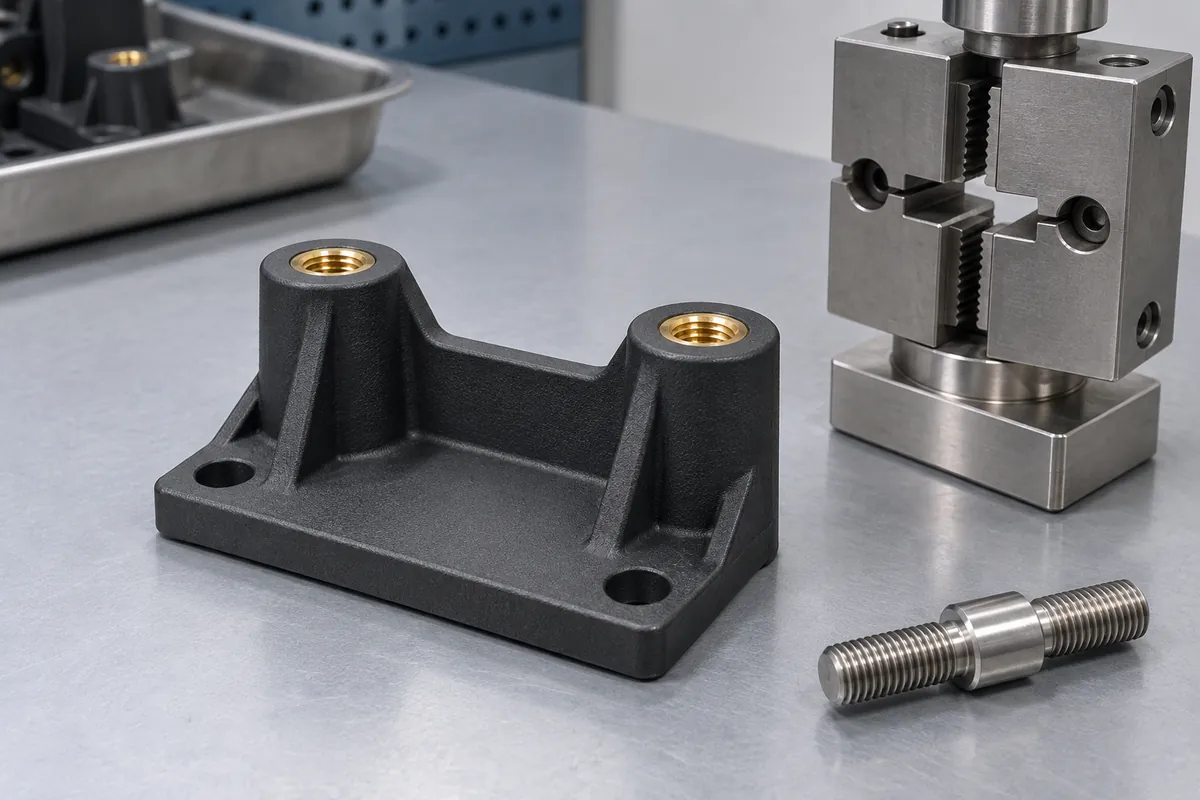
“The insert passed a pull test” sounds reassuring until the report leaves out how the bracket was supported, which direction it was loaded and what counted as failure. A high peak force can belong to a test that does not represent the product's use. A lower value may describe a more demanding fixture or a different failure definition.
A useful test specification describes the question before it asks for a number. For a threaded-insert bracket, insert rotation, axial extraction and ordinary screw tightening are different questions. This article builds an RFQ-ready test plan; it does not provide universal acceptance loads or repeat the geometric rules in a general insert-molding design guide.
All images in this article are newly AI-generated illustrations of engineering concepts, not photographs of a customer project or evidence of completed testing.
Separate Tightening, Torque-Out and Pull-Out
Assembly tightening applies a specified procedure to the screw and joint. A rotational retention test investigates when the insert moves or another defined failure occurs under torque. An axial test investigates resistance in a defined pull direction. The measured quantities and boundary conditions should remain distinct in the report.
SPIROL's performance-testing paper distinguishes tensile and rotational evaluations and stresses application-specific testing. Use manufacturer data to understand a candidate insert, then define the test for your actual geometry. Do not convert a catalog torque-out result directly into an approved screw-tightening setting.
For example, a conceptual mounting bracket may need an assembly check with its mating plate and a separate destructive retention check. The first asks whether the intended assembly operation damages or moves the insert. The second explores the failure boundary of identified samples. A development limit becomes an acceptance requirement only when the responsible engineering owner approves it.
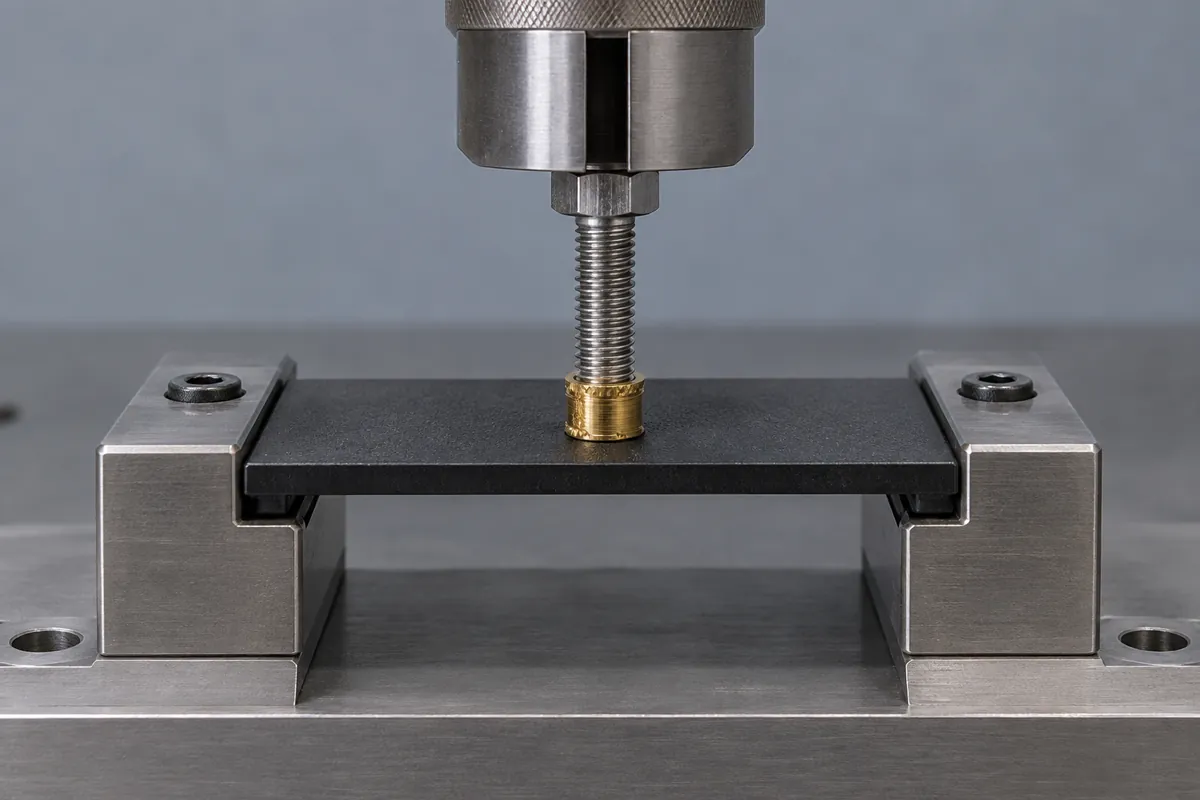
The Fixture Is Part of the Test Definition
Show the support surfaces on a sketch or photograph of the proposed fixture. A support placed immediately around a boss asks a different question from a bracket held only at its mounting feet. Decide whether the purpose is to characterize local insert retention or the complete bracket under its use conditions. Record the choice so a later supplier does not unknowingly change it.
Specify how the loading screw or stud engages the insert and how alignment is established. The method owner should check that the loading hardware and fixture can carry the planned test without creating an unintended failure. If the fixture contacts the insert directly or restrains a feature that would be free in service, document why that arrangement is appropriate.
This is also where to state machine settings, measurement units and calibration requirements. “Pull until failure” is incomplete if the teams have not agreed whether failure means first visible movement, a displacement threshold, a crack or complete extraction. Record the full observation needed for the decision, rather than retaining only the largest number on the screen.
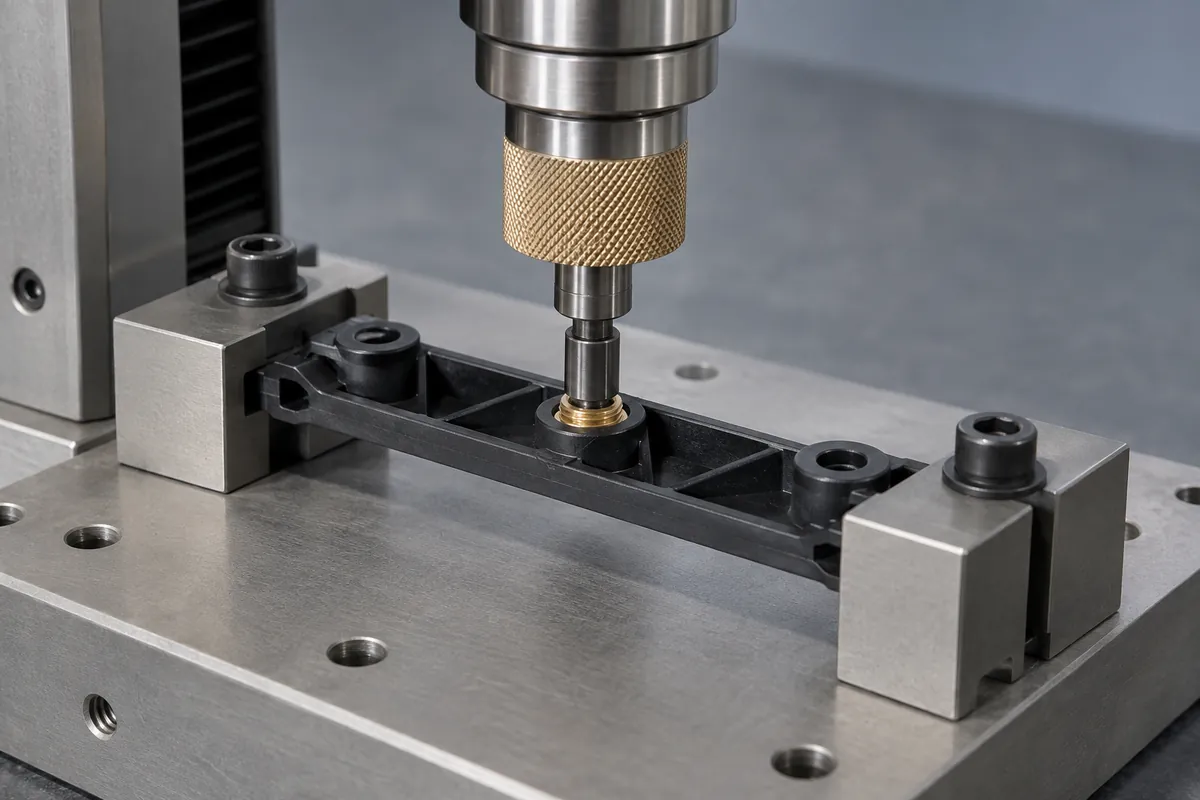
A Blank Plan to Complete Before Samples Are Made
Copy the worksheet into the RFQ and assign each unanswered field to an owner. The table is deliberately blank: filling it with plausible-looking forces or cycle counts would make the quotation less trustworthy, not more complete. If acceptance criteria are still under development, label the scope comparative testing.
| Field | Project input | Record to retain |
|---|---|---|
| Specimen and exposure | Drawing, resin, insert lot, conditioning, sample allocation: ____ | Individual specimen IDs and as-tested condition. |
| Method and support | Load axis, engagement, fixture, settings, units: ____ | Setup revision, calibration references and deviations. |
| Acceptance and evidence | Failure definition, limit, requirement source, approver: ____ | Individual readings, movement, failure location and images. |
Keep the Sample History Attached to the Result
Identify the exact resin grade, insert part number, drawing revision and manufacturing batch. Where more than one cavity or process condition is being assessed, preserve that grouping. An unexplained average across mixed configurations cannot establish whether the proposed production configuration meets its requirement.
Agree whether torque and pull-out tests use separate specimens. Applying one destructive test before another can change the specimen. If a sequential test is intentional, describe the sequence and what question it represents. Similarly, say whether conditioning takes place before assembly, after assembly or both; an unlabeled exposure step can make otherwise careful results impossible to compare.
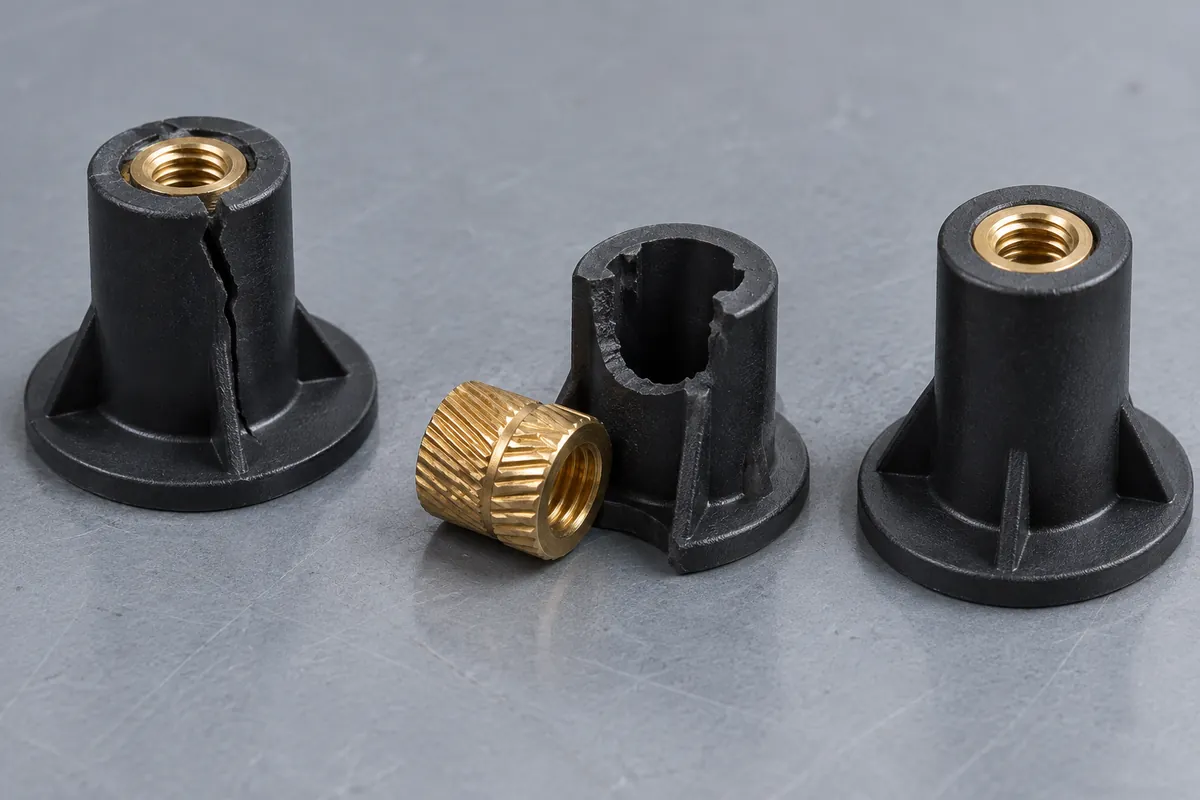
A Failure Record Should Explain What to Do Next
Record whether failure involved rotation, extraction, polymer cracking, thread damage or loading-hardware failure. A fixture problem may invalidate a test, but it must not silently disappear from the report. Retain the reason for exclusion and the approved replacement-test plan. A passing subset should not hide the specimens that were omitted.
Use the evidence to decide between further development, drawing changes, additional sampling or release. The threaded-insert bracket design study shows this sequence without inventing measured outcomes. For repeat assembly questions, add a separate repeated-fastening validation plan.
A quotation for injection-molded brackets should identify whether fixtures, testing and reports are included or separately scoped. Request a bracket quote with your retention-test requirements; send the applicable drawing and acceptance owner, not just a desired peak force.