
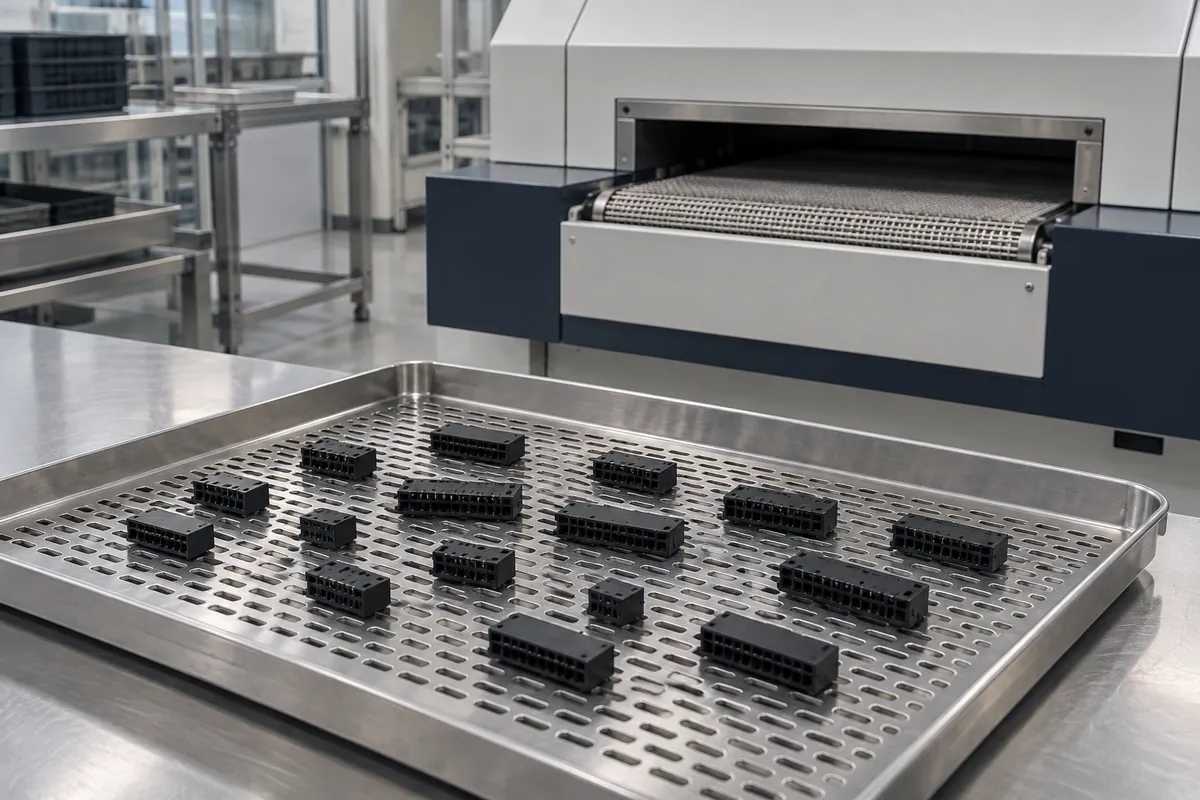
“Reflow resistant” is not a complete purchase requirement. It leaves open which profile is involved, how many passes occur, what the part contains during heating and what still needs to work after cooling. Two suppliers can reasonably interpret the phrase differently and submit samples that were evaluated under different conditions.
Specify reflow as an exposure sequence with an acceptance plan, not a single material temperature. For a molded connector body, the relevant outcome may include flatness, terminal alignment, retention or visible damage. Which of those matters depends on the assembly; none should be assumed from the resin family name alone.
Product design illustrations. Final geometry, materials and acceptance criteria are project-specific.
Confirm that the plastic actually enters reflow
Map the assembly sequence before requesting a high-temperature grade. Is the insulating body installed before soldering, afterward, or in a separate subassembly? Does it contain contacts during the process? Is it supported by a board, held in a fixture or free-standing? A requirement copied from a related connector can create unnecessary restrictions if the real part never experiences that step.
Record other thermal events separately. Preheating, drying, rework and service exposure can have different durations and mechanical constraints. Do not combine them into a vaguely larger “maximum temperature.” The owner of the electronics process should provide the applicable profile and identify permitted variations or repeated passes.
Use grade data to screen, then test the configuration
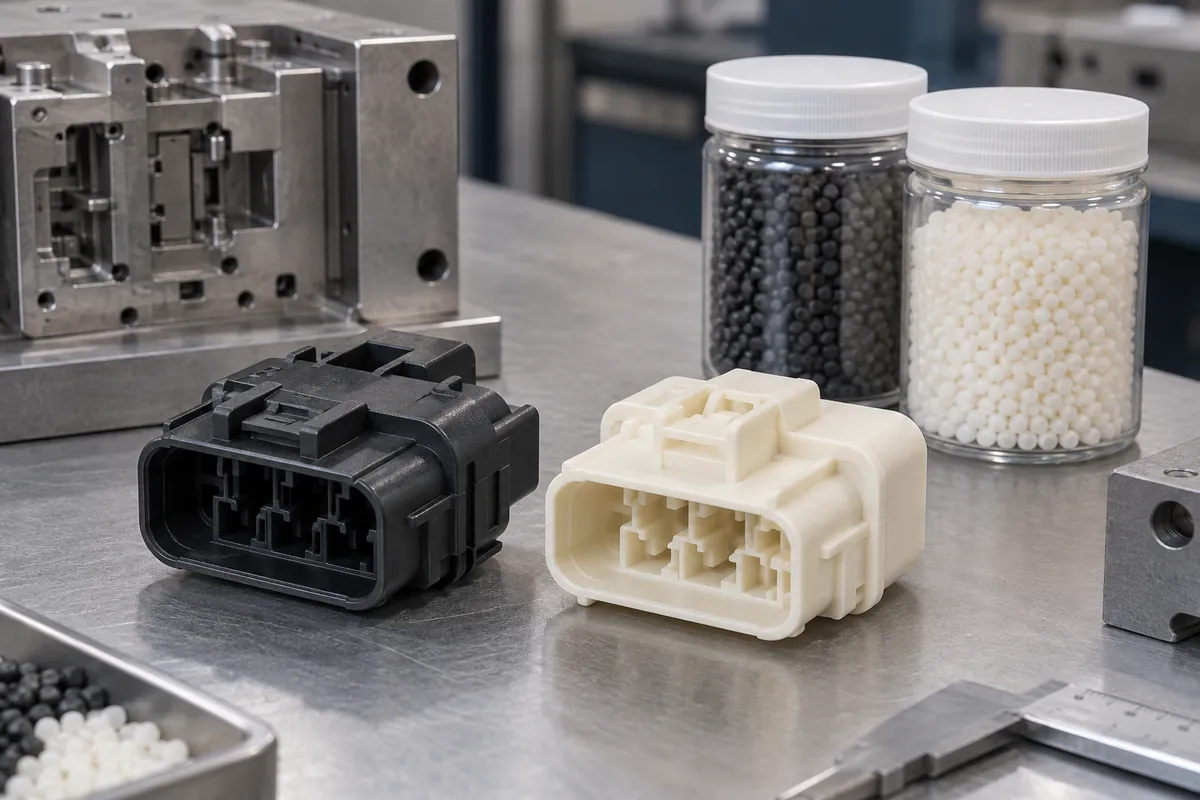
Celanese's mobile-device materials guidance identifies dimensional stability after reflow as a relevant property for selected LCP products. That is useful screening information, not proof that an arbitrary molded geometry will meet your assembly limits. Ask for the exact grade, reinforcement, color and relevant supplier guidance.
A heat-deflection value, melting point or continuous-use recommendation answers a different material question from a particular soldering profile. Do not use one of these values as a universal reflow acceptance temperature. If the available data does not cover the intended condition, mark the gap and agree a qualification route with the responsible engineering team.
Alternative grades should stay separately identified throughout molding and evaluation. The same nominal family can include different formulations, and a color or additive change may need review. A procurement substitution should not be accepted solely because the alternative's datasheet has a higher number in one thermal-property column.
Record the exposure experienced by the part
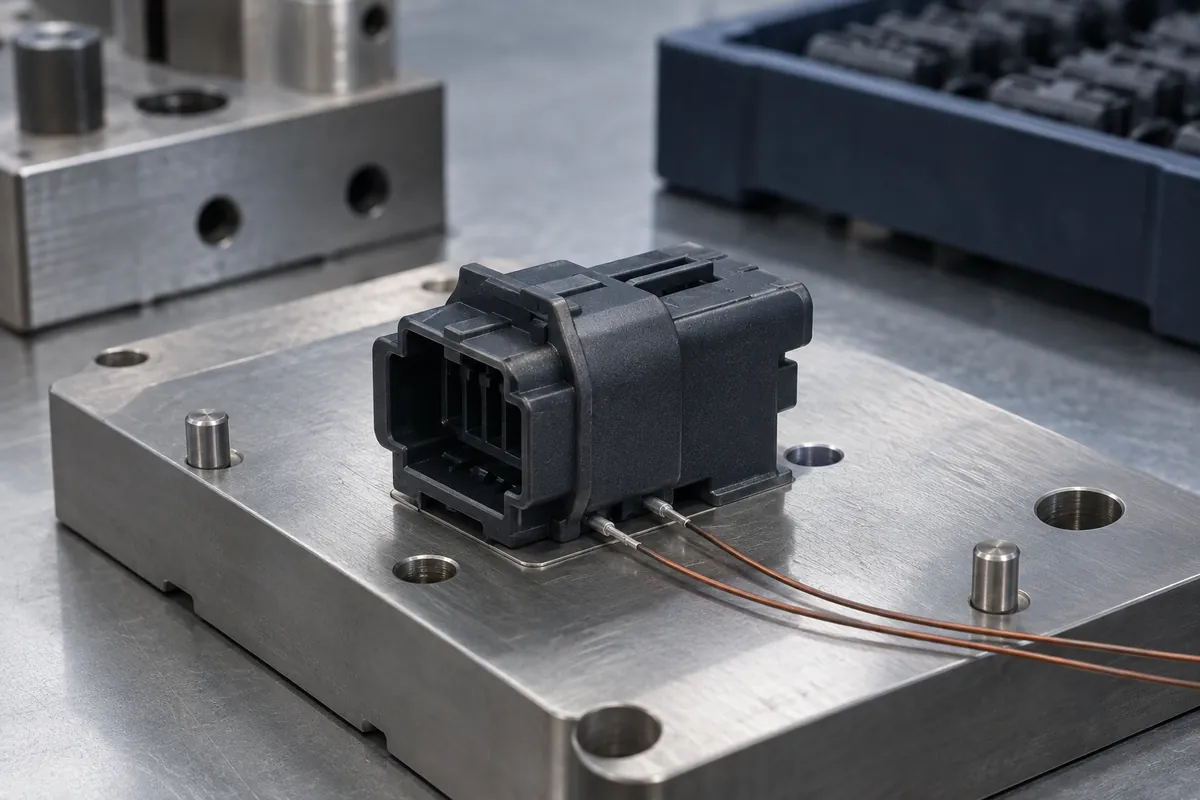
Specify the profile source, its revision, the measurement locations and how the actual run will be recorded. Oven settings alone are not a full history of the specimen. Part location, fixture arrangement and assembly mass should be controlled or documented so that the comparison has a clear meaning.
Also record the state before heating: storage history, packaging, drying or conditioning if required, and time out of the controlled environment. The purpose is not to invent a universal handling recipe. It is to avoid comparing one carefully prepared sample with another that has a different, undocumented history.
| Stage | Fields to agree | Evidence |
|---|---|---|
| Before exposure | Part, material and cavity IDs; assembly state; storage and conditioning. | Baseline dimensions, appearance and required functional observations. |
| During exposure | Profile revision; passes; support; measurement locations. | Actual run record linked to specimen IDs. |
| After exposure | Cooling or conditioning interval; inspection method; acceptance limits. | Individual before/after results and documented disposition. |
| Production transfer | Approved configuration; change triggers; responsible approver. | Controlled release record, not an unsupported family-wide claim. |
Look beyond visible melting or discoloration
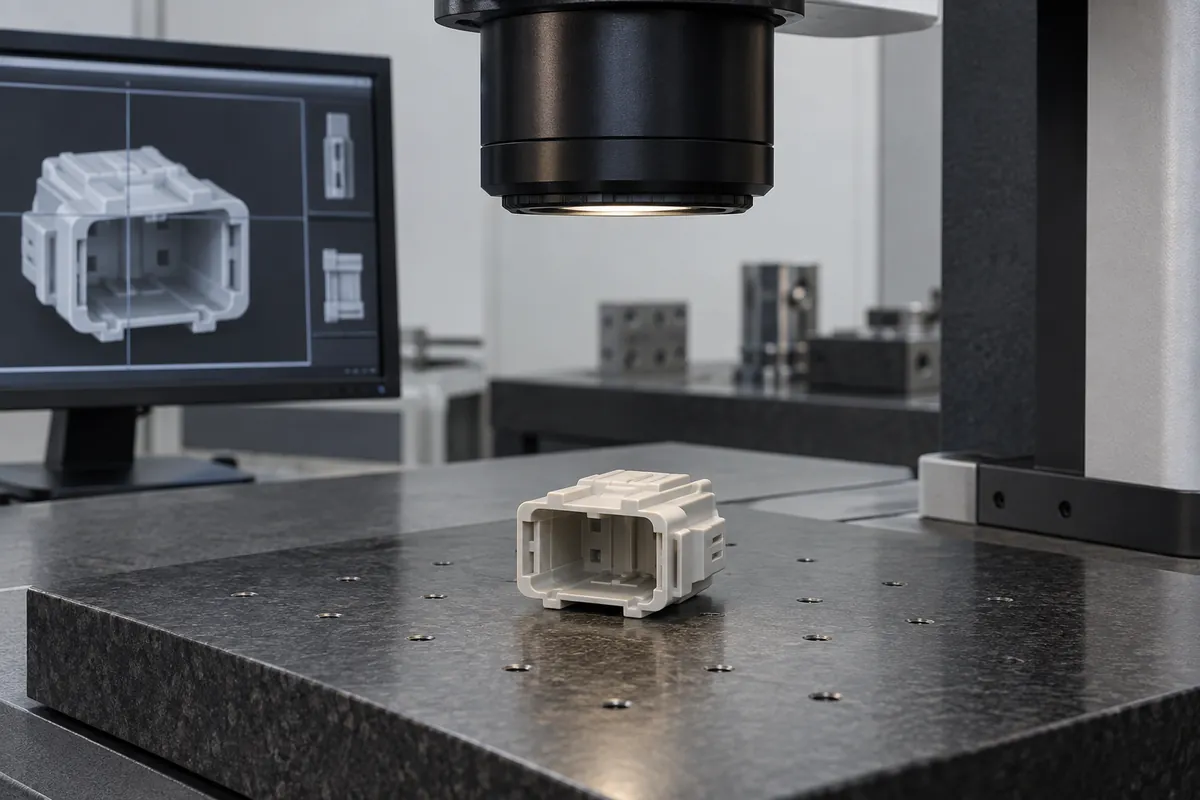
A housing that looks unchanged may still require dimensional and assembly checks. Define the relevant mounting or sealing surfaces, terminal-locating features and permitted variation in the drawing. The datum and pin-pitch guide helps keep those measurements consistent before and after exposure.
Where terminal installation or mating performance is part of the requirement, specify the actual counterpart and sequence. Do not substitute a casual hand fit for a defined acceptance check. If electrical or sealing qualification belongs to the completed connector, identify its owner rather than implying that a bare plastic-part inspection completes it.
Decide what a change would reopen
List the changes that require engineering review: grade, drawing, wall or rib geometry, gate arrangement, tool cavity, relevant process condition or thermal profile. The right response may be a focused recheck or a broader repeat evaluation; the design owner should decide based on what changed and which requirement could be affected.
Keep exploratory trials distinct from approval testing. An early trial can help reject a poor candidate or improve the method without establishing a production claim. Report that outcome honestly: what was tried, under what conditions, what remains unresolved and what evidence is needed next. No generic temperature guarantee is offered by this guide.
Turn the review into a defined molding scope
Explore our custom molded connector insulators and terminal carriers and the related illustrative engineering study. Send the drawing revision, counterpart details, intended use and the decisions still open. Development samples and production approval should have separate, agreed deliverables.