
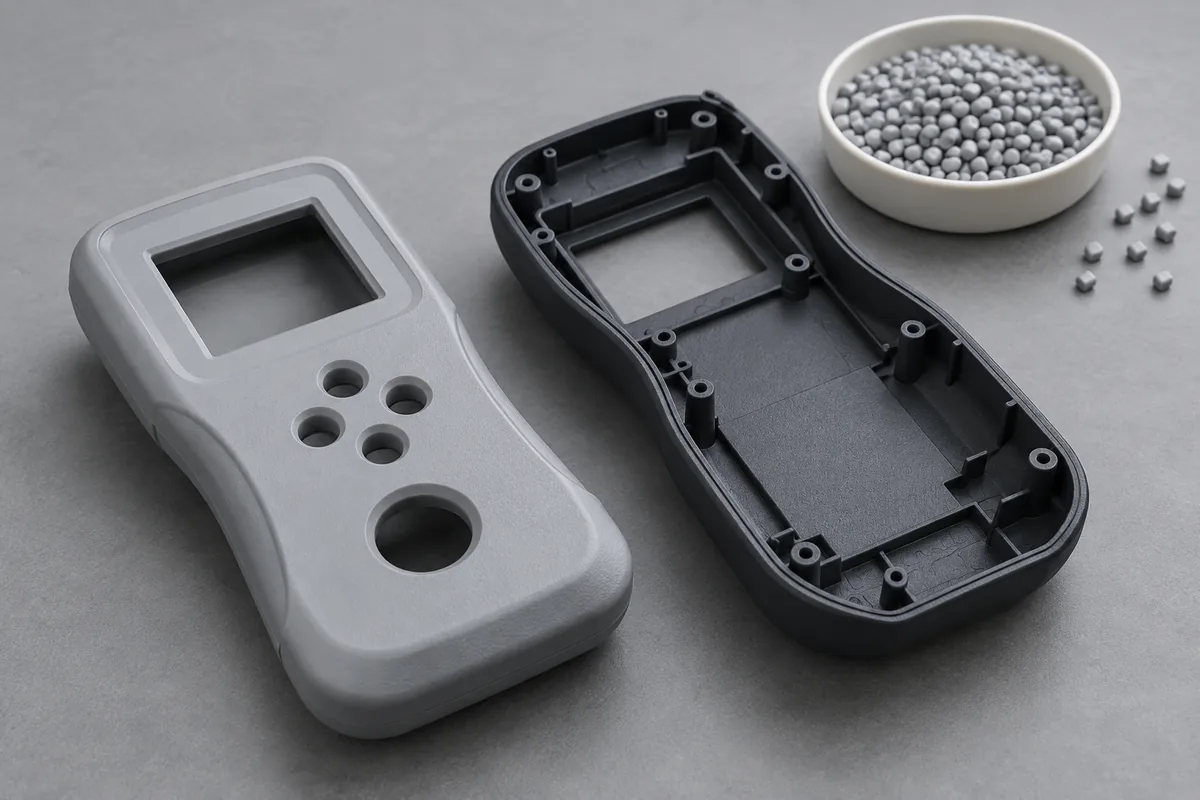
“Use PC/ABS because it is stronger” sounds decisive, but it is not a complete enclosure material specification. Stronger under which load, at which temperature, after which cleaning exposure, and in which grade? A handheld housing can fail at a screw tower or connector corner even when its resin has an attractive datasheet.
ABS and PC/ABS are candidate material families. Select an exact grade against the enclosure's operating conditions and verify the molded assembly. PC/ABS blends offer useful combinations of properties, while ABS may satisfy a less demanding brief. Neither family name guarantees drop performance, chemical resistance or a finished-product safety rating.
Product design illustrations. Final geometry, materials and acceptance criteria are project-specific.
Write the enclosure's job before comparing resin names
Separate normal use from occasional events. Record the temperatures near internal heat sources, storage conditions, expected impacts, mounting loads and chemicals that contact the housing. Identify whether it will be carried outdoors, repeatedly wiped, or held under continuous screw preload. The same external shape can require a different material in a different environment.
List the functions that must survive each condition: the lid remains retained, the display stays aligned, the connector can be used, or a visible surface remains acceptable. These are clearer requirements than “industrial grade.” Keep any safety-critical requirement under the responsible product engineer's qualification plan.
Compare exact grades on comparable data
Covestro's Bayblend portfolio includes different PC/ABS-related formulations, including filled and flame-retardant options. This range is a reason to request the specific grade's documentation, not to apply the best listed property to every blend. ABS grades also vary; a generic comparison chart cannot represent every approved supply option.
Check the test method, specimen condition and thickness behind each reported value. A heat-deflection or softening measurement is not an automatic continuous-use temperature for your loaded enclosure. A notched impact result on a standard specimen is not a drop-test result for an assembled device. Compare like with like before assigning a preference.
| Requirement | Useful screening information | Application evidence still needed |
|---|---|---|
| Heat and load | Exact-grade thermal and mechanical data under stated conditions. | Fit and retention under the actual temperature, load and duration. |
| Impact | Comparable grade data and any relevant supplier guidance. | Defined assembled-device impact or drop evaluation. |
| Cleaning exposure | Compatibility information for the actual agent and grade. | Stressed parts exposed using the intended concentration and sequence. |
| Appearance | Grade, color and molding-finish feasibility. | Approved molded samples with agreed viewing conditions. |
| Required recognition | Current grade-specific documentation and its scope. | Confirmation of applicability to the actual component and finished product. |
Review cleaning while the housing is assembled
A loose sample plaque may experience less mechanical stress than a closed enclosure. Fastening, a tight locating fit or an installed insert can change the condition at a vulnerable feature. Define the cleaning agent, concentration, contact time, wiping action and number of exposures before deciding what the test should show.
Use the intended assembly state and inspect the relevant locations afterward. Do not substitute a different cleaner because its trade name sounds similar. If only preliminary compatibility information exists, record that limitation and keep the candidate provisional. A claim that all PC/ABS or all ABS tolerates a solvent is too broad.
Do not treat a material change as a drop-in tooling change
Changing from one grade to another can affect processing, shrink behavior, appearance and feature dimensions. Ask the molder to review the actual geometry, tool and critical characteristics. A successful fill alone does not show that a lid, board support or screw joint remains acceptable.
Retain the previous configuration as a clear baseline: resin grade, color, drawing, cavity and relevant process information. Separate the intended material change from unrelated changes to gate, wall or fastener. Otherwise it becomes difficult to understand which change produced a difference at assembly.
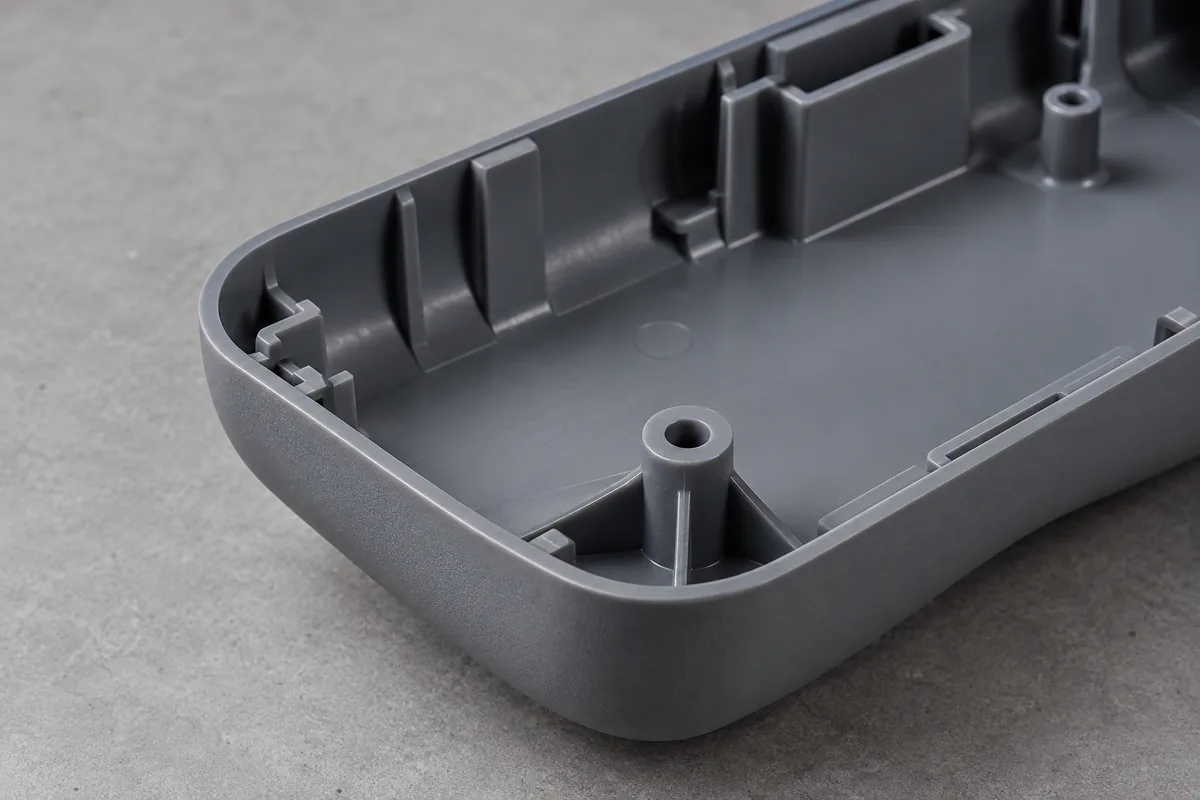
The screw-boss review is particularly relevant when fastening requirements drive the material decision. A different resin should not be used to avoid investigating a poor pilot-hole definition, a bottoming screw or an unsupported tower.
Qualify the color and surface together
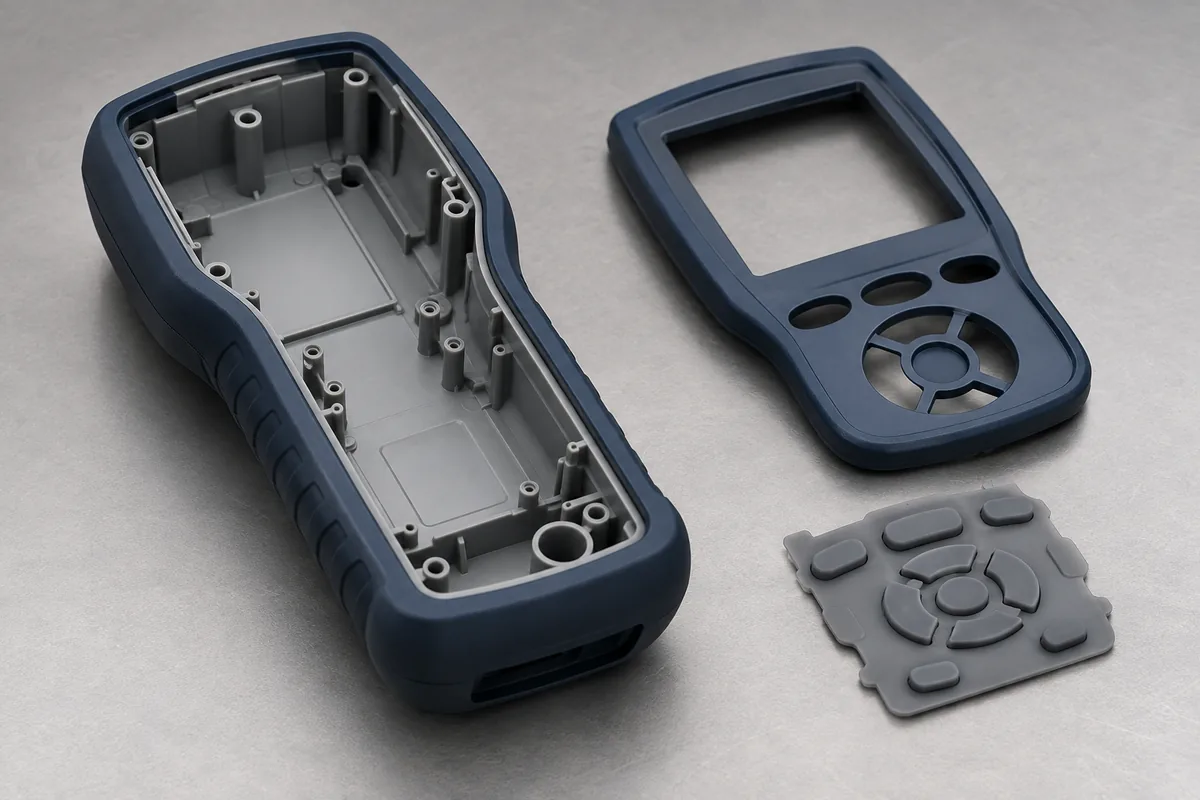
Two materials run in the same textured tool need not look identical. The visual result depends on more than the requested color name. Review molded samples in the proposed grade and color rather than approving a rendering or an unrelated plaque as the final enclosure standard.
Where a flame classification or other recognition is required, check the exact designation and its applicable conditions, including thickness and color restrictions where relevant. Do not infer complete-product approval from a resin brochure. The product owner must establish which documentation and tests apply to the finished assembly.
Make the quotation preserve the material decision
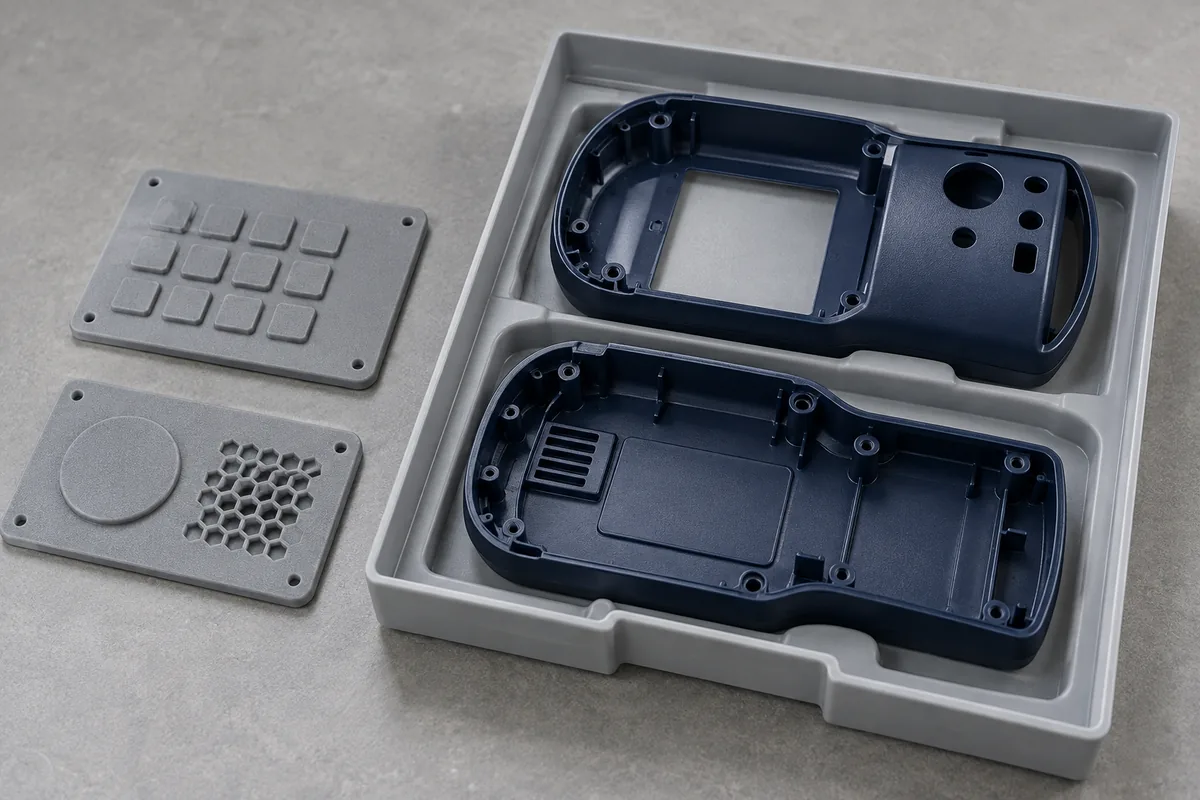
Name the approved grade when it exists. If alternatives are welcome, ask for them as separate options with the differences and evidence clearly identified. Do not allow an unspecified “equivalent ABS” to replace a reviewed formulation silently. Record who can authorize substitutions and what must be re-evaluated.
For an initial RFQ, send the application brief, critical geometry, required documentation and unresolved choices. A material decision can then progress from screening to identified samples and finally to approval. That sequence is more useful than choosing a family from a strength ranking and hoping the finished housing behaves the same way.
Turn the review into a defined molding scope
Explore our custom injection-molded electronic enclosures and the related illustrative engineering study. Send the drawing revision, counterpart details, intended use and the decisions still open. Development samples and production approval should have separate, agreed deliverables.