
Color options
Wide range, Pantone color matching via mixing series, typically up to 4 spot colors per run with tight registration
Pad printing transfers ink from an etched plate to a part using a flexible silicone pad, which conforms to curved, recessed, and irregular surfaces that a flat screen can't reach. It's the standard choice for detailed graphics or markings on complex molded geometry.
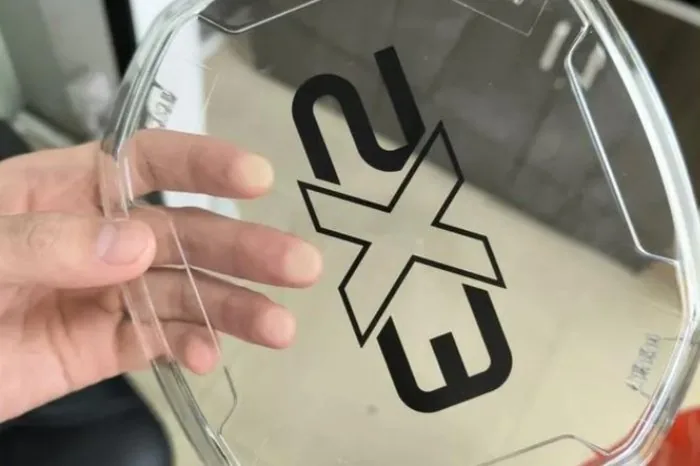
Pad printing solves a specific problem: getting a crisp, accurately placed graphic — a logo, a warning symbol, fine text — onto a surface that isn't flat. Because the silicone pad is flexible, it presses into recesses and wraps around curves and compound angles without distorting the image, which makes it the standard decorating method for buttons, curved housings, textured surfaces, and small components where a rigid screen simply can't make even contact.
Wide range, Pantone color matching via mixing series, typically up to 4 spot colors per run with tight registration
ABS, PC, PP, and most plastics, metals, glass, and rubber, with material-matched ink chemistry
Curved, recessed, textured, and compound-angle surfaces — pad printing's core strength
High — fine lines, small text, and intricate logos hold up well
No gradient capability; ink film on the part is thin (roughly 5-8μm) regardless of cliché etch depth
Every pad print follows the same basic sequence.
The design gets etched into a cliché — a steel or polymer plate — as a shallow recessed image.
→A flood bar or sealed ink cup spreads ink across the cliché, and a doctor blade wipes the flat surface clean, leaving ink only in the etched recess.
→A dome-shaped silicone pad presses down onto the cliché, picking up the inked image, then presses that image onto the part.
Because the pad is flexible, it deposits ink evenly even on a surface that isn't flat — that's the entire reason pad printing exists as a separate process from screen printing.
A few technical choices determine how a pad-printed part turns out, and they're worth understanding even if a supplier is making the final call.
steel plates last longer and suit high-volume runs; polymer (photopolymer) plates are cheaper and faster to produce, making them a practical choice for prototypes or shorter runs.
a standard starting point is 20-25μm. Shallower etching (15-20μm) holds fine text and detail better; deeper etching (25-35μm) suits bold graphics, textured substrates, or more opaque ink. The final ink film on the part ends up much thinner than the etch depth itself, since most of the ink volume is solvent that evaporates during transfer.
harder pads generally transfer a sharper image, but the pad still needs a shape that matches the part's geometry closely enough to achieve a rolling contact motion — without that, air can get trapped and show up as a defect in the print.
different substrates (plastic, metal, glass, rubber) need different ink formulations for reliable adhesion; using the wrong ink series for the material is a common cause of prints that scratch, peel, or fade early.
The two processes solve overlapping problems with different strengths — pad printing handles curved and complex geometry along with fine detail, while screen printing is more efficient for flat or cylindrical surfaces at high volume with bold, vibrant graphics.
Full comparison: Screen Printing.
Conforms to curved, recessed, and compound-angle surfaces that screen printing and most other decorating methods can't reach.
Holds fine detail well — small text and intricate logos print cleanly and consistently.
Supports multi-color designs with tight registration, typically up to four spot colors per run.
Works across a wide range of substrates — plastic, metal, glass, rubber — with the right ink chemistry.
No gradient capability — pad printing produces solid, defined color areas rather than smooth color transitions.
Dark or black substrates often need a white base coat printed first, since a single color pass may not be opaque enough to read clearly.
Requires more setup than screen printing — cliché production and fixturing add time and cost, especially for short runs on unique designs.
Cliché etch depth, pad selection, and ink chemistry all need to be right together; getting one wrong is a common source of smudging, poor opacity, or trapped-air defects.
Yes — that's pad printing's core strength. The flexible silicone pad conforms to curves, recesses, and textured surfaces that a rigid screen can't make even contact with, which is why it's the standard choice for complex molded geometry.
Steel clichés last longer and are suited to high-volume production runs. Polymer (photopolymer) clichés are cheaper and faster to produce, which makes them a practical choice for prototypes or shorter runs where tooling cost matters more than plate longevity.
No — pad printing produces solid, defined color areas rather than smooth gradients. A design that needs a color blend would need a different decorating method.
Most setups handle up to four spot colors in sequence with tight registration, which keeps layered, multi-color designs crisp even on small or curved surfaces.
It usually comes down to geometry: pad printing for curved, recessed, or complex surfaces, screen printing for flat or cylindrical surfaces at high volume. See Screen Printing for the full comparison.