info@fecision.com

Surface FinishesMold Surface Hardening

Mold Surface Hardening for Injection Molds

Mold surface hardening at Fecision starts with base steel heat treatment and extends into four targeted treatments — DLC coating, hard chrome plating, PVD coating, and nitriding — chosen by wear pattern, base steel, and cycle-life target.

Protective hard coating on an injection mold surface
4Targeted treatments

Why Hardening Matters

A mold cavity's surface takes direct, repeated contact with plastic under heat and pressure, thousands or millions of times over its working life. Left untreated, that contact wears the cavity, changes its dimension, and eventually degrades the parts molded from it — shifting tolerances, dulling cosmetic finish, or causing sticking that slows down every cycle.

Hardening treatment is a performance multiplier on top of the base steel, not a substitute for choosing the right one: a high-hardness coating applied over an improperly heat-treated or too-soft base steel can crack and delaminate under clamping pressure, since the softer substrate deforms underneath a brittle coating that can't flex with it. That's why hardening starts with the base steel itself.

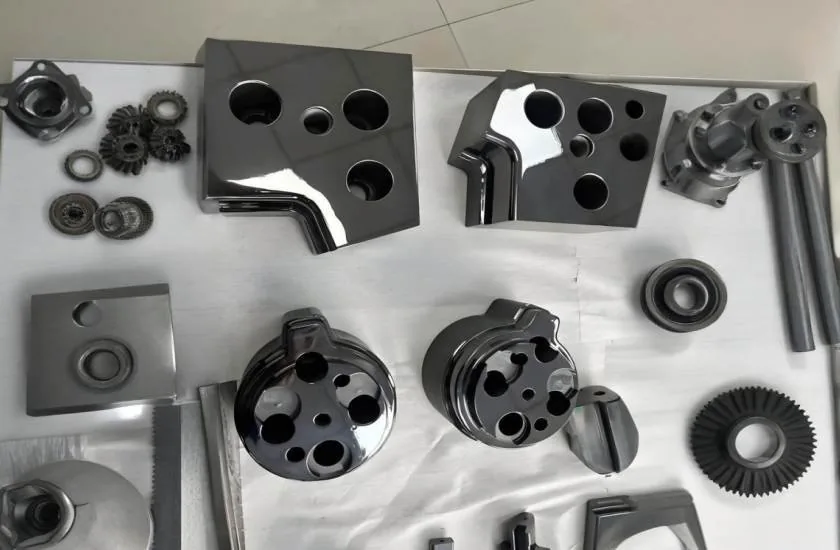
The Four Hardening Treatments

Each treatment trades off differently across hardness, thickness, and what it's best suited to protect against.

DLC Coating

A high-hardness carbon-based coating treatment for mold components, delivering exceptional wear resistance and low friction, which can effectively extend mold life.

Hardness
≥2200 HV (Fecision verified)
Thickness / depth
6-8μm
Effect on precision
Low-temperature deposition (<200°C) avoids re-tempering or distortion
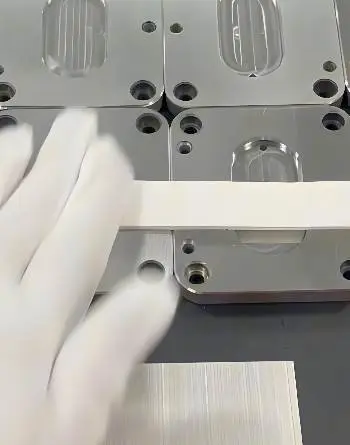
Quality verification for a treated mold surface

How Hardening Quality Gets Verified

A hardening treatment is only as good as the process that confirms it actually hit spec. Fecision verifies three things on every treated cavity before it goes back into production:

01

coating thickness, measured with a coating thickness gauge accurate to ±0.1μm;

02

surface hardness, checked with a Vickers hardness tester across a HV0.1-HV100 range;

03

adhesion, confirmed with a cross-hatch test that checks whether the coating actually bonds to the substrate rather than sitting on top of it waiting to flake off under load.

Skipping these steps is how a coating looks right on paper but fails early in production — verification catches that before the mold goes back to work.

Request a Quote

Choosing a Hardening Treatment

A few practical factors narrow the choice beyond hardness numbers alone.

Base steel matters:

nitriding works well on P20 and H13 but poorly on stainless mold steel, since the chromium oxide layer that gives stainless its corrosion resistance also blocks nitrogen diffusion.

Resin abrasiveness matters:

mildly abrasive materials are often well served by nitriding's lower cost, while heavily glass-filled resins or very high cycle-count programs typically justify DLC or PVD's higher hardness and lower friction. Corrosive resins like PVC benefit specifically from nitriding's corrosion resistance.

Environmental and regulatory considerations:

traditional hard chrome plating relies on hexavalent chromium chemistry that's under tightening environmental regulation in multiple markets, which is part of why PVD and DLC coatings have gained ground as alternatives over the past decade.

Frequently Asked Questions

Will a hardening treatment change my mold's dimensions?

It depends on the treatment. PVD and DLC coatings are thin (2-8μm) and applied at relatively low temperatures, so they have minimal dimensional impact. Nitriding diffuses into the steel rather than adding a layer on top. Hard chrome plating adds more measurable thickness, which gets accounted for in the cavity dimension during design.

Can an existing mold be retrofitted with a hardening treatment?

In some cases, yes, if wear or sticking has become a production problem. Whether it's a good candidate depends on the mold's current condition, base steel, and whether it was heat-treated correctly in the first place — this gets assessed case by case.

Does nitriding work on any mold steel?

No — nitriding works well on steels like P20 and H13 but poorly on stainless mold steel, since the chromium oxide layer that protects stainless from corrosion also blocks nitrogen from diffusing into the surface.

Mold Surface Hardening for Injection Molds

Talk to our experts about the right hardening treatment for your injection mold.

Request a Quote

Request A Quote

Tell Us About Your Project

Fields marked with are required.

By submitting this form, you agree that Fecision may use the supplied information to respond to your inquiry.