
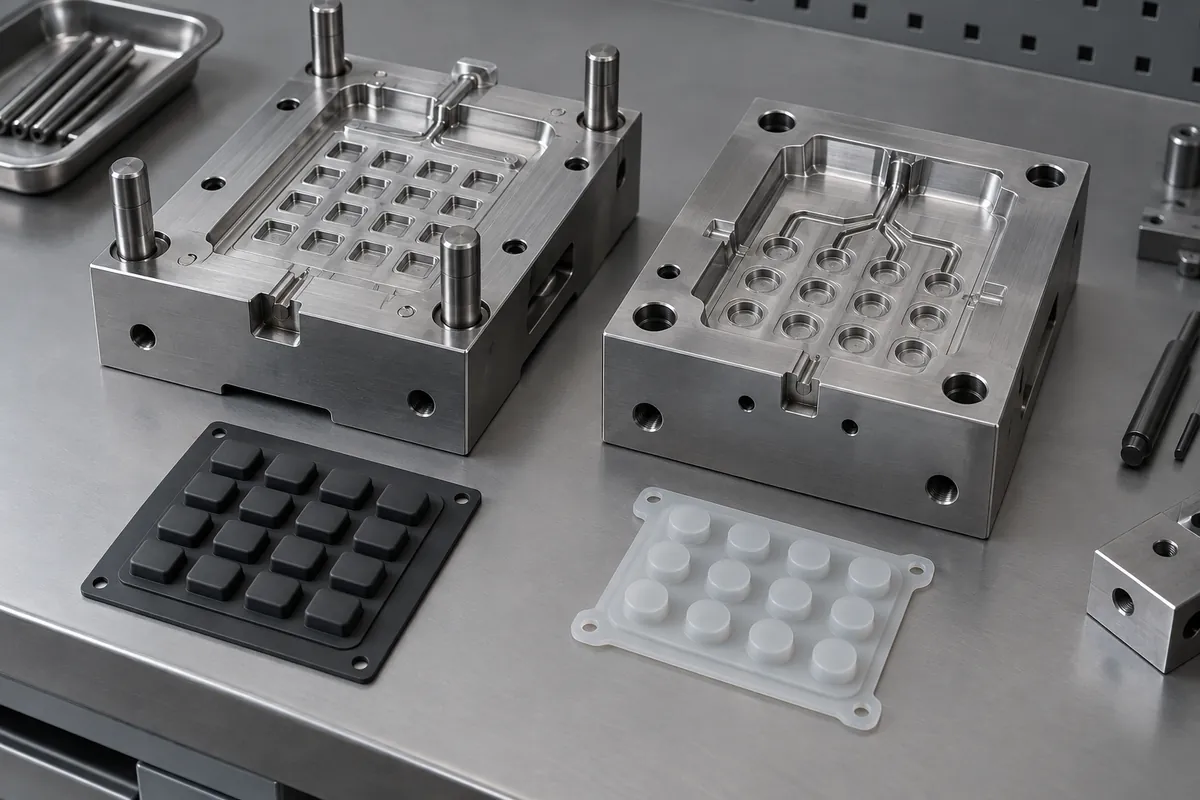
Product design illustrations. Final geometry, materials and acceptance criteria are project-specific.
Choosing a keypad molding process is not simply a decision between large and small order quantities. Geometry, material supply form, automation, flash control, secondary operations and the cost of a design change all affect the comparison. A useful quotation explains how the proposed process delivers the complete approved component.
Start with the same drawing and acceptance requirements for both proposals. If one includes conductive contacts, decoration and inspection while the other stops at an unmarked molded part, the unit prices describe different deliverables. Align the scope before drawing a conclusion about the economics of either route.
Understand the material and tool differences
LSR injection molding meters and mixes liquid components before filling a heated mold. The delivery system must manage the material before cure, while the mold provides the required curing condition. Cold-runner terminology does not mean the whole process operates without heat, nor does it justify describing every feed nozzle as a hot runner.
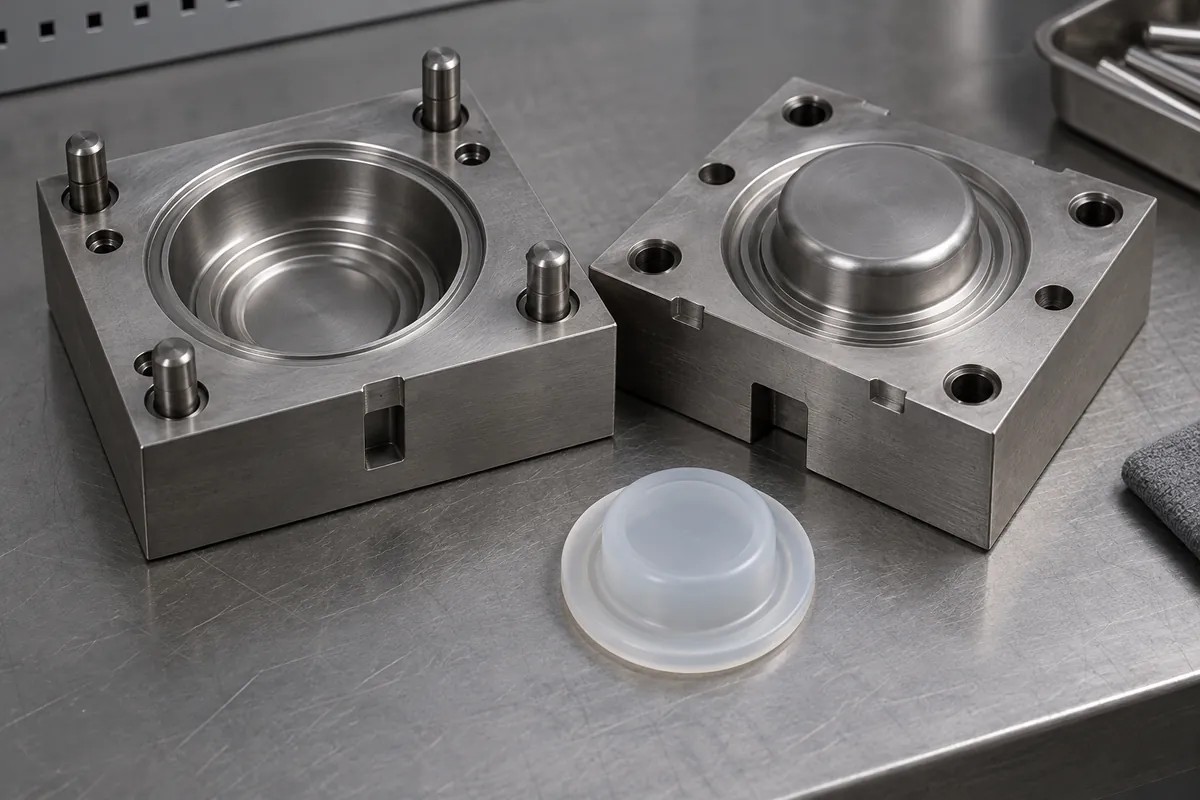
Compression molding generally starts with prepared rubber charges placed into an open tool before it closes. Charge preparation and placement become part of the process. The compound, cure system and tool arrangement determine how the material flows and how surplus material or flash is managed.
A manufacturer's liquid-injection-molding overview gives process context. Supplier-specific claims about cost or productivity should not be adopted as a universal crossover point. Obtain comparable proposals for the actual geometry and demand.
Examine the features that drive risk
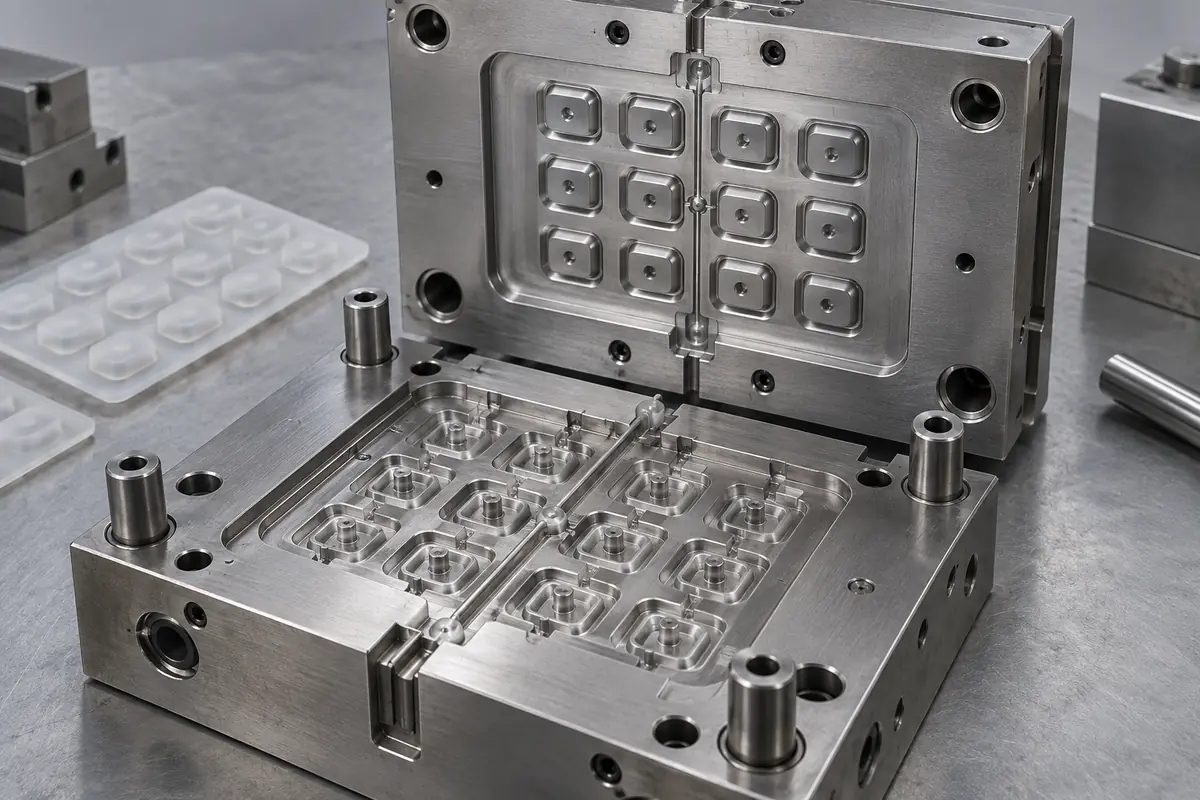
Thin flexible webs, deep key shapes and small sealing details may require different filling and demolding strategies. Ask where the gate and parting interfaces will be placed and which surfaces cannot accept a vestige or flash. These decisions can affect feel, appearance and assembly at the same time.
Incorporated contacts or contrasting light-transmitting regions add handling and positioning requirements. Determine whether these are formed, inserted or assembled later. A process suitable for the base keymat does not automatically address all the interfaces in the finished keypad.
Use representative samples to evaluate dimensional stability, return behavior and appearance. A prototype made with a different material or tool may answer a packaging question without predicting production tactile behavior. Label what each development sample is intended to demonstrate.
Compare the full production route
Include deflashing, any required post-cure, cleaning, contact operations and decoration. Their need depends on the selected material and process, not a blanket rule. Agree the state in which a component is measured and tested, especially if later operations can alter the key response or surface condition.
Separate tooling investment, sample approval, repeat-order cost and expected maintenance. A high cavity count can reduce one part of the unit cost while increasing tool complexity and the work needed to demonstrate cavity consistency. Forecast uncertainty should be discussed explicitly instead of hidden inside a single annual-volume estimate.
Ask how the manufacturer will control material lots, mixing or charge preparation, curing and cavity identification. Repeatability requires evidence from the proposed route. A very short quoted cycle has little value if it omits necessary handling or produces parts that need unquoted finishing.
Include the supply pattern as well as the annual total. Frequent small repeat orders, a long storage interval and a single large campaign place different demands on setup, inventory and material control. Discuss those conditions with the proposed manufacturer instead of assuming that the same nominal yearly quantity produces the same process economics in every arrangement.
Make the process decision reviewable
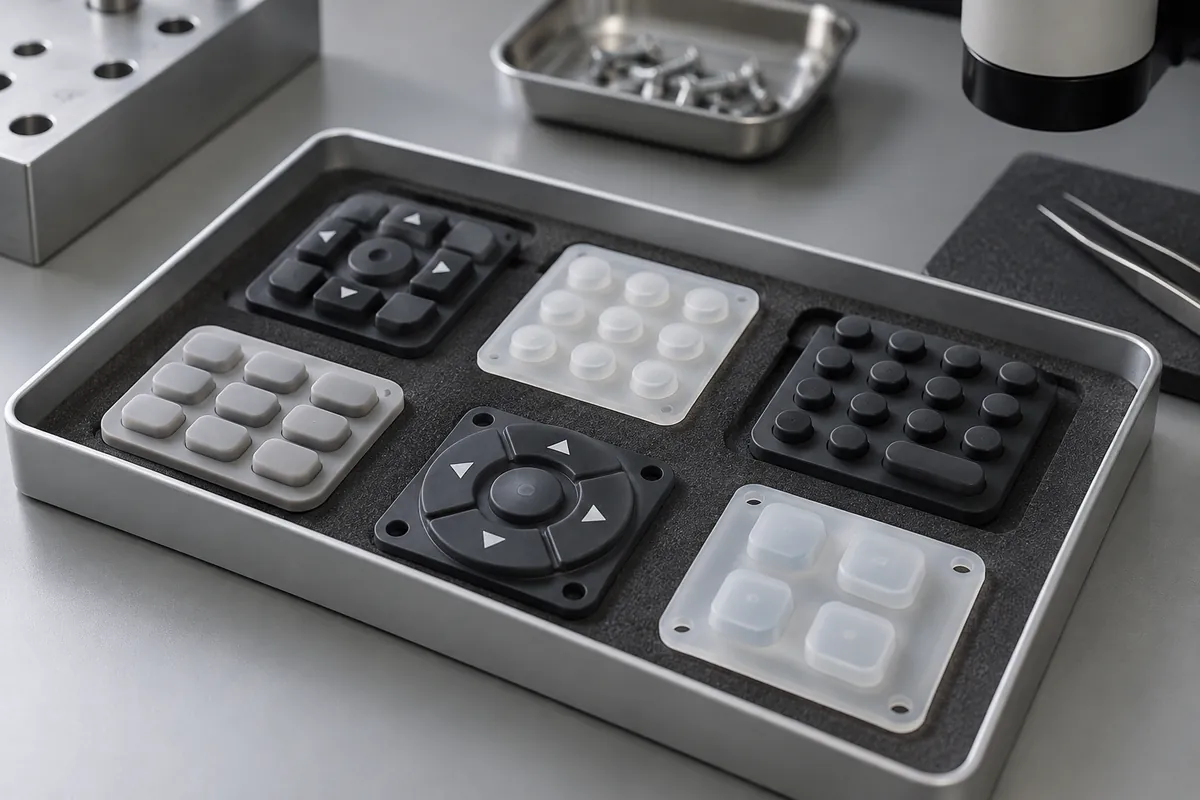
Record the drawing, material, tool concept and operations used for the comparison. State which assumptions could change the price or feasibility. This makes a later tooling or volume decision understandable without reconstructing informal discussions from the first quotation.
Use the force and travel requirements and legend specification as common acceptance inputs. The preferred process is the one that can supply the defined component with appropriate evidence and workable commercial terms, not the one associated with a generic volume slogan.
Discuss the component and its acceptance requirements
Explore our custom silicone keypads and the related project case study. Send the current drawing, mating-part details, operating conditions and required quantities. We can review tooling, molding and inspection as a defined supply scope, with development samples and production approval kept separate.