
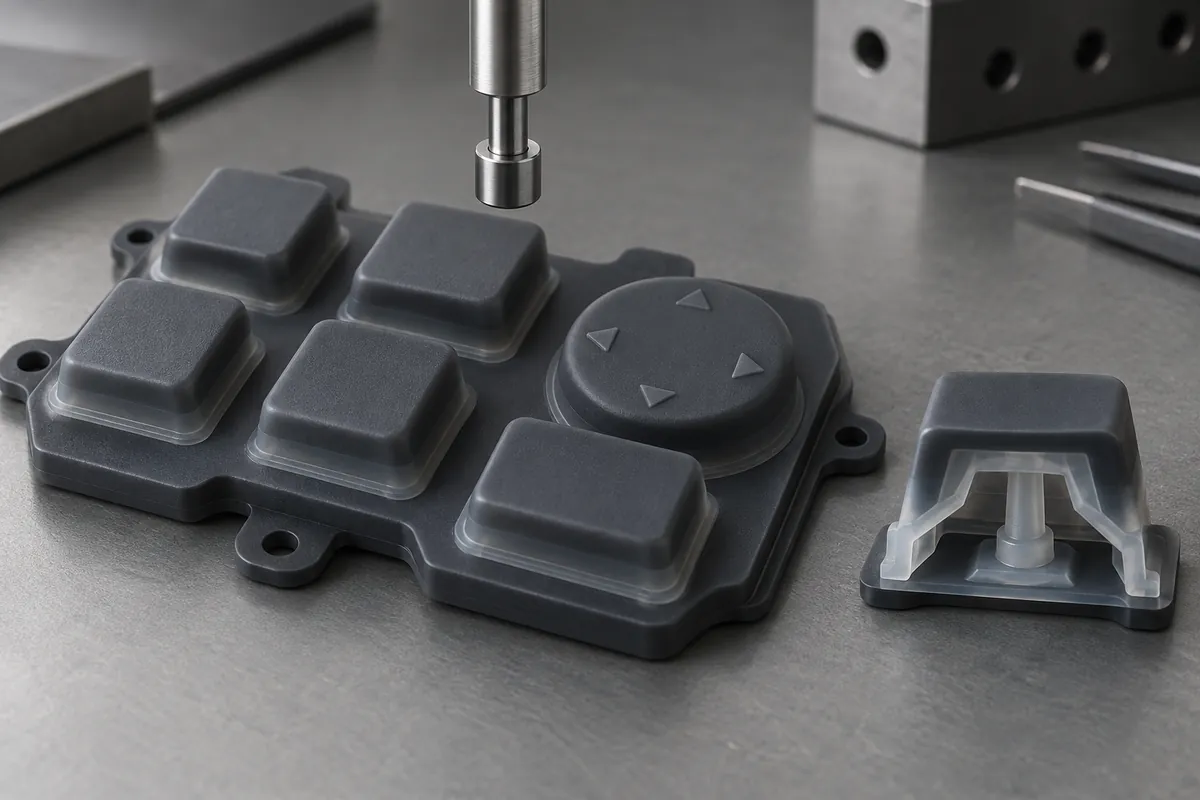
Product design illustrations. Final geometry, materials and acceptance criteria are project-specific.
A keypad can meet its free-state dimensions and still feel wrong in the finished panel. The operator presses a key cap, but the measured response includes the silicone web, the contact mechanism, the support beneath it and any interference with the bezel. Specifying only a hardness or an overall height leaves these interactions unresolved.
Start by defining the intended action. A deliberate industrial command, a frequently repeated navigation action and a recessed service key need not share the same response. Describe acceptable operating force and movement in the assembled product, then allocate the geometry and test requirements to the components that control them.
Separate force, movement and electrical closure
Actuation force usually refers to a defined point during depression. Contact force concerns loading at the electrical interface. Total travel is the permitted movement, while electrical closure may occur before the mechanical stop. Write which event each number describes, otherwise suppliers can report different points on the same force-displacement curve and appear to disagree.
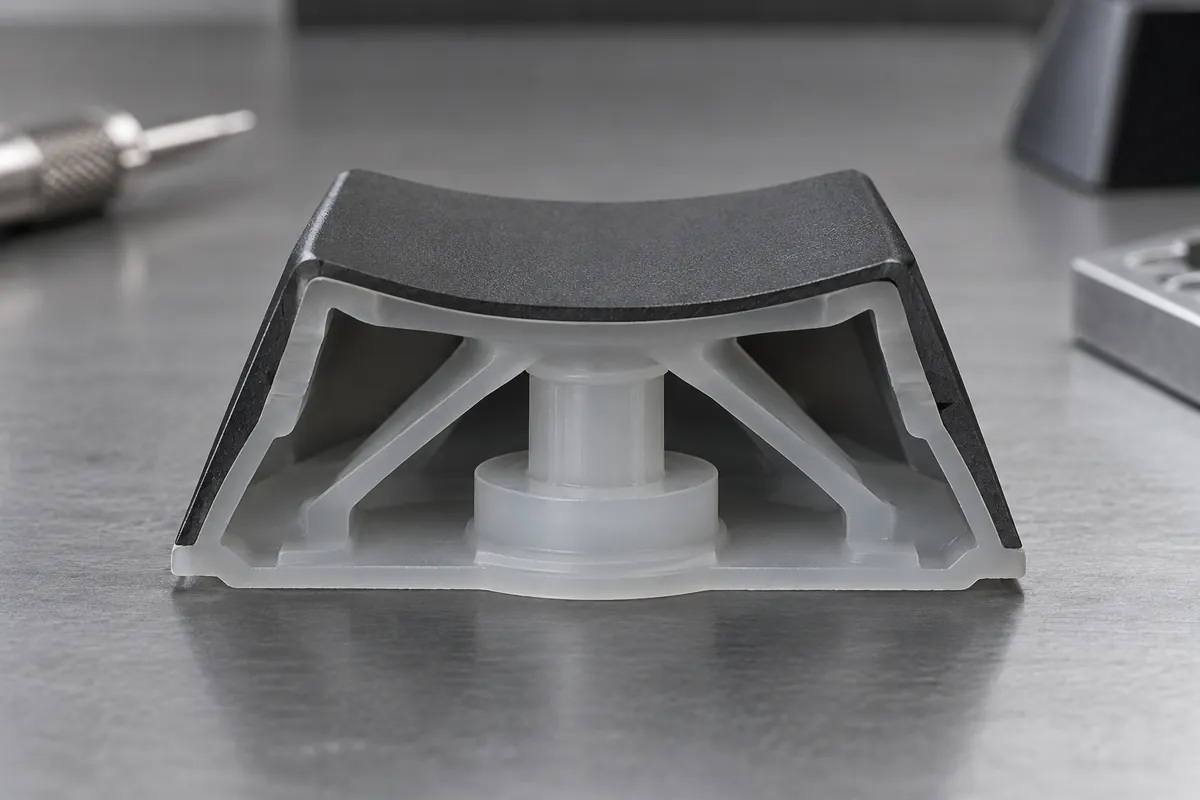
Tactile response includes the change in resistance as the key moves, not simply its maximum force. A collapsing web can provide a discernible change before bottoming. A silicone pusher over a metal dome can obtain much of its tactile response from the dome instead. These constructions require different design reviews even when the top surfaces look alike.
The manufacturer's keypad assembly overview identifies key travel and actuation force as assembly considerations. Use those categories to organize requirements, but do not import another manufacturer's capability values as acceptance limits for your own part.
Review the complete mechanical stack
Web angle, thickness and available space affect how the silicone deforms. Changing one dimension may alter force, return and local stress together. A harder compound is therefore not a universal solution to an inconsistent key. Compare geometry, material and cure condition before deciding which input to change.
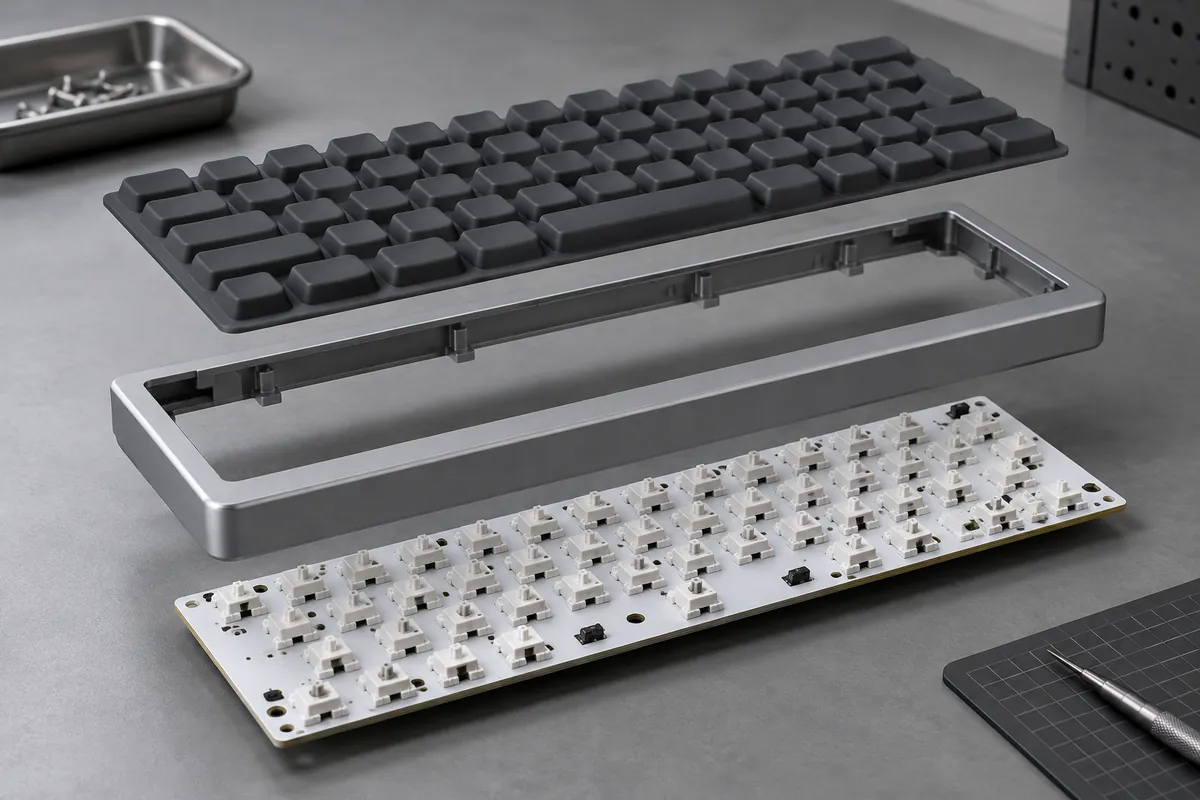
Include the bezel aperture and the mounting position. A key rubbing against an edge can create friction that masks the intended tactile event. An unsupported circuit board can deflect and consume part of the travel. Measure the support structure as well as the loose keymat when the assembled result differs from the development sample.
Check tolerances as a stack, rather than requesting tighter numbers on every part. The important relationship may be the pusher-to-switch gap after fastening. Establish where the stack is located and how fastener loading is controlled. More compression can improve one interface while unintentionally preloading a neighboring key.
Make the test repeatable
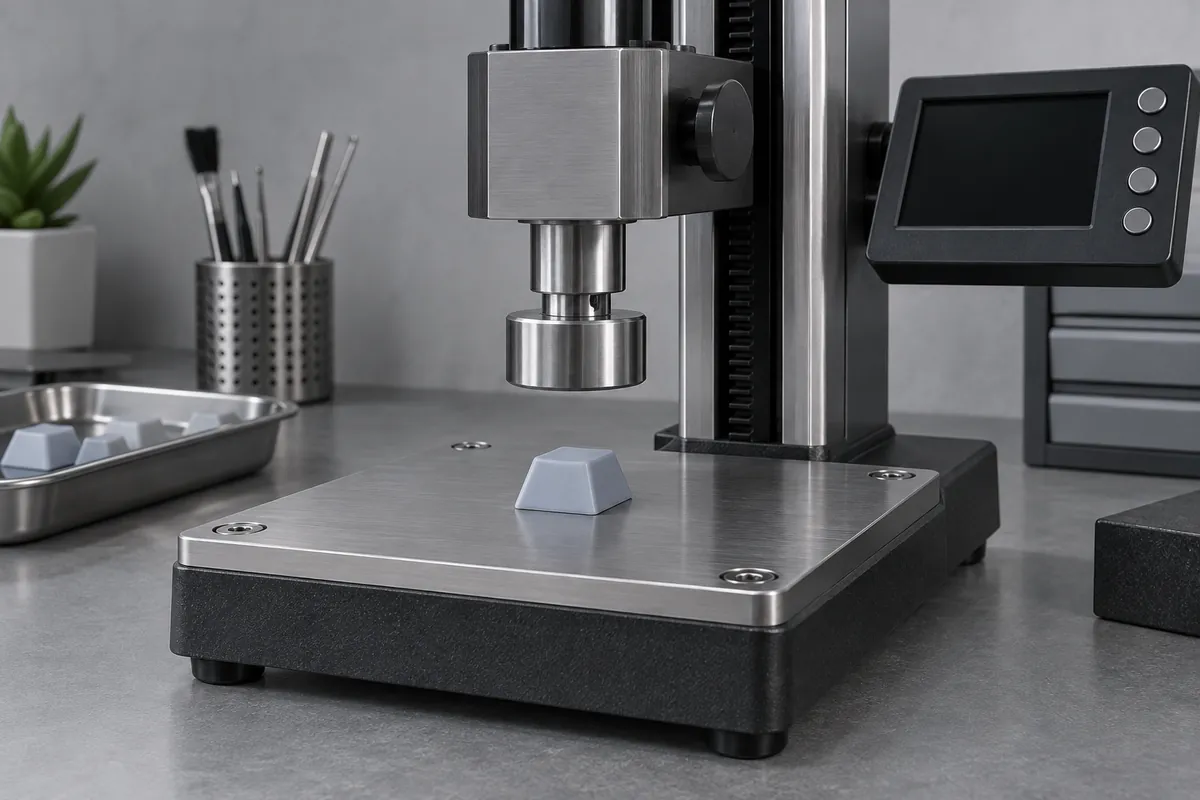
Record probe shape, contact position, depression speed, support fixture and the defined endpoint. A center press with a broad probe is not equivalent to an off-center press at a corner. If edge operation matters in use, include that condition deliberately instead of treating the resulting readings as random noise.
Retain individual force and travel observations with cavity and sample identification. A batch average can hide a consistently heavy cavity or one key position that binds. Development sampling should distinguish within-key repetition, differences across the keymat and differences between molded specimens. Report the sample population actually measured.
After environmental exposure or cycling, repeat the agreed method on the same relevant assembly state. Note whether the test measures first operation after storage or behavior after repeated presses. Do not claim a lifetime from a successful initial force check; the two measurements answer different questions.
Use discrepancies to guide the next trial
When one condition fails, preserve a reference configuration and change a controlled variable. Record whether the change was to the web, support, material, processing or contact system. This gives the next sample a meaningful comparison rather than merely a different feel.
If the switch architecture is still open, compare carbon pills and metal domes before freezing the tool. Agree the force, travel, closure and return criteria together. A clear release decision connects those observations to an identified drawing and assembled configuration.
Discuss the component and its acceptance requirements
Explore our custom silicone keypads and the related project case study. Send the current drawing, mating-part details, operating conditions and required quantities. We can review tooling, molding and inspection as a defined supply scope, with development samples and production approval kept separate.