
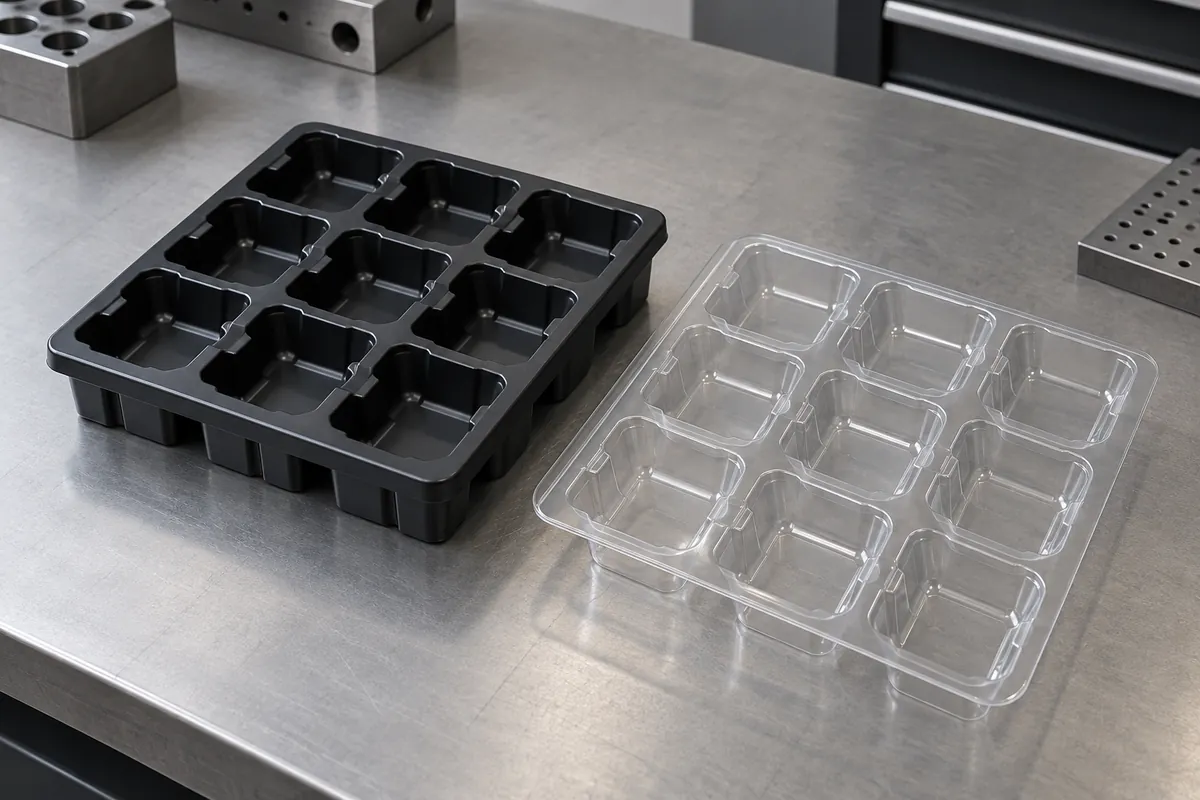
Product design illustrations. Final geometry, materials and acceptance criteria are project-specific.
A reusable tray has to protect parts through a handling cycle, not only hold them for a photograph. Loading, transport, stacking, cleaning and automated unloading can place different demands on the same pocket. Injection molding and thermoforming offer different ways to meet those demands, so compare them against the actual journey of the component.
Begin with the required lifetime and the interfaces that cannot change. A lightweight shipping insert and a returnable production carrier may look similar but solve different problems. Avoid choosing a process from the annual tray quantity alone before considering how many handling cycles each tray must support.
Identify the locating features that matter
Injection molding can integrate ribs, bosses, pockets and stacking details into a defined three-dimensional construction. These features still need draft, sensible section transitions and an achievable inspection plan. Adding a precise-looking locating pin to a model does not establish the positional performance of the molded carrier.
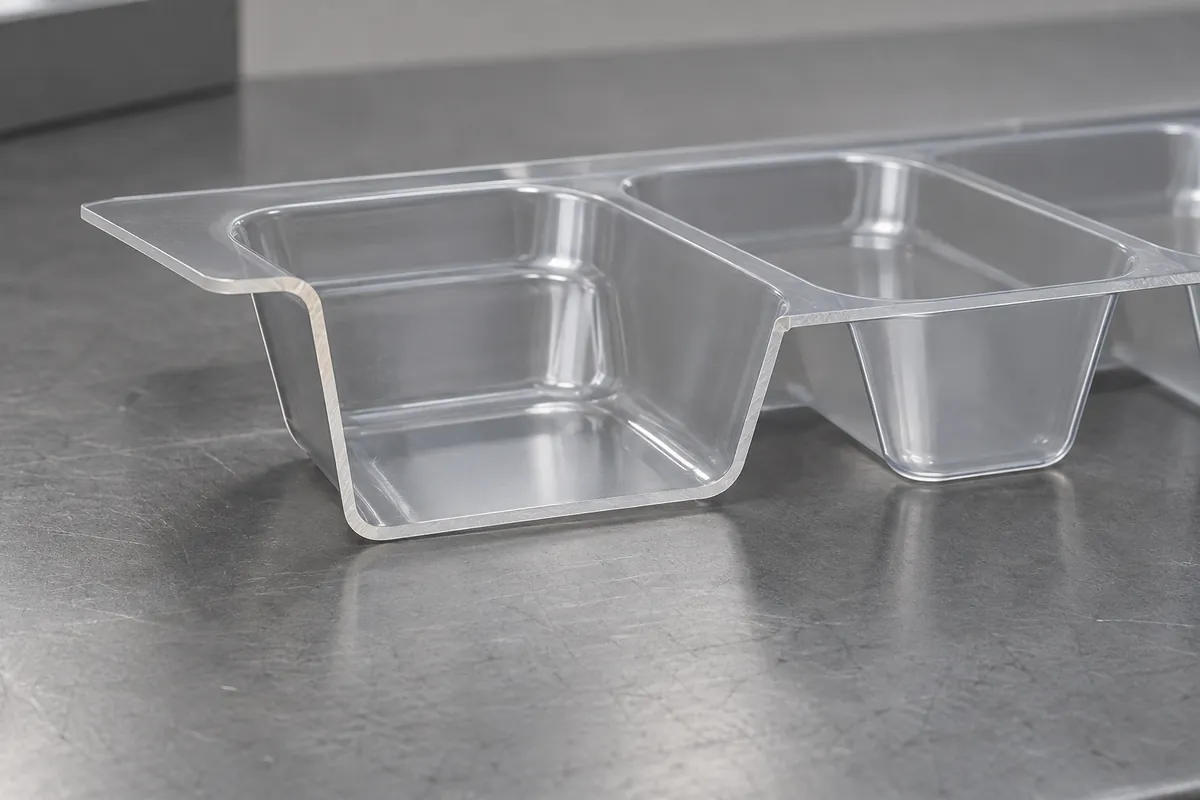
Thermoforming shapes a heated sheet against tooling. Wall distribution depends on how the sheet stretches into the geometry, and trimming becomes part of the finished outline. Deep pockets, tight corners and local support features therefore need review in terms of the forming process rather than being copied unchanged from a solid molded design.
ORBIS describes custom injection-molded trays as one packaging option. That establishes a relevant application category, not a reason to select it automatically. Ask what locating and repeated-use requirements justify the proposed construction.
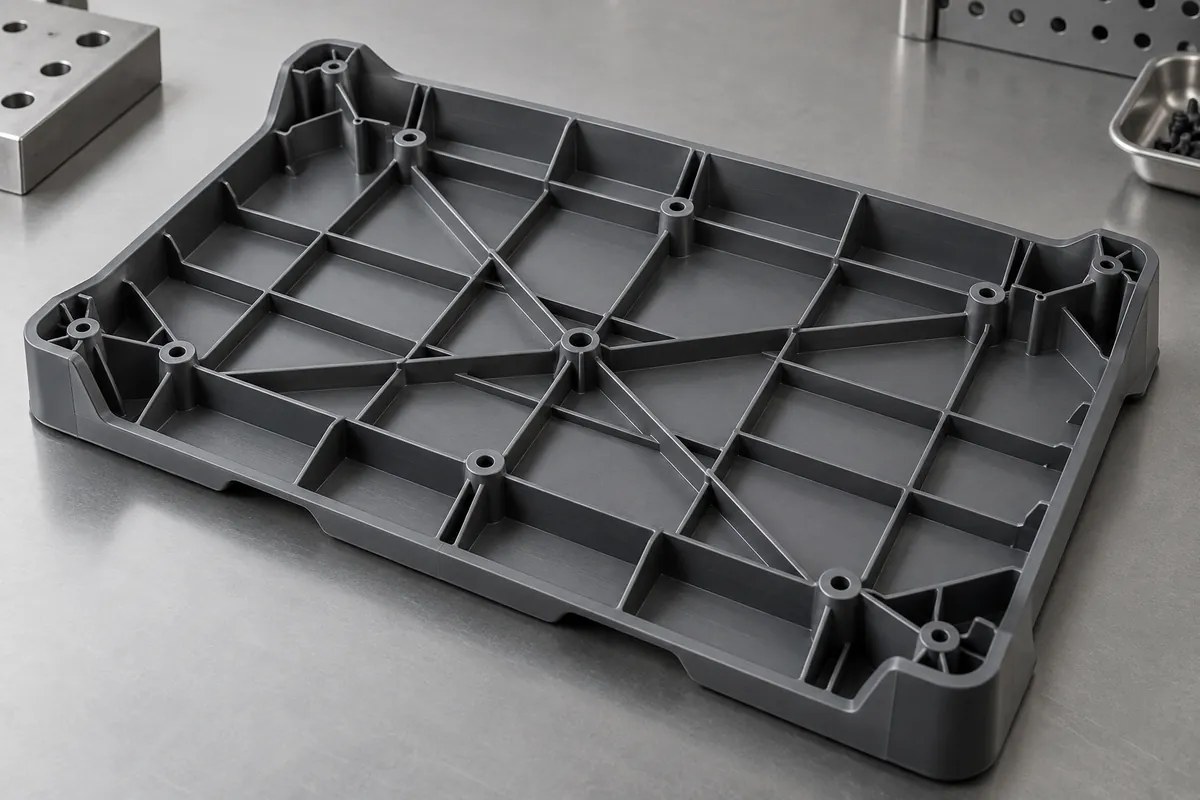
Review loading, stacking and release
A pocket that protects a part during transport must still allow reliable removal. Identify delicate surfaces, permitted contact points and the direction of extraction. A soft insert may provide protection differently from a rigid molded shoulder. Compare the actual contact mechanism rather than judging protection by pocket depth alone.
For stacked trays, trace the load through the rims, feet and supports. The component should not accidentally become a structural spacer. Check the bottom tray and the interface with a rack or pallet, because a successful single-tray bench check does not describe every load path in a full stack.
Consider whether empty trays nest and how they separate. Close-fitting tapered trays can bind, trap air or require excessive release force. De-nesting features and gripper access affect the handling equipment as well as storage density. A compact empty stack is useful only if the line can separate trays consistently.
Compare the complete reusable system
Include cleaning, identification, inspection and replacement in the cost review. A lower initial tray price can be offset by frequent damage or poor line compatibility. Conversely, a more substantial carrier may not be justified for a short program with limited reuse. Use the expected handling cycle rather than an assumed universal payback period.
Specify any ESD, contamination or chemical-exposure requirements separately. Neither a black color nor a particular forming process proves electrical protection. Material compounds and finished-part evidence must match the intended environment. A removable liner or coating also belongs to the delivered configuration and its maintenance plan.
Ask each supplier to state what the quote includes: tooling, trimming, inserts, marking, inspection, packing and sample approval. Compare the same component revision and demand pattern. Where the proposals differ, record the difference before interpreting the unit price as a direct commercial comparison.
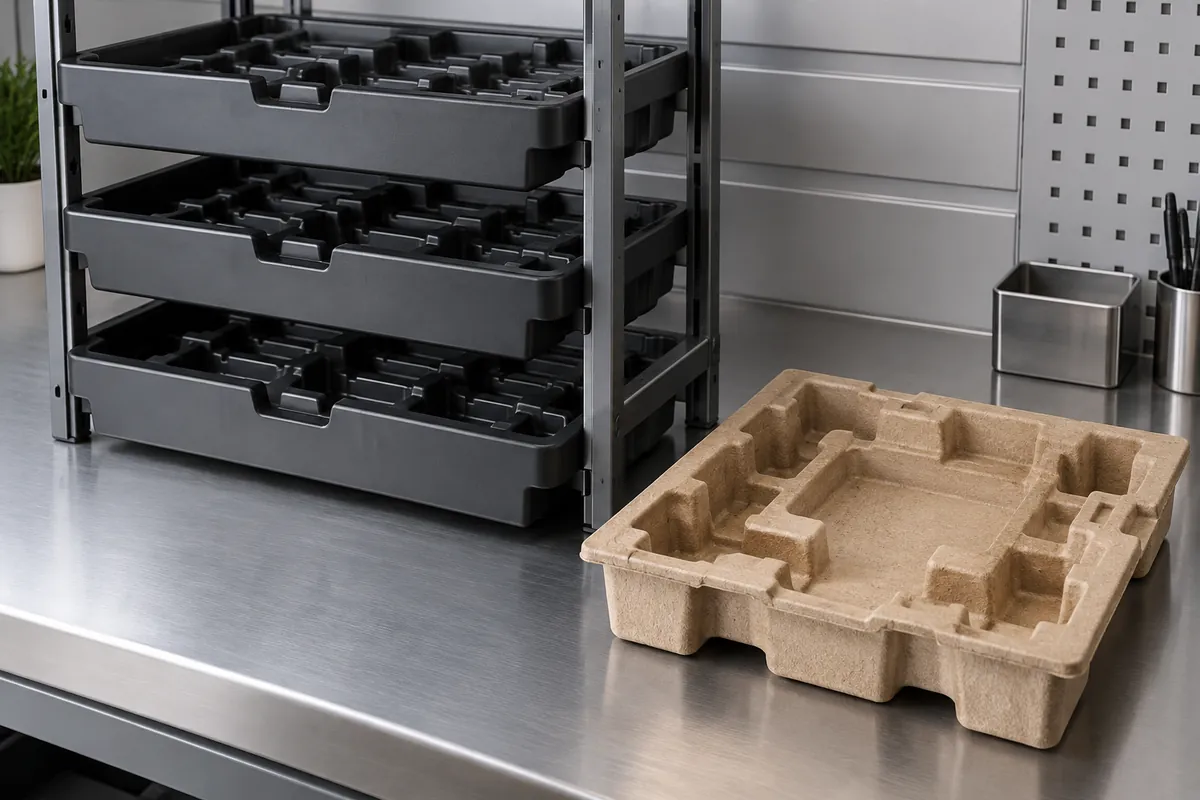
Keep the replacement strategy visible in the comparison. If trays circulate between several facilities, the useful fleet size includes units being cleaned, returned or inspected. A nominal annual purchase quantity does not describe the number of carriers required to keep the line supplied during those interruptions.
Test the route before committing to the tool
Use representative components to evaluate loading, transport vibration where relevant, stack support and extraction. Include worn or tolerance-limit counterparts if they represent real use. An empty carrier can pass a dimensional check while a loaded one fails at a critical contact point.
Review pocket support and release and stacking interfaces together. The process decision should connect the drawing to the required handling evidence, with limits of the prototype method clearly stated before production approval.
Discuss the component and its acceptance requirements
Explore our custom component trays and the related project case study. Send the current drawing, mating-part details, operating conditions and required quantities. We can review tooling, molding and inspection as a defined supply scope, with development samples and production approval kept separate.