
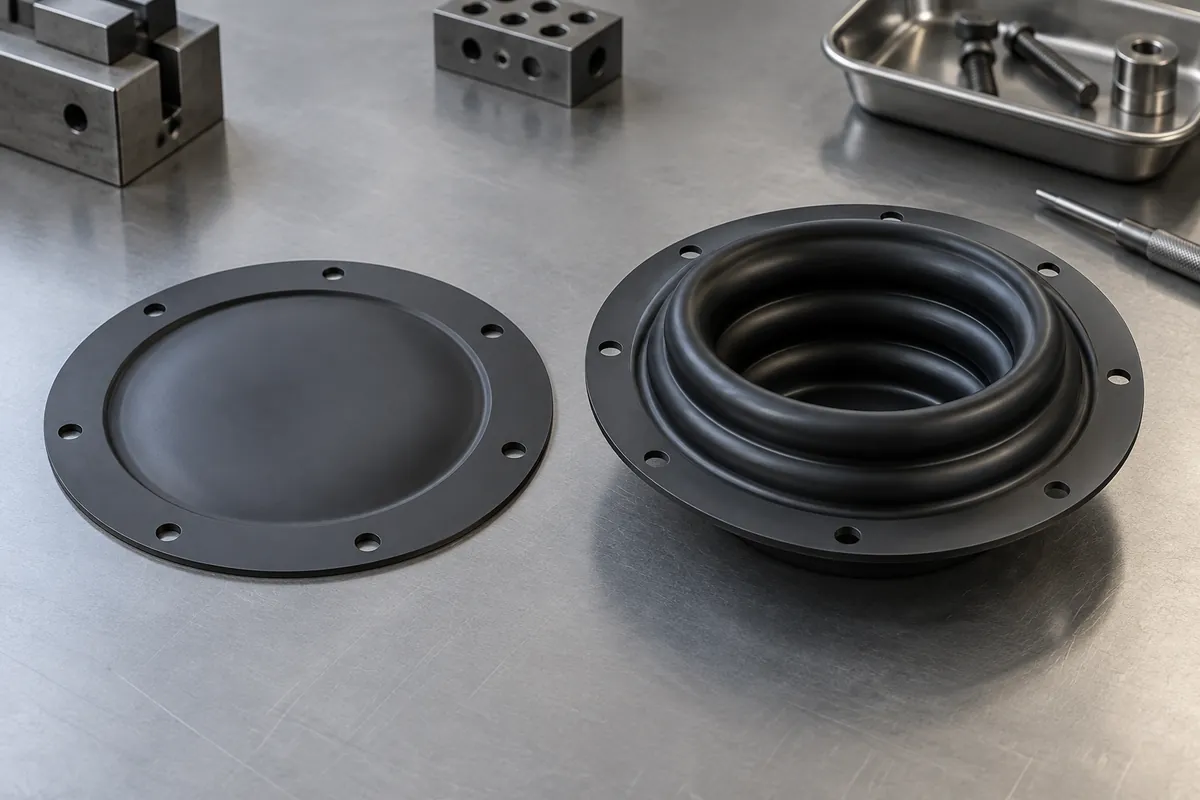
Product design illustrations. Final geometry, materials and acceptance criteria are project-specific.
A flat diaphragm and a rolling diaphragm can both separate two chambers while allowing movement, but they do not accommodate that movement in the same way. Selecting the shape from available space alone can leave the membrane stretched, unsupported or folded against the housing at the end of its travel.
Start with the motion envelope and pressure difference. Record the neutral position, both travel limits, whether pressure reverses and what happens when the mechanism stops. These conditions explain more about the required construction than a request for a flexible silicone disc with a specified outside diameter.
Distinguish flexing from controlled rolling
A flat or shallow contoured membrane accommodates displacement through deformation of its flexible region. The clamped edge, central attachment and transition radii influence where deformation concentrates. Increasing displacement without revisiting these regions can change both actuation force and local strain, even when the material hardness remains unchanged.
A rolling design uses a shaped wall that moves between supporting surfaces as the piston travels. Its behavior therefore depends on the piston and cylinder geometry as well as the molded diaphragm. The elastomer cannot be evaluated independently of those surfaces and the space available for the convolution.
The DiaCom design guide distinguishes short-stroke contoured forms from rolling configurations. Use that distinction to frame a design discussion, not to adopt another manufacturer's pressure or lifetime claims for a different part.
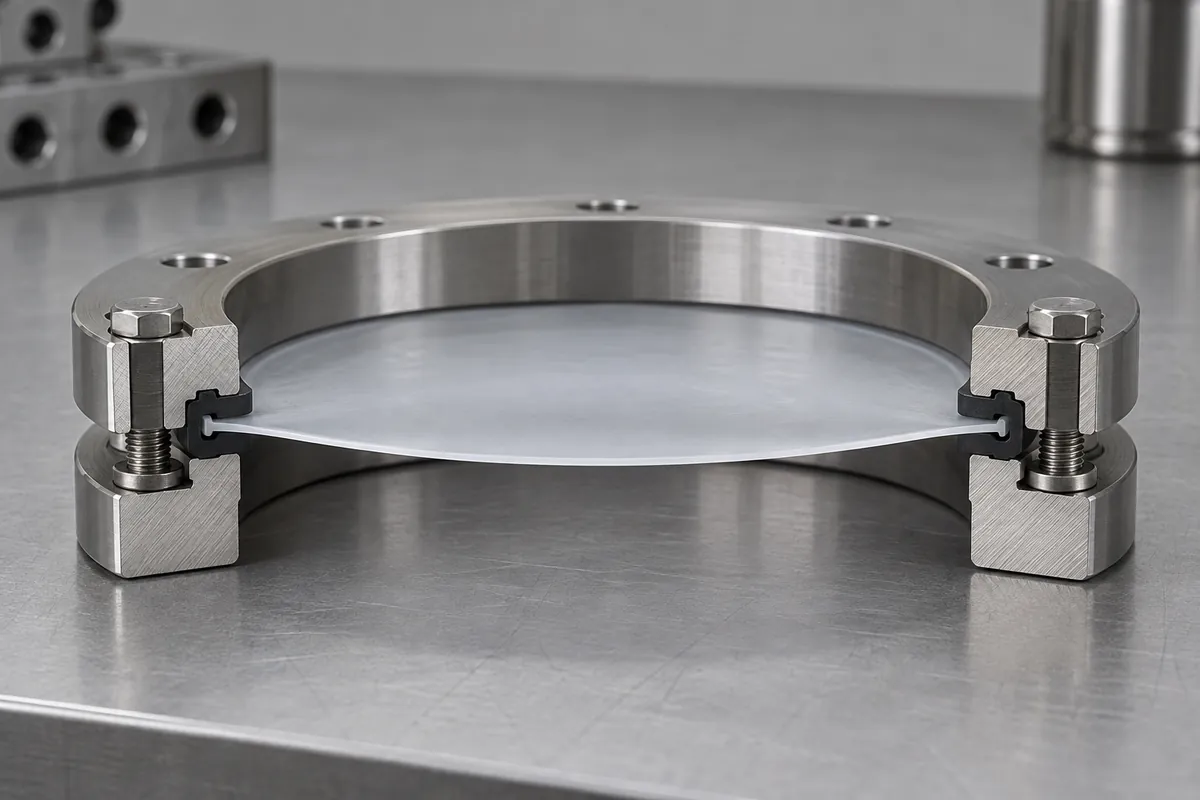
Include the housing in the selection
Draw sections at the neutral position and both travel limits. Check where the membrane contacts the support, whether it can become pinched and whether a fold has room to move. A nominal section through the resting assembly can hide a collision that appears only at maximum displacement.
Define the pressure direction throughout operation, including startup and shutdown. A construction supported in one direction may not tolerate the same pressure reversed. An unintended trapped volume or blocked vent can alter the effective pressure difference without changing the nominal inlet setting.
Account for assembly variation. A diaphragm installed off-center, twisted or clamped unevenly starts from a different mechanical condition. Locating features and a repeatable tightening sequence can be as important as the membrane profile when comparing prototype results from different fixtures.
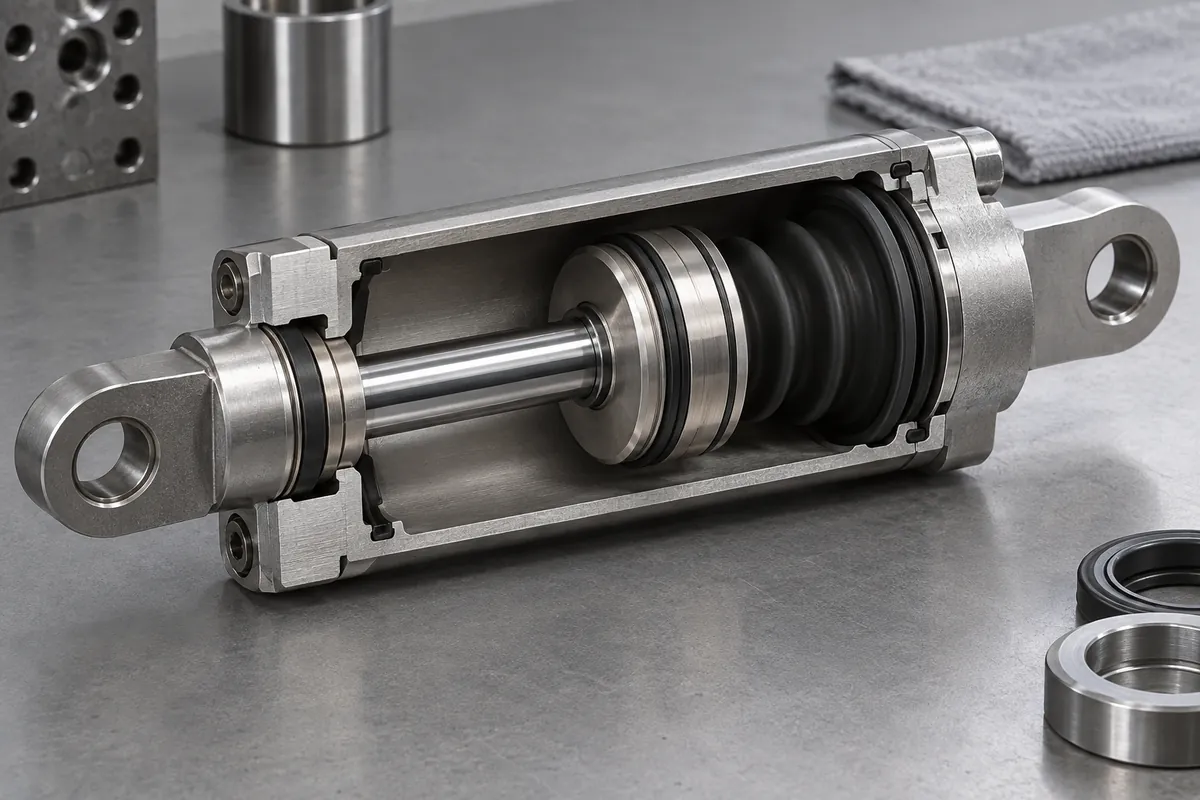
Compare force and validation requirements
Do not assume equal hardness means equal response. Thickness, molded shape, reinforcement and the supported area all affect the relationship between pressure, movement and force. Specify what the mechanism must do at each relevant position rather than accepting a material designation as a functional specification.
Identify whether the important outcome is sealing, displacement accuracy, low actuation force or repeated cycling. These objectives can conflict. A more robust edge may improve clamping but reduce the available flexible span, while a thinner active area may improve movement but require closer process and handling control.
Compare candidate assemblies under the same fluid, temperature, pressure cycle and fixture conditions. A successful dry bench movement does not establish performance in a wetted operating system. Document the test configuration so differences between shapes are not confused with differences between setups.
Consider an actuator whose neutral position shifts after a housing revision. Even if total travel remains unchanged, the membrane may now spend more of its motion near one limit. Reviewing both absolute end positions catches that change; comparing only the stroke number can make the revised assembly appear equivalent when it is not.
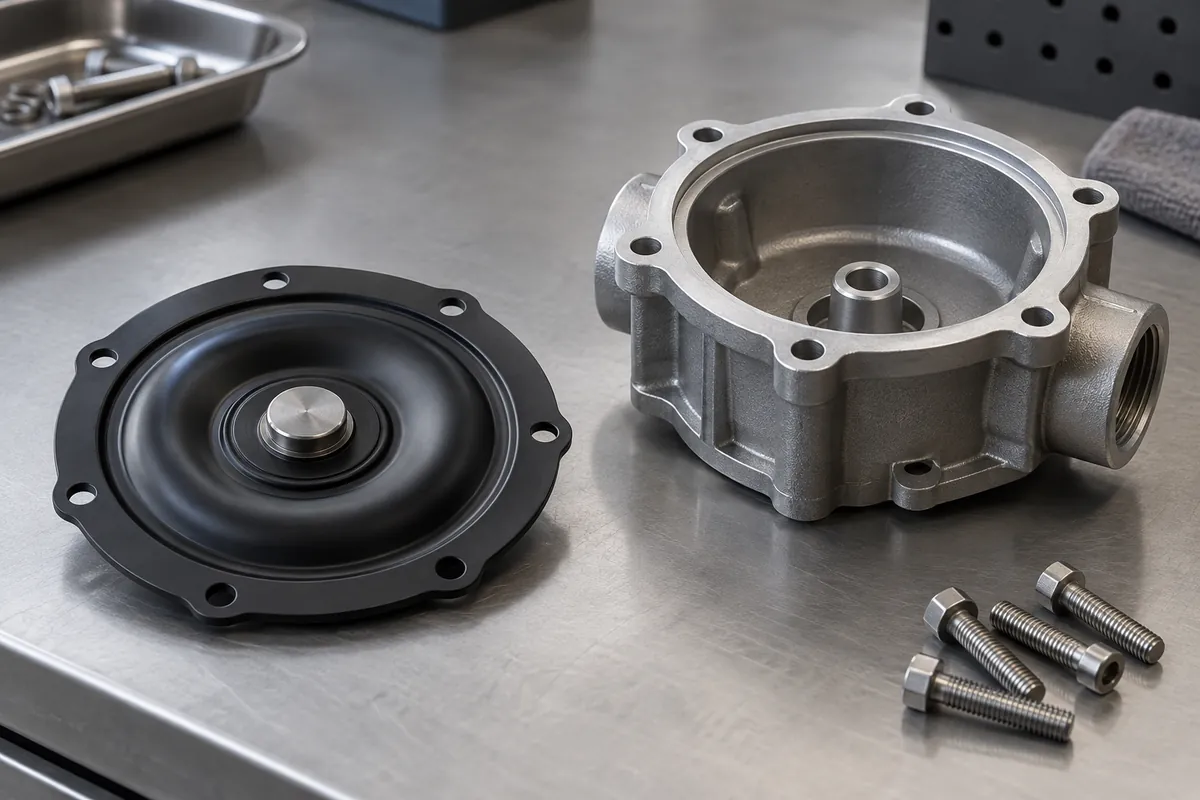
Release a defined assembly rather than a generic seal
Request separate feedback on molding feasibility and functional validation. A supplier may be able to manufacture the profile accurately without having evidence for the intended duty cycle. Keep sample inspection, assembly approval and endurance qualification as distinct deliverables in the development plan.
For a new design, compare the thickness and stroke relationship before committing to the tooling. Changing only the membrane material after a mechanical interference is discovered rarely resolves the underlying problem in a controlled way.
Retain the approved housing revision with the diaphragm drawing. Later changes to piston radius, clamp depth or travel stops should trigger review of the flexible component. The production requirement is the tested combination, not simply a diaphragm that resembles the original prototype.
Discuss the component and its acceptance requirements
Explore our custom silicone diaphragms and the related project case study. Send the current drawing, mating-part details, operating conditions and required quantities. We can review tooling, molding and inspection as a defined supply scope, with development samples and production approval kept separate.