
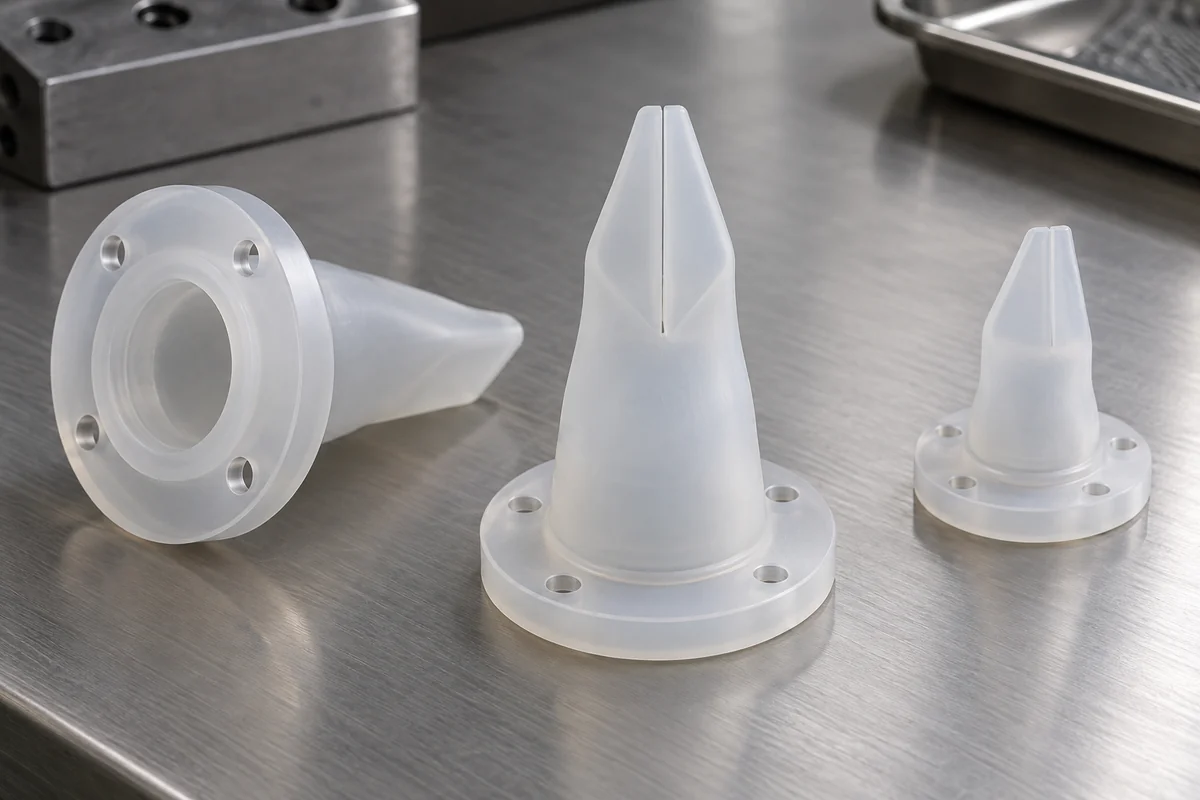
Product design illustrations. Final geometry, materials and acceptance criteria are project-specific.
A request for a silicone duckbill valve often begins with an outside diameter and a desired opening pressure. Those two values leave much of the supply scope undefined. The valve must fit a housing, interact with a particular fluid and close under a specified reverse condition. A useful quotation connects these requirements with the manufacturing route and the evidence needed to approve a part.
This guide concerns custom small molded elastomer components. It is not a selection chart for drainage outfalls or a promise that a miniature valve can replace a rated pipeline assembly. Before funding tooling, compare an available catalog component with the actual interface requirements. Custom development becomes relevant when a controlled housing, geometry or repeated supply requirement cannot be met appropriately by that option.
Describe the valve and its housing together
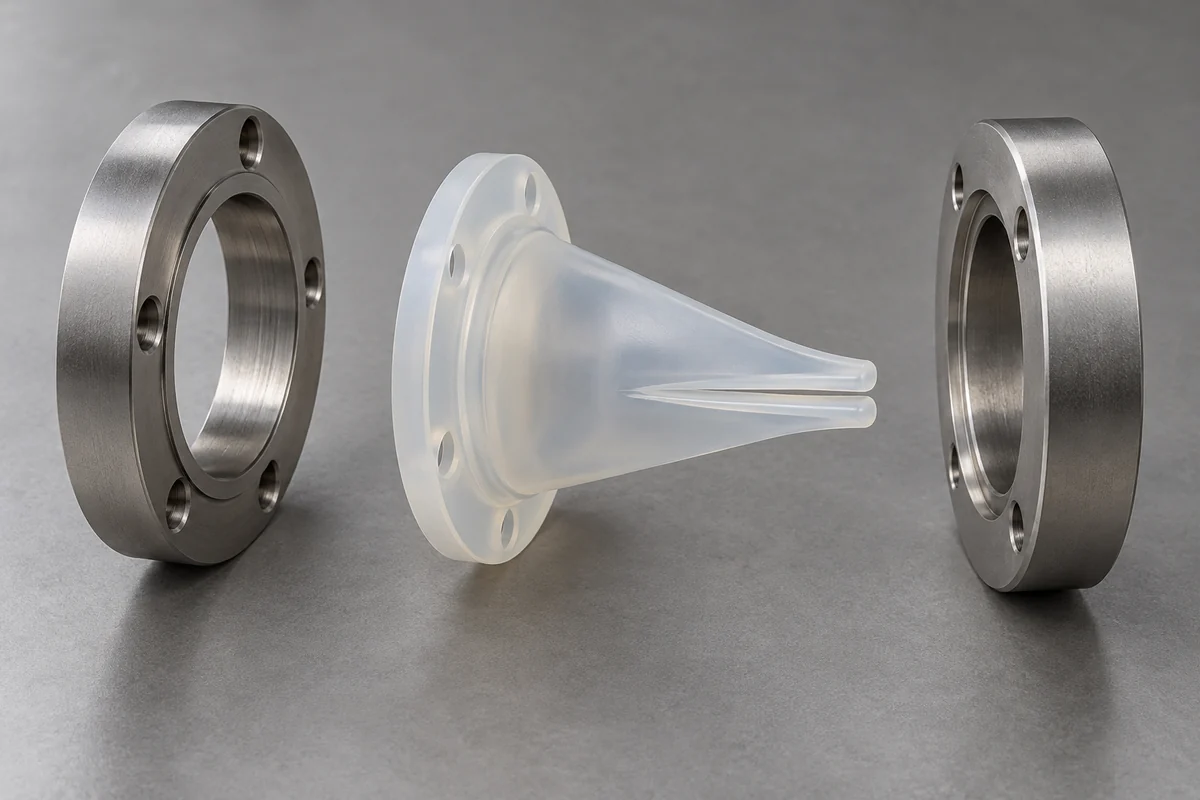
Provide the part drawing, a housing section and the assembled orientation. Identify where the flange is clamped, which surfaces locate the valve and where the flexible lips need clearance. A supplier cannot reliably infer these relationships from a photograph of the loose silicone part. Include the revision of both components so a later housing change is visible to the review.
The manufacturer's explanation of duckbill operation describes flexible lips that open for forward flow and close against backflow. That mechanism makes the lip region functionally different from the mounting flange. The RFQ should distinguish dimensions controlling retention from features controlling the opening and closing behavior.
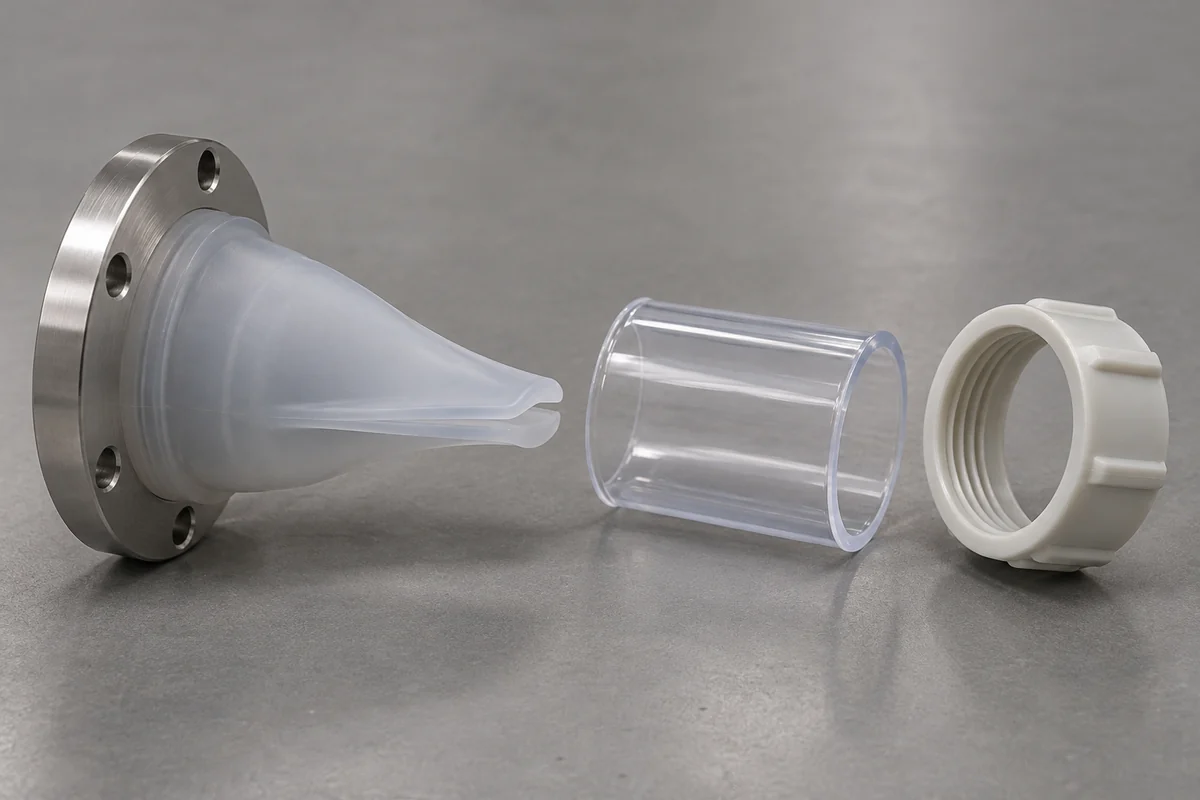
State who owns the housing and who supplies it for validation. A molded part can meet its free-state drawing but behave differently after installation. If the quotation includes only loose valves, assembly testing may be outside its scope. Agree whether the supplier delivers components, assembled cartridges or both, and provide the mating parts necessary for that deliverable.
Turn performance words into testable conditions
Opening pressure, flow rate and reverse leakage are separate requirements. Write an opening criterion, a forward pressure difference for the required flow, and a reverse-pressure condition with a hold time and leakage limit. The phrase low pressure does not tell a supplier which of these properties matters most or how acceptance will be decided.
Name the test fluid, its temperature and any relevant conditioning. Include the operating range and whether the device starts dry, remains wetted or experiences long periods of storage. A water-based bench check can support a development comparison, but it does not establish compatibility with every drug, solvent or cleaning fluid. Keep the actual exposure list in the controlled specification.
Separate normal operation from a proof test and from fault conditions. A component surviving a brief reverse-pressure hold is not automatically qualified for continuous service at that pressure. Similarly, one recorded forward-flow point does not establish a complete pressure-flow curve. Ask what the proposed test demonstrates and what remains a system-level responsibility.
Make finishing and evidence part of the quotation
Clarify whether the slit is formed during molding or introduced afterward, and include any required post-cure, cleaning or coating. These operations can change cost, lead time and the state of the part that needs evaluation. A quotation for an as-molded component is not equivalent to one for an inspected, finished valve even when their drawings share the same overall dimensions.
Define the material identification and supporting documents. A family name such as silicone is not a complete purchasing specification. If a particular regulated application is intended, assign responsibility for reviewing the finished component and device evidence. Do not turn a requested certificate or a supplier's material description into a claim that the final assembly is already approved.
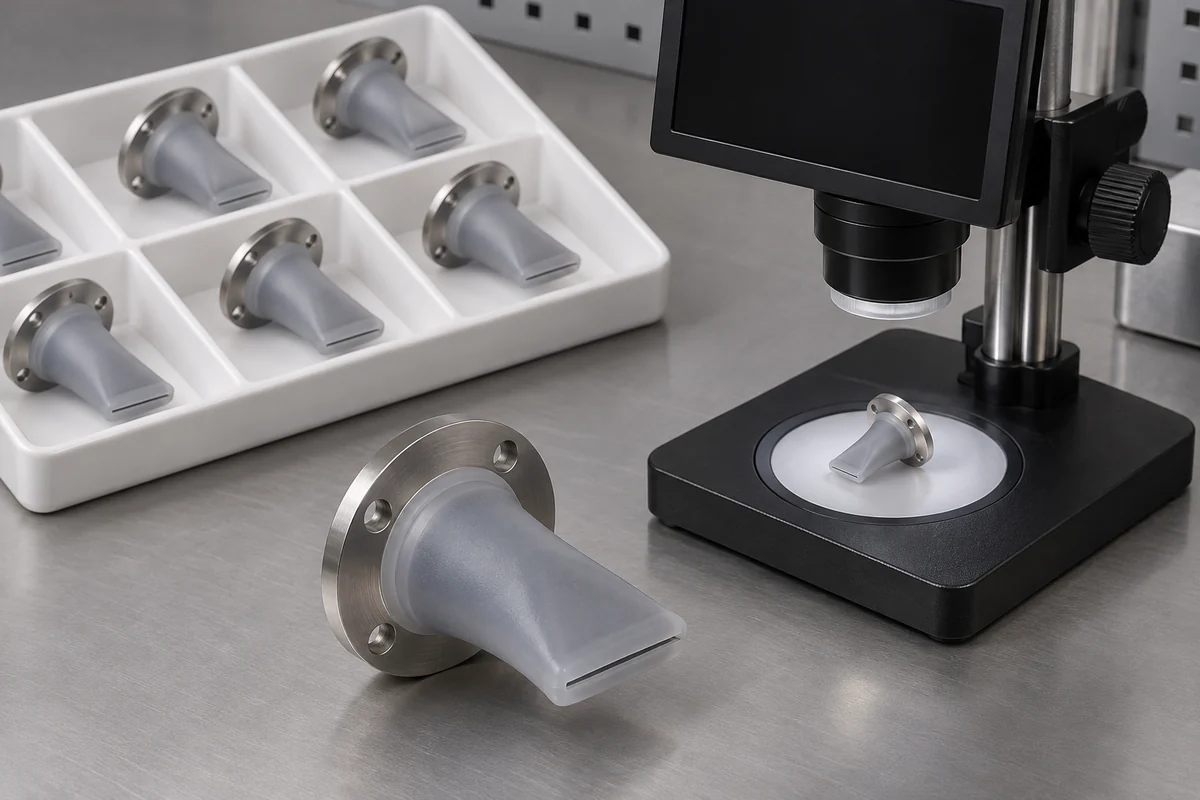
Discuss trial quantities and cavity identification before requesting routine production pricing. Some inspections are destructive; others require assembled samples or dedicated fixtures. Keep the quantities for development, qualification and delivery separate. This helps explain a tooling or test charge without hiding it inside an apparently comparable unit price.
Compare proposals against the same release scope
Review each proposal against the same drawing revision, material, finishing sequence and acceptance method. Resolve exclusions before selecting the lowest quoted unit price. Differences in coating, test fixtures or inspection coverage may represent different products rather than purchasing savings. Record which open decisions can change tooling and which can be resolved during a controlled trial.
Use our opening-pressure guide and backflow-test guide to define the evidence alongside the commercial scope. The RFQ is ready when the supplier can state what will be supplied, what will be checked and which approvals remain with the equipment owner.
Review your valve application
Explore our custom LSR silicone duckbill valves. Send the component and housing drawings, fluid conditions and acceptance methods to define the molding, finishing and inspection scope.