
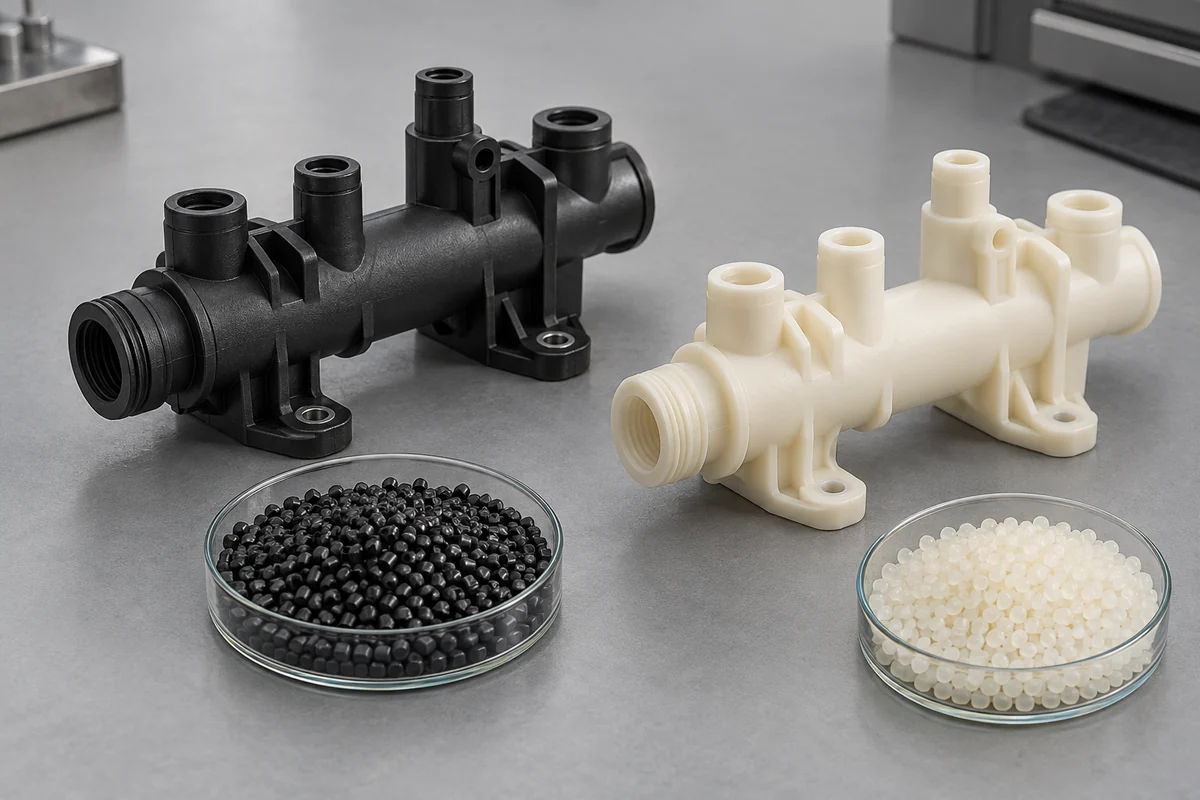
Product design illustrations. Final geometry, materials and acceptance criteria are project-specific.
Choosing PPS or PA66 for a fluid manifold is not a contest between two temperature numbers. The component must retain the required geometry, sealing behavior and mechanical performance in its actual fluid environment. A resin that looks stronger in a dry datasheet comparison may not answer the question that matters after conditioning, assembly and prolonged operation.
Begin with exact candidate grades rather than polymer names. Reinforcement, additives and supplier recommendations affect the relevant evidence. The color of a sample does not identify its chemistry or formulation. Material selection should remain a documented engineering decision, not a visual judgment based on a black part looking more industrial than a natural-colored one.
Translate the application into comparable conditions
List fluid composition, concentration, temperature, pressure history and required life. Include cleaning agents and storage if they can change exposure. For a cooling circuit, identify whether fresh fluid and aged fluid have the same controlled specification. A statement that a polymer resists glycol is incomplete when the concentration, additives and combined mechanical loading are left unspecified.
Separate continuous conditions from occasional extremes. A short excursion, repeated start-up cycle and sustained operating temperature can require different evidence. Keep the proposed development tests distinct from service requirements. Otherwise, the easiest test to run can quietly become the definition of acceptable performance instead of representing the intended duty.
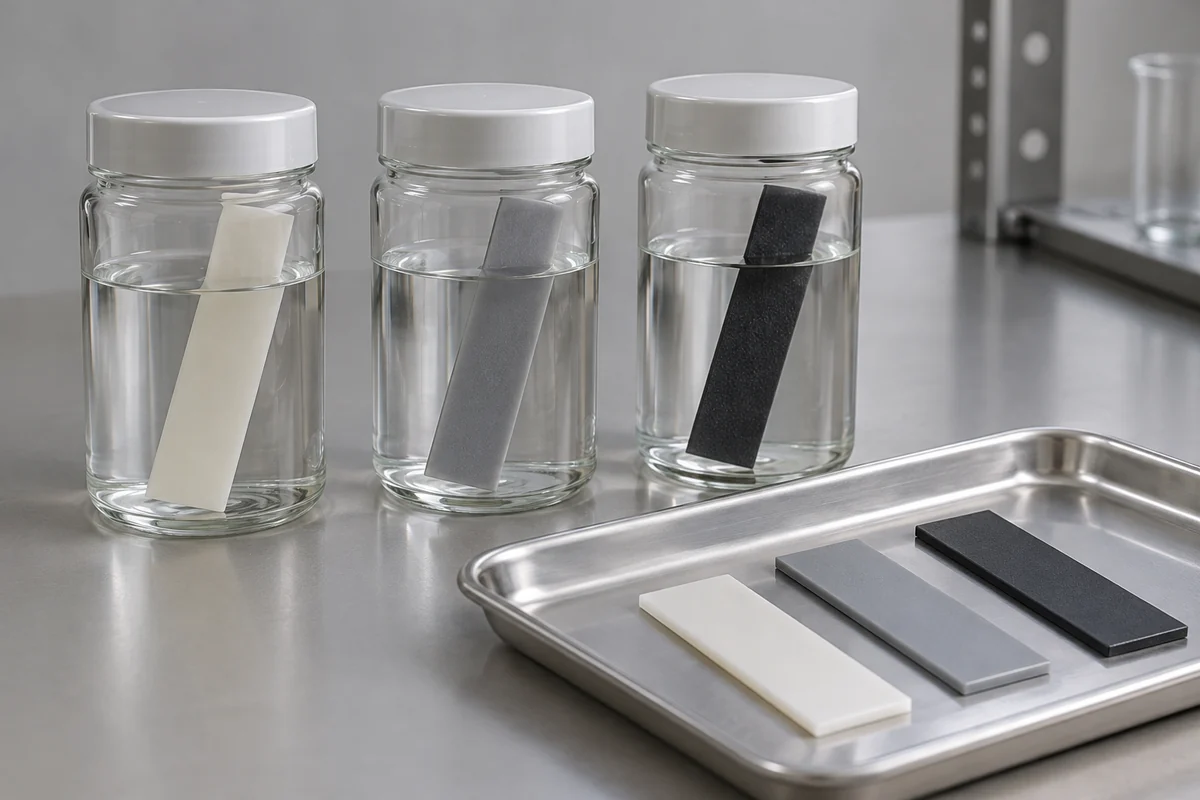
Include conditioning when judging nylon candidates
For PA66, ask which conditioning state the material data and dimensional checks represent. BASF's Ultramid brochure describes water uptake and associated dimensional and mechanical changes. Dry-as-molded and conditioned specimens are not interchangeable baselines. Evaluate the selected formulation in the required state, including the dimensions that determine port alignment and sealing.
Do not assume that all nylon candidates should be rejected or accepted together. A supplier may propose a formulation intended for a particular fluid duty, but its supporting data still need to match the application. Compare the actual grade, specimen conditions and retained properties before deciding whether a less expensive material creates additional design or qualification work.
Treat PPS data as evidence, not an automatic pressure rating
Celanese's Fortron PPS design manual discusses hydrolysis resistance while noting strength changes in reinforced grades after hot-water exposure. It also cautions that chemical-resistance guidance does not reproduce every loaded environment. That is a reason to evaluate the actual grade and part, not to convert a general resistance statement into a lifetime guarantee.
A manifold adds weld lines, changing section thickness, port loads and assembly constraints to the material question. Where a datasheet coupon does not represent those features, define the additional evidence needed. A short-term tensile value or elevated-temperature property may help screen candidates without establishing the allowable pressure of the finished assembly.
Compare the complete manufacturing route
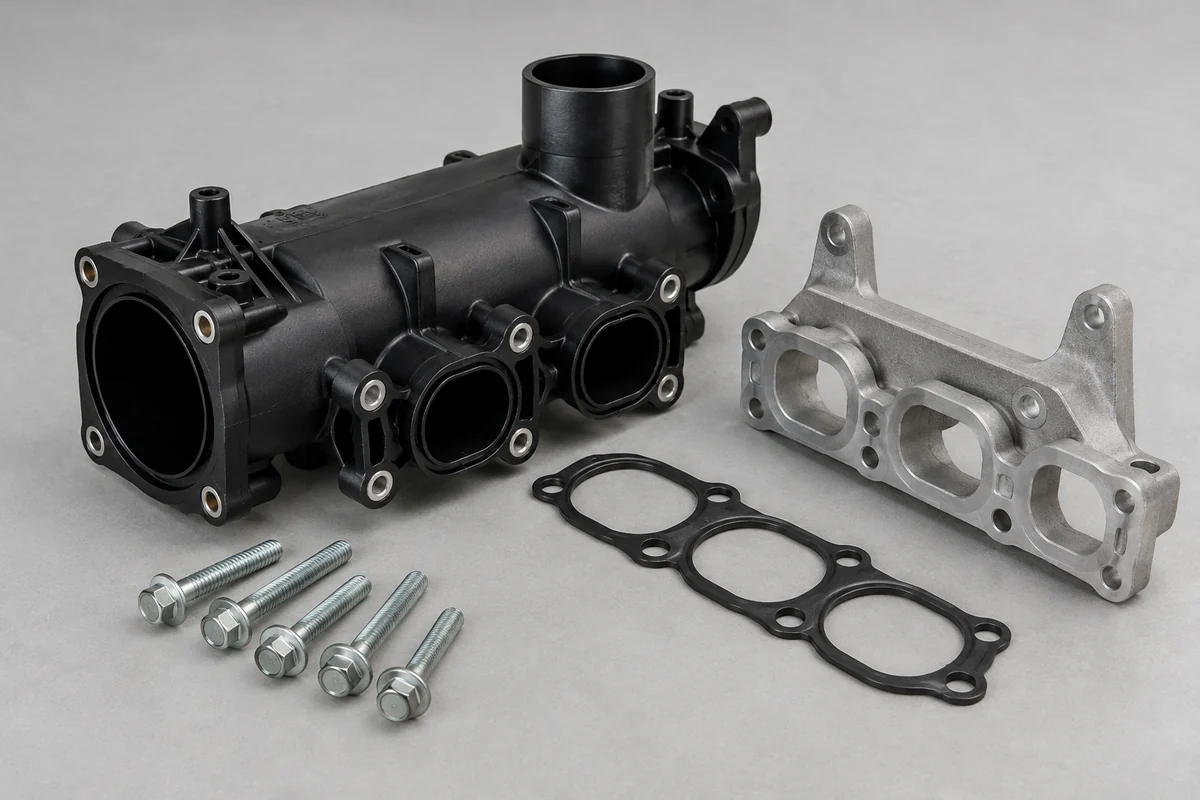
Review the mold and process implications with the proposed supplier. The candidate resin must fill the intended channels and wall regions while preserving the required interfaces. Do not assume that changing material in an existing tool leaves dimensions unchanged. A substitution can require new processing work, dimensional review and another sample-approval decision.
Include inspection and secondary operations in the cost comparison. A lower resin price may not translate into lower delivered cost if conditioning, rework, additional assembly or more extensive inspection is needed. Conversely, selecting a premium material should have a clear technical purpose. It should not compensate for an undefined acceptance requirement.
Ask which molding assumptions were used to assess each candidate. Gate choices, cooling, ejection and the feasibility of direct molded sealing faces deserve an explicit review. The gate and weld-line guide covers the relationship between the filling plan and the locations that may need additional validation.
Move from material screening to a component decision
A sensible comparison can start with supplier data and controlled specimens, then progress to molded components with the intended fittings and seals. Define what each stage answers. Exposure coupons may help identify a poor candidate; they do not necessarily reproduce a stressed port boss, an internal weld line or the dimensional stack of the assembly.
Agree observations and acceptance before testing. Depending on the project, these may concern dimensions, cracking, retained mechanical behavior, seal function or changes after conditioning. Record specimen identity and exposure history. An unexplained pass is difficult to compare with a later trial that uses another fixture, fluid formulation or sample state.
Keep unresolved lifetime work visible when choosing a trial material. A candidate can be suitable for the next development step without being approved for unrestricted production use. Our manifold RFQ guide shows how to communicate that stage clearly so that the quotation covers the next useful decision rather than an unsupported promise.
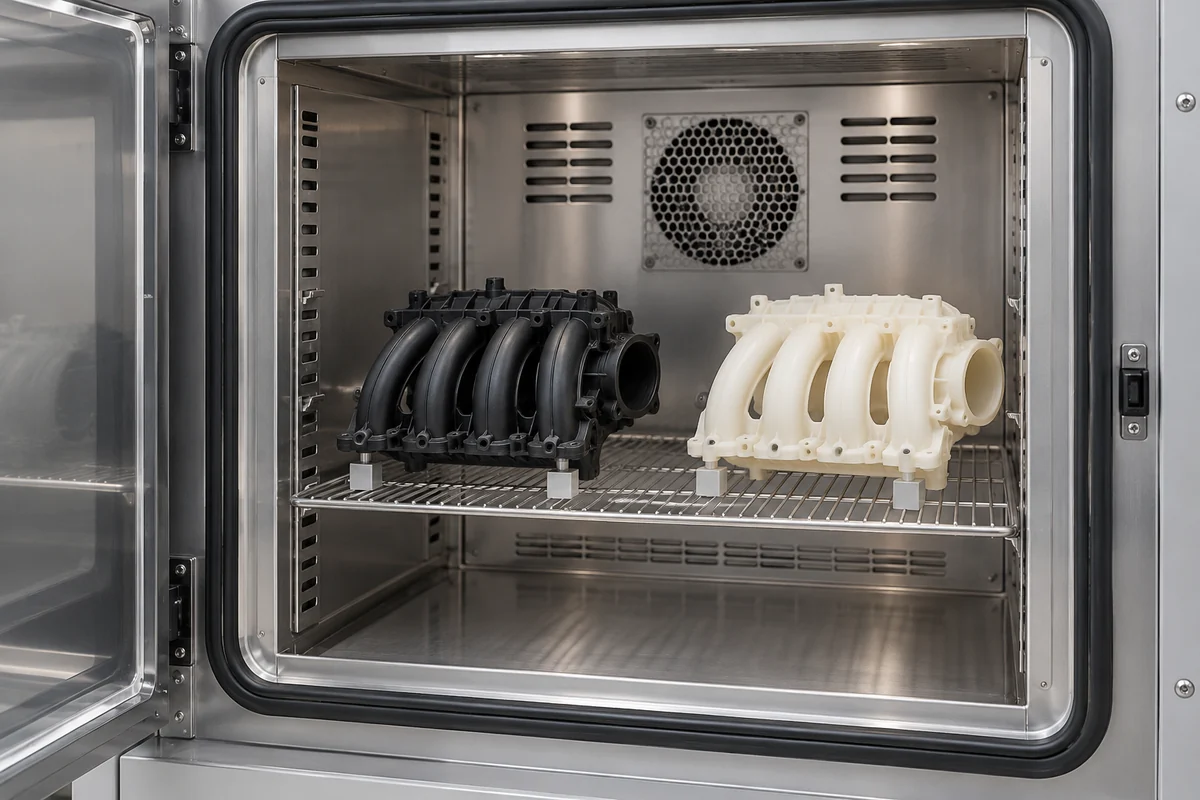
Discuss your molded fluid component
Explore our custom injection-molded fluid manifolds and the PPS liquid-cooling manifold trial case. Send the controlled drawing, mating interfaces, fluid conditions and acceptance requirements. Tooling, sample inspection and system qualification should have separately agreed deliverables.