
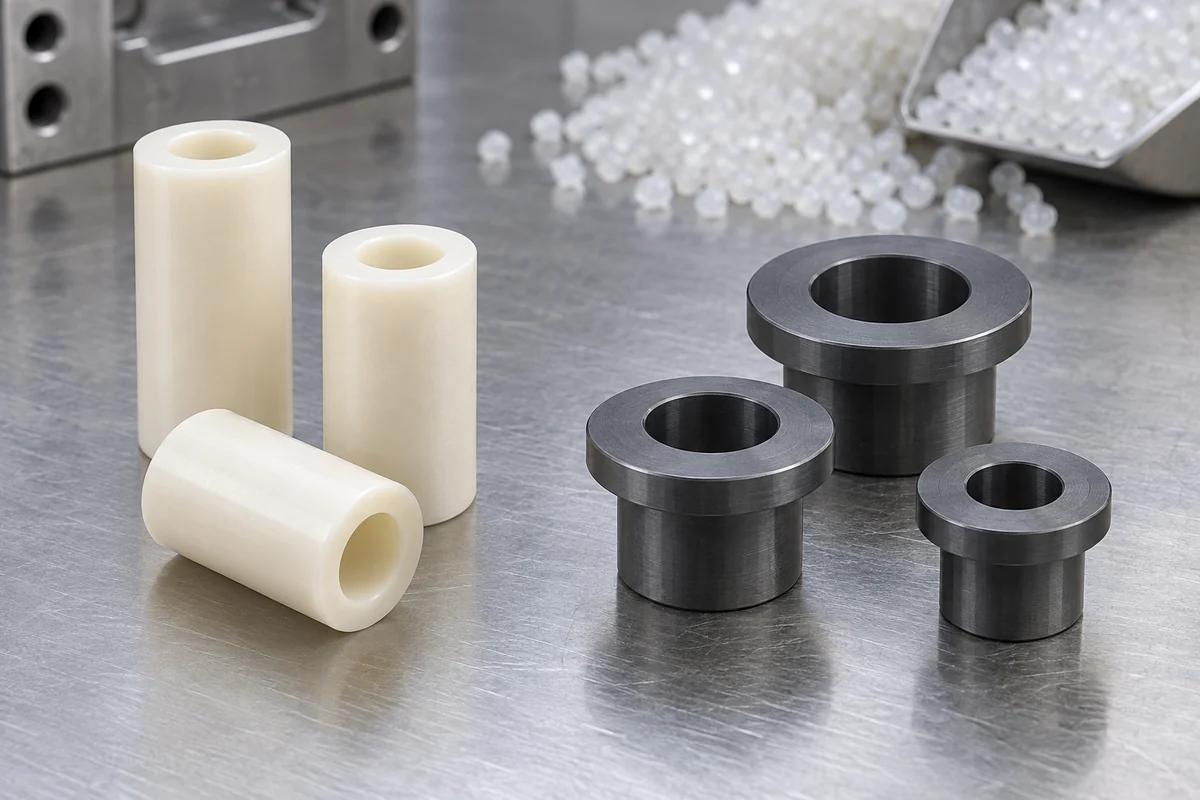
Product design illustrations. Final geometry, materials and acceptance criteria are project-specific.
A plastic spacer may look like a simple tube, but its material influences the distance it maintains after assembly. A board support that fits correctly at incoming inspection may face heat, humidity and screw compression in service. Choosing between nylon and POM therefore starts with the assembled function, not the color of the sample or the highest strength value in a material table.
For a static spacer, define the gap, contact faces and fastening arrangement first. Does the spacer carry sustained bolt compression, provide a locating shoulder, or simply prevent two components from touching? These are different jobs. A resin suitable for a lightly loaded locating feature is not automatically suitable for a highly preloaded support with a critical long-term height.
Compare exact grades in a defined condition
Nylon describes several polyamide families and many filled or modified grades. POM also includes different formulations. Comparing a reinforced nylon with an unfilled acetal while calling the result a universal nylon-versus-POM conclusion hides important differences. Record the exact candidate grade, reinforcement, color formulation and the properties that matter to this assembly.
Manufacturer data illustrates the need for that detail. BASF's B3EG6 grade information identifies reinforcement and moisture-related conditions rather than assigning one property set to every nylon. Use the current sheet for the grade actually proposed; this particular grade is an example of data structure, not a recommendation for your spacer.
Separate resin preparation before molding from conditioning of a finished part. A drawing should make clear the state in which dimensions are accepted and how that state relates to assembly. A delivery inspection carried out immediately after opening a sealed bag should not quietly be compared with a development sample stored for weeks in a different environment.
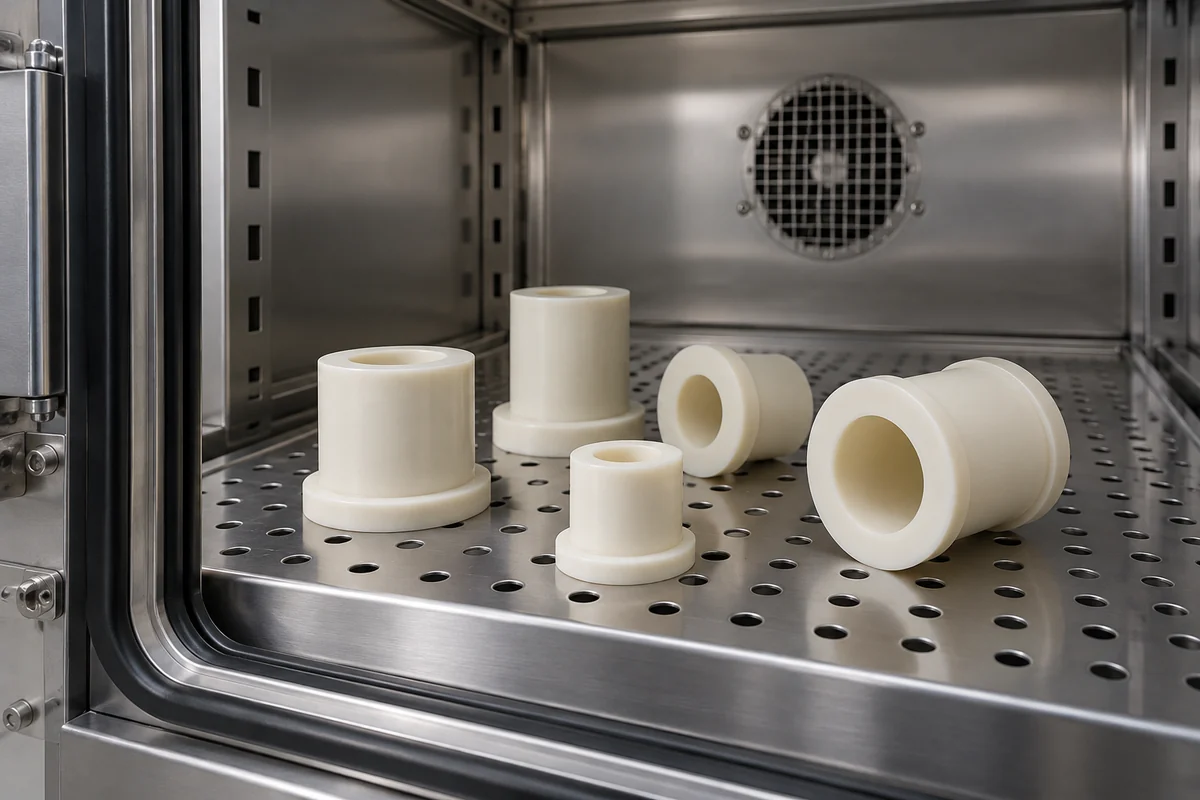
Use assembly height to organize the comparison
Imagine a hypothetical board supported at four corners. The important outcome is not just whether one loose spacer meets its nominal length. The four supports, board, base plate and fasteners establish the finished plane. If the two material candidates are measured under different conditions, an apparent material advantage may actually be a difference in how the samples were prepared.
Evaluate the same drawing and counterpart revisions with each candidate. Check the height at the intended bearing faces, inspect the contact pattern, and observe the board after tightening. Keep results from loose parts separate from installed assembly results. This makes it possible to identify whether a concern belongs to the material, molded geometry or fastening procedure.
Our spacer height and tolerance-stack guide explains how to connect the component dimension to the assembled clearance. Material selection should support that dimensional plan. It should not become a reason to assign an unnecessarily tight tolerance to every feature while leaving the functional reference undefined.
Check the load path before comparing strength numbers
Follow the force from the screw head through the washer, supported component, spacer and base. A narrow bearing area or a tilted contact face can matter even when the nominal spacer diameter looks generous. Increasing bulk material strength does not fix an assembly that presses against a small edge instead of a flat annular face.
Time also matters. A short installation trial is useful for fit, but it cannot demonstrate the height retained during a long loaded dwell. Define the service temperature, load duration and allowable movement, then seek the relevant grade data and an appropriate assembly test. The creep and bolt-preload article separates those questions from an initial torque check.

Keep electrical and chemical requirements explicit
If the spacer creates separation near conductors, list the actual electrical requirements with the equipment designer. A nonmetallic appearance does not establish an insulation rating, a required clearance or a flammability classification. Any material recognition must be checked against the exact grade, color, thickness and intended use, and it is not a certification of the completed assembly.
Similarly, write down the chemicals, cleaners and exposure conditions rather than asking for a generally chemical-resistant spacer. A supplier can then identify candidate data and gaps. Do not carry an approval from a different nylon formulation or an unstressed specimen directly into a tightened spacer joint.
Make the purchasing decision traceable
Ask for sample proposals that identify the candidate grade and manufacturing route. Include the same inspection state, fit checks and required supporting documents in each proposal. If one supplier changes the resin to achieve price or availability, treat that as a technical change requiring review rather than an interchangeable purchasing substitution.
A useful decision record explains why a candidate was accepted, what evidence supports the decision and which conditions remain untested. It can also record why the other candidate was rejected. That short explanation is more valuable during a future material shortage than a note saying only that nylon or POM was selected because it was better.
Discuss your custom spacer
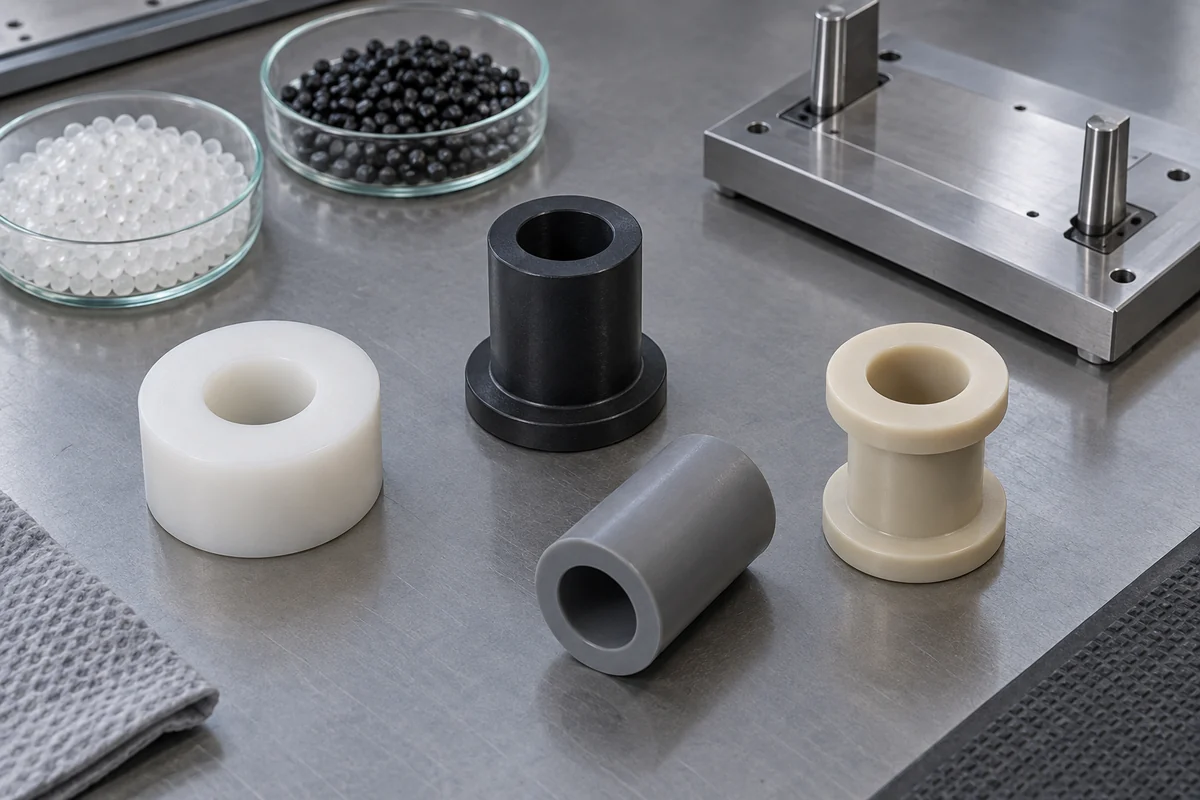
Explore our custom injection-molded plastic spacers and standoffs. Send the drawing revision, mating components, material requirements and expected quantities. FECISION can review the molding and sample-approval scope; application ratings and final acceptance must follow the agreed project requirements.