
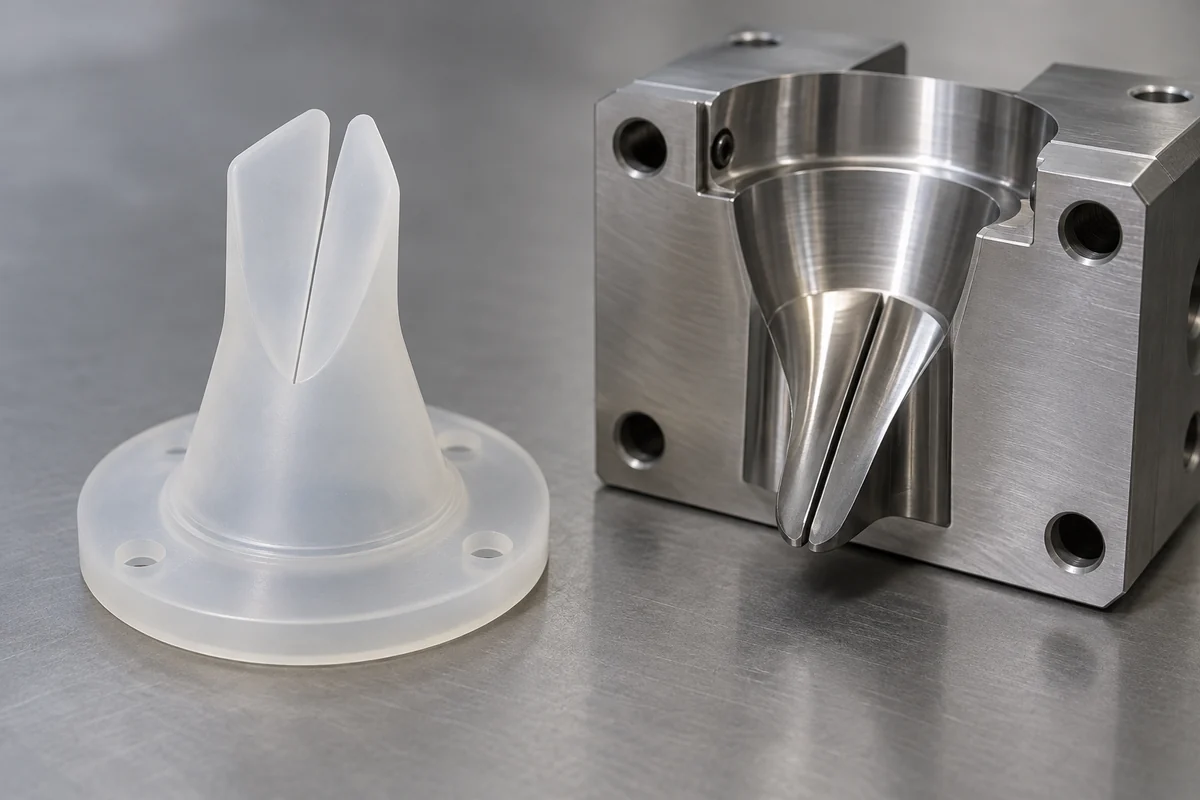
Product design illustrations. Final geometry, materials and acceptance criteria are project-specific.
The slit in a duckbill valve is small, but it is not a minor cosmetic detail. Its position, length and condition interact with the flexible lips and the assembled housing. A drawing that specifies only a nominal cut length can leave the manufacturing team uncertain about the required finished geometry. Review the slit as part of the valve's complete functional configuration.
The objective is not to impose one universal lip thickness or a preferred cutting process on every design. Different materials, envelopes and fluid conditions need different evaluations. A manufacturing review should make the proposed construction inspectable and repeatable, then connect it to the opening and backflow checks required by the application.
Review the wall transition as well as the tip
Show sections through the flexible region, the inlet body and the mounting flange. Identify where dimensions apply and whether they describe the free state or a supported measurement. Soft parts can deform during inspection, so a contact measurement may not describe the same geometry as an optical section. Agree the method alongside any tight dimensional requirement.
Consider what the mold must produce and how the part will leave it. An abrupt transition, thin feature or difficult-to-support region may complicate filling, venting, release or inspection. The tool review should explain the proposed core construction and where parting interfaces occur. A visually smooth computer model does not resolve those manufacturing questions by itself.
Keep the contact surfaces at the lips distinct from less critical external areas. A permissible vestige elsewhere may not be acceptable at a sealing line. Mark the areas to be protected from flash, damage or contamination, and describe the observation method. Avoid a blanket defect-free statement that cannot be applied consistently during inspection.
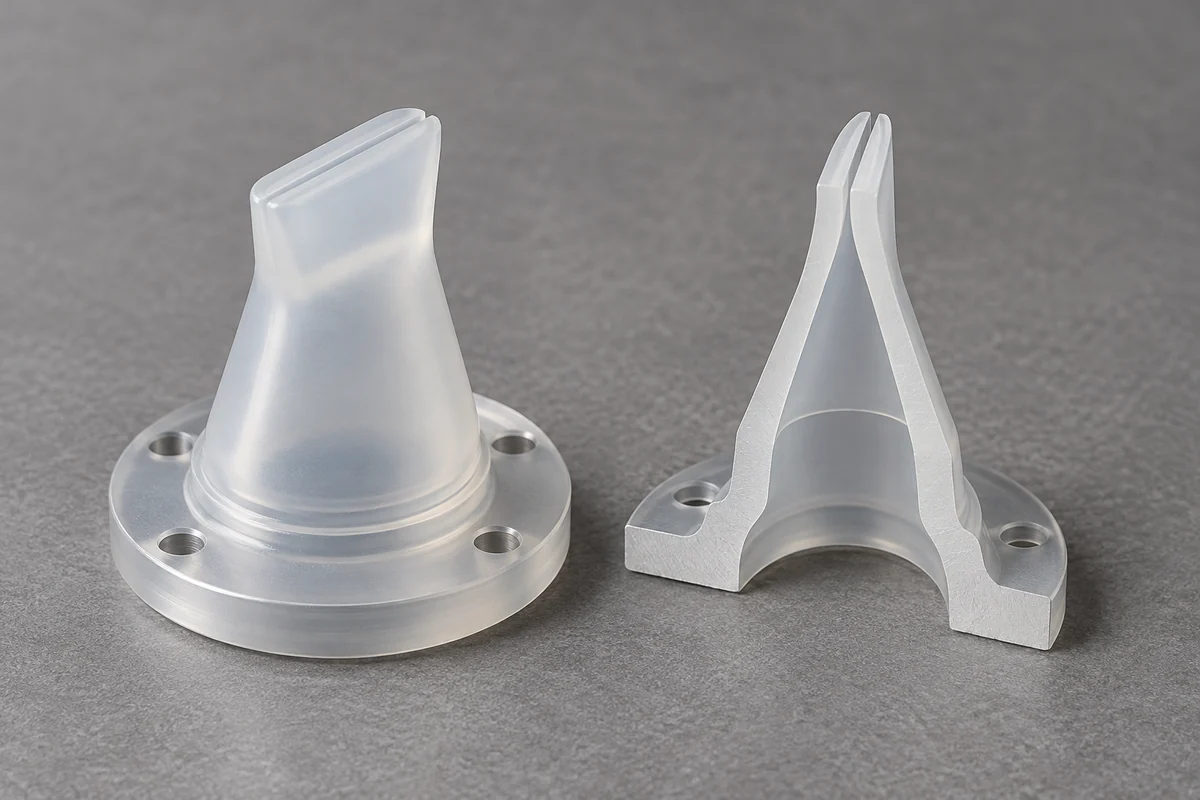
Compare a molded opening with a secondary slit
A directly formed opening makes the tool interface part of the opening definition. A secondary slit introduces a locating and cutting operation after molding. Each route has different tooling, handling and inspection requirements. Decide from the geometry and trial evidence rather than assuming that eliminating a secondary operation necessarily improves the finished valve.
For a secondary slit, define the feature that locates the part in the fixture. The cutting tool must relate to the molded lips, not to an arbitrary outer surface that may vary independently. Discuss blade condition, cut path and how an incomplete or misplaced slit is detected. These are process-control questions, not evidence that a particular setup has already achieved a tolerance.
For a molded opening, review the relevant shutoffs, support and wear control with the toolmaker. Specify how the actual resulting opening will be inspected after cure and release. The manufacturability decision includes maintenance and repeat production, not just whether one good sample can be produced. Keep the trial results tied to the exact tool and material revision.
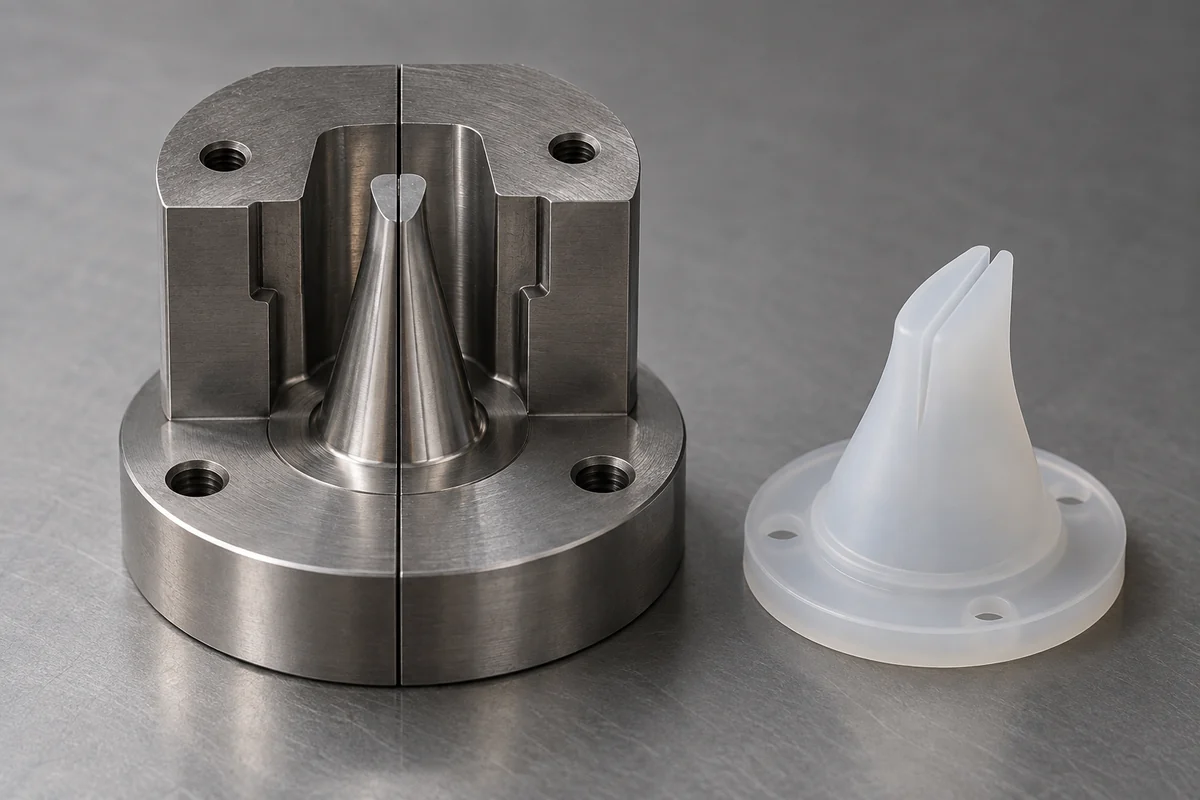
Define the complete finishing sequence
Write down where post-curing, trimming, slitting, cleaning and any coating occur in the process. Do not let each operation use an independently chosen sample condition. A dimension taken before a thermal or surface treatment may not be the correct acceptance measurement for the delivered component. The approved sequence belongs with the production specification.
If a surface treatment is proposed to address sticking, define its location and the evidence needed to assess it. A coating on the finished silicone is not the same change as a coating on the mold. Neither should be described as improving flow or compatibility until the relevant finished parts have been evaluated. Record the treated and untreated states separately during development.
For regulated applications, the FDA's component documentation examples emphasize the relevance of formulation, processing and final finished form. A new coating or cleaning operation therefore cannot be treated only as a cosmetic purchasing detail. The responsible device team should review its implications before transferring earlier material evidence.
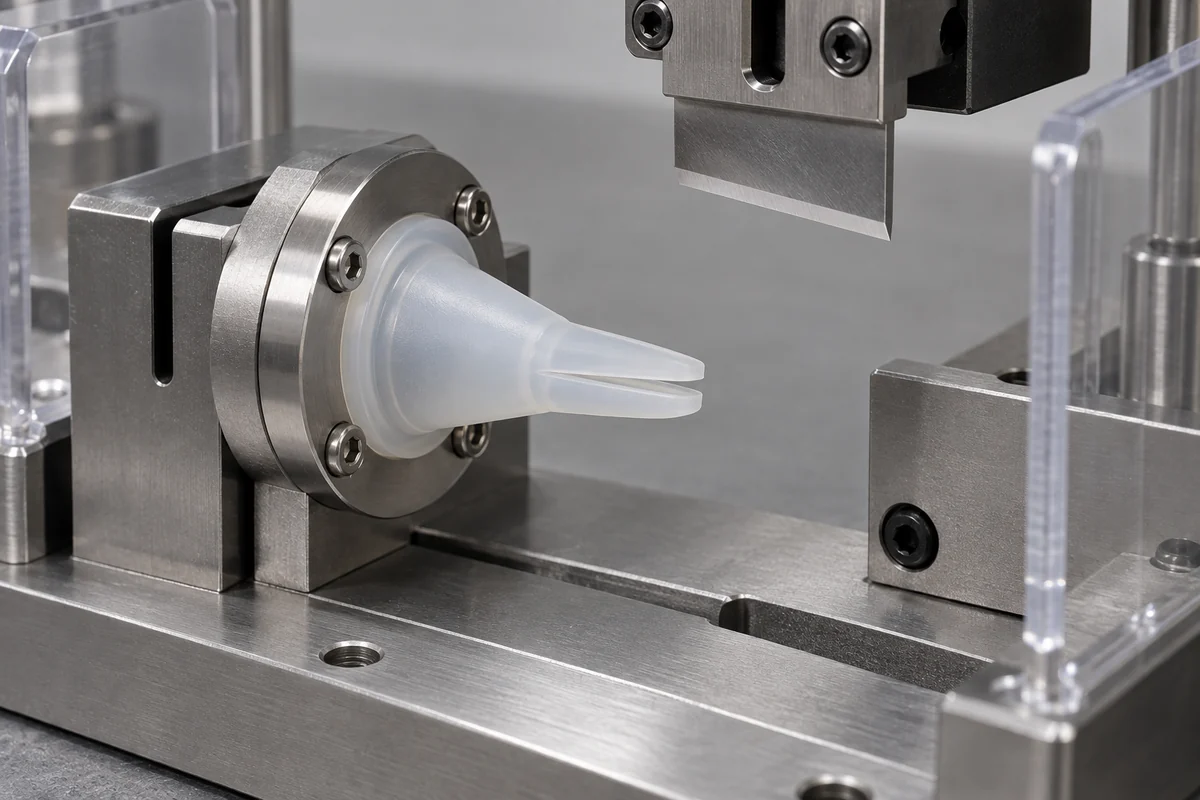
Approve geometry and function together
Inspect the agreed locations, retain cavity and finishing traceability, and test the finished state. Measure opening pressure and reverse leakage using defined methods. Dimensional acceptance does not automatically establish functional acceptance, and a functional sample does not remove the need to control critical geometry.
If a trial fails, preserve the sample and record which features changed before the next attempt. Do not combine a tool revision, a new slit setting and a coating change into an unexplained improvement claim. A useful development record shows the accepted configuration and the limits of its validation, making future changes easier to evaluate.
Review your valve application
Explore our custom LSR silicone duckbill valves. Send the component and housing drawings, fluid conditions and acceptance methods to define the molding, finishing and inspection scope.