
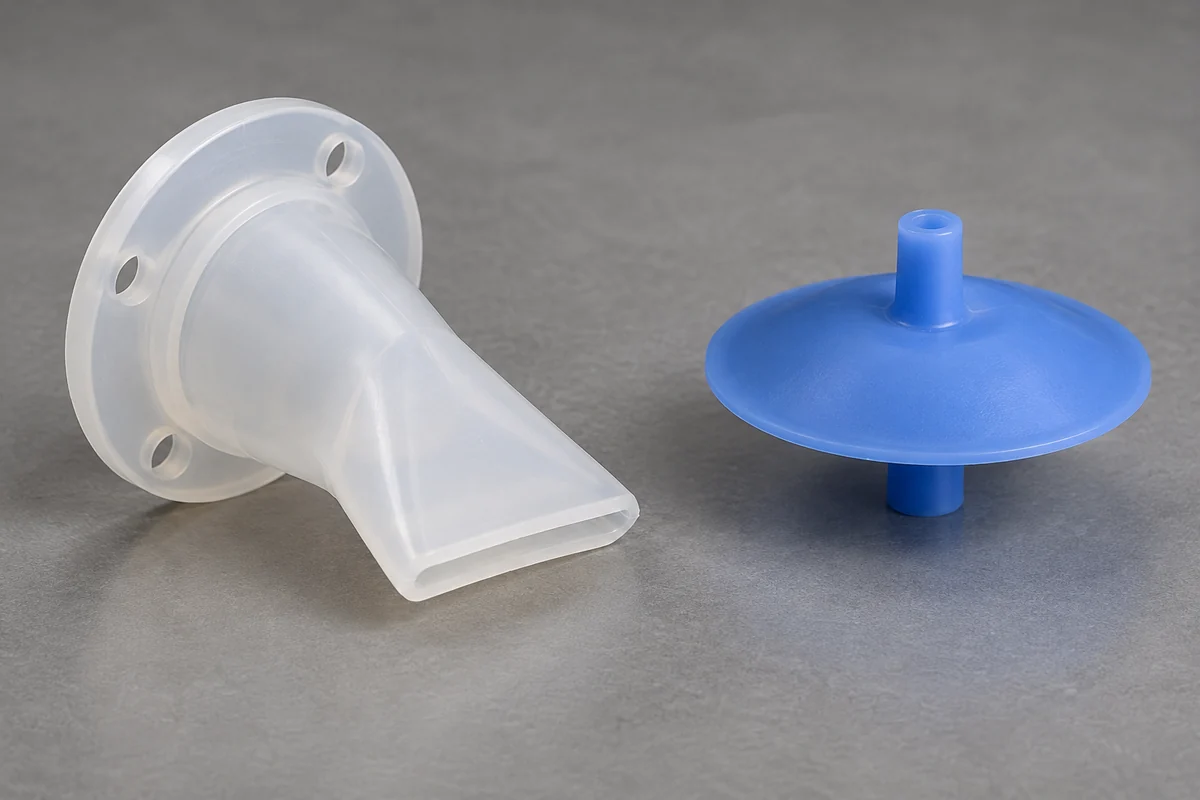
Product design illustrations. Final geometry, materials and acceptance criteria are project-specific.
Duckbill and umbrella valves can both provide a one-way function with an elastomeric component, but they do not use the same sealing arrangement. Choosing between them by appearance or by the word silicone misses the main design decision: where the flexible element seals and how it interacts with the housing. Compare the complete assembly before comparing component prices.
This discussion concerns small molded parts for a defined fluid circuit. It does not provide an interchangeable sizing rule or a universal pressure ranking. Within either family, geometry, material, mounting and manufacturing can differ substantially. A specific design must be evaluated against the same operating requirements before it can be selected.
Start with the sealing interface
A duckbill closes along its paired flexible lips. An umbrella design uses a flexible disk against a supporting seat. The manufacturer's duckbill description and umbrella description illustrate this mechanical difference. It shifts which features belong to the elastomer part and which must be supplied by the rigid housing.
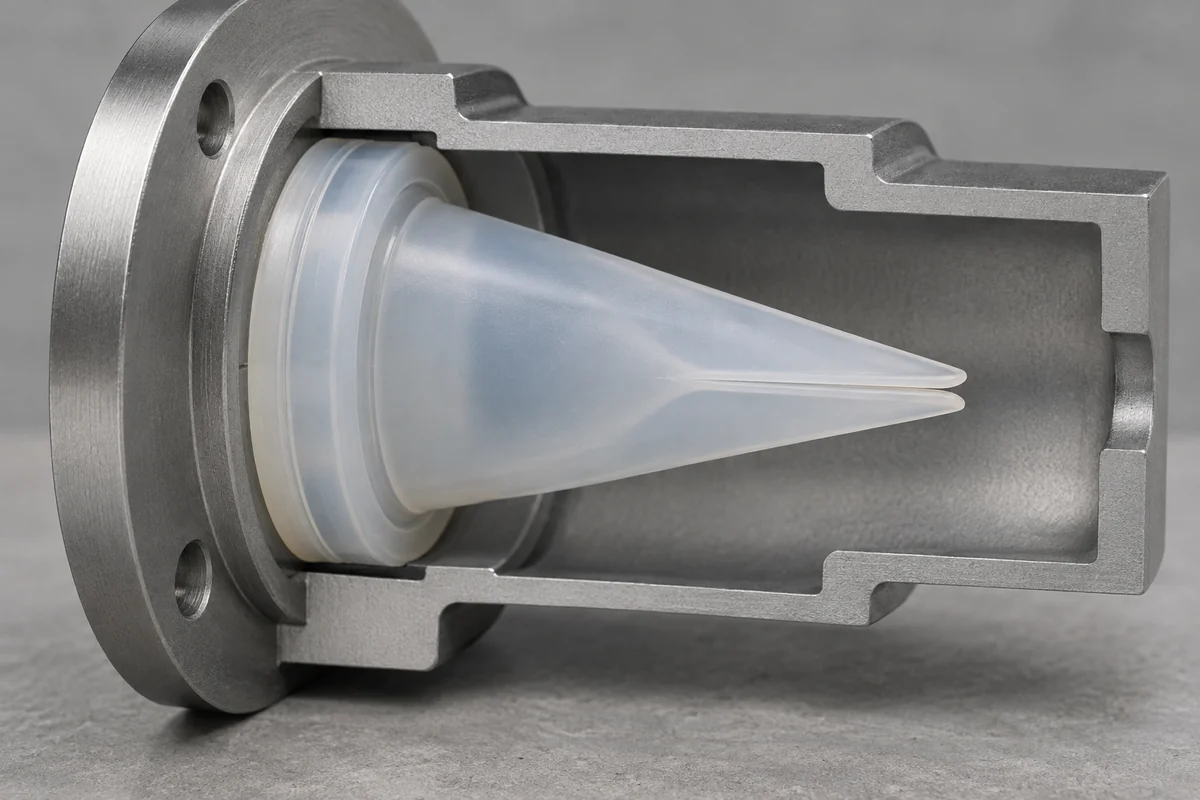
For the duckbill, review the lip geometry, slit condition and space needed as the bill opens. The flange or sleeve interface must retain the part without preventing its intended movement. The lips should not rub a housing wall merely because the nominal outside diameter fits. An assembly section often reveals this problem more clearly than separate part drawings.
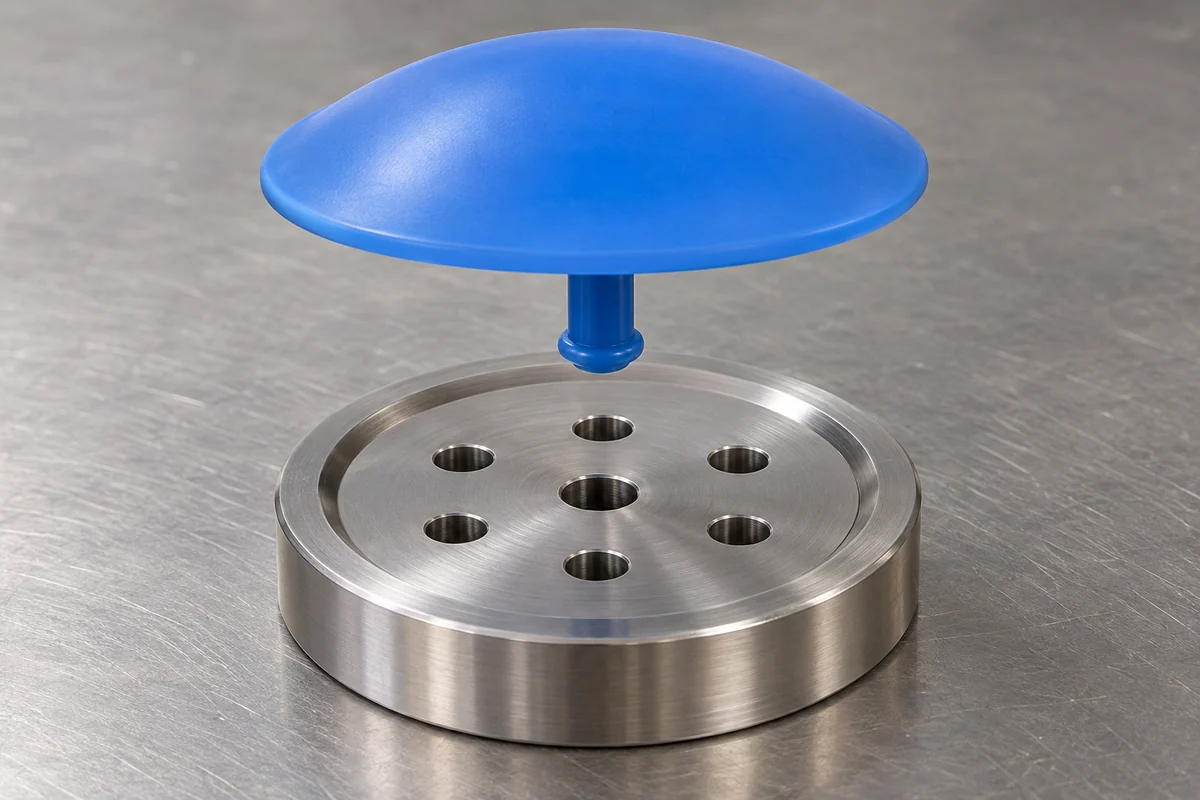
For the umbrella, the seat surface and its openings are part of the functional design. Consider the locating stem, seating arrangement and support under reverse loading. Changing the rigid seat can change the valve behavior even if the elastomer component remains unchanged. The purchasing specification therefore needs the relevant housing revision, not only the rubber part number.
Compare the available package and assembly access
Look at axial and radial space together. An elongated bill may fit a tubular layout, while a disk-and-seat arrangement may suit a different chamber shape. Neither layout is automatically smaller once retainers, ports and assembly access are included. Compare the installed envelope using real mating parts rather than comparing only the loose components.
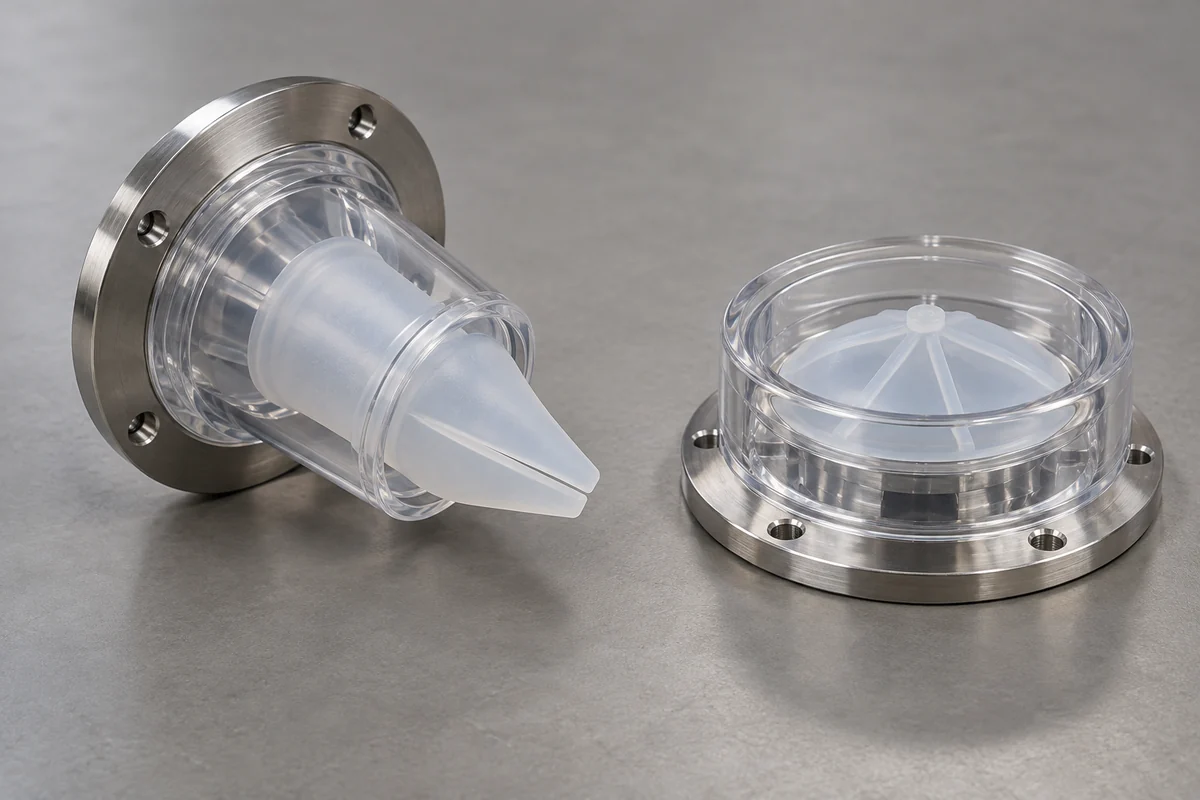
Ask how the operator or automated equipment will locate and verify the part during assembly. A design that is difficult to orient or inspect can move cost from molding into assembly and quality control. Consider access to the mounting feature and whether the completed assembly can be checked without disassembly. These practical issues should influence the design early.
Review cleaning access and trapped volumes when they matter to the application. A geometry that works in a dry bench demonstration may be unsuitable for a fluid that leaves deposits. Describe the exposure and cleaning sequence rather than using a broad cleanliness claim. The assembly review should identify which regions need evaluation and how they can be inspected.
Use matched test conditions for the comparison
Specify the same opening criterion, fluid and relevant flow points for both candidates. A supplier's headline cracking pressure may use a different detection method from the one your device requires. Ask for the measurement conditions before ranking designs. If the available data are not comparable, use them to plan a test rather than to declare a winner.
Evaluate reverse sealing separately and include the intended mounting tolerances. A candidate that opens easily may still fail the required backflow condition. Test the range of assembled conditions justified by the design, not just the most favorable hand-selected fit. Our leak-test guide explains how to separate the valve response from fixture effects.
Include repeat operation or exposure only when its conditions represent the application. A cycle count without a pressure history, fluid or failure criterion has limited value. If one design has not undergone the same evaluation as the other, mark that gap explicitly. A missing result is not proof of either superior or inferior performance.
Choose a manufacturable, verifiable configuration
Compare tooling, finishing, inspection and assembly costs after the functional shortlist is clear. A simpler loose part can require a more demanding seat or a separate finishing step. A slightly larger component may reduce assembly complexity. These trade-offs belong in a configuration review rather than a claim that one valve family is always cheaper.
For custom development, retain the reason for choosing a geometry and the evidence still required. Keep rejected alternatives and unresolved risks in the project record. If neither candidate meets the requirements, revisit the circuit or housing rather than forcing a material-only change. A documented selection makes the subsequent molding and validation scope easier to control.
Review your valve application
Explore our custom LSR silicone duckbill valves. Send the component and housing drawings, fluid conditions and acceptance methods to define the molding, finishing and inspection scope.