
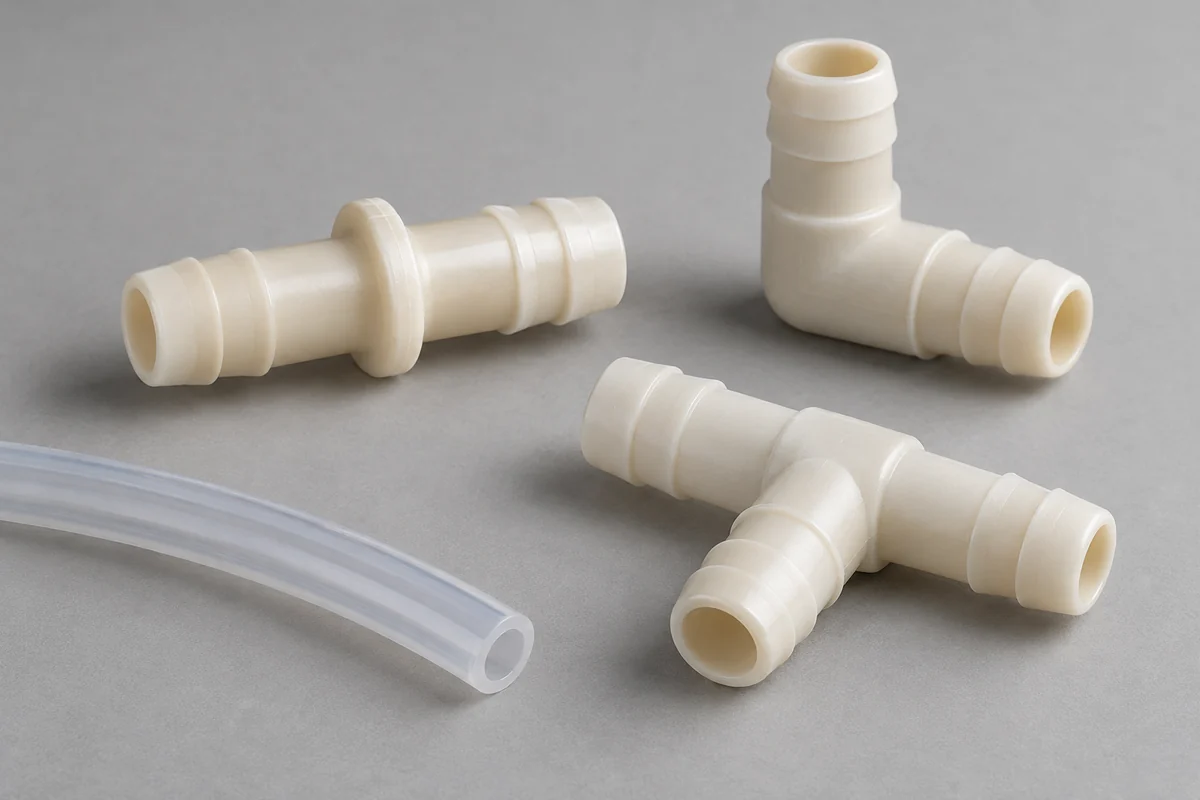
Product design illustrations. Final geometry, materials and acceptance criteria are project-specific.
A custom plastic hose barb is purchased as part of a connection, even when the order includes only the molded fitting. Its useful performance depends on the tubing, insertion method, environment and surrounding assembly. Sending only a nominal hose size leaves important decisions unpriced. Two suppliers can return different costs because they have silently assumed different deliverables.
Start by deciding whether a catalog fitting already satisfies the application. Custom tooling makes sense when you need a different mounting feature, branch arrangement, packaging envelope or controlled interface. It should solve a defined constraint. If the only requirement is a standard tube-to-tube connection, comparing existing fittings may be more appropriate than commissioning a new mold.
Identify what the quotation actually supplies
Show the current CAD and controlled drawing. Mark every included component: the molded body, inserted items, seals, tubing, clamps and any secondary operation. A quotation for loose fittings is not equivalent to one for cut tubing assembled to fittings. Make the difference explicit before comparing piece prices or asking whether inspection is included.
Define the opposite end of the connector as carefully as the barb. It may be a second hose interface, a threaded port, a flange or an integrated equipment feature. Include the mating drawing and installation space. An external shape that fits a bench prototype can still obstruct a clamp tool or interfere with the final enclosure.
Describe the tube rather than writing only its size
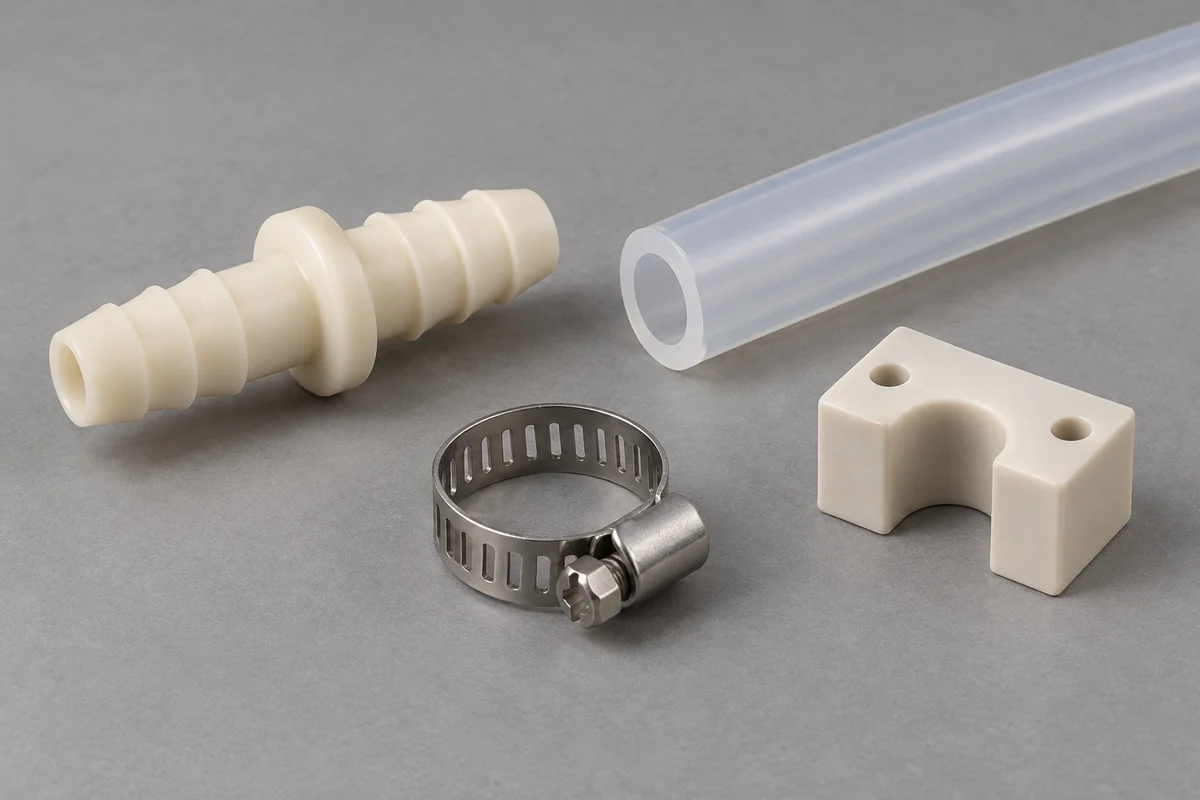
Provide the tubing manufacturer and exact specification where available. State inside diameter, outside diameter or wall thickness, tolerances, material and hardness. Clarify whether the dimensions describe an unassembled tube. The barb has to work with the actual tube population, not only with one nominal number copied from a purchasing description.
Explain the insertion depth, permitted assembly aids and whether a clamp is required. Give the assembler access limits and the allowed insertion effort if it is controlled. A change that increases pull-off resistance may also make assembly more difficult. Our tube-size and interference guide explains why these requirements need to be considered together.
Separate operating requirements from test requirements
Identify the conveyed medium and its temperature range. For an air system, disclose oil carryover, cleaning exposure or other relevant contaminants rather than treating compressed air as an unchanging environment. State expected pressure events, vibration, hose routing and external loads. These are inputs to the engineering review, not proof that a proposed polymer already meets the duty.
A working-pressure requirement, a short leak check and an axial pull-off requirement answer different questions. Specify each separately and identify who owns complete-assembly qualification. A fitting that survives a mechanical retention check has not thereby established its leak rate or pressure-cycle life. Avoid accepting a quotation whose broad performance wording has no defined method behind it.
Make material and tooling choices reviewable
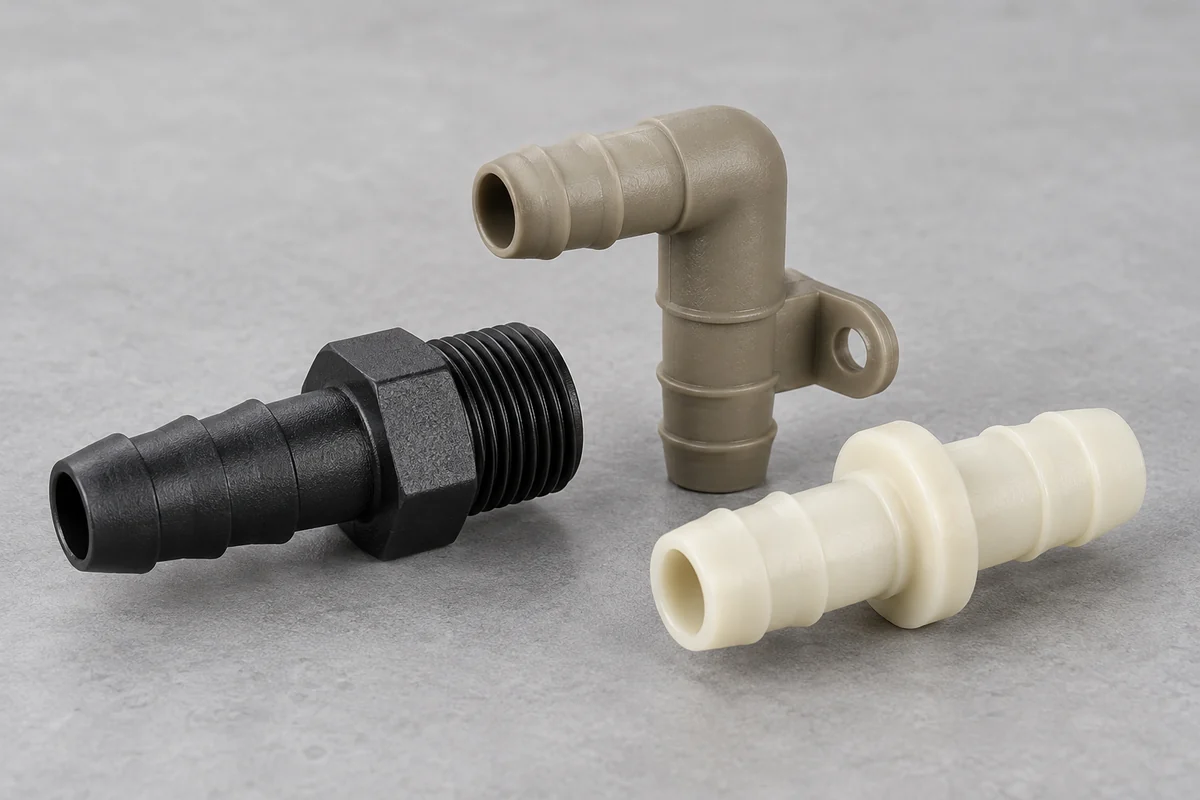
Specify an exact resin grade when it is already approved. If selection is open, provide the application conditions and ask for a documented candidate review. Do not substitute a generic POM or nylon label for a controlled material. Color, additives and any permitted reprocessed content also belong in the agreed material specification.
Request the proposed cavity count and explain the demand behind it. A small development order and an established repeat program can justify different tooling decisions. Ask how the supplier will retain cavity identity through sample inspection. A tool with more cavities increases the number of product streams that must meet the accepted geometry; it does not automatically guarantee lower total program cost.
Discuss where the tool separates across the fitting and how the barb edges will be formed. A seam or gate vestige in a tube-contact region may need a specific limit or a revised location. Include the inspection access for the bore and retaining profile. Correct external diameter alone does not establish a clean connection surface.
Compare quotes against an agreed acceptance package
List the required sample dimensions, appearance references and functional tests. State how many parts will be tested and which cavities they represent. Define the expected report content and whether the buyer supplies the tubing. Our pull-off test planning guide provides a way to describe the retention evaluation without turning one sample result into a universal rating.
Separate first-article approval from repeat inspection. Development may require detailed measurements from every cavity, while an approved production plan can use a different sampling arrangement. Ask for the proposed lot identification, change notification and containment process. These details determine what happens when a cavity or tubing specification changes after the original samples were accepted.
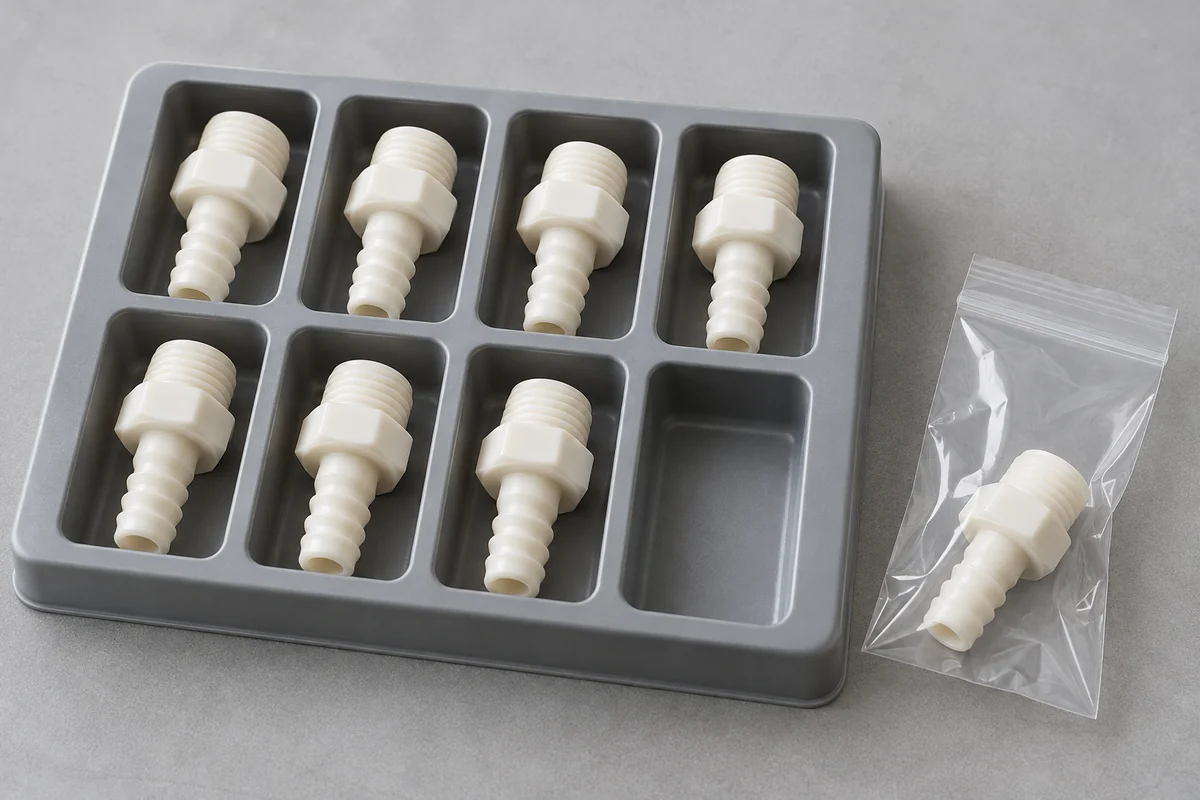
Include packaging and cleanliness expectations. Protective bags, separated compartments and capped openings are different deliverables. If the application needs a defined cleanliness level, specify how it is assessed. Ordinary clean-looking packaging is not evidence of a regulated or measured cleanliness class, and that requirement should not be implied by a product photograph.
Finally, compare tooling, development samples, repeat supply, assembly and reporting as separate lines. A useful proposal explains assumptions and unresolved decisions alongside price. That makes it possible to choose a manufacturing route on a like-for-like basis and avoids discovering after tool approval that the connection test you expected was never part of the order.
Review your custom hose connection
Explore our custom injection-molded hose barb fittings and the POM hose-barb retention case study. Send the fitting drawing, exact tubing specification, assembly conditions and acceptance requirements so that the quotation covers a defined part and inspection scope.