
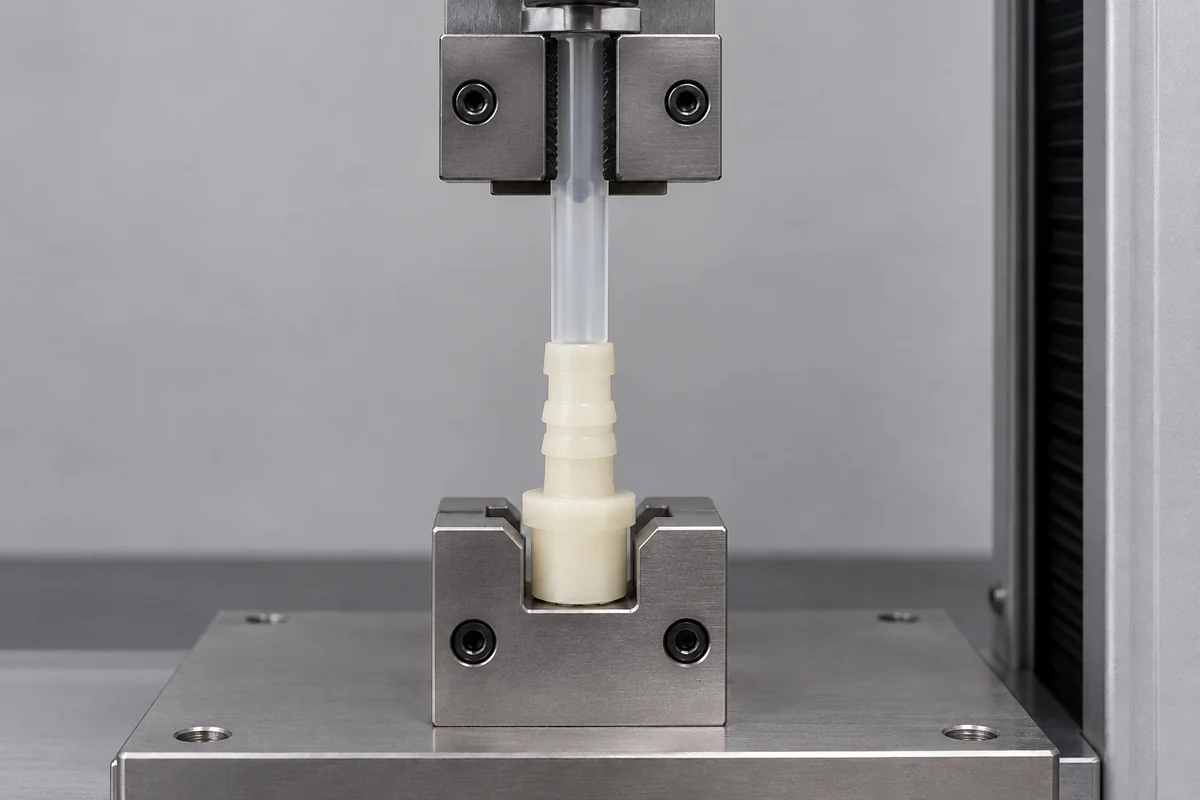
Product design illustrations. Final geometry, materials and acceptance criteria are project-specific.
A pull-off force without an assembly definition is difficult to use. The value may describe a particular tube, a particular insertion depth or even the way a fixture gripped the specimen. Before comparing suppliers or revisions, define the question the test is intended to answer. An axial retention check is useful evidence only within its recorded configuration and procedure.
Keep that question separate from pressure containment. Pulling a tube from a fitting does not measure leakage, pressure-cycle endurance or burst behavior. Those evaluations need their own requirements and appropriately controlled procedures. A convenient force reading should not be converted into a working-pressure rating for a custom connector.
Control the tube and the assembled configuration
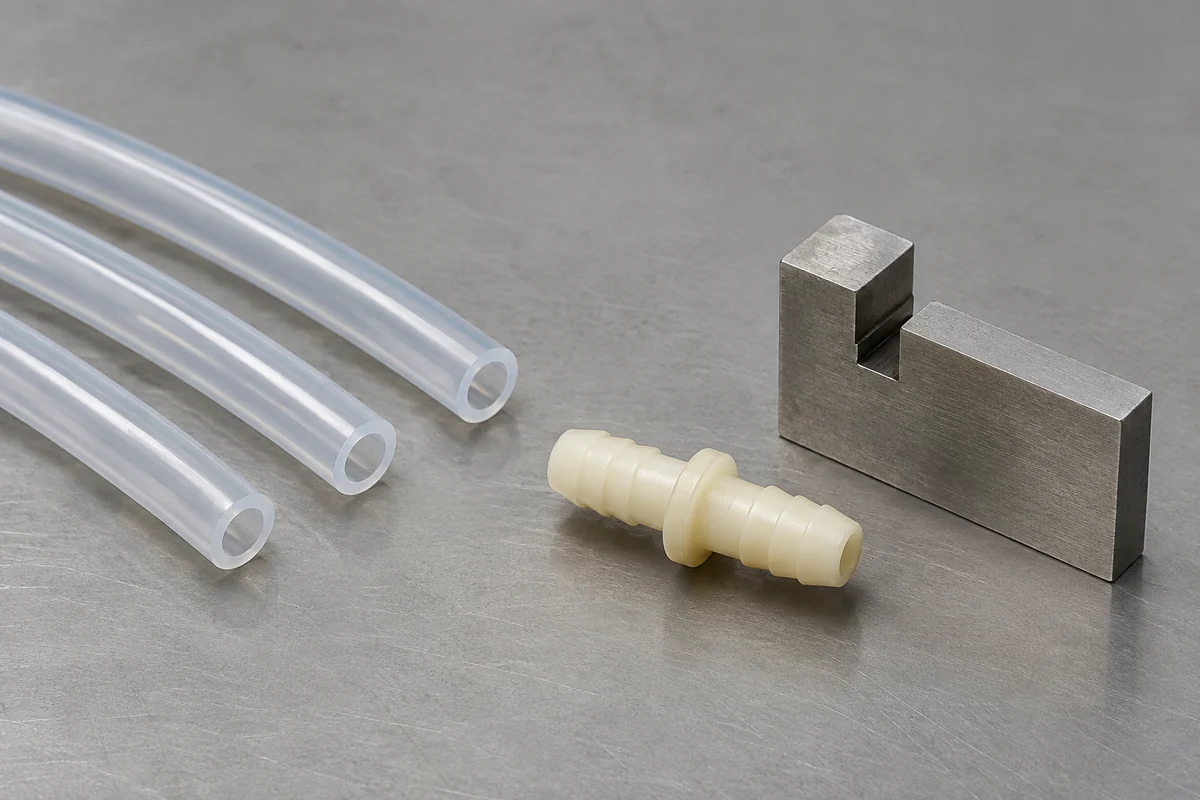
Identify the tube supplier, grade, inside diameter, wall or outside diameter, hardness where specified and material lot. Record relevant conditioning and exposure. Two tubes with the same nominal inside diameter can still represent different test assemblies. A report that names only a generic material leaves important comparison conditions unresolved.
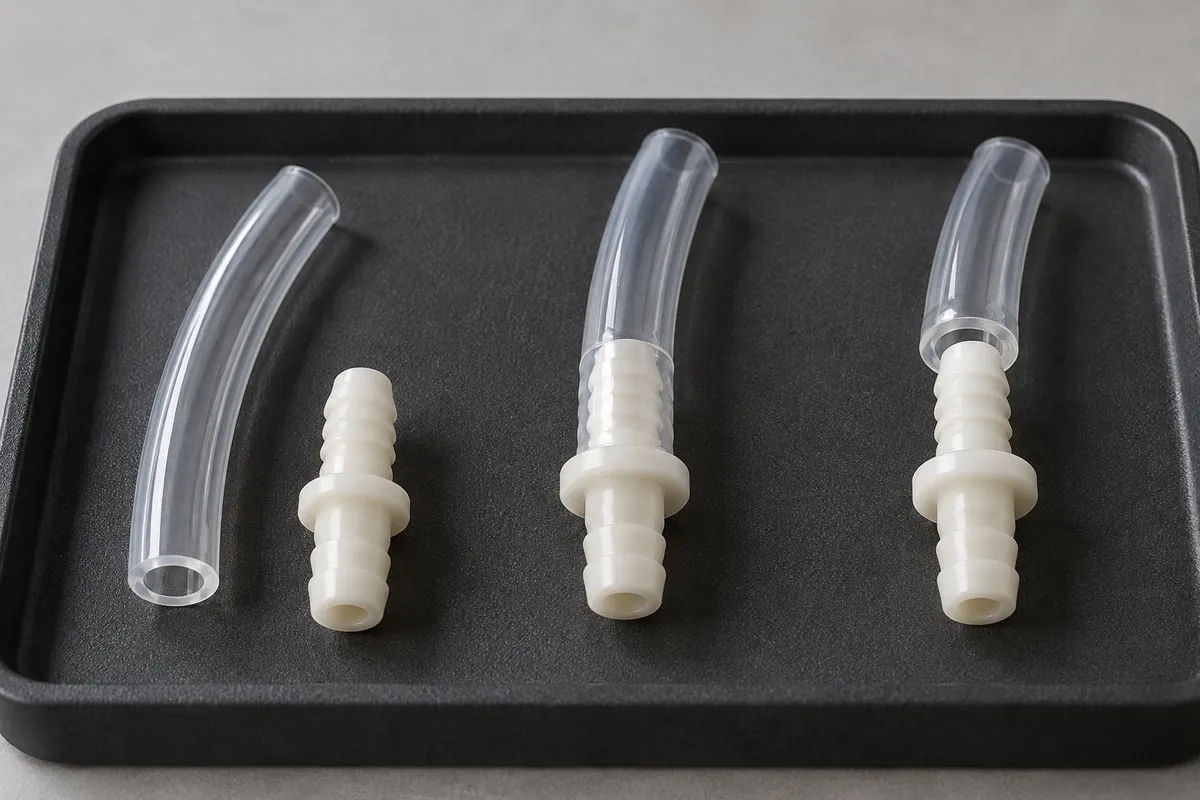
Define the fitting revision and cavity identity, the insertion depth and the seated reference. State whether a clamp is included, with its installation details if applicable. The barb sizing guide explains the relationship between the fitting profile and the tube specification; the test plan should reference that accepted geometry rather than recreate it informally.
Make assembly preparation repeatable
Record how the connection is assembled and whether an assembly aid is permitted. Specify any required waiting period before testing. If one group is tested immediately and another after a different interval, the results no longer isolate only the intended design change. Keep preparation consistent or identify the difference explicitly in the evaluation.
Do not repeatedly reuse a tube or fitting unless reuse is part of the question being studied. Previous insertion, clamping or loading may change the specimen. Distinguish new-assembly retention from a repeated-assembly study. The sample history belongs in the record even if the external appearance seems unchanged.
Align the fixture with the intended load
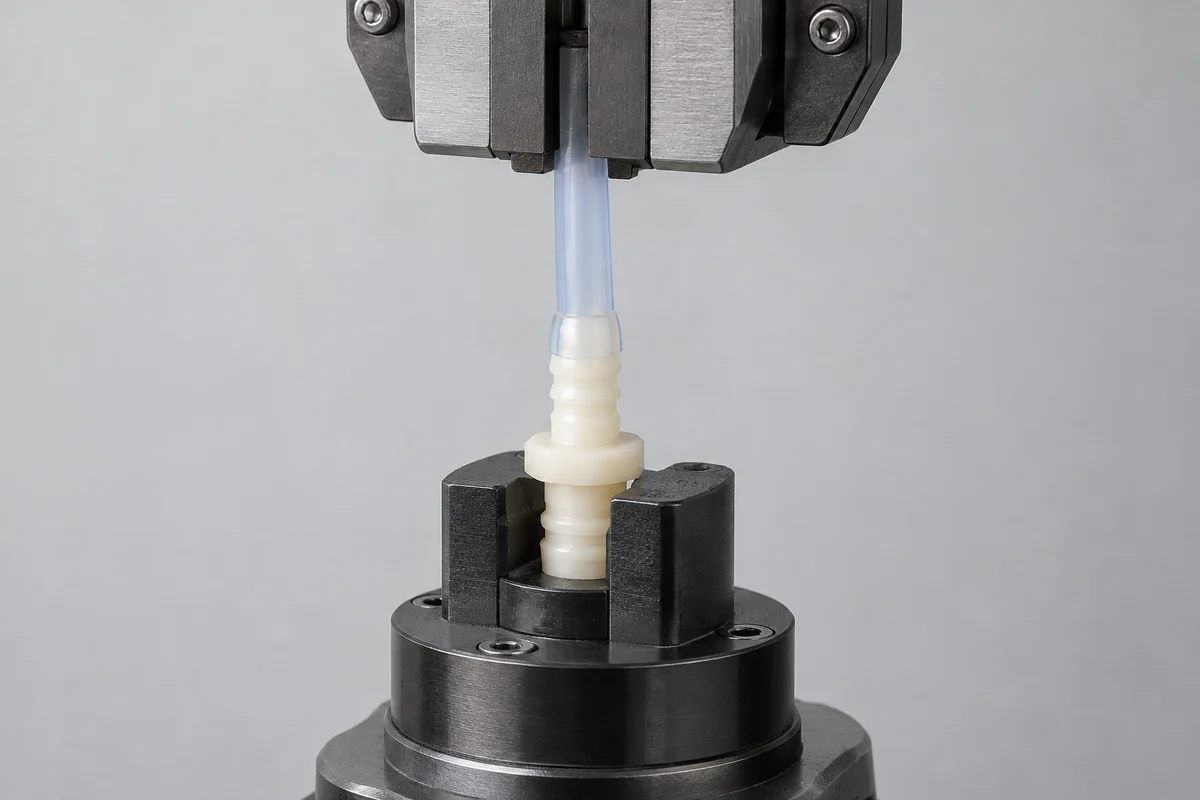
Describe how the fitting is supported and how the tube is gripped. The setup should apply the intended loading direction without unintentionally cutting, crushing or slipping at a grip. Keep the fixture description with the results. A failure caused by the grip is not equivalent to separation at the barbed interface.
Specify the machine's controlled test rate and the quantity being recorded. A crosshead-rate setting is a procedure parameter, not a universal speed suitable for every connection. Identify the instrument and the relevant measurement controls. Where a recognized method applies, use its current requirements and document deviations rather than attaching a standards label to an improvised test.
Choose specimens that represent the decision
A multi-cavity mold produces separate cavity streams. Decide whether the evaluation covers every cavity and record the specimens accordingly. A small unlabelled group may be enough to explore a fixture, but it should not be described as comprehensive tool approval. Sampling should follow the actual decision and risk, not a convenient round number.
Use consistent sample selection for before-and-after comparisons wherever practical. If an early trial and a later trial have different populations or conditions, report them separately. A higher later minimum may be encouraging, but it does not establish a precise percentage improvement attributable to one change when the comparison basis is incomplete.
For temperature, fluid exposure or aging questions, define separate specimen groups and their histories. Keep those conditions traceable through preparation and testing. An ambient, newly assembled result cannot answer a retained-performance question after extended exposure. It is better to state that the later condition remains open than to imply that the initial test covers it.
Report the failure mode alongside the force
Record whether the tube slipped from the barb, tore, moved in a grip or remained attached while another component failed. Include the relevant observation and specimen identity. A peak force alone can conceal an important change in failure mode. The interpretation should follow what actually happened, not simply whether the number exceeded a threshold.
Preserve individual readings, not just an average. The number of specimens, range and cavity coverage help readers understand what the summary represents. A sample mean above a requirement does not demonstrate that each tested assembly met it. If the acceptance criterion applies to individual results, evaluate and report it on that basis.
State the limits of the conclusion. A passing development sample set can support the agreed next decision without establishing lifetime reliability or a quantified defect rate for every future batch. Repeat-production sampling should be separately approved, with defined responses to changes or nonconforming observations. It is not automatically identical to the trial sampling plan.
For a quotation, provide the controlled tubing, assembly drawing and proposed method with the required report fields. Agree who supplies the tube and owns final system qualification. This turns a vague request for good retention into a reviewable scope and allows the molding supplier to price the fixture, sample preparation and inspection work honestly.
Review your custom hose connection
Explore our custom injection-molded hose barb fittings and the POM hose-barb retention case study. Send the fitting drawing, exact tubing specification, assembly conditions and acceptance requirements so that the quotation covers a defined part and inspection scope.