
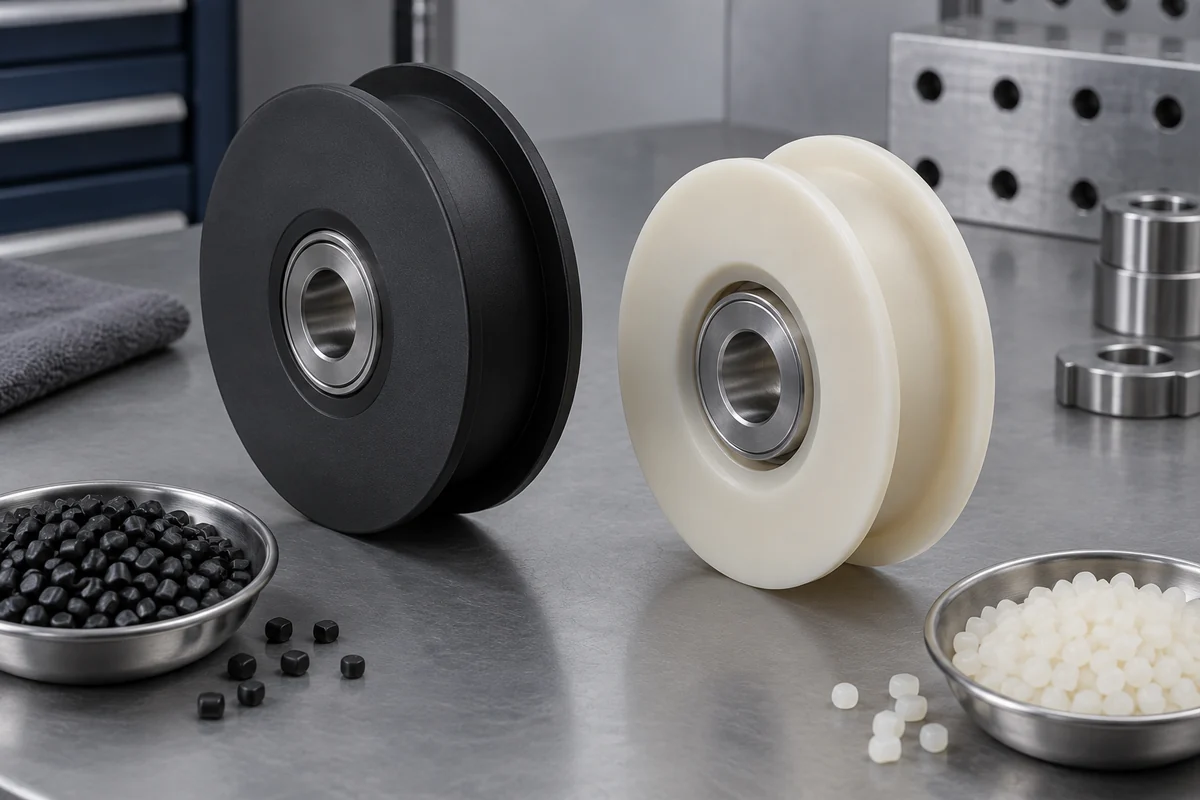
Product design illustrations. Final geometry, materials and acceptance criteria are project-specific.
Nylon and acetal are both candidates for some plastic pulley applications, but choosing between them is not a contest with a universal winner. The useful comparison concerns a particular compound, wheel geometry, bearing arrangement and mating surface. A material that works well in one guide wheel can be a poor choice when humidity, contact pressure or installation constraints change.
Start by defining the pulley function. A wheel rolling on a track, a belt idler and a sliding guide have different contact conditions. Even a nominally rolling contact can include local slip. Identify the counterface, loading and motion before comparing data. Otherwise a low-friction value from an unrelated test may distract from the failure mechanism that matters.
Compare actual grades, not only family names
The BASF Ultramid overview identifies several polyamide families and applications. It is a starting point, not a specification for an unnamed pulley compound. PA6, PA66, reinforced formulations and modified grades should not be treated as one interchangeable material with one set of properties.
Likewise, acetal formulations differ. The Delrin low-wear and low-friction overview describes specialized material options. Their intended advantages do not establish the behavior of every acetal grade in every contact pair. Obtain current grade-specific information and compare properties measured under relevant, stated conditions.
Include moisture in the dimensional discussion
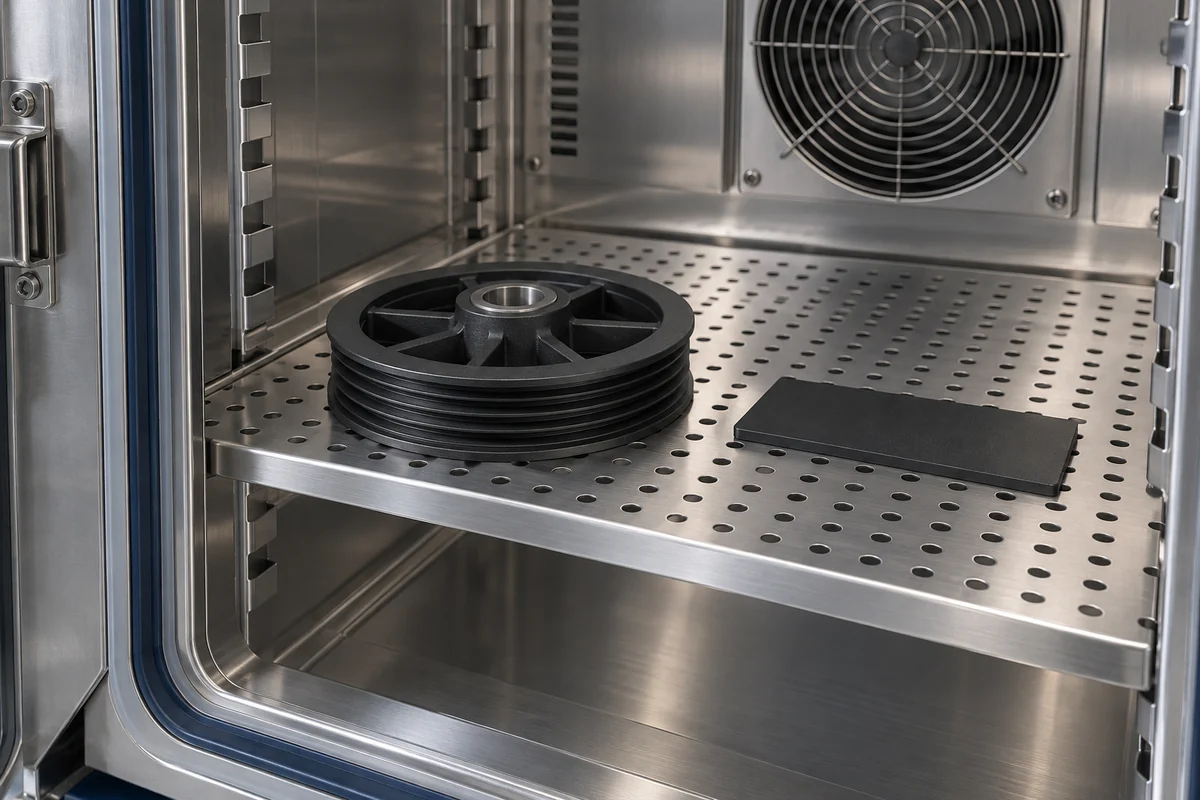
Moisture is an important review point for nylon components because the material condition can affect dimensions and mechanical response. The amount and rate depend on the grade, geometry and environment. Do not apply one generic percentage to every wheel. Identify the storage, measurement and service conditions, then review relevant supplier data and part-level evidence.
This matters at both the tread and the bearing interface. A bore accepted shortly after molding may behave differently after conditioning or exposure. Discuss how the design accommodates variation and when parts are inspected. Comparing a dry nylon sample with a differently conditioned candidate confounds the material decision with the preparation procedure.
Acetal is often considered when dimensional behavior under changing humidity is important, but that does not make it dimensionally invariant. Temperature, geometry, processing and loading still need review. Set an acceptance window for the completed part and test representative states. A broad material-family preference cannot replace a controlled fit assessment.
Treat friction and wear as contact-system behavior
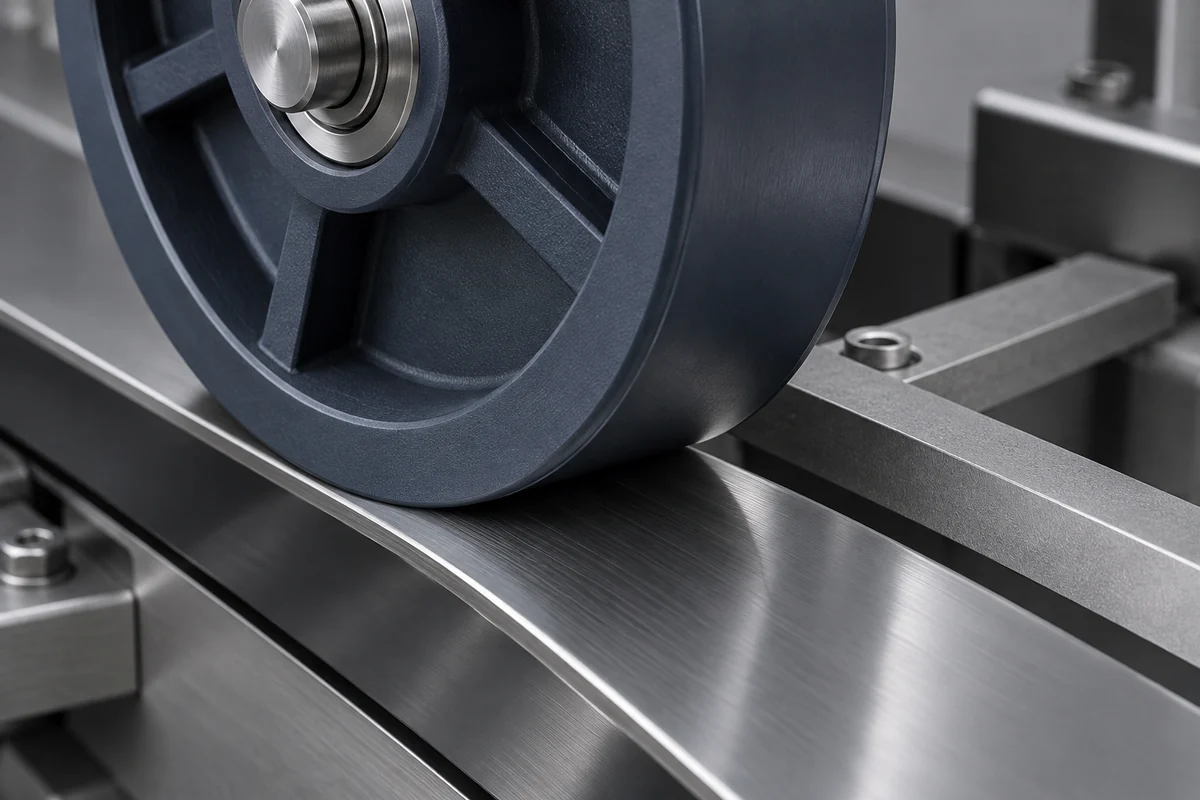
Record the belt or track material, surface finish, cleanliness and lubrication condition. Those details can change the contact behavior and what debris develops. A polished steel strip and an abrasive contaminated belt are not equivalent counterfaces. The design review should identify which one represents the application and whether both need evaluation.
Distinguish sliding friction from bearing resistance and from rolling losses. A free-spin observation mainly describes a narrow assembled condition, not the complete loaded contact. If the wheel runs hot or wears, investigate alignment, bearing fit and slip as well as the polymer. Replacing the resin may not address the underlying mechanical problem.
Review modifiers without assuming a guaranteed benefit
Lubricating additives or reinforcement can change a compound's behavior, but an additive name alone is not a specification. Ask whether the material is a supplier-defined grade or a separately compounded formulation, and obtain its controlled identification. The base resin data sheet does not automatically describe the finished modified compound.
Consider what a change does to molding, bearing retention and the mating component, not only to a headline wear property. Different shrinkage or stiffness may require a revised geometry or tool compensation. A comparison is meaningful only when each candidate has a suitable manufacturing condition rather than one candidate being processed with an unsuitable inherited recipe.
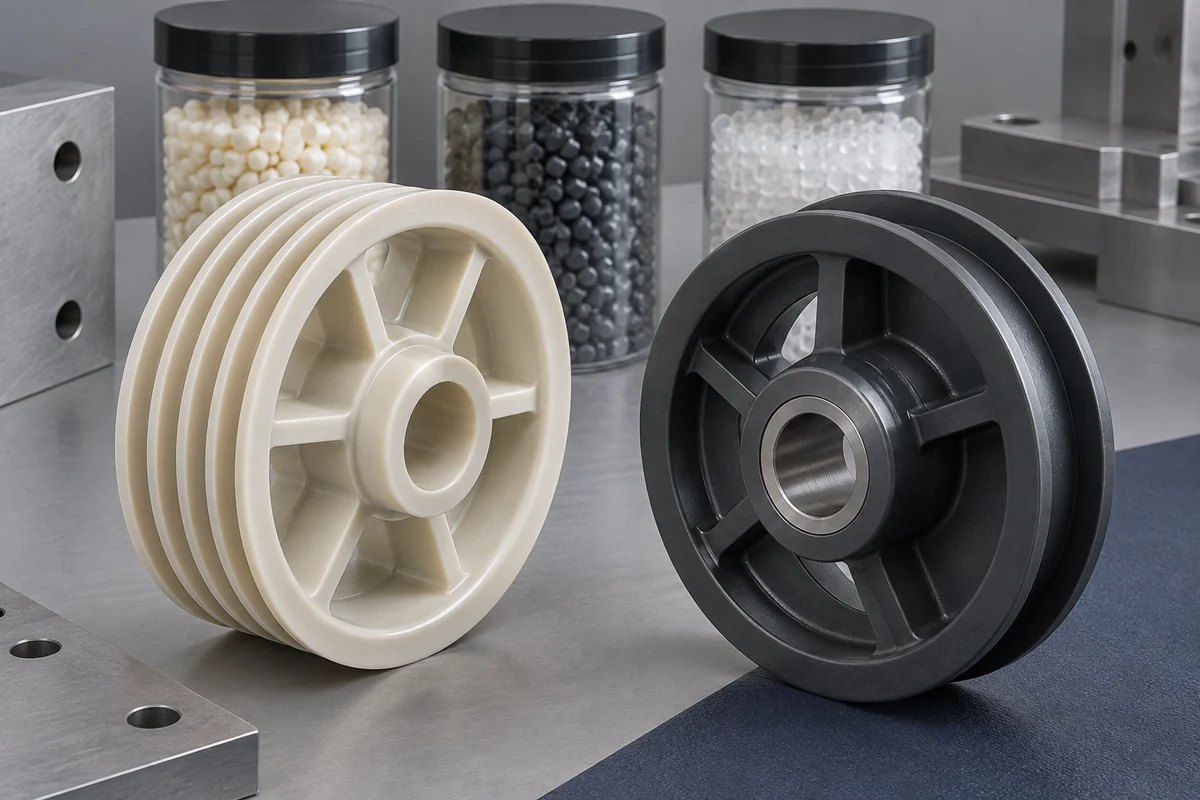
Color is not reliable evidence of resin identity or modifier content. Keep material lot information with the molded sample and any test report. The photographs in this article illustrate geometry and evaluation concepts; they are not a method for identifying a polymer. A purchasing description should name the compound instead of asking for the black or white version.
Choose the combination that meets the agreed evidence
Plan a comparison with traceable samples, controlled mating parts and a defined environment. Measure dimensions and rotation behavior before and after the relevant exposure, then evaluate the selected contact and wear criteria. Our pulley wear-test guide explains how to connect observations with the conditions that produced them.
Keep rejected candidates and the reason for rejection in the project record. If both materials fail, revisit geometry, alignment or loading rather than forcing a material-only decision. The accepted result is a documented compound-and-design combination. It is not a claim that all nylon pulleys outperform all acetal pulleys, or the reverse.
Discuss a defined pulley application
Explore our custom injection-molded plastic pulleys. Send the component drawing, mating belt or track, bearing specification and acceptance requirements to review tooling, molding and inspection as one supply scope.