
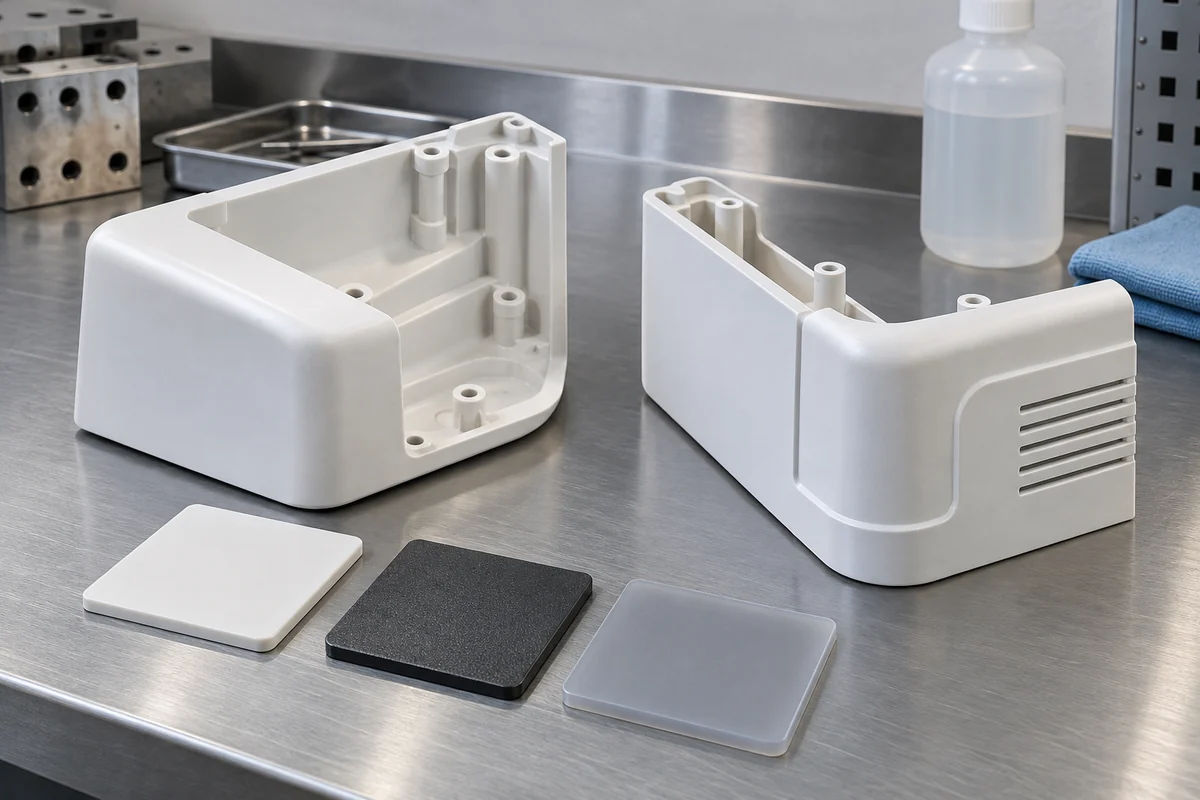
Product design illustrations. Final geometry, materials and acceptance criteria are project-specific.
A white plastic housing may look unchanged after one wipe and still be unsuitable for its intended cleaning routine. Surface appearance is only one part of the question. Repeated exposure can interact with fastening stress, coatings, labels and the geometry around openings. The useful purchasing question is not simply whether PC/ABS resists disinfectants, but which configuration has been evaluated under which conditions.
Start with the intended cleaning instructions supplied by the equipment team. A chemical compatibility review for an external non-implantable instrument housing is not a cleaning-efficacy study, a sterilization validation or a declaration that the device is safe for every healthcare setting. Those responsibilities should remain distinct even when several teams contribute to the same program.
Translate the cleaning routine into an exposure description
Identify the commercial cleaner or defined formulation, dilution, contact time, application method, rinsing and drying sequence. Record the expected frequency and service-life assumption. Wiping and soaking are not interchangeable descriptions; neither is a brief splash equivalent to prolonged contact in a recessed seam.
Then state which surfaces are exposed. A front panel may be routinely wiped while its inside wall only encounters cleaner after a spill. Gaskets and labels can receive a different exposure from the main shell. Treating the complete housing as one flat material coupon can miss these distinctions before the first sample is even molded.
Include the stress state, not just the polymer name
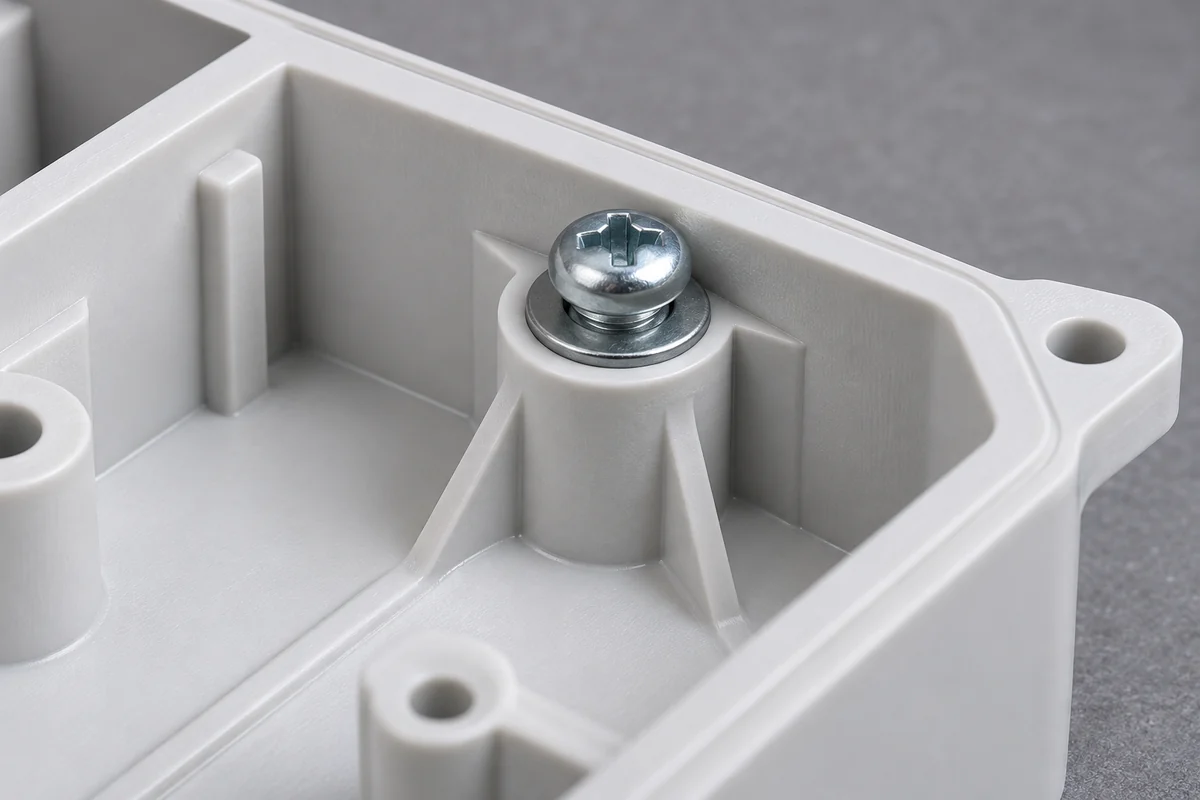
Investigate the installed housing with its screws, clips and mating components. Material screening on a relaxed plaque is useful evidence, but it does not reproduce every stress concentration in a thin corner or loaded screw boss. Exposure and mechanical loading should be considered together when defining the evaluation specimens.
Covestro's discussion of chemical-resistant polycarbonate for healthcare illustrates why manufacturers develop application-specific material options. It does not establish that every polycarbonate or PC/ABS grade has equivalent resistance. Ask the resin supplier for current evidence relevant to the proposed grade and exposure, and identify what still needs part-level evaluation.
Screen candidates without calling the screen a qualification
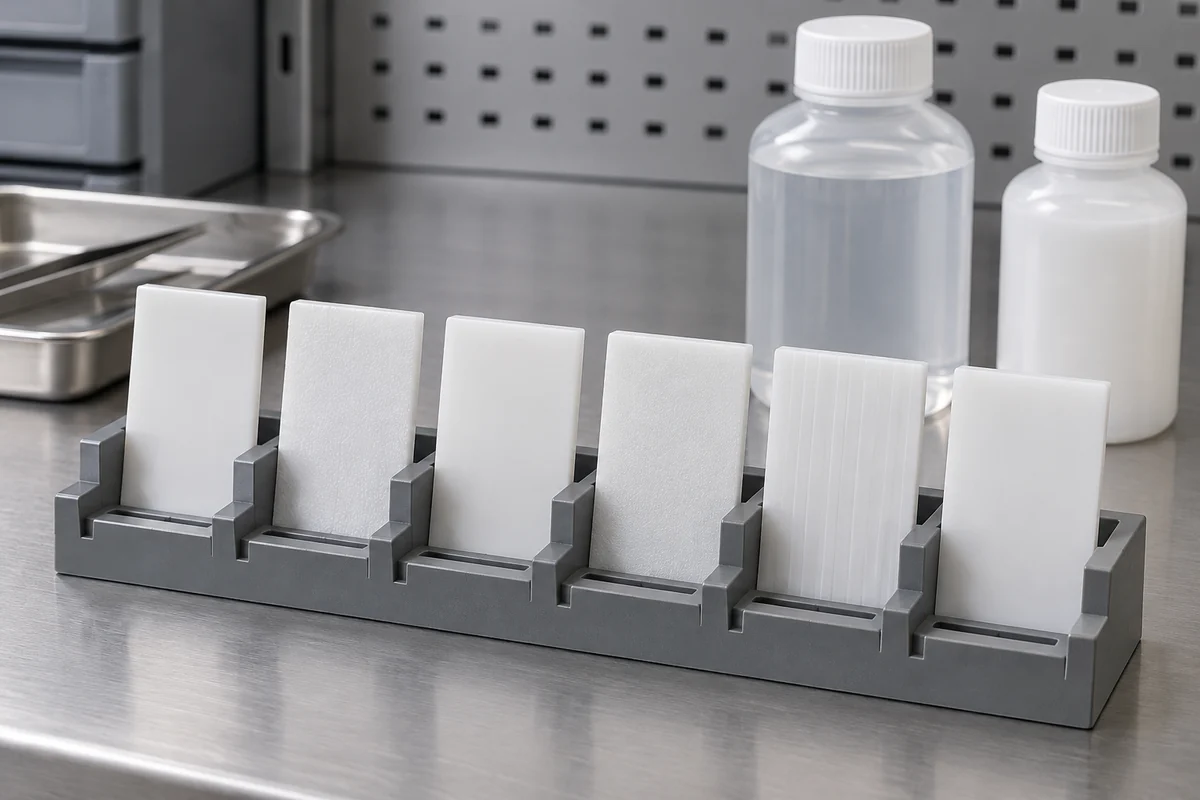
A controlled screening exercise can help eliminate unsuitable candidates before tooling. Use identified materials and consistent specimens, with an unexposed comparison where appropriate. Keep the procedure, conditioning and observations attached to the sample identity. An unexplained pass label is difficult to interpret when another formulation is proposed months later.
Do not turn a generic resin-family comparison into a guaranteed ranking. Colorants, fillers, processing and surface treatment can alter the relevant behavior. If a supplier proposes an alternative grade, review its evidence as a new candidate rather than assuming that a similar trade name or family designation makes it interchangeable.
The transition from screening to housing approval should be explicit. Specify whether the next stage includes molded parts, final color, installed fasteners, labels and coatings. If some items are excluded from the trial, keep them open in the validation plan. Their absence should not disappear when the sample report is summarized for purchasing.
Define what must remain acceptable after exposure
Agree the relevant observations before the trial: cracks, crazing, discoloration, tackiness, dimensional movement, label condition or fastening performance. Not every project needs the same measures, and an appearance requirement alone may not address a functional concern. Conversely, a functional check should not silently excuse an unacceptable cosmetic change on a visible panel.
FDA describes reprocessing as device-specific. A supplier's material test is therefore not a substitute for the device manufacturer's applicable validation and labeling work. This distinction is especially important when a request mixes surface compatibility, microbial effectiveness and a desired lifetime into one proposed pass/fail test.
Keep the approved configuration together
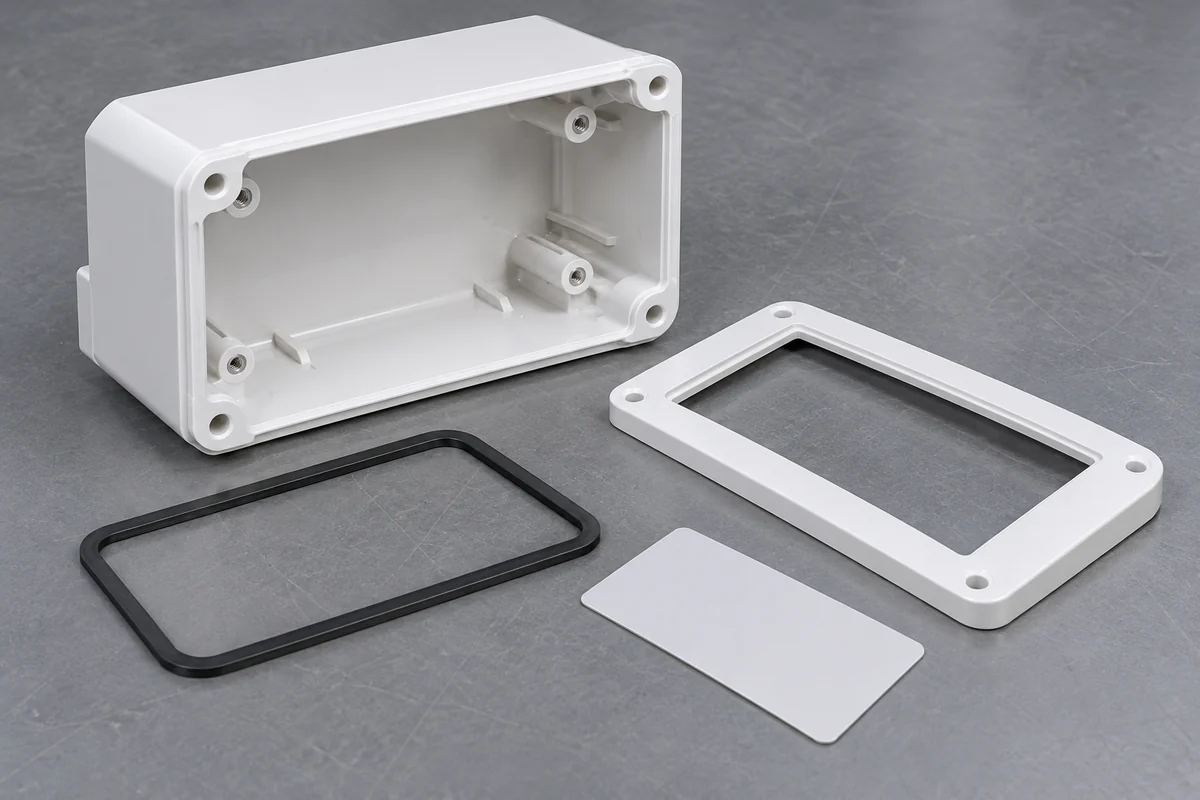
The shell, decorative trim, gasket and label may come from different suppliers, but they experience cleaning as an assembly. Review their interfaces, including places where liquid can remain. A cleaner compatible with one component can still affect an adjacent adhesive or coating, so the final plan should account for the combination the customer will use.
Record the formulation and revision used for the accepted specimens, then define change notifications. A future resin substitute, color change or different coating preparation should trigger a review of the existing evidence. Our traceability guide explains how to link that record to molded lots without claiming that paperwork alone proves performance.
Discuss your custom enclosure
Explore our custom injection-molded medical device enclosures and the tabletop analyzer housing project. Share the controlled drawing, intended use, quantities and acceptance requirements. Component supply and finished-device qualification should have clearly assigned responsibilities.