
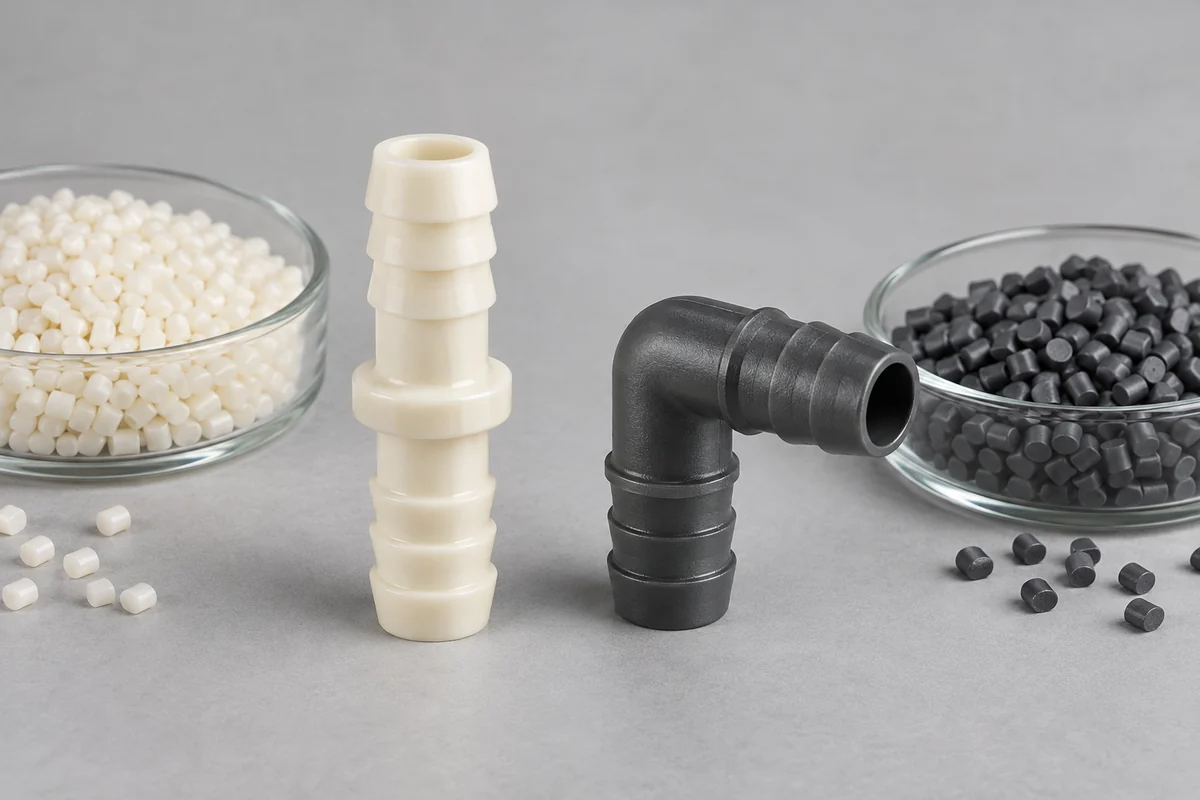
Product design illustrations. Final geometry, materials and acceptance criteria are project-specific.
POM and nylon can both appear in discussions about plastic hose fittings, but choosing between them requires more than ranking generic strength or temperature values. The fitting interacts with a deformable tube, a particular medium and a defined assembly method. The material decision needs to support that complete connection, including how the dimensions and surface condition are controlled after molding.
Begin by naming exact candidate grades. POM includes different resin families and formulations; nylon likewise covers different polymers, reinforcement and additives. A supplier's proposed substitute should therefore be a documented material change, not a color match. Our acetal and Delrin comparison provides background on the terminology without replacing grade-specific review.
Translate service conditions into material questions
List the conveyed medium, temperature history and any cleaning or incidental exposure. Include expected external loads from hose routing and installation. A tube that is bent tightly against the fitting may introduce a different load condition from a freely supported test assembly. The relevant evidence should match those conditions rather than only the appearance of the sample.
For pneumatic equipment, identify whether the air system introduces oil or other substances at the connection. For liquid service, define the formulation and concentration rather than using a broad label such as coolant. A general material-compatibility statement is a starting point for a question, not approval of every formulation, exposure time and stressed geometry.
Make conditioning part of the nylon comparison
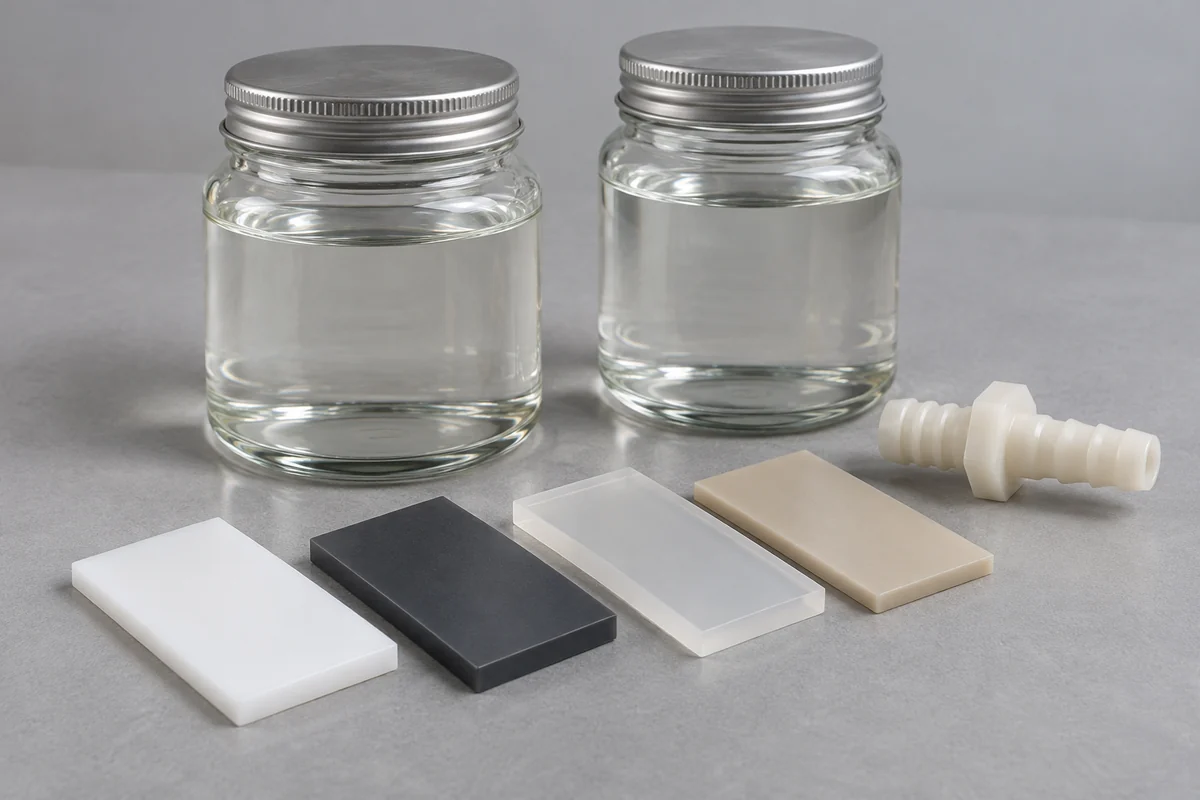
BASF's Ultramid brochure describes moisture uptake and its effects on polyamide dimensions and mechanical behavior. Check the state represented by the selected grade's data. Dry-as-molded values and conditioned values should not be used interchangeably when judging the barb's fit or mechanical response.
This is not a reason to reject every nylon candidate. It is a reason to define the condition relevant to manufacture, storage, assembly and service. Ask how the proposed inspection state relates to the intended application. If those states differ, identify the additional measurements or assembly checks needed to connect them rather than relying on an unexplained correction factor.
Review molded dimensions for the POM candidate
The Delrin molding guide treats mold shrinkage and post-molding dimensional change as processing and design considerations. For a barb, the accepted profile must be demonstrated on identified molded parts. A resin datasheet shrinkage value is not a substitute for measuring the actual tool's ridge, bore and functional surfaces.
Ask when the supplier measures parts and what happens after a tool or process change. A fitting can look unchanged while a critical profile dimension moves. If the candidate needs a revised tool allowance or a different inspection condition, include that work in the material comparison. The apparent saving from a resin substitution may otherwise omit the cost of requalification.
Compare functional samples under the same boundary
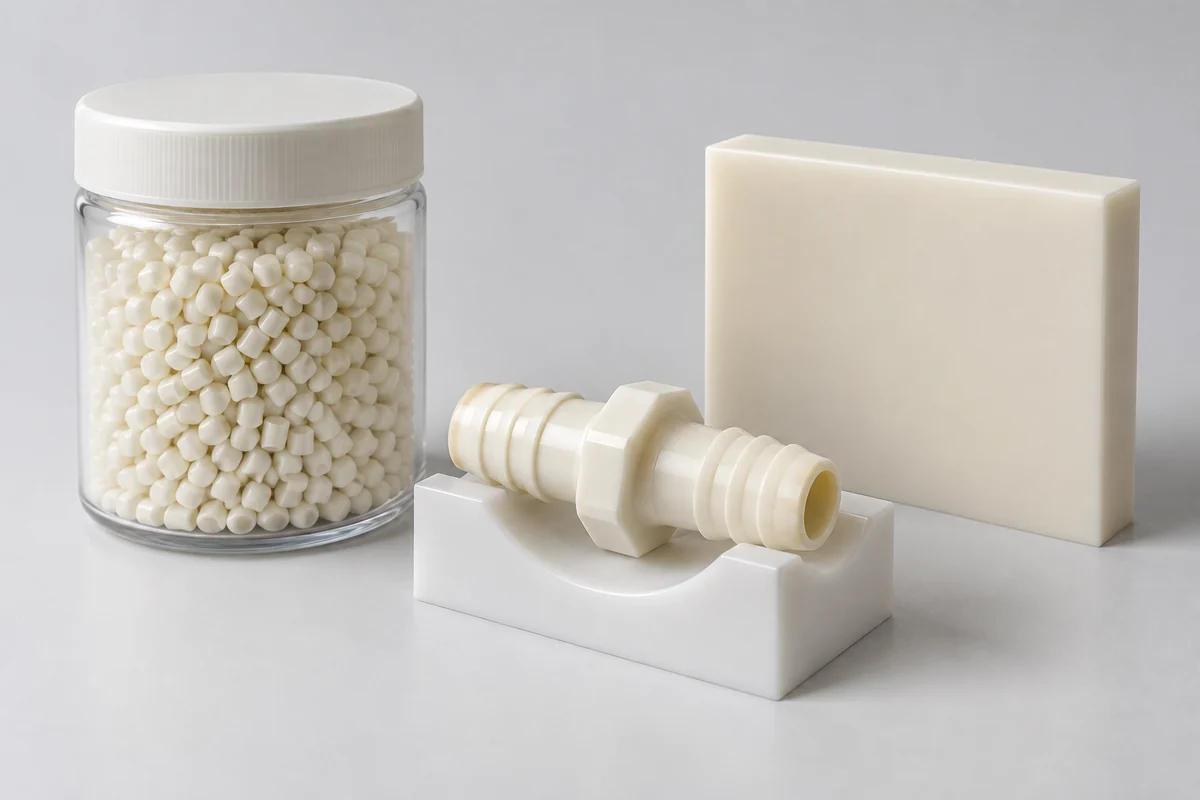
Use the same controlled tubing, assembly depth and method when the goal is to compare materials in one design. Identify any geometry or tooling difference between the samples. If a new material requires a revised profile, describe the evaluation as a comparison of two connection designs rather than attributing every outcome solely to the polymer.
Define retention, leakage and any exposure tests separately. A material that gives a favorable initial pull-off force may still require evaluation after conditioning or service exposure. Conversely, a lower initial reading does not establish that a candidate is unsuitable without reference to the actual acceptance requirement. The decision should follow the application, not a contest for the largest number.
Record how the assembly fails or changes during evaluation. Tube slip, tube damage, fitting damage and fixture problems carry different information. A report containing only peak force can hide a changed failure mode. Explain what was observed and whether the method was capable of distinguishing a connection problem from a problem introduced by the test setup.
Include manufacture and supply control in the decision
Ask which approved grades, colors and additives the supplier can support consistently. A prototype made from one material should not establish approval for an unspecified family of future substitutes. State the notification and review process for changes. This matters even when the commercial description of the part remains a simple plastic hose barb.
Consider whether reinforcement or other formulation differences affect the proposed manufacturing and surface requirements. Do not assume that a stronger coupon means a better tube-contact surface. Review the actual molded profile, seam and edge condition. The tube encounters the finished fitting, not the abstract material property used to shortlist the candidate.
Keep regulated uses explicit. Neither a polymer family name nor a general industrial product page establishes approval for food contact, potable water, medical use or another regulated application. Those duties require the relevant grade documentation and project-specific review. If they are outside the quotation, say so rather than leaving the buyer to infer an approval.
A useful selection record names the chosen grade, connection geometry, tubing, required conditioning and the evidence supporting release. It also records the open limitations. That makes a later material substitution reviewable and gives purchasing a specification it can actually control. The outcome is an accepted assembly definition, not a claim that POM or nylon is universally superior.
Review your custom hose connection
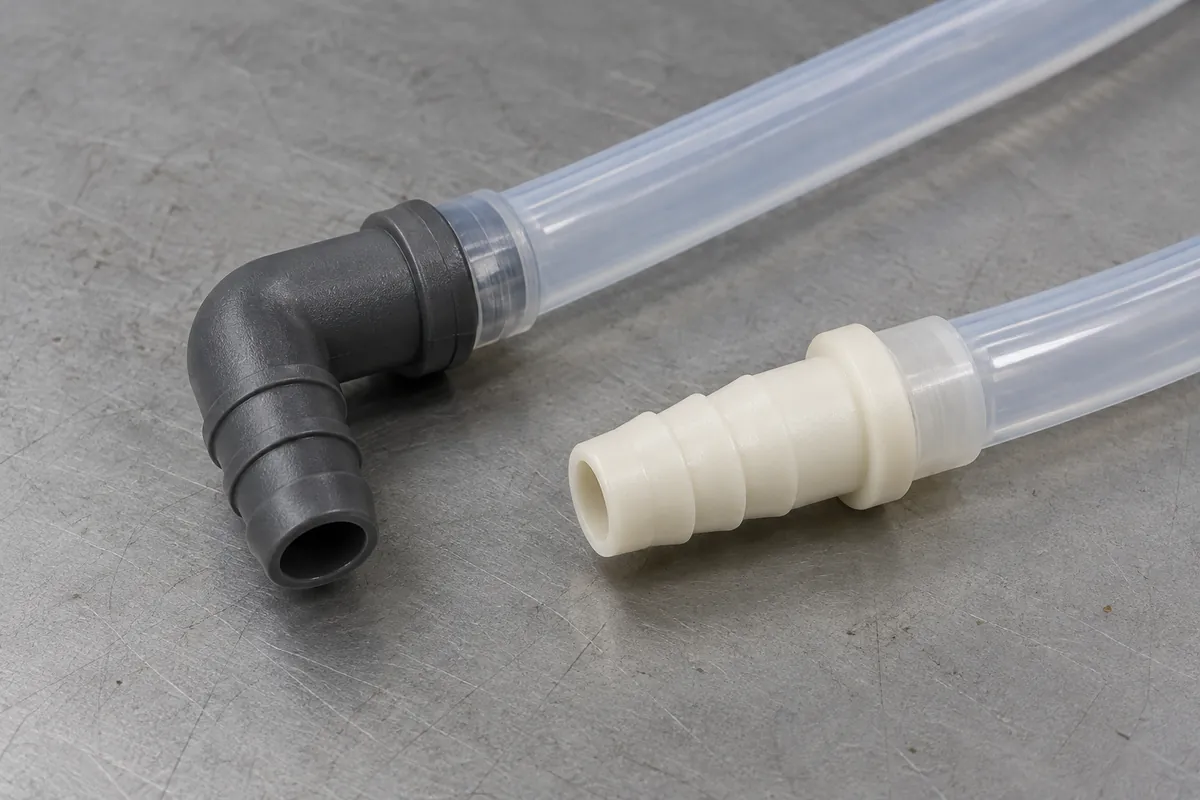
Explore our custom injection-molded hose barb fittings and the POM hose-barb retention case study. Send the fitting drawing, exact tubing specification, assembly conditions and acceptance requirements so that the quotation covers a defined part and inspection scope.