
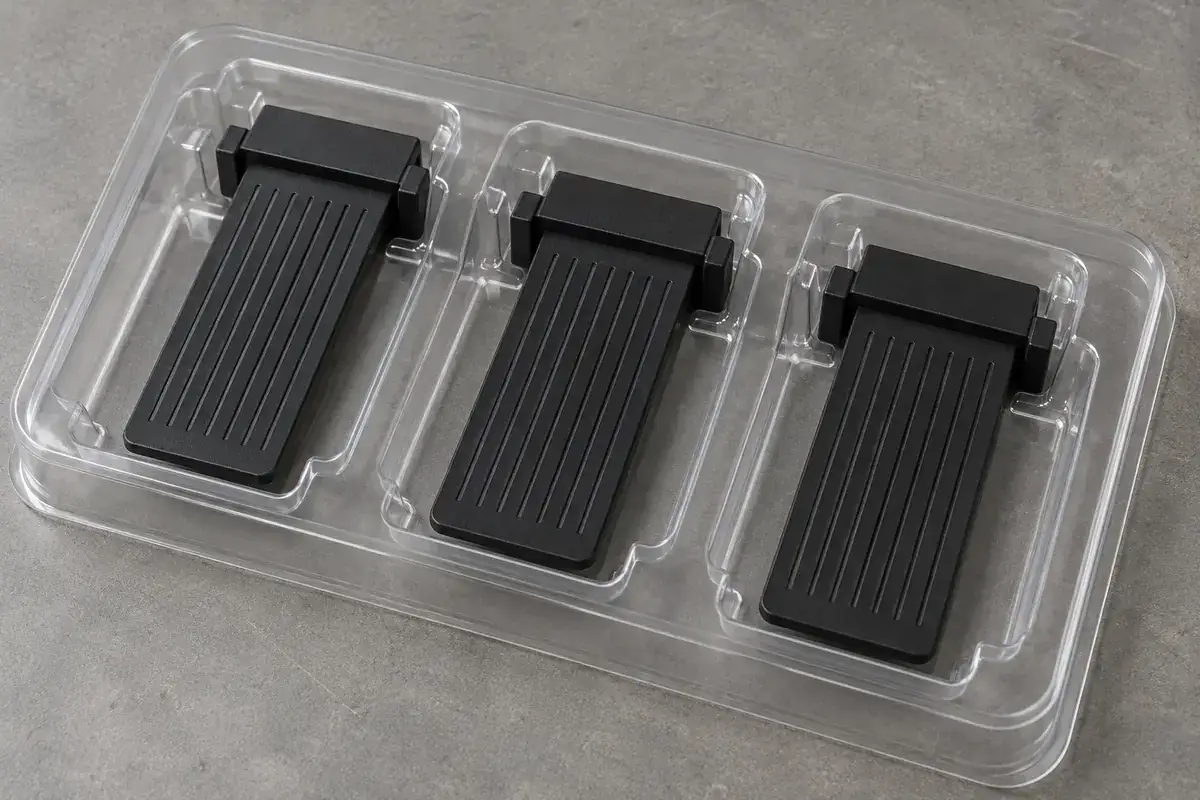
A molded USB insulator can leave the cavity with the intended geometry and arrive at assembly with a bent tip or a loose particle in a contact channel. The intervening transfer path deserves the same engineering attention as the molding step. Small parts are easy to move in bulk, but their thin tongues and narrow features may not tolerate uncontrolled contact with one another.
Cleanliness and mechanical protection are connected but distinct requirements. A tray can keep parts separated while shedding material from its own surface. A cleaning operation can remove particles while applying an unsuitable chemical or mechanical load. The useful goal is a defined condition at the receiving process, supported by a transfer and packing method that preserves both geometry and surface state.
Product design illustrations show the molded components and their assembly relationships.
Define what must be kept out of the interface
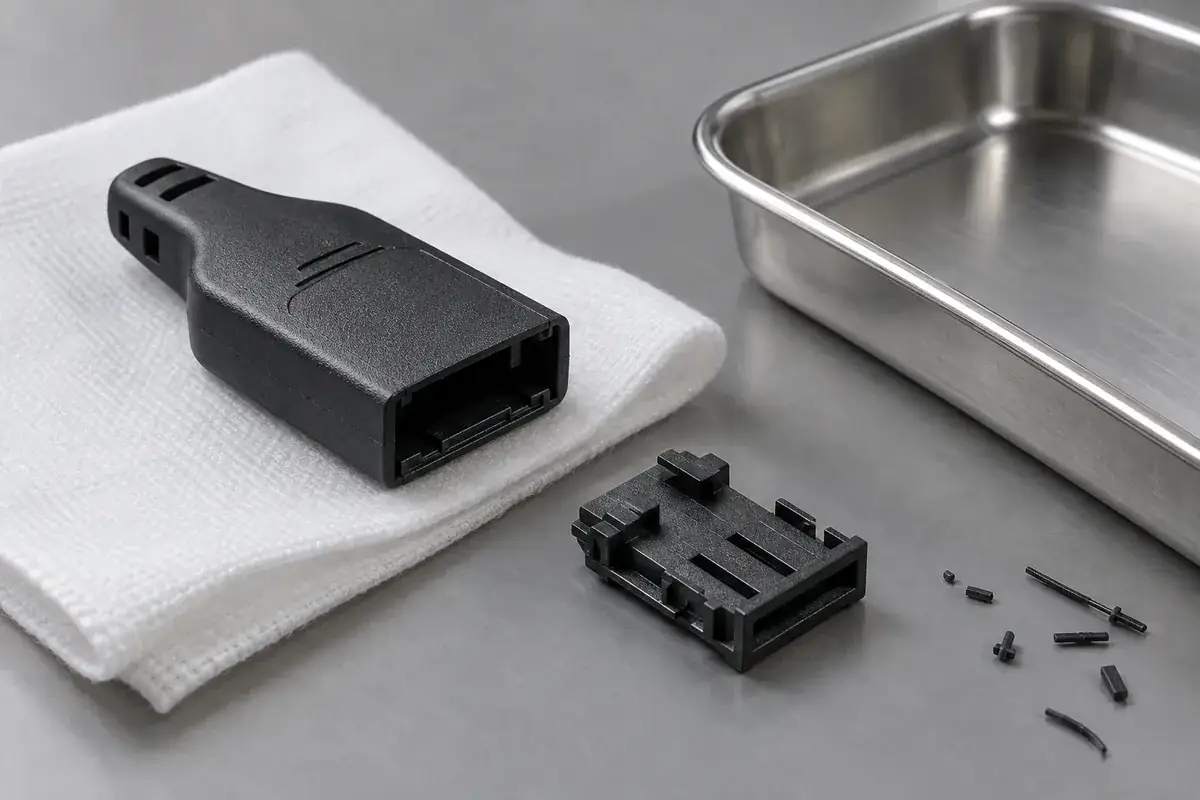
Particles can originate from gate separation, trimming, damaged ribs, packaging or the surrounding process. Their consequences depend on size, location and behavior in the intended assembly. A particle resting outside a clear rear surface poses a different question from a sliver lodged in a terminal path. Define the relevant regions and contamination concerns rather than applying an unexplained clean-part label.
An attached edge that may detach later deserves separate attention from loose contamination introduced after molding. The contact-slot flash guide describes that distinction at the forming interface. Cleaning away detached fragments can improve the immediate appearance without correcting the weak edge that continues to produce them.
The acceptance method should suit the requirement. A controlled visual inspection may be appropriate for specified visible debris, while another application may require a defined extraction or analytical method. The method, sampling and decision criteria need agreement for the actual component. There is no universal particle limit that can be inferred merely from the term USB insulator.
The receiving assembly process is part of this definition. If the part enters a controlled assembly environment or undergoes an approved cleaning step there, the supplied condition should be compatible with that sequence. State where the required condition is assessed so that shipping condition, incoming inspection and post-cleaning condition are not treated as interchangeable.
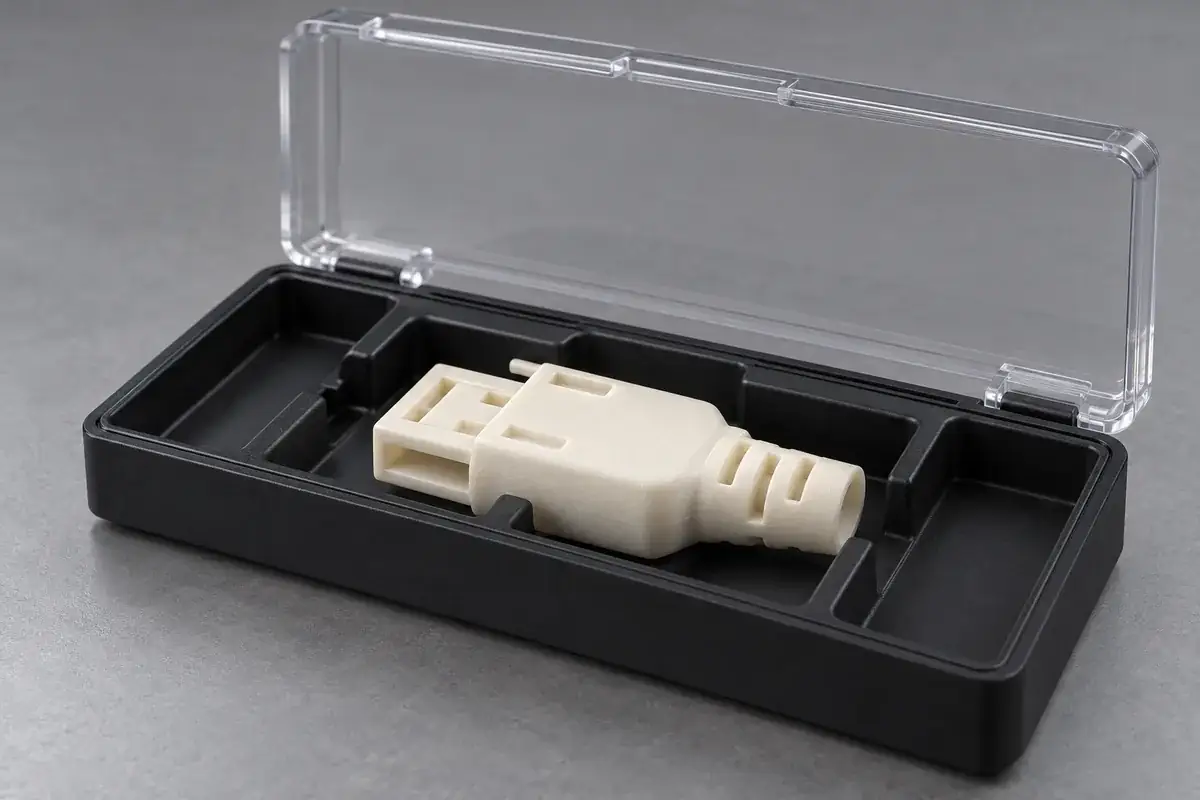
Remove contamination without changing the part
Cleaning is a manufacturing operation with material and geometry consequences. A liquid, solvent or elevated-temperature step may interact with the selected resin, colorant or any included metal. Mechanical agitation can load a thin tongue or rub adjacent parts together. Review the proposed method against the exact component configuration and material guidance before treating it as a routine addition.
Airflow can move loose particles, but it can also move them into a deeper recess or transfer contamination from the air system. A wipe can clean an accessible surface while leaving fibers or snagging a fine feature. These possibilities do not make either method inherently unsuitable; they mean the method must be selected, controlled and evaluated for its intended surface.
Where trimming is performed, organize the process so removed material has a clear path away from the part. Supporting the carrier close to the gate can reduce mechanical loading, while collection and separation of scrap can limit later transfer. The gate-vestige discussion connects those handling needs to the initial tooling choice.
Keep development evidence before and after cleaning where contamination is being investigated. If only cleaned samples are retained, the origin and quantity of debris may become difficult to understand. The purpose is not to accumulate photographs without a decision, but to determine whether the source is a process defect, a transfer event or an inadequate removal method.
Support the thick body and protect the thin tip
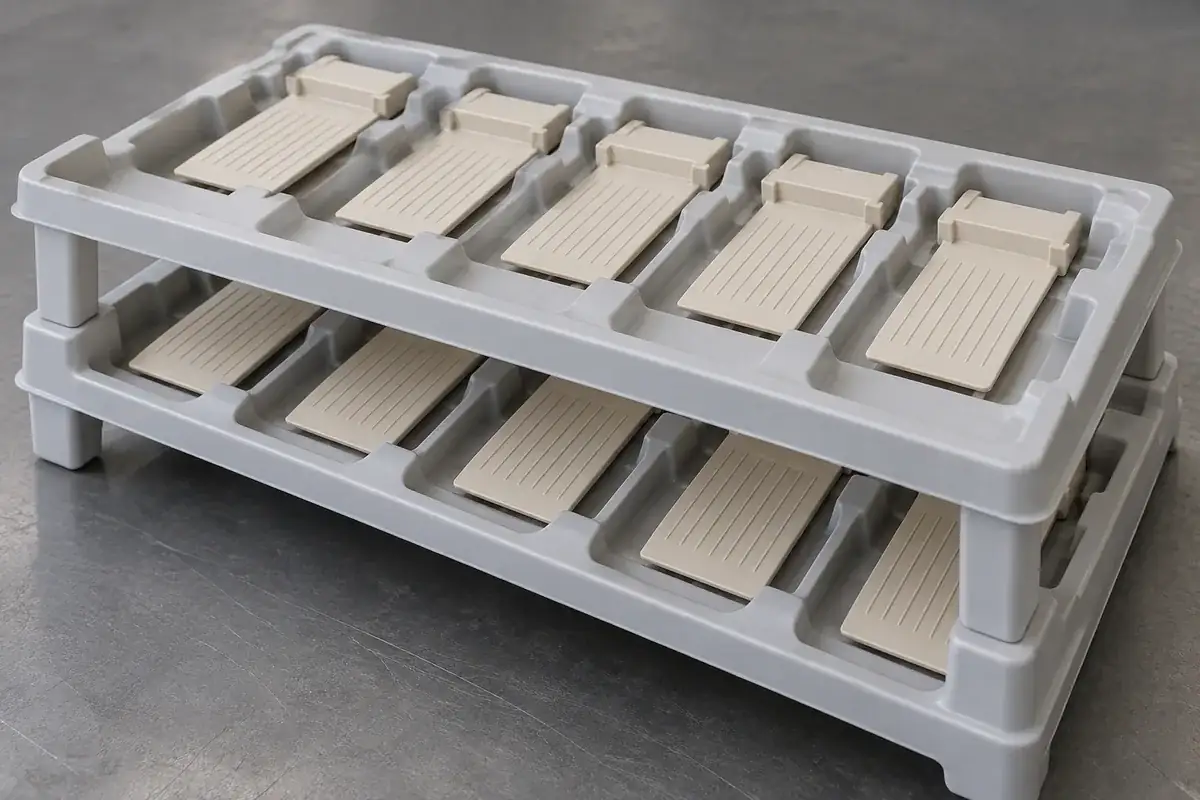
An individual pocket can locate a carrier by its rear body while providing clearance around the tongue. That arrangement reduces the chance that a neighboring part or upper tray presses on the thin projection. The pocket should also allow removal without levering against the tongue. Easy loading is not enough if unloading creates the damage that the package was meant to prevent.
Stacked trays need an intentional load path. The upper tray should react through the intended supports rather than through the components below. Clearance in an unstacked tray does not establish clearance under shipping or handling conditions. Evaluate the proposed stack and closure arrangement in the actual packing configuration selected for the program.
A very tight pocket can hold the part securely but scrape a locating rib or make removal difficult. A very loose pocket can allow repeated impacts during movement. The appropriate balance depends on component geometry and the handling sequence. Trial the proposed package with representative parts and assess both surface condition and dimensional state afterward.
Packaging material should be reviewed for relevant cleanliness and compatibility requirements. Do not add an electrostatic, cleanroom or other controlled-environment claim solely because a tray has a particular color. Where such properties are required, specify the material or package evidence and the applicable handling controls as part of the purchase definition.
Make traceability useful at the receiving bench
Keep the component revision, material and relevant lot identity connected to the package. If cavity identity is required for dimensional investigation, preserve it in a practical way through sample selection and reporting. A label that cannot be related to the enclosed parts provides little help when a receiver finds a repeatable local defect.
Part orientation can also matter. A consistent pocket orientation makes receiving inspection and assembly loading easier and reduces unnecessary handling. It should follow the intended process rather than an arbitrary visual arrangement. If a component can be placed in two similar orientations, consider whether the package or work instruction makes the required distinction clear.
Manufacturer documents such as the Hirose CX family information concern defined connector products and their associated handling context. A custom plastic supply program needs its own packing and receiving requirements. The manufacturer’s complete-product claims do not automatically characterize a separate tray of custom molded tongues.
When a receiving problem appears, compare retained samples, package condition and the location of the affected parts within the shipment. Damage limited to a particular contact region may point to the pocket, while debris distributed across several regions may suggest another transfer source. Preserve the actual observations before changing both the molding and packaging process at once.
For custom USB insulating tongues and carriers, define the intended incoming condition, package orientation and protected surfaces alongside the drawing. The molding proposal can then include a transfer and packing approach suited to the part’s thin geometry.
Good handling preserves the work already achieved in the mold. By separating particle sources, cleaning effects and package contact, the team can correct the mechanism responsible for a receiving defect and release a supply process that protects the component all the way to its next operation.