
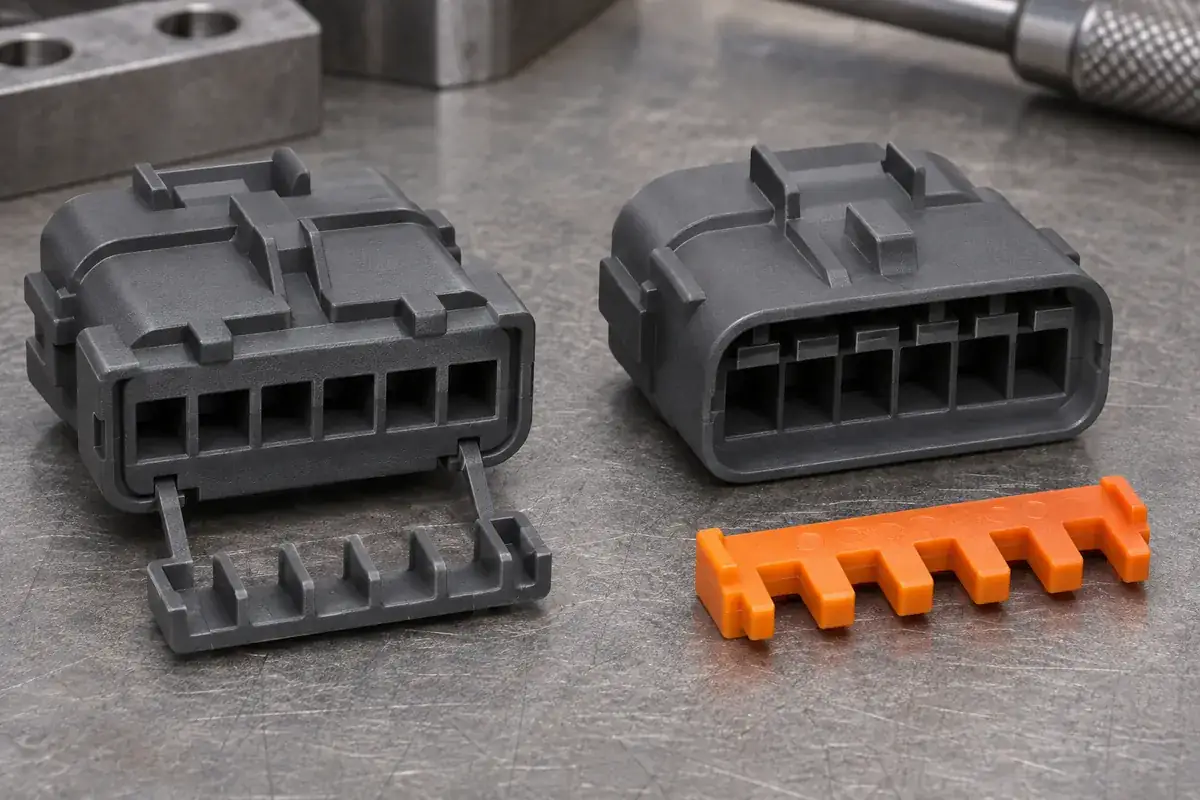
Removing a loose component from an assembly can look like an obvious improvement. An integrated terminal lock cannot be omitted from the parts tray in the same way as a separate clip, and it may simplify handling. Yet combining functions also connects their material, molding and repair requirements. Fewer part numbers do not automatically mean an easier connector to manufacture or service.
The useful comparison starts with the terminal-retention function, not the bill of materials. Define what must prevent terminal withdrawal, what must detect an incorrect terminal position and how the lock moves between assembly states. Then compare an integrated concept and a separate component against that same requirement. A design with a different retention principle is not a like-for-like cost alternative.
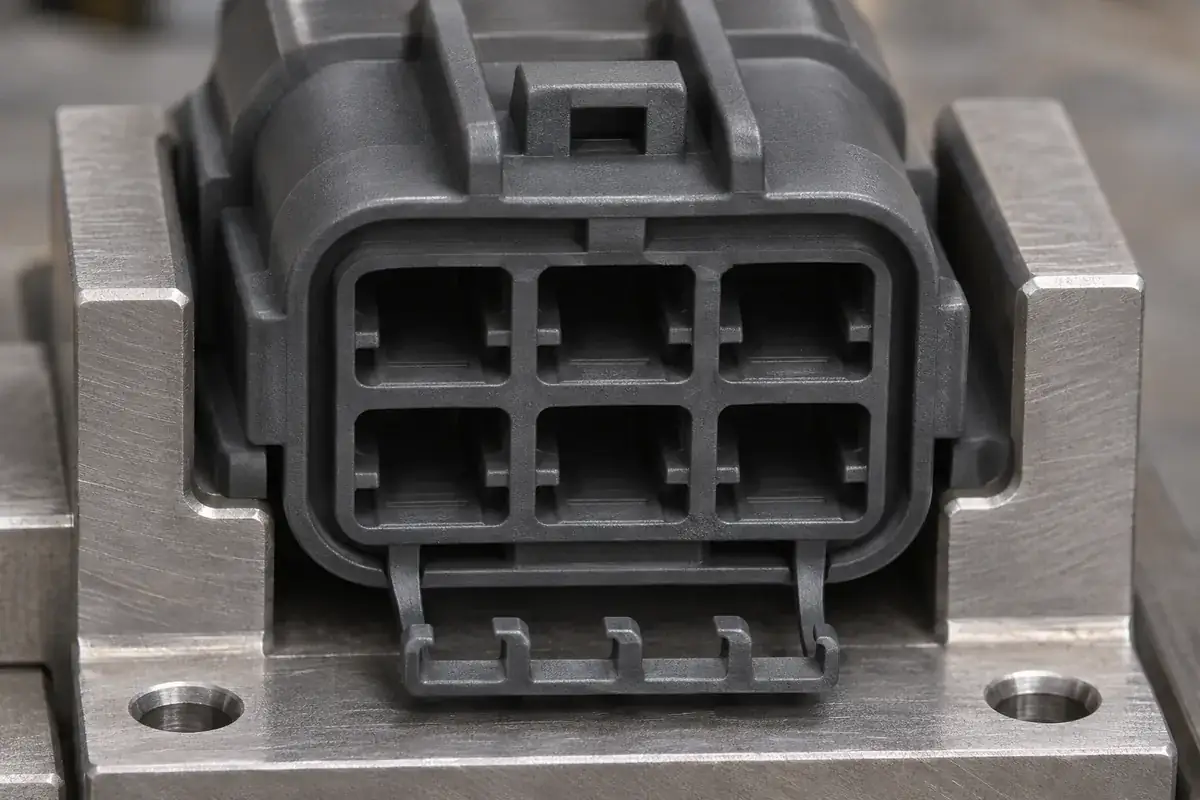
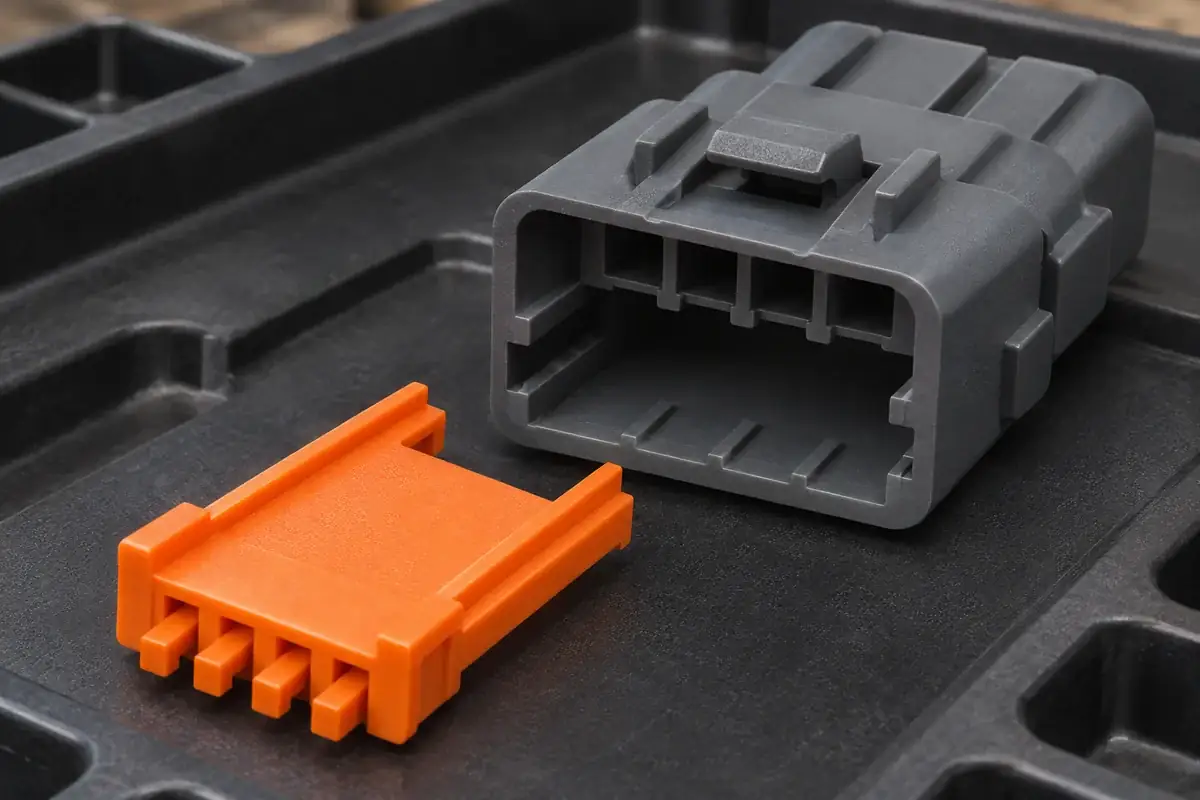
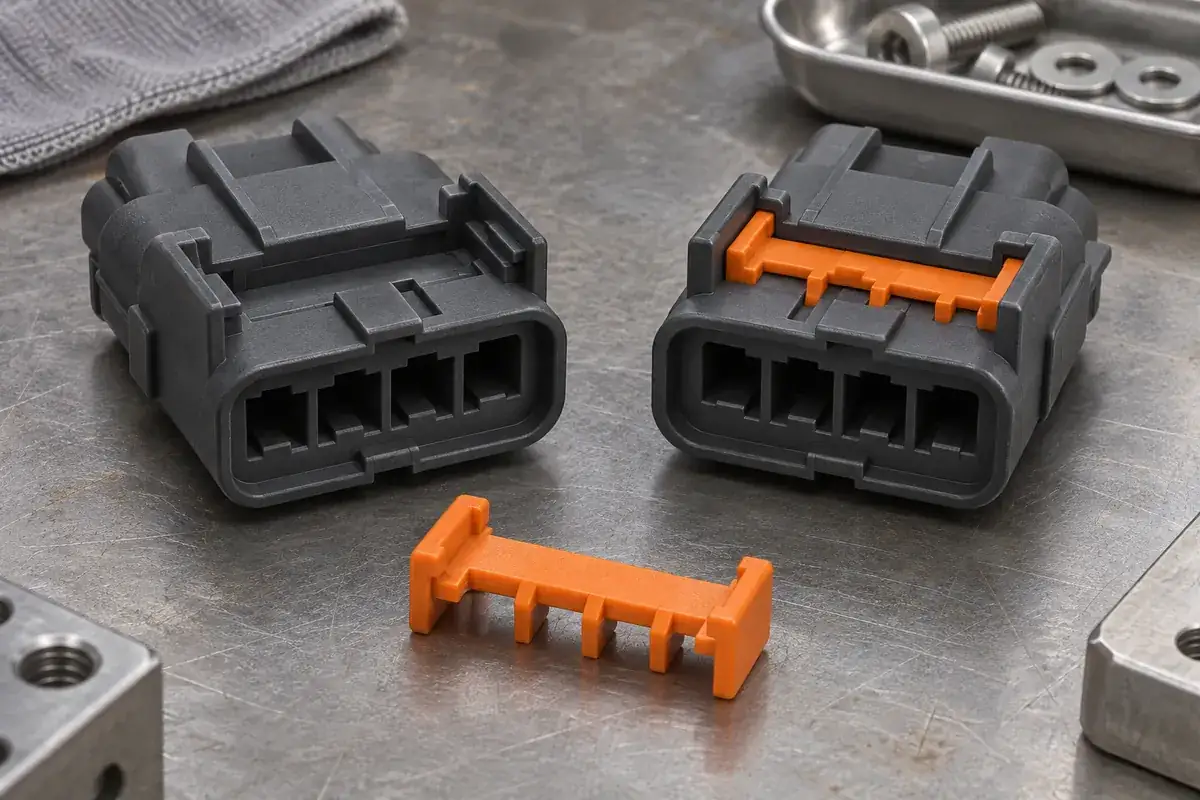
Product design illustrations accompany the assembly and manufacturing explanations below.
Clarify what integrated means in this design
Integrated can describe several constructions. A retaining feature might be molded into the housing, connected through a flexible link, or captured as part of a supplied subassembly. A captured separate component is still a separate molded part even if the harness assembler receives it already installed. Name the actual construction so assumptions about tooling, material and replacement do not become mixed together.
Molex's contact-retention guide shows that TPA implementations differ, including how the terminal is retained before the additional feature is engaged. That variation matters more than the label. For the proposed design, identify the primary retention, the added locking interface and the condition in which the terminal is allowed to move.
A one-piece flexible feature may reduce loose-part handling, but the link or moving beam becomes part of the housing's functional design. Its allowable movement and final load path need to be defined. Do not assume that every integrated TPA uses a living hinge, or that a hinge-like appearance establishes a suitable material or repeated-use capability for the application.
A separate lock introduces an additional component interface. It needs a defined orientation, guidance and retaining method during each assembly state. Those features can be beneficial: they may provide controlled travel or allow a different material. The extra interface also creates opportunities for the wrong revision, incomplete installation or loss, which the assembly and supply plan must address explicitly.
Compare the complete loading sequence
Review terminal insertion before deciding which concept assembles faster. An attached feature may be conveniently present but obstruct a cavity, tool or wire if its open position is poorly controlled. A loose lock may leave the housing completely accessible until all terminals are installed. The difference should be assessed with the intended wire arrangement, not with unpopulated samples alone.
The intermediate position also changes handling. A captured lock that stays clear of the terminal path can support staged assembly and transport. If it can fall into its final position accidentally, the assembler may need to reopen it before loading contacts. The relevant comparison is the number and reliability of actual operations, including recovery from a normal handling disturbance.
Automation adds another perspective. A separate clip needs presentation and orientation, while an integrated moving feature may need an actuator that follows a more complex path. Either approach can be practical. Include the available fixture access, part support and sensing method when comparing proposals; reducing the number of fed parts may increase the complexity of the assembly station.
For manual assembly, evaluate how the operator recognizes each state without using a vulnerable feature as a handle. A convenient push surface should load the intended structure and remain reachable after the wires are dressed. Review this alongside pre-lock and final-lock sequencing so a simple closing action does not hide an earlier missing operation.
Let material and tooling requirements influence the choice
The housing and the moving lock may ask different things of a polymer. One region may need dimensional stability around terminal cavities while another must deflect during installation. An integrated part has to reconcile those duties within its material and geometry. A separate part can use a different grade, but that option requires compatibility with the assembly's temperature, fluid and aging conditions.
Do not compare resin families alone. Grade, reinforcement, molding direction and local geometry influence the behavior of a thin beam or hook. A generous material property from a data sheet does not describe the strain at a sharp molded corner. Review the functional movement with the exact candidate material, then define sample evaluation that represents the intended component condition.
The mold concept can change the balance too. An integrated feature may introduce a difficult undercut or a thin connecting section that complicates filling and ejection. A separate lock needs its own tooling and handling, but may provide a simpler parting arrangement for both components. These are geometry-specific trade-offs rather than a general rule that fewer parts always mean cheaper tooling.
Plan how critical surfaces will be controlled after molding. Guide width, retaining shoulders and local flash can influence lock travel even when overall dimensions are acceptable. For an integrated feature, measuring the housing in its free state may not describe the feature in its working position. For a separate lock, the inspection plan must cover both sides of the interface.
Include repair and supply in the commercial comparison
A damaged separate lock may be replaceable without replacing the housing, provided the mating shoulders remain intact and the approved service procedure permits it. An integrated feature may make damage more consequential. Conversely, a separate replacement can introduce a wrong-part risk. Neither outcome is automatic; define the intended repair unit and how its identity will be controlled.
Service access should be demonstrated in the populated condition. An integrated feature that opens neatly on the bench may have no available swing space inside the equipment. A separate part may need withdrawal clearance that the installed harness cannot provide. Refer to the secondary-lock service-access review when deciding whether the apparent repair advantage remains practical.
Compare quotations at the same delivered boundary. One proposal may include a housing with a preinstalled lock, while another prices two loose molded components. Add the required assembly, inspection, packaging and replacement stock before comparing the commercial result. Also record who controls changes to the lock and housing drawings so a revision to one does not silently affect the other.
When discussing custom TPA components, provide both concepts if the architecture is still open, along with the terminal model and service requirements. The decision should follow the intended sequence, material demands and production arrangement. A well-chosen integrated or separate lock makes those duties clear, instead of treating part count as a substitute for functional design.