Why Clean Room Injection Molding Matters: ISO Standards, Classification, and Compliance

Why Clean Room Injection Molding Matters

Table of Contents

Contact Us

info@fecision.com

Room 1802, 18th Floor, Building 2, Yicheng Huanzhi Center, at the intersection of Renmin Road and Bayi Road, Jingxin Community, Longhua Street, Longhua District, Shenzhen

Clean room injection molding produces plastic parts inside an enclosed, HEPA-filtered environment where airborne particle concentrations, temperature, and humidity are controlled to ISO 14644-1 standards. ISO Class 7 limits particles to ≤352,000 ≥0.5 µm per cubic metre at 60 air changes per hour; ISO Class 8 allows ≤3,520,000 at 20 ACH. Both are mandatory for regulated medical, optical, and microelectronic manufacturing.

One airborne particle too many can end a device’s useful life before it ever reaches a patient. That’s not a figure of speech — a 50 µm fibre embedded in a cardiovascular seal during moulding can trigger thrombosis.

A sub-micron particle landing on an optical waveguide during cure scatters laser energy unpredictably. These aren’t hypothetical failure modes. They’re the documented reason that medical, optical, and microelectronic manufacturers pay a 2–3× facility premium to produce parts inside controlled environments governed by ISO 14644-1.

This guide covers the ISO cleanroom classification system, what those numbers mean in practical terms, the three occupancy states that determine compliance, and how device class maps to cleanroom class.

What Is a Clean Room in Injection Molding?

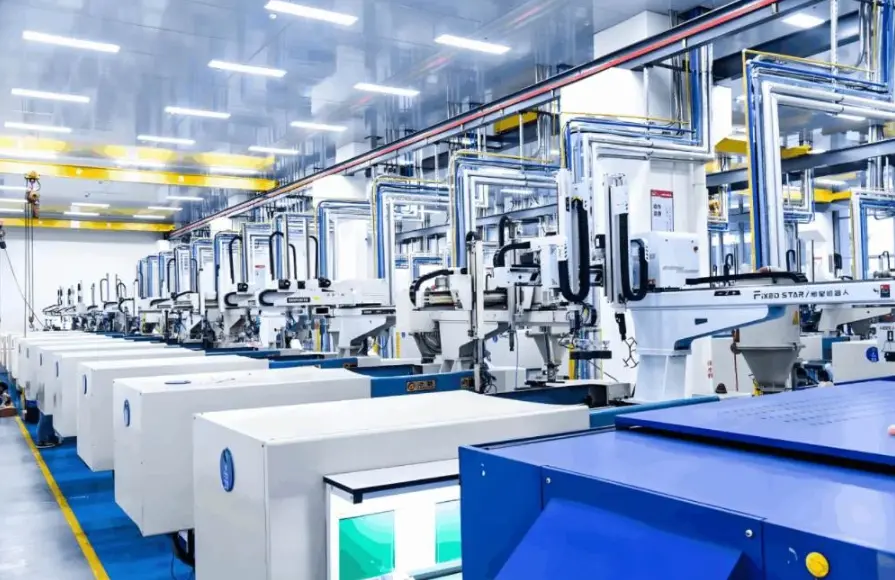
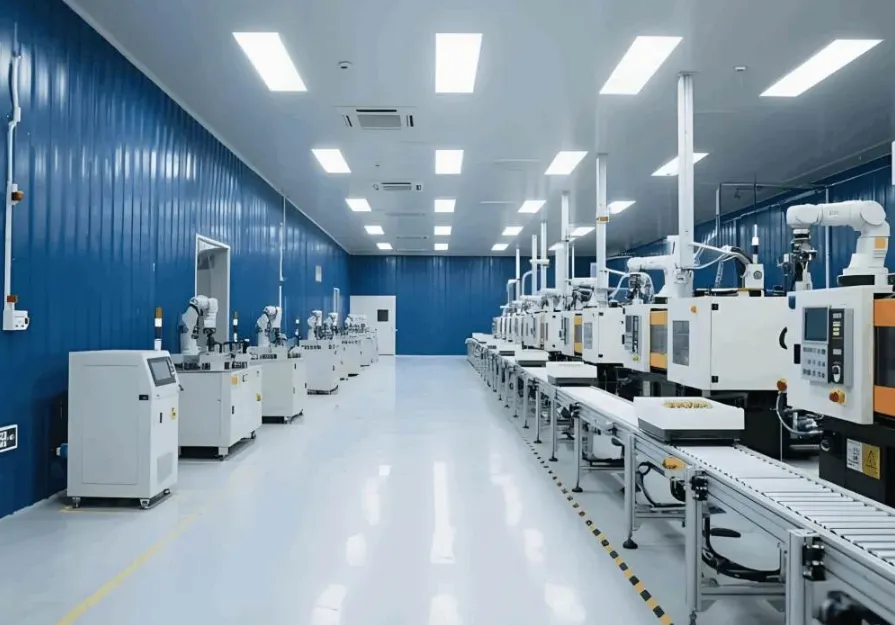
A clean room in injection molding is an enclosed production space where airborne particulate concentrations are continuously controlled by HEPA filtration and managed airflow.

ISO 14644-1:2015 — published by the International Organization for Standardization — defines the classification system for these environments, setting maximum particle concentrations per cubic meter of air at specified particle sizes from 0.1 µm to 5.0 µm [1]. This discipline covers everything from material handling to personnel protocols to prevent any foreign debris from contaminating your parts.

The standard replaced US Federal Standard 209E (which used particles per cubic foot) and covers nine classes from ISO 1 (the most stringent, used in semiconductor lithography) to ISO 9 (roughly equivalent to outdoor air).

For injection molding of medical, pharmaceutical, and microelectronic components, ISO Class 7 and ISO Class 8 are the most commonly applied classifications. More stringent cleanliness classes, such as ISO Class 5 or Class 6, are utilized for the most sensitive medical and optical components.

Beyond particle control, ISO 14644 also addresses temperature stability, humidity control, positive pressure differential between zones, and airflow pattern design. A cleanroom that meets particle count limits but allows temperature swings of ±5°C will still produce dimensional variation in precision molded parts — controlled environment molding is a system, not just a filtration specification.

ISO 14644-1 Cleanroom Classification Table

The table below maps ISO classes to their particle count limits, minimum air change requirements, legacy Federal Standard 209E equivalents, and the medical device applications they support. ★ marks the two classes used in the majority of injection molding production.

ISO ClassMax ≥0.5 µm (particles/m³)Max ≥1.0 µm (particles/m³)Min ACH (air changes/hr)Fed Std 209E EquivalentMedical Device Application
ISO 5≤ 3,520≤ 832240–480Class 100Class III implantables, aseptic fill-finish
ISO 6≤ 35,200≤ 8,320150–240Class 1,000Sterile surgical instrument components
ISO 7 ★≤ 352,000≤ 83,20060 min.Class 10,000Medical device housings, Class II devices, pacemaker assembly
ISO 8 ★≤ 3,520,000≤ 832,00020 min.Class 100,000Non-sterile medical parts, secondary ops, food-contact closures
ISO 9No limitNo limit~10Room airBackground zones, packaging (unclassified)

Context for the numbers: normal indoor room air contains approximately 35 million particles ≥0.5 µm per cubic metre — roughly 100× dirtier than an ISO 8 environment and 10,000× dirtier than ISO 5 [2].

HEPA filters are rated at 99.97% efficiency at 0.3 µm — the most penetrating particle size — and are the primary mechanism achieving these classifications. The number of air changes per hour (ACH) determines how quickly the HEPA-filtered supply air dilutes and displaces any particles generated by people, equipment, or processes inside the room.

The cost gap between ISO 7 and ISO 8 is significant: ISO 7 facilities typically cost 2–3× more to build and operate than ISO 8 due to higher HVAC capacity, increased filtration area, greater energy consumption, and stricter gowning requirements.

HVAC infrastructure alone accounts for 25–40% of total cleanroom project cost regardless of class. This cost differential drives the risk-based classification approach: selecting the least stringent class that the device’s contamination risk profile genuinely requires, not defaulting to the strictest available.

The Three Occupancy States: Why Operational Testing Is the Only One That Counts

ISO 14644-1 defines three distinct occupancy states for cleanroom testing and certification. Understanding which state applies to your compliance requirement is one of the most consequential and most frequently misunderstood aspects of cleanroom validation.[3]

Occupancy StateDefinitionPurposeKey Note
As-BuiltFacility complete; no equipment, production tools, or personnelBaseline verification of HVAC and filtration performanceUseful for contractor acceptance; lowest particle loads
At-RestEquipment installed and operational; no production personnel presentConfirms equipment particle contribution; used for routine certification checksMany facilities pass at-rest; operational is the true compliance state
Operational ✓Full production running: personnel gowned, machines cycling, parts being producedThe required compliance state under ISO 14644-1 and FDA QMSRHighest particle load — personnel generate the dominant particle source during active production

The practical implication is stark: facilities that are qualified in the at-rest state must still demonstrate compliance in the operational state to satisfy ISO 14644-1 and FDA QMSR requirements. Personnel are the dominant particle source inside a functioning cleanroom — a gowned person generates approximately 100,000 particles ≥0.5 µm per minute during normal movement.

A cleanroom that passes at-rest certification may exceed its class limit during production if gowning protocols, personnel count, or movement patterns are not controlled.

Our Class 1000 (ISO 7) medical LSR cleanroom is certified in the operational state under full production conditions — two operators, machines cycling, parts transferring to packaging. This is the certification state that ISO 13485 auditors examine, not the at-rest baseline.

Medical Device Classification and Required Cleanroom Class

FDA and ISO 13485 require manufacturers to justify their cleanroom classification through documented risk analysis. The assessment considers device classification under 21 CFR Part 860 (Class I, II, or III), patient contact type, sterility requirements, and bioburden control strategy. The table below maps device classes to the cleanroom environments they typically require.

Device ClassCategoryCleanroom ClassRepresentative Applications
Class IIIImplantableISO 5–6Pacemakers, cochlear implants, orthopedic implants, long-dwell catheters
Class II (sterile)Surgical / fluid-pathISO 6–7Sterile surgical instruments, IV connectors, syringe barrels, respiratory masks
Class II (non-sterile)Diagnostic / wearableISO 7Diagnostic equipment housings, wearable monitors, reusable surgical tools
Class INon-sterile, low riskISO 7–8Tongue depressors, bandages, exam gloves, non-contact device enclosures
Food / pharma packagingIndirect contactISO 8Closures, dispensing valves, food-contact components, pharmaceutical packaging

Note on sterility: ISO 14644 controls airborne particles, not sterility. A Class 7 cleanroom does not produce sterile parts — terminal sterilisation (autoclave, EtO, gamma, e-beam) achieves sterility after molding.

Cleanroom classification reduces the bioburden on parts entering sterilisation, improving the probability of achieving sterility assurance level (SAL) targets. This is why a clean room is necessary but not sufficient for sterile device production.

The Importance of Clean Rooms in Injection Molding

Why Clean Room Injection Molding Matters: Five Mechanisms

The following five areas show how a clean environment protects your parts.

1. Contamination as a Failure Mode — Not Just a Cosmetic Issue

Particulate inclusions behave as stress concentrators in the polymer matrix. A 50 µm embedded fiber in a cardiovascular seal creates a crack initiation site that propagates under cyclic loading — a failure mode that doesn’t appear during manufacturing inspection but emerges in service.

At injection molding temperatures, the polymer melt is exceptionally receptive to contamination — particles become permanently embedded during fill, before the surface skin forms. Post-molding cleaning cannot reliably remove embedded particles from a cured elastometric or optical part. The only reliable intervention is preventing particle contact during molding.

2. Air Quality Architecture — HEPA, Laminar Flow, and Positive Pressure

A functioning cleanroom is not simply a room with a HEPA filter. It is an engineered airflow system. HEPA filters remove 99.97% of particles ≥0.3 µm from supply air.

Positive pressure differential between adjacent zones — a minimum of 10–15 Pascals between the cleanroom and surrounding areas — prevents contaminated air from infiltrating when doors open. The gradient runs from cleanest to least clean: the molding cell is the highest-pressure zone, the gowning anteroom is intermediate, and the corridor is at ambient.

Temperature is maintained at 68–72°F (20–22°C) and relative humidity at 30–50% RH — humidity control prevents microbial growth and manages static charge on polymer parts [3].

3. Material Handling Discipline

The molding environment is only as clean as the material entering it. Virgin resin for medical-grade molding arrives in sealed foil pouches; operators open these inside glove boxes or transfer airlocks to prevent ambient exposure before the material reaches the hopper. Colorants and additives undergo pre-screening for metallic contamination.

Machine selection also matters. All-electric injection molding presses — which use servo motors rather than hydraulic actuators — are strongly preferred for cleanroom environments. Hydraulic systems generate fine oil aerosols that HEPA filtration cannot wholly prevent from reaching the mold cavity.

4. Regulatory Compliance — FDA QMSR, ISO 14644-2, and ISO 13485

FDA 21 CFR Part 820 (now the Quality Management System Regulation, or QMSR, effective February 2, 2026) requires manufacturers to ‘establish and maintain procedures to adequately control environmental conditions’ wherever those conditions affect product quality [4].

ISO 14644-2 governs the requalification schedule. The standard recommends maximum intervals between certification tests based on cleanroom class: ISO Class 5 requires requalification every 6 months; ISO Classes 6–8 require requalification annually [5].

ISO 13485:2016, now incorporated into the US QMSR, requires that cleanroom processes be validated as special processes — statistical output verification is not sufficient evidence of process control for an enclosed moulding environment.

5. Environmental Stability as a Process Control Variable

Temperature and humidity affect polymer melt viscosity, resin moisture absorption rate, and dimensional behaviour during cooling. A ±1°C shift in mould temperature changes shrinkage by a measurable percentage in LSR and other sensitive materials.

Clean room environments — by maintaining temperature at 20–22°C and humidity at 30–50% RH — eliminate this variability source. Statistical Process Control (SPC) becomes meaningful in a cleanroom in a way it isn’t on an uncontrolled factory floor.

Practical Benefits of Clean Room Injection Molding

While the primary goal is purity, these environments offer several practical business advantages.

First-Pass Yield above 98%

Contamination-related cosmetic rejects — specks, silver streaks from embedded particles, surface blemishes — are the dominant defect mode in conventional factory production of precision parts. Controlled environments eliminate the particle sources that cause these defects, lifting first-pass yields from the 85–90% typical in uncontrolled production to above 98% in mature cleanroom operations.

For high-value medical or optical parts, a 10–13% yield improvement on expensive engineering resins (PEEK, PSU, medical-grade PC) repays the facility premium rapidly.

Extended Tooling Life

Abrasive particulate — metallic dust, polymer fines, ambient grit — enters mould vents and accelerates wear on vent land surfaces and moving mould components. In cleanroom moulding, filtered air supply and material handling protocols dramatically reduce the abrasive load reaching the mould.

Production data across mold populations shows that cleanroom tools frequently achieve double the shot count between maintenance intervals compared to equivalent tools running in uncontrolled environments.

Audit-Ready Documentation Trail

Regulated manufacturers — particularly those under FDA QMSR, EU MDR, or MDSAP — require documented evidence that environmental conditions meet specified limits throughout production.

Cleanroom operations generate continuous environmental monitoring records (particle counts, temperature, humidity, pressure differential) that are stored, retrievable, and attached to the Device History Record (DHR) for each production lot.

Clean Room Injection Molding Applications

Clean Room Injection Molding Applications

The following device and component categories require cleanroom moulding as a baseline manufacturing condition — not as an option:

  • Implantable medical components: pacemaker headers, cochlear implant components, orthopedic device parts (ISO 5–6 minimum; long-dwell implants are the most stringent classification)
  • Fluid delivery and infusion systems: IV connectors, syringe barrels, infusion pump valve membranes — any component with a fluid-path lumen that a particle could obstruct or a patient’s bloodstream would contact
  • Respiratory and ventilation devices: mask seals, respiratory valves, breathing circuit connectors — ISO 7 standard; neonatal devices may require ISO 6
  • Surgical instruments and disposables: trocar components, laparoscopic tool seals, electrosurgical insulation, PSU/PPSU handles requiring autoclave resistance
  • Diagnostic and laboratory instrumentation: microplate wells, pipette tips, analytical instrument gaskets — sub-micron particle contamination distorts assay results; optical clarity requires particle-free surface
  • Semiconductor and microelectronic packaging: wafer carriers, chip sockets — ionic contamination causes circuit failure; ESD and particle requirements are simultaneous
  • Optical components: lens barrels, fibre-optic connectors, satellite optics moulded in PEEK or Ultem — single particle causes measurable performance degradation
  • Aseptic food and pharmaceutical packaging: closures, dispensing valves — ISO 8 standard; controlled environment reduces bioburden before sterilisation or aseptic filling

Frequently Asked Questions

What is the difference between ISO 7 and ISO 8 for injection molding?

ISO Class 7 (formerly ‘Class 10,000’) limits airborne particles to ≤352,000 ≥0.5 µm per cubic metre and requires a minimum of 60 air changes per hour. ISO Class 8 (formerly ‘Class 100,000’) allows ≤3,520,000 particles at the same size threshold and requires a minimum of 20 ACH — a tenfold difference in allowable particle concentration.

How often does a cleanroom need to be requalified?

ISO 14644-2 mandates maximum requalification intervals by class: ISO Class 5 must be recertified every 6 months; ISO Classes 6–8 require annual requalification.

What device class requires what cleanroom class?

The risk-based mapping runs: Class III implantables (pacemakers, cochlear implants) → ISO 5–6; Class II sterile devices (surgical instruments, IV connectors) → ISO 6–7; Class II non-sterile and diagnostic equipment → ISO 7; Class I non-sterile low-risk devices → ISO 7–8; food-contact and pharmaceutical packaging → ISO 8.

Why are all-electric injection molding machines preferred in cleanrooms?

Hydraulic moulding machines use oil-pressurised systems that generate fine aerosol mist as seals wear — a particle source that HEPA filtration cannot reliably intercept before it reaches the mould cavity. All-electric machines use servo motors with no hydraulic fluid, eliminating this contamination vector.

Electric machines also offer tighter process control through direct servo feedback on injection speed and pressure, reducing shot-to-shot variability — a secondary benefit in medical precision molding.

Does cleanroom classification guarantee sterile parts?

No. ISO 14644 controls airborne particle concentration, not sterility. Parts moulded in a Class 7 or Class 8 cleanroom are not sterile — they carry reduced bioburden relative to parts moulded in uncontrolled environments.

Terminal sterilisation (autoclave, EtO, gamma, or e-beam) achieves sterility. The cleanroom’s role is to lower the pre-sterilisation bioburden to a level where terminal sterilisation can reliably achieve the required Sterility Assurance Level (SAL) of 10⁻⁶ for implantable devices.

Conclusion

Clean room injection moulding is not a marketing credential. It is an engineered response to a specific failure mechanism — airborne particulate contamination during moulding — that cannot be corrected after the part is made.

Fecision delivers elite reliability through our ISO 13485 certified medical-grade clean room injection molding and Class 7/8 clean room environments. We utilize validated contamination control and real-time particle monitoring to protect your sensitive designs. Our traceable material flow and audit-ready documentation ensure your biocompatible parts meet every strict FDA and EU MDR requirement perfectly.

Fecision specializes in medical injection molding, especially for lsr injection molded parts, providing a reliable cleanroom environment for your critical medical projects. Contact us today to secure a certified clean room injection molding roadmap for your next project!

References & Authoritative Citations

All sources publicly available. Accessed April 2026. No competitor backlinks.

[1] ISO 14644-1:2015. ‘Cleanrooms and associated controlled environments — Part 1: Classification of air cleanliness by particle concentration.’ International Organization for Standardization.  https://www.iso.org/standard/53394.html

[2] Mecart Cleanrooms. ‘Clean Room Classifications (ISO 8, ISO 7, ISO 6, ISO 5).’ Particle count table and Federal Standard 209E equivalents.  https://www.mecart-cleanrooms.com/learning-center/cleanroom-classifications-iso-8-iso-7-iso-6-iso-5/

[3] Setra Systems. ‘What is ISO 8 Cleanroom Classification?’ ISO 7 vs ISO 8 particle counts and ACH comparison; three-state testing context.  https://www.setra.com/blog/what-is-iso-14644-1-cleanroom-classification

[4] U.S. Food and Drug Administration (FDA). ‘Quality Management System Regulation (QMSR).’ 21 CFR Part 820. Effective February 2, 2026.  https://www.fda.gov/medical-devices/postmarket-requirements-devices/quality-management-system-regulation-qmsr

[5] Envigilance. ‘ISO 14644 Clean Room: Air Quality Monitoring Guide 2026.’ Requalification intervals: ISO 5 every 6 months; ISO 6–8 annually. (January 2026)  https://envigilance.com/compliance/iso-14644-clean-room/

Let's Achieve Something Remarkable Together!

You May Also Like

Start your project now