
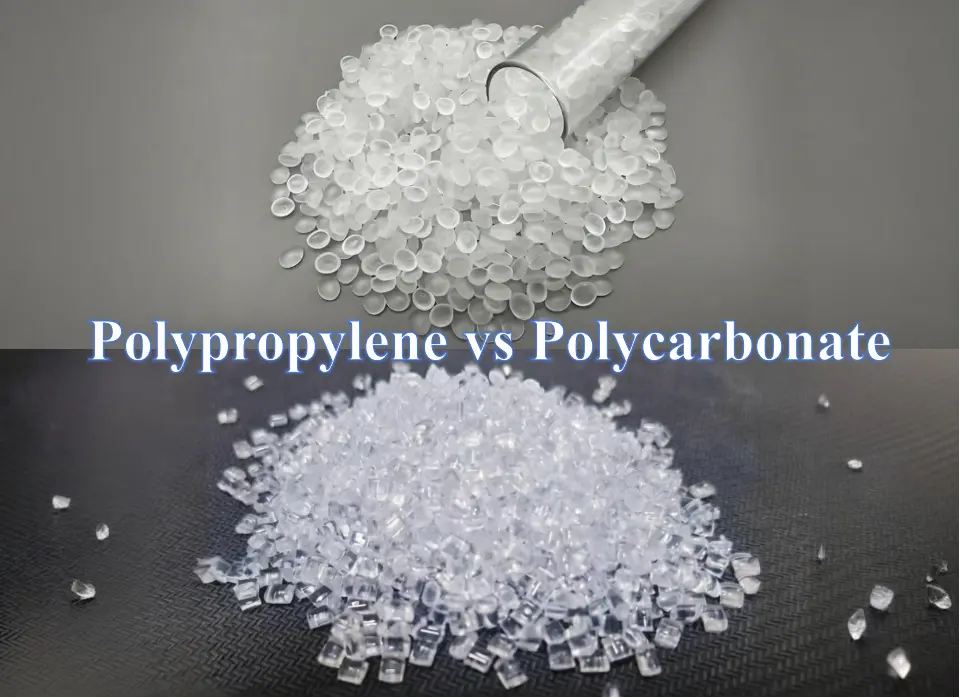
| PP (polypropylene) is a semi-crystalline polyolefin: cheap, chemically inert, autoclave-compatible, and the only thermoplastic with living hinge capability — but it shrinks 1.5–3.0% anisotropically and is opaque. PC (polycarbonate) is an amorphous polymer: optically clear, stiff, with an HDT of 125–140°C and low isotropic shrinkage (0.5–0.8%) — but it costs 2× more, requires desiccant drying before molding, and is attacked by many common solvents. |
These two materials rarely compete for the same application. PP wins wherever chemical resistance, living hinges, food contact, or low cost drives the decision. PC wins wherever optical clarity, dimensional precision, or heat resistance above 80°C is required.
This guide covers both materials from an injection molding standpoint: structure, quantified engineering properties, processing parameters, and a 12-scenario selection framework for the most common design decisions.
What Are Polypropylene and Polycarbonate?
Polypropylene (PP)
Polypropylene is a semi-crystalline polyolefin produced by polymerising propylene with a Ziegler-Natta or metallocene catalyst. The catalyst controls chain tacticity — isotactic PP (the standard commercial form) has a regular, ordered chain structure that crystallises to 40–70% during cooling. This crystallinity is the source of PP’s distinctive combination of chemical resistance, stiffness, and the unique self-orienting molecular property that enables living hinges.
PP is available in three primary structural types for injection molding: homopolymer (stiffest, highest HDT, most brittle at low temperatures), random copolymer (more transparent, better low-temperature toughness, slightly lower stiffness), and impact copolymer (rubber-toughened, excellent impact to −40°C, opaque). Each is a distinct material with different processing behavior.
Polycarbonate (PC)
Polycarbonate is an amorphous polymer based on bisphenol A (BPA) and carbonate groups. Its amorphous structure — no crystalline regions — means it solidifies without the volume contraction associated with crystallisation, producing low, uniform shrinkage (0.5–0.8%) and naturally transparent parts. This same structure gives PC its high impact toughness and its sensitivity to moisture hydrolysis during molding.
PC’s optical clarity (> 90% visible light transmission) is comparable to glass and surpassed only by PMMA among common injection-molded thermoplastics. This property, combined with impact resistance and dimensional precision, drives its use in lenses, protective glazing, diagnostic windows, and electronic device housings where structural integrity and visual inspection are both required.
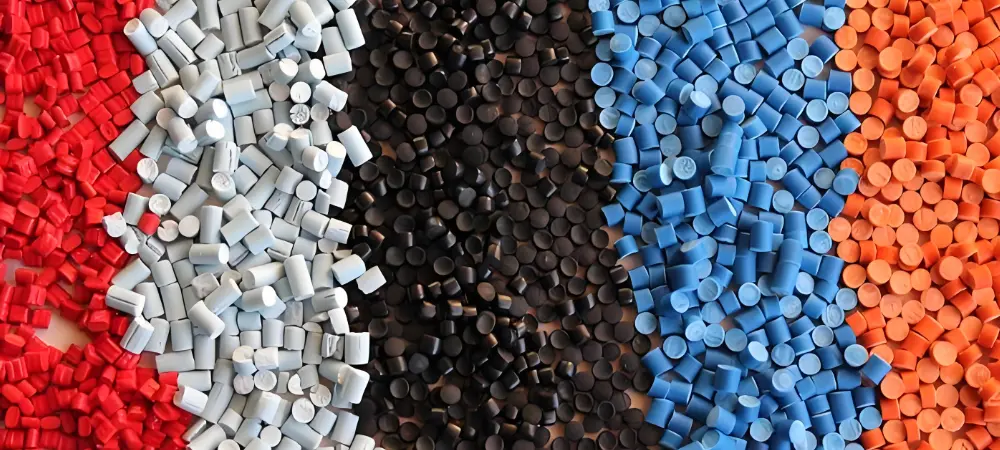
Polypropylene vs Polycarbonate: Side-by-Side Properties
The table covers the 11 properties most relevant to material selection in injection molding. Data represents typical ranges for standard unfilled commercial grades; glass-fiber values are noted where the difference is significant.
| Property | Polypropylene (PP) | Polycarbonate (PC) |
| Structure | Semi-crystalline polyolefin. 40–70% crystallinity. True melting point ~160°C. | Amorphous polymer. No crystalline regions; no sharp melting point. Softens gradually above Tg ~147°C. |
| Tensile strength | 25–40 MPa (homopolymer) 20–35 MPa (impact copolymer) | 55–75 MPa — substantially stronger under static load |
| Heat deflection temp (1.82 MPa, 264 psi) | 55–65°C unfilled 130–145°C (GF30 grade) | 125–140°C unfilled 140–150°C (GF grade) |
| Mold shrinkage | 1.5–3.0% — high and anisotropic GF filled: 0.5–1.0% | 0.5–0.8% — low and isotropic GF filled: 0.2–0.5% |
| Optical clarity | Opaque (standard grades) Random copolymer: slightly translucent | > 90% visible light transmission — naturally clear |
| Chemical resistance | Excellent. Resists acids, bases, oils, solvents, fuels, and most aqueous solutions. | Moderate. Resists dilute acids and water. Attacked by ketones, esters, chlorinated solvents, organic acids. |
| Water absorption (24h) | < 0.02% — essentially none. No pre-drying required. | 0.1–0.2% — desiccant drying to < 0.02% mandatory before molding. |
| Living hinge capability | Yes — unique to PP. Correct gate orientation + 0.25–0.35 mm wall → millions of flex cycles. | None. PC cracks under repeated tight-radius flexing. |
| Sterilization | Autoclave (121°C, limited cycles), gamma, EtO — all compatible. | EtO and gamma — excellent. Autoclave degrades clarity and impact over repeated cycles. |
| Flame performance | HB standard; V-0 grades available | V-0 grades widely available (Covestro Makrolon FR series) |
| Recyclability | Resin code #5. Widely recyclable. | Resin code #7. Recyclable; limited municipal collection. |
The Five Properties That Decide Most PP vs. PC Questions
Ninety percent of PP vs. PC decisions come down to one or two of these five factors:
1. Chemical Resistance
PP’s near-universal chemical resistance stems from its non-polar hydrocarbon backbone — no functional groups for most chemicals to attack. It resists acids, bases, oils, fuels, alcohols, and aqueous solutions indefinitely under normal conditions. The only reliable attacks are concentrated oxidizing acids and a subset of aromatic/chlorinated solvents at elevated temperatures.
PC is the opposite. Its carbonate ester backbone is reactive with strong alkalis, organic acids, ketones (acetone, MEK), esters, and chlorinated solvents. Even solvents that don’t dissolve PC can cause environmental stress cracking — attacking parts at molded-in stress points like gate areas and sharp corners without visibly degrading the bulk material.
Common hospital disinfectants and lubricants contain compounds that stress-crack PC housings at concentrations that would leave PP untouched.
2. Dimensional Precision and Shrinkage
PC’s amorphous structure produces low, isotropic shrinkage (0.5–0.8%). For connector housings, sensor enclosures, and instrument panels where pin spacing or aperture dimensions must hold to ±0.05 mm across production lots, PC is the natural choice.
PP crystallizes as it cools, contracting more in one direction than another. For a large flat panel in PP, differential shrinkage across the part can bow the panel by several millimeters even with a well-designed tool. GF-filled PP reduces total shrinkage but doesn’t eliminate the anisotropy — it becomes less severe, but still requires simulation to manage.
3. Living Hinges
PP is the only injection-moldable thermoplastic with true living hinge capability. The semi-crystalline chain structure allows molecular orientation during filling — when flow is perpendicular to the hinge axis and the wall is 0.25–0.35 mm, PP chains align along the bending direction and create a structure that survives 50–100 million flex cycles. One-piece flip-top caps, medical dispenser closures, and hinged container lids all depend on this property.
PC cannot do this. Its amorphous, glassy chain structure fractures under the repeated tight-radius flexing of a living hinge. Any design that requires an integral hinge must use PP.
4. Optical Clarity and Heat Resistance
PC’s > 90% visible light transmission is a consequence of its amorphous structure — no crystalline boundaries to scatter light. Standard PP is opaque. For lenses, instrument covers, diagnostic device windows, or any part where LEDs must be read through the housing wall, PC is the only injection-moldable option of the two.
On heat resistance, PC’s HDT of 125–140°C covers most electronics, automotive interior, and medical instrument enclosure requirements. Unfilled PP softens under load above 65°C, which rules it out for anything near a motor or in a warm enclosure. GF30 PP bridges the gap at 130–145°C, but only for structural (non-optical) applications.
5. Cost and Pre-Drying Infrastructure
PP is cheaper than PC — but the production cost gap is often wider than the material price suggests. PP production cells need no drying infrastructure. PC cells need a dedicated desiccant dryer on every press, adding capital equipment and a pre-drying step (3–4 hours) before each production run. For a high-volume line running shifts, that preparation cost is significant.
For parts where either material can meet the specification, PP is almost always the correct economic choice. The cases where PC’s cost is justified are exactly the ones where PP can’t deliver: optical clarity, dimensional precision in humid environments, and continuous heat resistance above 80°C.
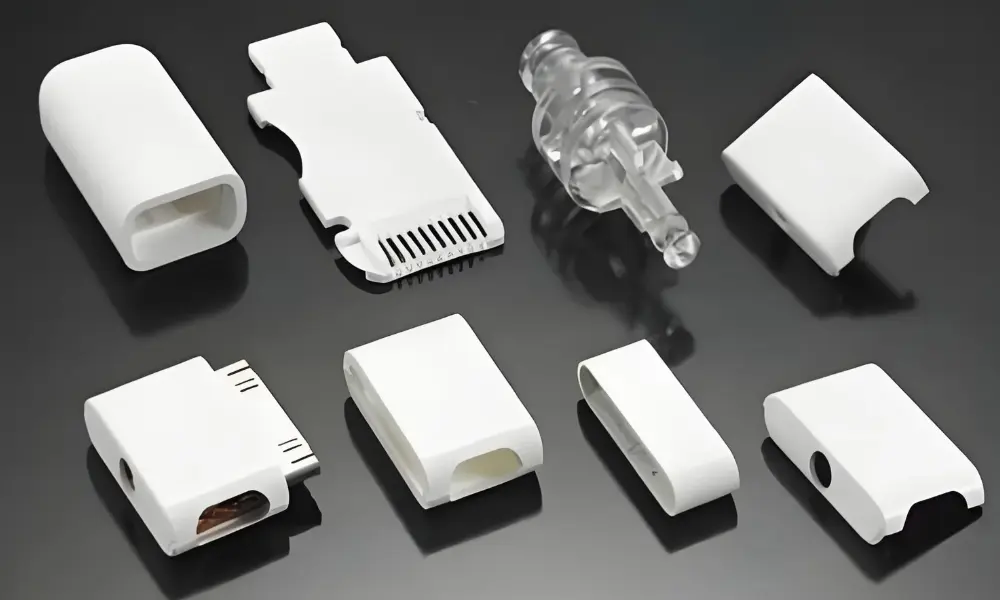
Processing: Key Differences at the Press
PP and PC need different production setups. The most important difference isn’t temperature — it’s whether pre-drying equipment is required. PP needs none. PC needs a dedicated desiccant hopper dryer on every production cell; without it, parts will be brittle and potentially unusable.
| Parameter | PP | PC |
| Pre-drying | Not required. PP absorbs essentially no moisture. Allow pellets to warm to room temp if moved from cold storage. | Mandatory. Desiccant hopper dryer at 120°C for 3–4 hours to below 0.02% moisture. PC hydrolyzes irreversibly when molded wet — parts become brittle and discolored. |
| Barrel temperature | 220–280°C. Wide, forgiving window. Purge with PE on extended shutdowns. | 260–320°C. Narrower window. Do not exceed 320°C — chain scission occurs. Progressive injection reduces flow marks on optical surfaces. |
| Mold temperature | 20–80°C. Higher temp → better gloss, lower shrinkage. Living hinge parts: 15–30°C; flex hinge immediately post-ejection. | 70–100°C mandatory. Cold molds produce flow marks and high residual stress. For optical parts: 85–95°C to minimize birefringence. |
| Mold shrinkage | 1.5–3.0% (unfilled), anisotropic. Run Moldex3D or Moldflow before cutting steel for any precision PP part. | 0.5–0.8%, isotropic. Tolerances of ±0.05 mm on standard features achievable with straightforward cavity compensation. |
| Tool steel | P20 acceptable for unfilled PP. GF-filled PP: H13 at 48–52 HRC required (glass fiber is abrasive). | P20 acceptable for structural PC. Optical surfaces: S136 stainless, polished to Ra < 0.05 µm. |
| Post-mold | No conditioning needed. Check dimensions after 24–48 h — PP continues crystallizing slightly after ejection. | Anneal stress-critical or optical parts at 120–130°C for 1–4 h. Reduces stress cracking risk from chemical exposure. |
PP Anisotropic Shrinkage: Why Simulation Is Not Optional
For any PP program with tolerances tighter than ±0.25 mm, run a mold filling simulation before tooling is ordered. The shrinkage perpendicular to flow can be 3–4× higher than parallel to flow, and the exact values depend on gate location, wall thickness, and cooling uniformity. These interactions can’t be reliably estimated by hand.
→ Learn more about Fecision PC injection molding and PP injection molding capabilities:
Where Each Material Dominates
The application split between PP and PC is rarely contested — each material has settled into the sectors that match its properties.
PP: Disposables, Chemical Handling, Living Hinges, Food Contact
Medical disposables are PP’s highest-volume application globally: syringes, specimen cups, IV connectors, lab consumables. FDA 21 CFR 177.1520 compliance, autoclave sterilization, and cost make PP the default for single-use devices. [3]
Automotive fluid systems: fuel filler necks, coolant tanks, battery housings, air intake manifolds (in GF-PP). PP’s chemical resistance to automotive fluids makes it the standard choice wherever regular fluid contact occurs.
Food and consumer packaging: microwave-safe containers, bottle caps, living-hinge lids, and food storage components use PP for its FDA compliance and the unique hinge capability no other material provides at this price.
PC: Optics, Electronics Enclosures, Automotive Lighting, Precision Housings
Consumer electronics: laptops, monitors, appliances, and industrial control housings use PC or PC/ABS blends for dimensional accuracy, UL 94 V-0 flame ratings, surface quality for painting, and the established supply of certified grades (Covestro Makrolon, SABIC Lexan). [1]
Automotive lighting: headlamp outer lenses, fog lamp covers, and interior lighting diffusers. PC’s > 90% light transmission, impact resistance, and HDT above 125°C satisfy headlamp requirements no other thermoplastic matches at equivalent cost.
Reusable medical device housings: diagnostic instruments, infusion pump bodies, and monitoring enclosures use PC for its EtO/gamma sterilization compatibility, clarity (for LED read-through), and impact resistance. The material split in medical is often: disposable components in PP, reusable housings in PC.
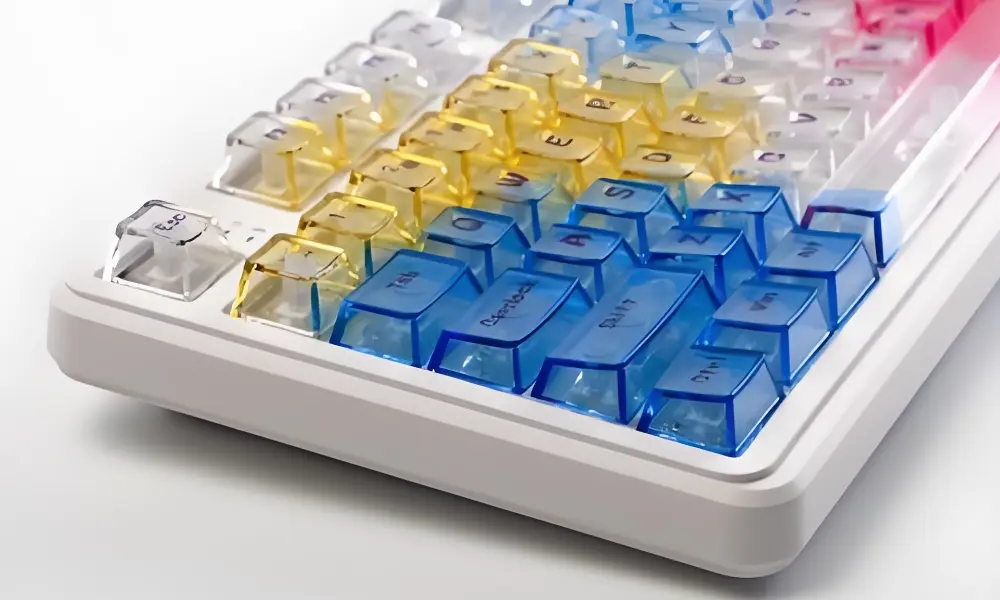
Selection Guide: 12 Common Scenarios
Run down the list and find your requirement. The last row addresses one common mistake — parts that need electroplating, where neither PP nor PC is the right answer.
| Requirement | Choose | Reason |
| Part must flex, hinge, or snap repeatedly | PP | Only thermoplastic with living hinge capability. PC cracks under repeated tight-radius flexing. |
| Part requires optical clarity | PC | > 90% light transmission. Standard PP is opaque. Transparent PP grades exist but sacrifice mechanical performance. |
| Chemical or oil exposure (acids, bases, solvents, fuels) | PP | Near-universal chemical resistance. PC is attacked by ketones, esters, and chlorinated solvents. |
| Continuous service above 80°C under load | PC (or GF-PP) | Unfilled PP: HDT 55–65°C. PC: 125–140°C. GF30-PP extends to 130–145°C for the intermediate range. |
| Tight tolerances (< ±0.1 mm on critical dimensions) | PC | Isotropic shrinkage 0.5–0.8% is predictable. PP shrinkage is anisotropic and requires mold flow simulation to manage. |
| Food contact or potable water | PP | FDA 21 CFR 177.1520 compliant. Standard BPA-based PC is not approved for food contact. |
| Single-use medical disposables (syringes, containers) | PP | Autoclave compatible. Lower cost. FDA compliant. |
| Reusable device housing, EtO or gamma sterilized | PC | Excellent EtO/gamma compatibility. Retains clarity and impact through sterilization cycles. |
| UL 94 V-0 flame rating for electronics | PC | V-0 grades widely available. PP V-0 grades exist but have narrower processing windows. |
| Impact resistance below −20°C | PP (impact copolymer) | PC impact drops sharply below −20°C. Impact-copolymer PP retains toughness to −40°C. |
| Cost-sensitive high-volume commodity parts | PP | $0.80–$1.20/lb vs PC at $1.60–$2.40/lb, plus no drying infrastructure required. |
| Electroplating required | Use ABS instead | Neither PP nor PC electroplates via the standard ABS acid-etch process. ABS is the correct choice for chrome-plated parts. |
The GF-PP bridge note in row 4 is worth expanding. GF30-PP extends heat deflection to 130–145°C, which overlaps substantially with unfilled PC’s 125–140°C range. For structural (non-optical) applications in this temperature band, GF-PP is a legitimate lower-cost alternative to unfilled PC — it costs less and needs no pre-drying.
Conclusion
Polycarbonate delivers high impact resistance, clarity, and good heat performance but benefits from hard coats to fight scratches and UV. Polypropylene gives chemical and oil resistance, abrasion toughness, and flexibility; BOPP films add clarity where needed. Make the final pick by matching performance needs to real use conditions.
Fecision runs PP and PC on separate process lines — PP cells need no drying infrastructure; PC cells run desiccant hopper dryers as standard. Both material families are supported from DFM through volume production.
- PP grades in production: Homopolymer, random copolymer, impact copolymer, GF30/GF40, UV-stabilized, medical-grade (ISO 10993). Living hinge programs with validated gate orientation.
- PC grades in production: General-purpose, high-flow, UL 94 V-0, medical-grade (ISO 10993), PC/ABS blends. Desiccant drying to < 0.02% moisture as standard for all PC runs.
- Quality planning: FECISION coordinates the applicable manufacturing partner's quality-system scope and the drawing-based inspection plan. Agree first-article records, critical dimensions and any process-capability study needed for the specific PP or PC component.
- DFM service: Simulation for PP precision programs. PC optical part stress and birefringence analysis. Gate orientation review for PP living hinge programs.
Contact Fecision for material selection advice and DFM review at: fecision.com/contact-us
Frequently Asked Questions
Which has higher impact resistance — PP or PC?
At room temperature, PC (60–80 kJ/m² notched Izod) is substantially tougher than homopolymer PP (3–8 kJ/m²). However, impact-copolymer PP grades achieve > 60 kJ/m² impact and retain toughness to −40°C — PC’s impact drops sharply below −20°C. For cold-temperature applications, impact-copolymer PP can equal or exceed PC’s practical toughness.
Can GF-filled PP replace PC for high-temperature structural applications?
Yes, in the 100–145°C continuous service range. GF30-PP extends HDT to 130–145°C, overlapping substantially with unfilled PC’s 125–140°C. For structural applications at these temperatures where optical clarity isn’t required, GF-PP is a viable lower-cost alternative. Above 150°C, consider PPS or PEEK. GF-PP cannot replace PC where optical clarity or isotropic shrinkage is required.
Is any grade of PC food-contact compliant?
Standard BPA-based PC is not approved for food contact in the US or EU due to bisphenol A migration concerns. PP is FDA 21 CFR 177.1520 compliant for food contact and is the standard injection-molded thermoplastic for food-contact applications. Tritan copolyester (Eastman) is the recommended BPA-free, transparent alternative to PC for food and beverage applications.
Which material is better for outdoor UV-exposed applications?
Neither standard grade is UV-stable. UV-stabilized PP with carbon black is highly durable for outdoor structural parts. UV-stabilized and hardcoated PC is required for outdoor optical applications like headlamp covers. For the best outdoor aesthetics without a hard coat, ASA (acrylonitrile-styrene-acrylate) is the preferred alternative to both for exterior appearance applications.
References
Accessed May 2026.
[1] Covestro AG. Makrolon® Polycarbonate — Technical Data Sheets and Injection Molding Processing Guide. https://solutions.covestro.com/en/products/makrolon
[2] LyondellBasell Industries. Moplen® Polypropylene — Injection Molding Grade Technical Documentation. https://www.lyondellbasell.com/en/polymers/p/Moplen-Series-PP/
[4] U.S. Food and Drug Administration. 21 CFR Section 177.1520 — Olefin Polymers. https://www.ecfr.gov/current/title-21/chapter-I/subchapter-B/part-177/subpart-B/section-177.1520