
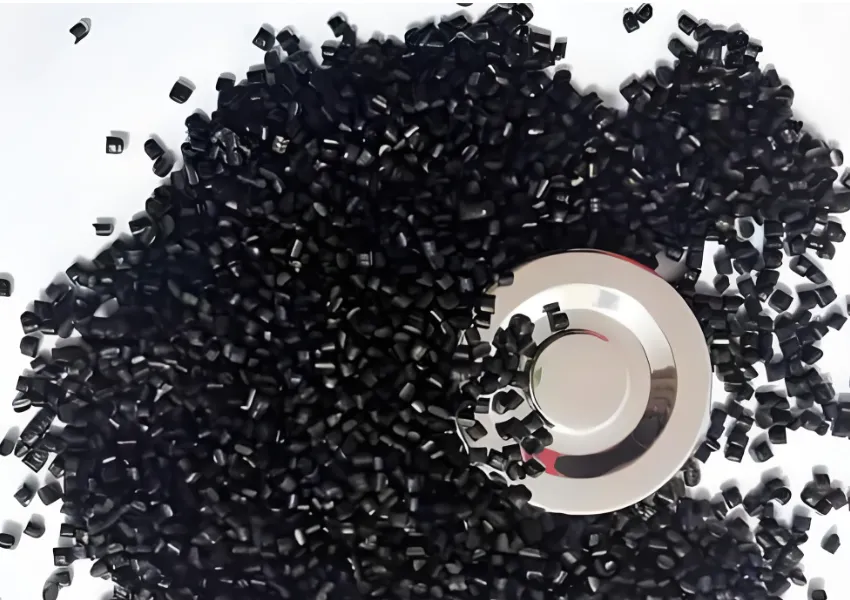
| HDPE (high-density polyethylene) is a semi-crystalline polyolefin with outstanding chemical resistance and low-temperature toughness, but high molding shrinkage (1.5–3.0%) and a low-energy surface that resists painting. ABS (acrylonitrile-butadiene-styrene) is an amorphous engineering terpolymer with superior dimensional precision (shrinkage 0.4–0.7%), excellent surface finish, and full paintability — but lower chemical resistance than HDPE. The choice between them hinges on whether chemical resistance or dimensional accuracy and surface quality is the primary requirement. |
Both materials are injection-molded at Fecision across a wide range of industrial, consumer, and packaging applications. Understanding where each material wins — and where it is limited — is the starting point for every material selection decision involving these two widely available commodity-to-engineering polymers.
What Are HDPE and ABS?
HDPE — High-Density Polyethylene
HDPE is a semi-crystalline polyolefin produced by polymerising ethylene with a catalyst that creates a predominantly linear molecular backbone with minimal branching. This linear structure allows polymer chains to pack closely together, producing a high degree of crystallinity (60–80%) — which is the source of HDPE’s distinctive combination of stiffness, chemical resistance, and low permeability.
The absence of polar groups in the HDPE backbone — it contains only carbon and hydrogen — is what gives it chemical inertness. There are no functional groups for acids, bases, or most solvents to react with. This same non-polarity is why HDPE surfaces are difficult to bond, paint, or print on without surface treatment: the surface energy (38–42 dynes/cm) is below the threshold required for most adhesives and coatings to wet properly.
ABS — Acrylonitrile-Butadiene-Styrene
ABS is an amorphous terpolymer in which three monomers contribute distinct functional properties. Acrylonitrile provides chemical resistance, stiffness, and heat resistance. Butadiene rubber particles, dispersed as micro-domains in the matrix, provide impact toughness and low-temperature ductility. Styrene provides rigidity, surface gloss, and ease of processing.
Because ABS is amorphous — it has no crystalline structure — it does not have a sharp melting point. It softens gradually above its glass transition temperature (Tg ~105°C), which gives it a wide, forgiving processing window. Its low shrinkage (0.4–0.7%) results directly from this amorphous structure: without the volume contraction associated with crystallisation, dimensions are more predictable and tolerances tighter.
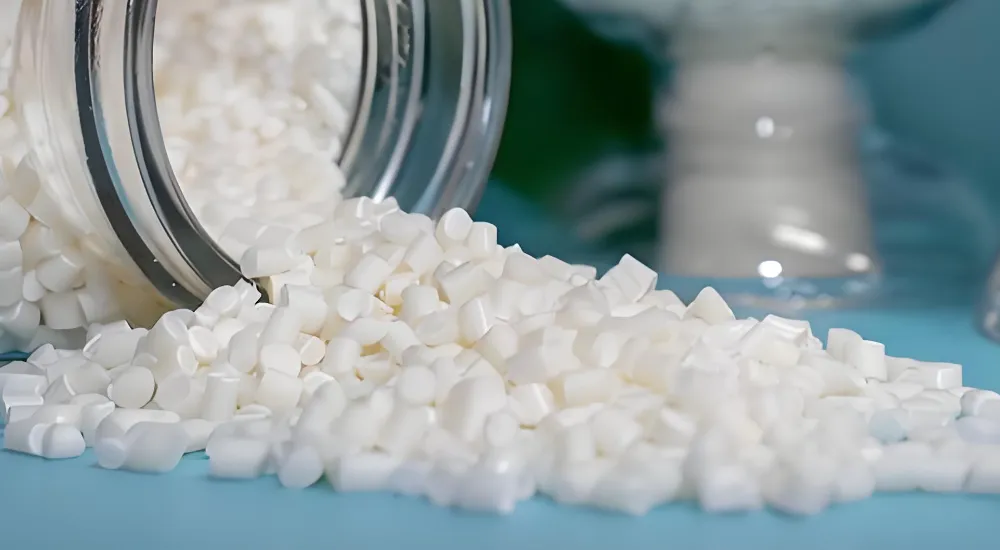
HDPE vs ABS: Full Engineering Properties Comparison
Choosing the right polymer changes how your part performs in real use. The table below provides quantitative data on various properties. Property values represent typical ranges for standard unfilled grades; reinforced or specialty grades will differ.
| Property | HDPE | ABS |
| Density | 0.94–0.97 g/cm³ (floats in water) | 1.02–1.06 g/cm³ |
| Tensile strength | 28–35 MPa | 40–50 MPa |
| Flexural modulus | 1.2–1.8 GPa (less rigid) | 2.0–2.8 GPa (stiffer) |
| Notched Izod impact | ≥ 20 kJ/m² — excellent low-temp toughness; retains impact down to −40°C | 12–20 kJ/m² — good at room temp; drops below −20°C |
| Heat deflection temp (1.82 MPa / 264 psi) | 60–85°C — limits structural use above ~70°C continuous | 80–100°C — suitable for most consumer/industrial enclosures up to ~90°C |
| Melting / softening point | 130–137°C (Tm) | Vicat softening ~95–110°C (amorphous — no sharp Tm) |
| Molding shrinkage | 1.5–3.0% — high and anisotropic. Requires mould flow simulation for precision parts. | 0.4–0.7% — low and predictable. Enables tight dimensional tolerances. |
| Water absorption (24h) | < 0.01% — essentially zero | 0.2–0.4% — pre-drying required before moulding |
| Chemical resistance | Excellent vs. acids, alkalis, most organic solvents, oils, and aqueous solutions. Attacked by strong oxidising acids (concentrated HNO₃). | Good vs. weak acids, alkalis, and many water-based solutions. Attacked by ketones, esters, chlorinated solvents. Swells in concentrated acids. |
| UV resistance | Poor (without UV stabiliser) — oxidises and embrittles. UV-stabilised grades available for outdoor use. | Poor — yellows and embrittles under prolonged UV. Requires UV-stabilised grades or protective coating for outdoor applications. |
| Surface finish | Waxy, low-energy surface (38–42 dynes/cm). Painting and adhesive bonding require surface activation (flame or plasma treatment). | Naturally paintable, plateable, and bondable. No surface activation required for most decorating and joining processes. |
| Recyclability | HDPE (resin code #2) — most widely recycled plastic globally after PET. Established collection and reprocessing infrastructure worldwide. | ABS (resin code #7) — recyclable but limited collection infrastructure. Industrial recycling programmes exist; consumer collection is inconsistent. |
The most consequential difference for tooling engineers:
HDPE shrinks 1.5–3.0% with significant anisotropy — shrinkage perpendicular to the melt flow direction is consistently higher than parallel to it. ABS shrinks 0.4–0.7% with very low anisotropy. A 100 mm dimension in HDPE can vary by up to 3 mm depending on flow direction and cooling conditions; the same dimension in ABS varies by less than 0.7 mm. This is why HDPE parts with tight tolerances require mould flow simulation before tooling is cut.
Key Differences in Depth
Chemical Resistance — HDPE’s Primary Advantage
HDPE resists concentrated sulphuric acid, hydrochloric acid, sodium hydroxide, bleach, alcohols, and most aqueous salt solutions. Its resistance derives from the polymer backbone — with no reactive functional groups, there is nothing for most chemicals to attack.
The primary chemical limitation of HDPE is strong oxidizing acids (concentrated nitric acid, fuming sulphuric acid) and a subset of aromatic and halogenated hydrocarbons that cause swelling at elevated temperatures.
ABS offers good resistance to dilute acids, dilute alkalis, and water-based solutions — adequate for many consumer and industrial applications. Its vulnerability is chlorinated solvents (methylene chloride, trichloroethylene), ketones (acetone, MEK), and esters, which dissolve or severely craze ABS. This limits ABS in any application where these chemicals are part of the process or cleaning protocol.
Dimensional Stability — ABS’s Primary Advantage
ABS’s amorphous structure produces shrinkage of 0.4–0.7% with near-isotropic behavior — the same percentage in all directions. This predictability is what makes ABS the standard for dimensionally critical parts: electronic housings with precise connector cutouts, instrument bezels with tight aperture tolerances, and snap-fit assemblies where engagement force is specified.
HDPE’s shrinkage (1.5–3.0%) is not only higher but anisotropic — it varies by 2–4× between the flow direction and the cross-flow direction in the same cavity. Overcoming this requires cavity dimensions compensated separately for each direction, validated by trial and measurement.
Impact and Low-Temperature Performance
Both HDPE and ABS offer good impact resistance, but through different mechanisms at different temperature ranges.
HDPE’s semi-crystalline structure absorbs energy through deformation at the interlamellar interfaces between crystalline and amorphous regions. Notched Izod impact strength is typically ≥ 20 kJ/m², and this remains relatively stable down to −40°C — making HDPE the preferred material for refrigerated, frozen, or arctic-environment applications.
ABS’s impact toughness comes from the rubber (butadiene) phase, which absorbs energy by deforming and crazing. Impact strength is good (12–20 kJ/m²) at room temperature but drops significantly below −20°C as the rubber phase approaches its glass transition temperature and loses its energy-absorbing capacity.
Surface Energy and Decorating
Surface energy governs whether a material can be painted, bonded, or printed. HDPE’s surface energy (38–42 dynes/cm) is below the critical threshold (~45 dynes/cm) required for most inks, coatings, and adhesives to wet and adhere. Surface activation — flame treatment, plasma treatment, or corona treatment — is required before decorating HDPE.
ABS’s surface energy (42–46 dynes/cm) is above this threshold for most coating systems, and its styrene-acrylonitrile matrix provides good chemical anchor sites for paint adhesion. This is why ABS is the standard material for injection-molded parts that require subsequent painting, electroplating, or vacuum metallizing — processes that account for a significant fraction of premium consumer product manufacturing globally.
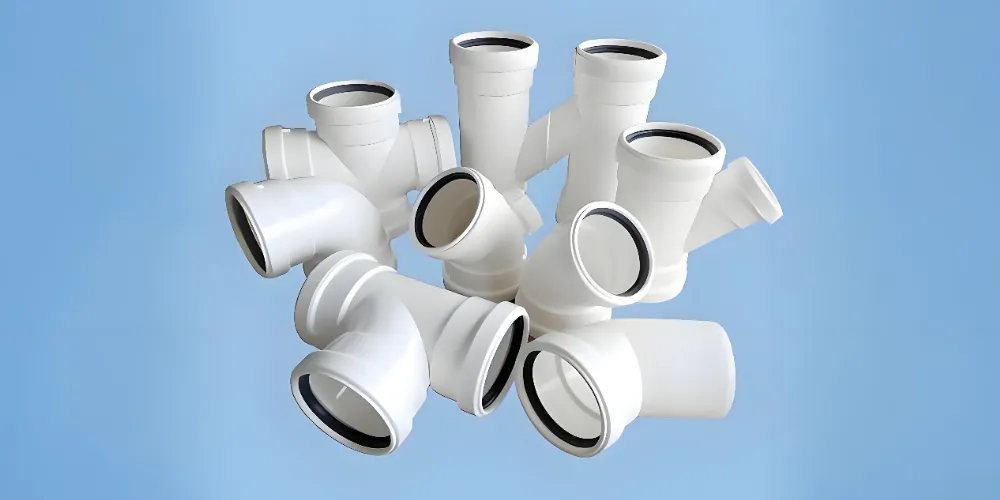
Injection Molding HDPE — Processing Guide
HDPE injection molding is well-established for containers, caps, closures, and industrial components. The process is forgiving in terms of temperature window and does not require pre-drying, but shrinkage management is the central engineering challenge for any precision HDPE program.
| Parameter | HDPE Specification | Engineering Notes |
| Pre-drying | Not required (moisture absorption < 0.01%) Note: if surface-wet, dry at 80°C / 2 h | HDPE does not absorb moisture from humid air. However, condensation on cold pellets (brought from cold storage into a warm molding environment) can cause surface splay on the molded part. |
| Barrel temperature | Rear: 160–200°C Middle: 200–240°C Front / nozzle: 200–260°C Melt temperature: 180–260°C | Keep residence time short — HDPE can degrade above 300°C, generating oxidation products. Lower barrel temps favor chemical resistance by preserving molecular weight; higher temps improve flow for thin-wall filling. |
| Mold temperature | 20–60°C | Lower mold temperatures increase cooling rate and crystallinity — producing harder, stiffer parts with higher shrinkage. Higher mold temperatures reduce crystallisation rate, lowering shrinkage but extending cycle time. Uniform cooling across the cavity is essential to minimize differential shrinkage and warpage. |
| Injection pressure | 60–105 MPa fill 30–60 MPa hold | HDPE has good melt flow at processing temperature. The primary challenge is shrinkage (1.5–3.0%), not fill. Adequate hold pressure and hold time are critical to pack out the cavity before gate freeze-off — insufficient packing produces sink marks and voids. |
| Shrinkage compensation | 1.5–3.0% (unfilled) Anisotropic — higher perpendicular to flow | Mold flow simulation is mandatory before tooling investment. Cavity dimensions must be compensated based on simulation-predicted flow and cross-flow shrinkage values — not a single percentage applied uniformly. GF-reinforced HDPE reduces shrinkage to 0.6–1.2%. |
| Gate sizing | 2–4 mm diameter typical for containers 0.8–1.5 mm for small parts | HDPE’s low melt viscosity allows large gates. Use full-round or trapezoidal runners to minimize pressure loss. Submarine gates are acceptable for smaller parts. Avoid undersized gates — shear heating can cause degradation and surface discolouration. |
| Post-molding | No conditioning required | HDPE is ready for use as-ejected. Dimensional checking for precision parts should be done after 24–48 h at 23°C — HDPE continues to crystallize slightly after ejection, causing minor dimensional change in the first few hours after molding. |
Warpage from differential shrinkage is the most common first-article failure in HDPE molding. Parts with large flat sections, uneven wall thickness, or asymmetric gate locations are particularly susceptible. The root cause is always differential crystallisation rates across the part — sections that cool faster crystallise more, shrink more, and pull the part into a curved or twisted shape.
Designing for uniform wall thickness and balanced gate placement — confirmed by mold flow simulation — is the engineering solution, not process adjustment.
→ Fecision HDPE injection molding capabilities: fecision.com/materials/hdpe-injection-molding/
Injection Molding ABS — Processing Guide
ABS is one of the most process-friendly injection molding materials — wide processing window, low shrinkage, excellent surface quality, and straightforward gate and runner design. The principal process discipline is moisture management before molding and temperature control during molding.
| Parameter | ABS Specification | Engineering Notes |
| Pre-drying | 80°C for 2–4 h Target: < 0.1% moisture | ABS is hygroscopic. Moisture above 0.1% causes splay marks (silver streaks) on the surface, reduced impact strength, and lower gloss. These defects cannot be corrected downstream. |
| Barrel temperature | Rear: 180–200°C Middle: 200–220°C Front / nozzle: 210–230°C Melt temperature: 200–240°C | Keep melt temperature below 250°C — ABS begins to degrade above this temperature, producing butadiene off-gas, discoloration, and reduced impact resistance in the molded part. |
| Mould temperature | 40–80°C | Higher mold temperatures (60–80°C) improve surface gloss and reduce internal stress — critical for plated or painted parts and for parts requiring post-machining without distortion. Lower temperatures (40–50°C) are acceptable for structural parts where surface cosmetics are secondary. |
| Injection pressure | 70–110 MPa fill 30–50 MPa hold | ABS has excellent flow and low shrinkage (0.4–0.7%). The main process discipline is avoiding overpacking, which induces high residual stress and can cause post-mold distortion or stress cracking when the part contacts certain chemicals. |
| Shrinkage | 0.4–0.7% (SABIC Cycolac™ general-purpose grades) Low anisotropy — uniform in all directions | ABS’s low, predictable shrinkage is its most important processing advantage over semi-crystalline polymers. Tolerances of ±0.1 mm are routinely achievable on standard part features. For plating-grade ABS, mold surfaces must be polished to SPI A-1 — plating reveals every surface defect. |
| Post-molding | Anneal at 70–80°C for 2–4 h if residual stress is a concern | Annealing reduces internal molding stress — recommended for parts that will be electroplated (reduces blistering risk), exposed to chemical environments (reduces stress cracking), or dimensionally critical after machining. |
→ Fecision ABS injection molding capabilities: fecision.com/materials/abs-injection-molding/
Applications: Where Each Material Is Used
HDPE Applications
Chemical and liquid containment: HDPE is the global standard for industrial chemical drums, jerry cans, laboratory reagent bottles, and pipeline fittings where contact with acids, alkalis, or solvents is continuous. Its impermeability to liquids and near-universal chemical compatibility make it the only viable injection molding material for these applications.
Food contact and consumer packaging: HDPE (#2) is FDA 21 CFR 177.1520-compliant for food contact. Milk jugs, detergent bottles, cutting boards, and food storage containers use HDPE because it does not transfer taste, odour, or harmful compounds to food products. [1]
Medical and laboratory consumables: Specimen cups, sample transport containers, reagent storage bottles, and medical waste containers exploit HDPE’s chemical resistance and cleanability.
Outdoor and infrastructure: UV-stabilised HDPE is used for utility cable protection conduits, irrigation fittings, marine buoys, and playground equipment. The material’s toughness at low temperatures and resistance to moisture are the primary drivers in these applications.
ABS Applications
Consumer electronics enclosures: Laptop housings, keyboard bodies, monitor bezels, and set-top box shells are produced in ABS because it combines dimensional accuracy, surface quality, ease of painting or texturing, and UL 94 flame ratings (V-0 through HB) required by electrical equipment safety standards.
Automotive interior trim: Dashboard panels, pillar trim, console covers, and door handle inserts use ABS or PC/ABS blends. The combination of stiffness, dimensional accuracy, and paint adhesion is the defining requirement for Class-A automotive interior surfaces.
Medical device housings: Medical-grade ABS (ISO 10993-biocompatible, FDA food-contact compliant) is used for diagnostic instrument housings, fluid management enclosures, and respiratory device bodies where EtO or gamma sterilization compatibility is required.
Protective equipment and structural consumer goods: Helmets, guards, tool housings, and appliance bodies exploit ABS’s impact resistance, structural rigidity, and the ability to integrate complex geometry in a single injection molded shot.
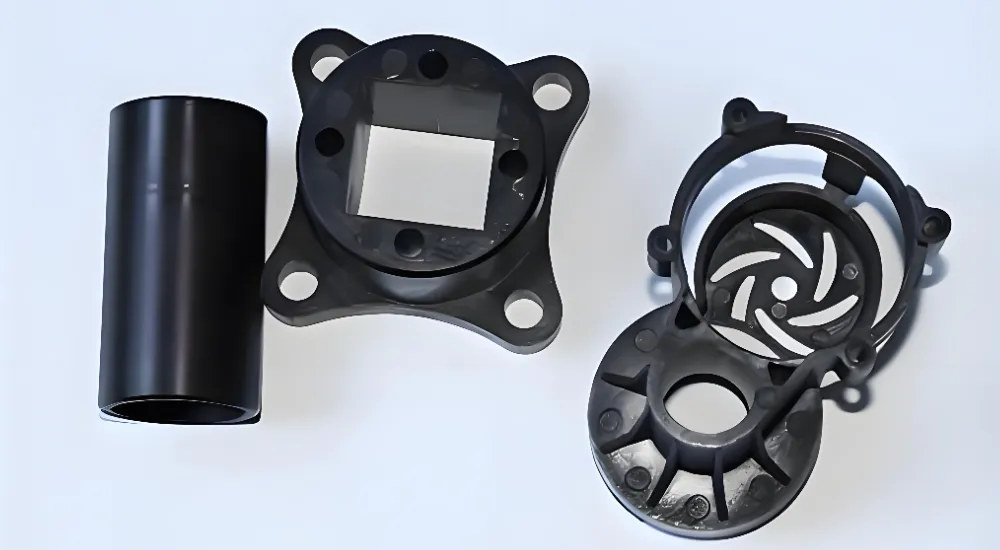
Application Selection Guide : HDPE or ABS?
Use this table as a starting framework. Confirm final material selection against grade-level datasheets from the resin supplier for the specific operating conditions of the application.
| Requirement | Recommendation | Engineering Rationale |
| Chemical exposure to acids, alkalis, solvents, oils | Choose HDPE | HDPE resists virtually all acids, bases, and aqueous solutions. ABS is attacked by ketone and ester solvents commonly found in industrial cleaning agents. |
| Tight dimensional tolerances for precision parts | Choose ABS | ABS shrinkage (0.4–0.7%) is 3–5× lower than HDPE’s (1.5–3.0%) and is nearly isotropic. Parts with hole patterns, snap fits, and mating interfaces that must be held to ±0.1 mm are routinely produced in ABS. |
| Surface finish / aesthetics / painting / plating | Choose ABS | ABS accepts electroplating, painting, vacuum metallising, and pad printing directly. HDPE’s low-energy surface requires flame or plasma treatment before any coating will adhere reliably. |
| Food contact / potable water contact | Choose HDPE | FDA 21 CFR 177.1520 covers HDPE for food contact. HDPE does not leach plasticisers, bisphenols, or other hormone-disrupting compounds. |
| Low-temperature service below −20°C | Choose HDPE | HDPE retains impact toughness down to −40°C. ABS impact strength drops significantly below −20°C. |
| High service temperature above 80°C | Choose ABS (or upgrade material) | ABS retains structural integrity to ~90°C (HDT at 1.82 MPa). HDPE begins to soften above 70–80°C under load. Neither is suitable for continuous service above 90°C. |
| Electronic device housings / consumer products | Choose ABS | ABS’s combination of surface quality, dimensional accuracy, and broad availability of UL 94 V-0 flame-retardant grades makes it the dominant material for consumer electronics housings, appliance bodies, and instrument enclosures. |
Cost, Sustainability, and Recyclability
Material Cost
HDPE is modestly less expensive than ABS on a per-kilogram basis. For parts where both materials meet the specification, HDPE offers a material cost advantage. However, the total cost comparison must account for tooling complexity — HDPE’s high shrinkage and anisotropy often require more development iterations and more complex cavity compensation than ABS, partially or fully offsetting the material price advantage.
Recyclability and End-of-Life
HDPE carries resin identification code #2 and has the most mature post-consumer recycling infrastructure of any injection moulding polymer. Municipal curbside collection accepts HDPE containers in most developed countries. Recycled HDPE retains usable properties for many applications — pipe, lumber, containers.
ABS carries resin code #7 and lacks comparable consumer collection infrastructure. Industrial and manufacturing process recycling is available, and ABS regrind can be reprocessed at the molding facility with typical mechanical property retention of 90–95% for up to 5 recycle cycles. For products designed with post-consumer recyclability as a primary specification, HDPE is the clearer choice.
HDPE and ABS Injection Molding at Fecision
Fecision molds both HDPE and ABS across industrial, consumer, packaging, and medical applications. Process capability covers the full parameter ranges documented in the injection molding guides above.
- HDPE in production: laboratory containers, chemical storage components, medical specimen cups, utility enclosures, and consumer goods packaging. Mould flow simulation standard for all HDPE precision parts before tooling commitment.
- ABS in production: diagnostic equipment housings, electronic device enclosures, consumer product bodies, industrial control panels. UL 94 V-0 FR grades, medical ISO 10993 grades, and electroplating grades all in current production.
- Quality: ISO 9001:2015 certified. CMM first-article inspection with CpK monitoring. Material lot traceability from raw material CoA to finished part.
- DFM service: DFM review available for HDPE programs before tooling investment — specifically addressing shrinkage anisotropy and warpage risk.
Contact Fecision for material selection advice and DFM review at fecision.com/contact-us.
Frequently Asked Questions
Is HDPE or ABS stronger?
ABS has higher tensile strength and higher flexural modulus — making it stiffer and stronger under static load. HDPE has better impact resistance at low temperatures.
Why does HDPE warp more than ABS during injection molding?
HDPE is semi-crystalline — polymer chains rearrange into ordered crystalline regions as the melt cools. This crystallisation causes volumetric contraction that varies with flow direction, cooling rate, and wall thickness. ABS is amorphous — it has no crystalline structure and shrinks uniformly and predictably. Differential cooling in HDPE creates differential shrinkage across a part, which manifests as warpage.
Can HDPE be painted or bonded without treatment?
Not reliably. HDPE’s surface energy is below the threshold needed for most paints, adhesives, and inks to wet and adhere permanently. Surface activation raises surface energy and enables reliable adhesion. ABS does not require this treatment for most decorating and bonding processes.
Which material is better for food-contact applications?
HDPE is FDA 21 CFR 177.1520-compliant for food contact and is the global standard for food containers, cutting boards, and packaging. ABS is available in FDA food-contact compliant grades but is less commonly specified for direct food contact than HDPE.
References & Authoritative Sources
Accessed May 2026.
[1] U.S. Food and Drug Administration. 21 CFR Section 177.1520 — Olefin Polymers. https://www.ecfr.gov/current/title-21/chapter-I/subchapter-B/part-177/subpart-B/section-177.1520