
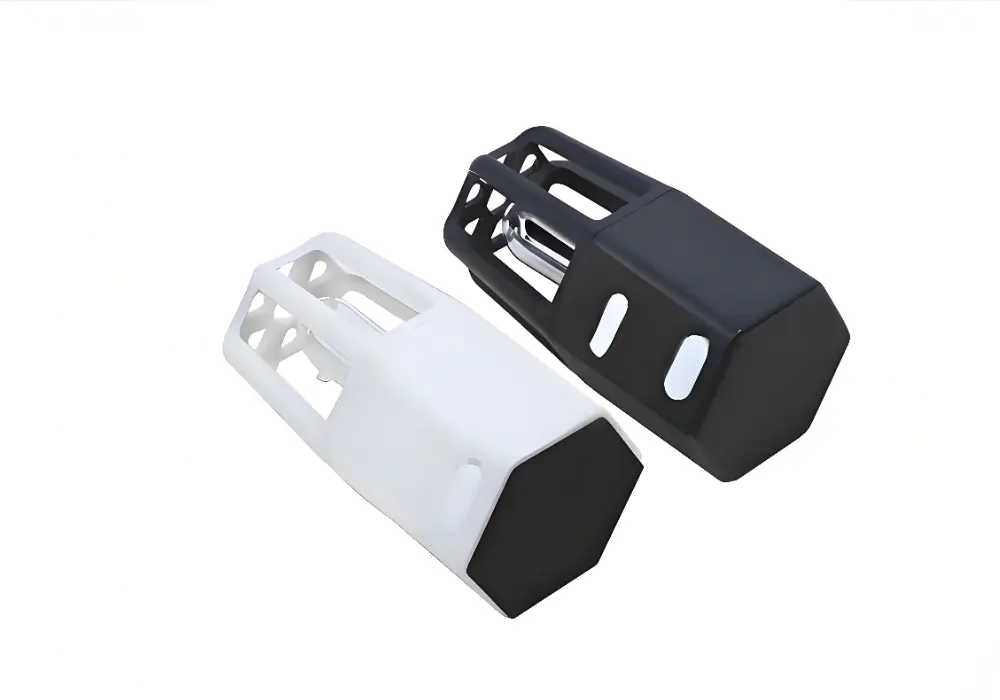
| Co-injection molding is an injection molding process that produces a two-material sandwich structure — a functional polymer core fully encased by a cosmetic or protective skin — in a single clamp cycle. The core can be 50%+ recycled or commodity resin; the skin uses virgin, food-safe, or UV-stable material. Cycle times run 15–60 seconds depending on part size and material combination. |
That sandwich structure is what separates co-injection from every other multi-material process: the core is fully hidden, the skin is continuous, and neither material requires a separate mold or second machine cycle. The sections below explain how it works, where it outperforms alternatives, and where it doesn’t.
What Is Co-Injection Molding?
Co-injection molding — also called sandwich molding — injects two distinct polymers into a single mold cavity through a specialized coaxial nozzle system. The result is a finished part with an outer skin layer that completely encapsulates an inner core layer, fused during molding with no secondary bonding or assembly.
The layered structure enables a fundamental manufacturing trade-off: use an expensive, high-performance, or food-safe resin where it matters (the visible or contact surface), and use an economical, recycled, or functionally specialized resin everywhere else (the bulk interior).
Because both materials are injected in one continuous clamp cycle, there is no part handling between shots, no secondary bonding step, and no assembly risk.
How Co-Injection Molding Works
The co-injection molding process relies on a dual-barrel injection unit feeding into a single precision nozzle. Each barrel melts and conditions one polymer independently. The nozzle controls how the two melt streams enter the cavity — either in sequence or simultaneously.
Sequential Co-Injection
Sequential co-injection is the most common approach. The skin material injects first, flowing along the cooled mold walls and filling approximately 70–75% of the cavity volume. The core material then injects into the center, pushing the still-molten skin toward the walls and filling the remaining volume. A final small shot of skin material seals the gate area, completing the encapsulation and preventing core breakthrough at the injection point.
This sequence gives precise control over core placement and wall distribution — important for thick-walled structural parts where core volume and position affect both mechanical properties and weight.
Simultaneous Co-Injection
Simultaneous co-injection delivers both materials through a coaxial nozzle at the same time. The skin forms an outer annular stream that envelopes the core stream as both flow into the cavity. This creates the sandwich structure from the injection point outward, rather than building it in two phases.
It’s faster than sequential co-injection and better suited to thin-walled or geometrically symmetric parts. The requirement is tighter: viscosities and melt temperatures must be closely matched to prevent inter-layer mixing. When calibrated correctly, it delivers consistent parts with minimal waste at high cycle rates.
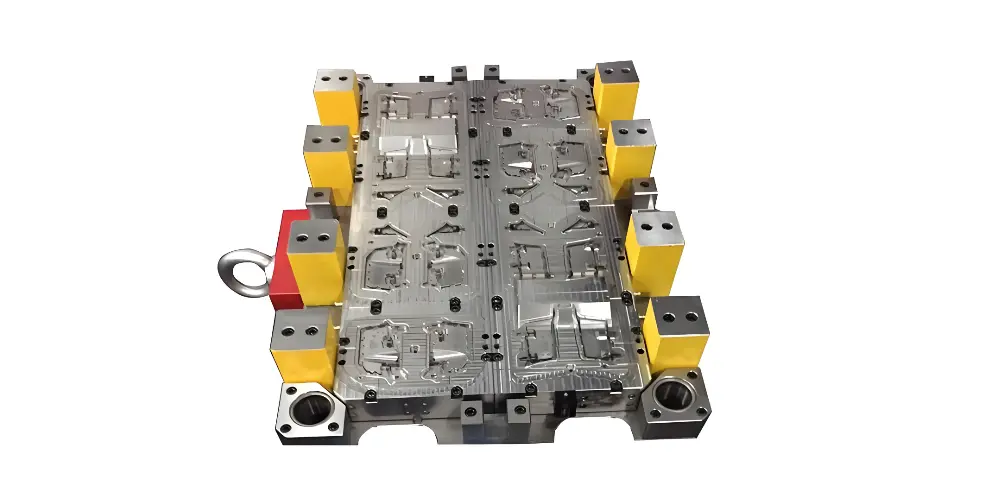
Five Advantages of Co-Injection Molding
Using two materials in a single production cycle unlocks a range of strategic benefits for manufacturers. From dramatic cost savings to enhanced sustainability, co-injection molding stands out for high-volume production.
1. Material Cost Reduction
Expensive engineering resins, colorants, and food-safe virgin polymers are used only for the thin outer skin. The bulk of the part volume uses economical regrind, recycled plastic, or low-cost commodity resin. For large parts in high-volume production, this targeted resin allocation drives significant per-part savings without affecting surface quality or performance.
2. Sustainability Through Recycled Core Content
Co-injection molding is a powerful tool for meeting corporate ESG targets. Post-consumer recycled (PCR) content or production regrind can make up 50% or more of a co-injected part’s core by volume. The outer skin layer uses virgin polymer to maintain food contact safety, UV resistance, or aesthetic requirements. The result is a product that meets recycled content targets while looking and performing like a fully virgin-material part. [1]
3. Functional Grading in a Single Shot
Co-injection molding enables a single part to carry two distinct property profiles. Soft-touch TPE skins over rigid PP cores eliminate separate grip components. Foam cores reduce weight and improve acoustic dampening compared to solid sections. Both outcomes are achieved in one machine cycle, without assembly.
4. Single-Cycle Production Efficiency
Combining two materials in one clamp cycle eliminates the secondary operations required by overmolding or adhesive joining. There is no part transfer between molds, no handling-related defects, and no work-in-process inventory accumulating between stations. This compresses lead time and increases throughput directly.
5. Design Freedom for Complex Geometries
Variable wall thickness sections can incorporate core material precisely where mechanical properties or weight reduction are needed. The single-cycle process also eliminates post-molding welding or assembly. This lets designers create geometry that would require multiple components in conventional molding — and manufacturers produce it in one step.
Co-Injection Molding Examples & Industry Applications
Co-injection molding is versatile, used across nearly every industry that produces plastic parts. Its ability to balance cost, performance, and sustainability makes it ideal for high-volume production where surface quality and internal functionality are critical.
Industrial Enclosures and Equipment Housings
Electrical enclosures, junction boxes, and machine housings use impact-resistant engineering polymer cores (glass-filled PA66 or ABS) encased in UV-stable, chemical-resistant virgin PP or PC skins. The core provides structural rigidity and dimensional stability; the skin resists UV degradation and chemical splash without requiring a separate coating step. Co-injection delivers both properties at commodity resin economics for the bulk of the part volume.
Food and Beverage Packaging
Bottles, trays, and containers use virgin PET or PP for the food-contact skin layer — meeting FDA 21 CFR food safety requirements. Post-consumer recycled PET or PP makes up the core layer. This structure advances sustainability targets by maximizing recycled content without exposing recycled material to food contact.
Medical Device Housings
Surgical instrument handles and diagnostic equipment housings use rigid, sterilization-resistant polymer cores (ABS or PC) with soft TPE skins that provide ergonomic grip and effective sealing surfaces. The single-cycle process produces fully sealed parts with no assembly gaps — a critical requirement for sterile medical environments. ISO 10993-biocompatible skin materials maintain regulatory compliance at the contact surface.
Consumer Tool Handles
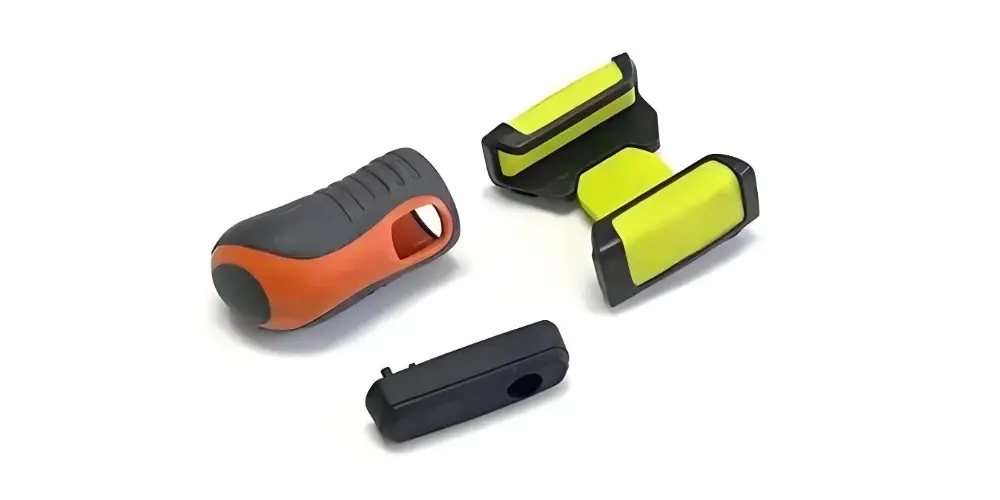
Hand tools — screwdrivers, pliers, garden tools — use glass-filled nylon cores for torque strength and rigidity, with soft TPU skins that reduce vibration and improve grip comfort during extended use. The co-injected structure achieves both properties in one part that requires no secondary assembly or bonding.
Marine and Outdoor Equipment
Life jackets, buoys, and rescue equipment use buoyant closed-cell foam cores with dense, water-impermeable HDPE or PVC skins. The skin prevents water saturation and UV degradation; the core provides the flotation. The sandwich structure maintains these properties independently, so degradation of the skin does not affect flotation performance.
Appliance Components
Washing machine tubs, dishwasher interiors, and refrigerator liners use structural, impact-resistant polymer cores with stain-resistant, chemical-resistant skin layers. The skin resists aggressive detergents and marks while the core provides the structural strength required for thousands of hours of mechanical use.
Co-Injection Molding vs. Other Multi-Material Processes
Choosing the right multi-material molding process depends on your design goals, production volume, and budget. Below is a direct comparison of co-injection molding with overmolding and two-shot molding—the two most popular alternatives.
Co-Injection Molding vs. Overmolding
Overmolding bonds a second material onto a pre-formed, solid substrate. It requires two distinct molding phases and precise substrate positioning to avoid defects. Extra labor is also needed to handle parts between shots.
Co-injection molding introduces both polymers into the same mold cavity during one continuous clamp cycle, fusing layers before either material solidifies. It eliminates secondary mold placement and part handling, streamlining throughput and minimizing inventory.
Overmolding is ideal for low-volume production or selective material overlay. Co-injection molding is superior for high-volume production of fully encapsulated sandwich-structure parts.
Co-Injection Molding vs. Two-Shot Molding
Two-shot molding uses a rotating mold plate or sliding core system to move parts between two cavities. It enables zone-specific material placement with visible boundaries between the two materials.
It can also handle resins with very different processing temperatures, as materials are injected into separate cavities. The tradeoff is more complex tooling with rotation mechanics.
Co-injection molding uses stationary tooling, forming concentric layered structures with the core hidden beneath the skin. It requires compatible resins but offers faster cycle speeds and simpler tooling—plus a uniform, unmarked surface finish.
Co-Injection vs. Overmolding vs. Two-Shot Molding: Quick Comparision
The three main multi-material injection processes each serve a different part geometry and volume profile. The table below maps the key differences.
| Co-Injection Molding | Overmolding | Two-Shot Molding | |
| Mold cavities | Single (stationary) | Two (sequential, standard) | Two (rotary/sliding, specialized) |
| Cycle structure | One continuous shot — single clamp cycle | Two separate shots — two clamp cycles | Two sequential shots — single machine cycle |
| Material placement | Full skin/core sandwich encapsulation | Selective overlay on a pre-formed substrate | Zone-specific placement with visible boundaries |
| Tooling complexity | Moderate — specialized coaxial nozzle | Low — standard single-material presses | High — rotary or sliding mold mechanics |
| Material requirements | Matched melt temps and viscosity required | Minimal — wide material compatibility | Minimal — wide material compatibility |
| Skin/core ratio control | Precise — controlled by injection timing | N/A — substrate is fixed | N/A — zones are fixed by cavity geometry |
| Core visibility | Core fully hidden — uniform surface | Substrate edge may be visible | Visible boundary line between zones |
| Production volume fit | High-volume: 100,000+ units | Low-to-medium: 1,000–100,000 units | Medium-to-high: 50,000+ units |
| Best for | Cost-driven, fully encapsulated sandwich parts | Selective grip/overlay, low-run production | Zone-specific multi-material with visible boundaries |
When to choose co-injection: the part needs a fully encapsulated sandwich structure, the core must be completely hidden, and production volume justifies the specialized equipment.
When to choose overmolding: selective material placement is needed, volume is low-to-medium, or resin compatibility is too limited for co-injection.
When to choose two-shot: visible boundaries between zones are acceptable or desirable, and tooling investment is justified by volume.
Limitations to Evaluate Before Choosing Co-Injection
These constraints determine whether co-injection is the right process for a given program. Evaluate each one against the specific part design and production volume.
Material Compatibility Constraints
Skin and core polymers must be chemically and processing-compatible. They need matched melt temperatures, viscosities, and shrinkage rates—plus good interlayer adhesion.
Widely divergent viscosities risk delamination or core breakthrough. Chemically incompatible resins can cause warpage, cracking, or poor bonding. Thorough material testing and pairing is essential to avoid defects.
Geometric Constraints
Co-injection molding creates a full sandwich structure, so the skin layer must encapsulate the entire exterior surface of the part. Selective material placement on specific faces or zones is not feasible.
If your project requires zonal material distribution (e.g., a soft grip on only one side of a tool handle), overmolding or two-shot molding are better suited.
Process Complexity
Controlling two molten material streams in a single mold is far more complex than standard molding. It demands sophisticated sequencing, real-time monitoring, and precise calibration of flow rates, temperatures, and pressures.
The equipment is also more complex to set up and maintain. Operator training requirements exceed those of conventional molding, requiring highly skilled technical staff.
Core Breakthrough Risk
Core breakthrough—core material seeping through the skin layer—is a persistent risk. It’s caused by improper injection timing, unbalanced pressure, poor viscosity matching, or flawed mold design.
This creates unsightly visual blemishes that are nearly impossible to rework. Even with precise process control, you must account for a small percentage of scrap, especially during setup and calibration.
Reviewing a Co-Injection Project with FECISION
FECISION coordinates injection molding projects with manufacturing partners. Co-injection feasibility and the assigned site's equipment, material experience and capacity must be confirmed for the specific part; this guide is not a blanket claim of an in-house co-injection production line.
- Part and material review: supply the model, skin and core grades, recycled-content target and intended use.
- Process review: agree the layer distribution, gate arrangement, material compatibility and trial scope with the proposed manufacturing partner.
- Acceptance: specify critical dimensions, layer coverage, bond performance and inspection methods. Cycle time and tolerances require project-specific validation.
- Documentation: confirm the assigned site's relevant certificate scope and the required sample and production records; do not treat a partner certificate as FECISION's own certification.
For selective surface coverage rather than a skin/core structure, compare overmolding services and two-shot molding during the design review.
Conclusion
Co-injection molding’s core value is precise: use the right material in the right location of every part, with no secondary operations and no assembly. The skin carries the surface performance requirements; the core carries cost efficiency, recycled content, or functional properties like foam density. In a single clamp cycle, the process delivers what would otherwise require two separate molding operations plus an assembly step.
Whether it’s the right process depends on volume, geometry, and material compatibility — the three constraints that co-injection manages differently than overmolding or two-shot molding.
Ready to mold smarter and balance performance, cost, and sustainability for your plastic part project? Visit Fecision today to explore our cinjection molding services and get your free project quote right now.
Frequently Asked Questions
What materials are compatible in co-injection molding?
Skin and core polymers must have matched melt temperatures (within ~30°C) and compatible melt viscosities to prevent delamination or core breakthrough. Common pairs include virgin PP skin over recycled PP core, PC skin over ABS core, and TPE skin over rigid PP or PA core.
How does co-injection molding reduce material costs?
The core — which makes up 50–70% of a typical part’s volume — uses economical regrind, recycled resin, or a lower-cost commodity polymer. Only the thin outer skin uses virgin, food-safe, or UV-stable material. For large parts in high-volume production, this targeted material allocation reduces per-part resin cost without affecting surface quality.
What is core breakthrough in co-injection molding?
Core breakthrough occurs when core material penetrates the skin layer and becomes visible on the part surface. Root causes include improper injection timing, pressure imbalance between skin and core, viscosity mismatch, or insufficient skin thickness at thin sections.
When should I choose co-injection over overmolding?
Choose co-injection when the core must be fully hidden, production volume is above ~100,000 units, and material cost reduction or recycled content is a primary design goal. Choose overmolding when selective material placement is needed (soft grip on one zone only), production volume is lower, or resin compatibility requirements are too tight for co-injection’s matched-viscosity constraint.
What cycle times does co-injection molding achieve?
Typical co-injection cycle times run 15–60 seconds depending on part size, wall thickness, and material combination. Simultaneous co-injection generally achieves shorter cycle times than sequential co-injection for equivalent part geometry. This is comparable to standard single-material injection molding at the same wall thickness — the co-injection equipment overhead does not substantially increase cycle time.
References
Accessed May 2026.
[1] Society of Plastics Engineers (SPE). ‘Sandwich Injection Molding: Processing and Applications.’ SPE Technical Papers. https://www.4spe.org/
[2] Michaeli, W. & Brockmann, C. ‘Co-Injection Molding: Skin/Core Distribution and Process Stability.’ Polymer Engineering and Science, 2001.
[3] Rosato, D.V. & Rosato, M.G. Injection Molding Handbook, 3rd Edition. Kluwer Academic Publishers, 2000.