
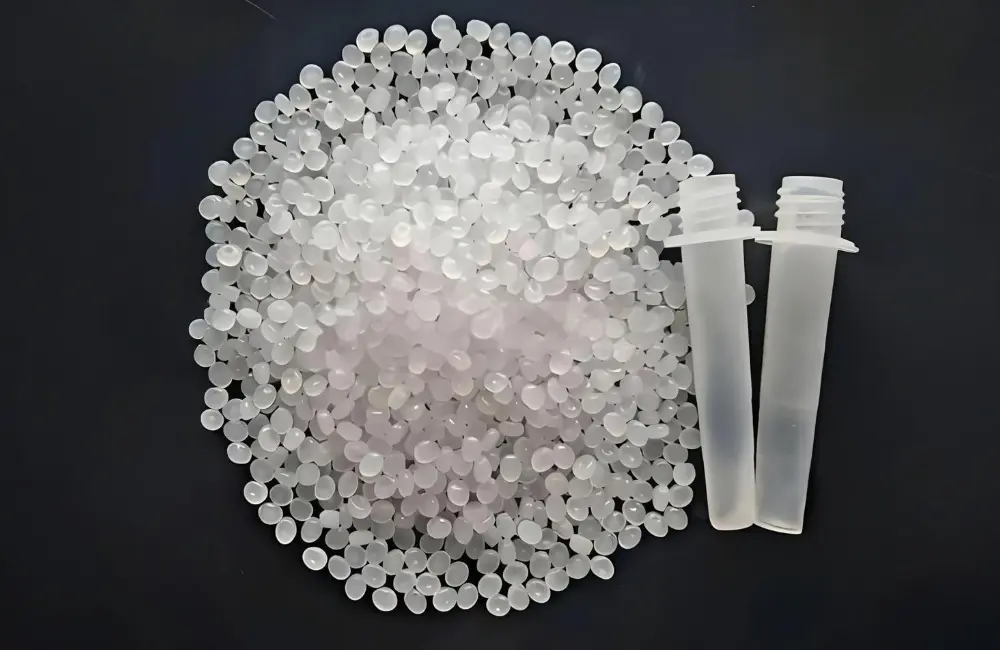
Low-density polyethylene (LDPE) is a versatile thermoplastic produced through high-pressure free-radical polymerization of ethylene. With a density range of 0.91–0.94 g/cm³ and a branched molecular structure, LDPE delivers exceptional flexibility, impact resistance, and chemical stability—making it the material of choice for injection-molded packaging, medical components, and industrial parts.
This guide covers LDPE properties, processing parameters, the most common defects and how to fix them, a side-by-side comparison with HDPE, and a selection framework for when to use LDPE versus HDPE or LLDPE.
What Is Low Density Polyethylene (LDPE)?
LDPE is produced by high-pressure free-radical polymerization of ethylene at 15,000–50,000 psi and 150–350°C. These extreme conditions cause random chain branching — long and short branches extending from the main polymer backbone. That branching is the source of LDPE’s distinctive properties.
The branches prevent polymer chains from packing closely together, which gives LDPE its low density (0.910–0.925 g/cm³), flexibility, and softness. They also reduce crystallinity to 45–55% — lower than HDPE’s 70–80% — which explains LDPE’s lower melting point (105–115°C), higher impact at cold temperatures, and higher mold shrinkage compared to amorphous resins like ABS.
LDPE Properties vs. HDPE: Side-by-Side Data
The table includes HDPE as a reference point — the two are often considered together, and understanding what separates them clarifies when LDPE is the correct choice.
| Property | LDPE | HDPE (for comparison) |
| Density | 0.910–0.925 g/cm³ | 0.940–0.970 g/cm³ |
| Structure | Heavily branched chains; 45–55% crystallinity | Linear chains; 70–80% crystallinity |
| Tensile strength | 8–20 MPa — low; flexible, not structural | 21–38 MPa — higher; stiffer |
| Elongation at break | 100–650% — stretches significantly before failure | 100–1,000% (varies by grade) |
| Flexural modulus | 0.17–0.28 GPa — very flexible | 0.70–1.50 GPa — notably stiffer |
| Impact resistance | Excellent; retains toughness to −60°C | Good; drops at low temperature |
| Heat deflection temp (66 psi / 0.45 MPa) | 40–50°C — not suitable for hot liquids | 60–82°C — modest improvement |
| Melting point | 105–115°C | 125–135°C |
| Mold shrinkage | 1.5–4.0% — high and anisotropic | 2.0–5.0% — higher and more anisotropic |
| Chemical resistance | Excellent vs acids, bases, alcohols, water Swells in aromatic and chlorinated hydrocarbons | Excellent; slightly better solvent resistance than LDPE |
| Water absorption (24h) | < 0.01% — no pre-drying required | < 0.01% — no pre-drying required |
| Food contact compliance | FDA 21 CFR 177.1520 — yes (virgin grades) | FDA 21 CFR 177.1520 — yes (virgin grades) |
Key takeaway: LDPE is appropriate when flexibility, low-temperature performance, and food-contact compliance matter more than stiffness, heat resistance, or dimensional precision. HDPE is the correct choice when the part needs to hold its shape under load, resist higher service temperatures, or meet tighter tolerances. For applications needing both LDPE flexibility and better stress crack resistance, LLDPE is worth evaluating.
LDPE Injection Molding Processing Parameters
All processing parameters below apply to standard injection molding grades of LDPE (MFI typically 2–30 g/10 min at 190°C/2.16 kg per ASTM D1238). [3]
| Parameter | Specification and Engineering Notes |
| Pre-drying | Not required for virgin resin — LDPE absorbs essentially no moisture (< 0.01%). Exception: regrind should be dried to prevent splay on the molded surface. |
| Barrel temperature | Melt temperature target: 160–220°C, to avoid oxidative degradation. Higher melt temperatures improve flow but increase shrinkage and cycle time. |
| Mold temperature | 25–50°C. Uniform cooling across the cavity is essential — temperature differentials above 10°C between faces cause warpage. |
| Injection pressure | Injection: 70–105 MPa. Pack/hold: 40–60% of injection pressure. LDPE flows very easily — avoid excessive injection pressure, which causes flash, overpacking, and residual stress. |
| Injection speed | Medium-fast. Profiled injection limits warpage in large flat parts. |
| Mold shrinkage | 1.5–4.0% — anisotropic. GF-filled LDPE grades reduce but do not eliminate anisotropy. |
| Cooling time | LDPE’s low melting point and high thermal conductivity allow short cooling times. Typical range: 10–25 seconds depending on wall thickness. |
| Ejection | LDPE’s flexibility is a processing advantage at ejection — parts deform under ejector pin contact, then recover. |
Mold Design Considerations
Gate sizing: Minimum gate diameter 0.8–1.5 mm for standard wall thicknesses. LDPE’s low viscosity means it fills easily, but undersized gates create excessive shear and surface defects near the gate.
Venting: Vent depth 0.01–0.015 mm at end-of-fill locations. LDPE’s low melt viscosity means proper venting is critical — trapped air burns the surface and slows cycle time.
Draft angles: Minimum 0.5° on polished surfaces; 1° on textured surfaces. LDPE’s flexibility helps at ejection, but zero-draft surfaces will drag and mark on textured or polished cavities over time.
Common Defects, Root Causes, and Fixes
LDPE’s most frequent defect is warpage. Most other LDPE defects have straightforward corrective actions once the root cause is identified.
| Defect | Root Cause | Corrective Action |
| Warpage | Uneven cooling; anisotropic shrinkage; excessive hold pressure; thin/thick wall transitions | Use uniform wall thickness. Balance cooling channels. Lower hold pressure. Increase mold temperature uniformity. |
| Sink marks | Insufficient hold pressure; thick sections cooling slowly; hot runners freezing off too early | Increase hold pressure and hold time. Core out thick sections to approach uniform wall. Extend cooling time before ejection. |
| Flash | Excessive injection pressure; worn parting line; clamping force too low; melt temperature too high | Check projected area vs machine tonnage. Reduce injection pressure. Lower melt temperature. Inspect and repair parting line surfaces. |
| Splay / silver streaks | Moisture in regrind; material degradation from excess barrel temperature; gas from additives | Dry regrind at 60–80°C / 2–4 h. Lower barrel temperature. Reduce back pressure. Purge barrel if material has been sitting. |
| Short shots | Injection speed too slow; gate too small; mold temperature too low; insufficient injection pressure | Increase injection speed. Verify gate size (minimum 1.0 mm for most LDPE wall thicknesses). Raise mold temperature. Check venting at end-of-fill locations. |
| Stress cracking (ESCR) | Residual molding stress combined with chemical exposure; insufficient draft; sharp corners | Anneal at 60–70°C after molding for chemical-contact parts. Increase radii at corners. Add draft. |
Environmental stress cracking (ESCR) deserves attention beyond what the table covers. LDPE can crack progressively over time when residual molding stress combines with chemical exposure — even at relatively low chemical concentrations. Detergents, oils, and certain packaging contents are common triggers.
If ESCR is a design concern, specify an ESCR-resistant grade, reduce residual stress through annealing, or evaluate LLDPE, which has substantially better ESCR performance than standard LDPE.
Advantages and Limitations of LDPE Injection Molding
LDPE’s advantages are closely tied to its molecular structure, and so are its limitations. Understanding both prevents misapplication.
Advantages
- No pre-drying required: saves production setup time and eliminates desiccant dryer capital cost and operating expense compared to PC, PA, or PET.
- Low processing temperature: reduces energy cost per cycle. LDPE runs at 160–220°C vs. 260–320°C for PC — roughly 25–30% lower energy input per shot.
- Excellent chemical resistance: resists acids, bases, alcohols, and most aqueous solutions. Suitable for contact with food, cleaning products, and laboratory reagents.
- Flexibility and cold-temperature impact: retains toughness at −60°C. Living hinges in LDPE don’t last as long as PP (millions vs. hundreds of thousands of cycles), but LDPE snap features and hinges are functionally adequate for most packaging applications.
- FDA food-contact compliance: virgin grades comply with 21 CFR 177.1520 — the regulatory basis for food packaging and medical device packaging applications. [2]
Limitations
- High and anisotropic mold shrinkage (1.5–4.0%): limits achievable tolerances. Any precision application requires mold flow simulation before tooling.
- Low heat deflection temperature (40–50°C at 0.45 MPa): rules out hot-fill packaging, automotive engine bay components, and any enclosure near a heat source.
- Low stiffness: LDPE’s flexural modulus of 0.17–0.28 GPa is 5–8× lower than ABS and 10× lower than PC. It cannot substitute for structural engineering resins.
- Environmental stress cracking (ESCR): residual stress from molding combined with chemical contact can cause progressive cracking at stress concentrations. LLDPE is significantly more resistant.
- Poor UV stability: unless UV stabilizers are compounded in, LDPE degrades and embrittles outdoors within months.
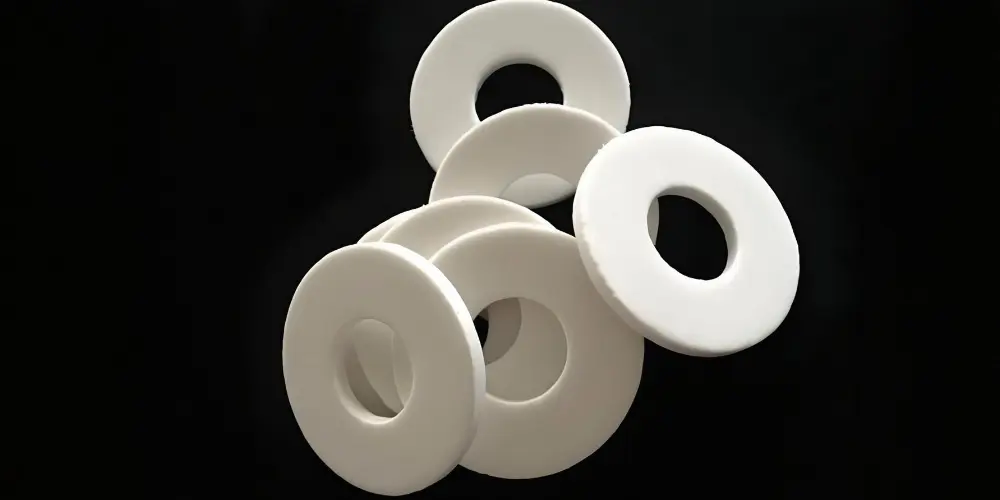
Applications of LDPE Injection Molded Parts
LDPE is not the right material for structural or precision applications — but for flexible, chemically resistant, and food-safe parts, it is often the most cost-effective option available.
Packaging and Consumer Goods
Squeeze bottles, dropper assemblies, and dispensing caps are LDPE’s highest-volume application category. The flexibility that makes LDPE mechanically unimpressive is exactly what allows a squeeze bottle to deform under hand pressure and return to shape. LDPE caps and closures benefit from the same snap-back behavior at far lower cost than TPE or silicone alternatives.
Food-contact containers, kitchenware, and flexible storage lids use LDPE for its FDA 21 CFR 177.1520 compliance, ease of cleaning, and suitability for contact with oils, acids, and cleaning agents that would stress-crack or degrade other materials.
Medical and Laboratory
Squeeze bottles for reagents, dropper assemblies, wash bottles, and flexible tubing connectors rely on LDPE’s combination of chemical resistance, flexibility, and biocompatibility. LDPE withstands gamma irradiation and EtO sterilization — the standard sterilization routes for single-use disposable laboratory components.
Medical packaging inserts and trays use LDPE where flexibility in the packaging is required — for example, blister backing components where the LDPE layer must flex to allow product removal without the package cracking.
Industrial and Electrical
Cable insulation housings, connector strain reliefs, and flexible conduit fittings leverage LDPE’s excellent electrical insulating properties (dielectric strength: 18–22 kV/mm) alongside its flexibility and chemical resistance. LDPE’s resistance to moisture and aqueous solutions makes it suitable for outdoor electrical installations exposed to rain.
Agricultural and irrigation components such as drip emitter housings and flexible fittings benefit from LDPE’s weather resistance at ambient temperatures, low cost, and compatibility with fertilizer solutions and pesticides.
Conclusion
Low-density polyethylene injection molding is an ideal method for creating flexible and chemically resistant products. It offers a valuable combination of properties suitable for various applications, from packaging to medical components. Understanding optimal processing conditions is crucial for achieving high-quality parts. While LDPE has its limitations, its recyclability and potential for incorporating recycled content make it an attractive option for environmentally conscious manufacturing.
For companies seeking to leverage LDPE injection molding, partnering with experienced injection molding manufacturers like Fecision can help navigate material selection and processing challenges. Contact Fecision today to discuss your needs.
Frequently Asked Questions
Is LDPE FDA approved for food contact?
Virgin LDPE complies with FDA 21 CFR 177.1520 for food-contact applications. This covers direct food contact in packaging, containers, and closures. The compliance applies to virgin material only — recycled or contaminated grades require separate evaluation and documentation.
How does LDPE differ from HDPE in injection molding?
LDPE features highly branched molecular chains, resulting in lower density, greater flexibility, and superior impact resistance compared to HDPE. In injection molding, LDPE processes at lower temperatures , requires lower mold temperatures, and exhibits higher shrinkage. LDPE is preferred for flexible applications; HDPE for rigid, structural parts.
What is the difference between LDPE and LLDPE in injection molding?
LLDPE has a more linear backbone with short-chain branches, which gives it higher tensile strength and dramatically better environmental stress crack resistance (ESCR) than LDPE, while maintaining similar flexibility. Processing parameters are similar. If ESCR is a design requirement or parts under sustained mechanical stress — LLDPE is typically the better choice.
Can LDPE be used for medical device injection molding?
Yes, LDPE is widely used for medical device components requiring flexibility, chemical resistance, and biocompatibility. Common medical LDPE applications include squeeze bottles for reagents, flexible tubing, dropper assemblies, and laboratory containers.
Is LDPE recyclable in injection molding applications?
Yes, LDPE is 100% thermoplastic and can be reprocessed. Recycled LDPE (rLDPE) can be blended with virgin material at ratios up to 30-50% for non-medical applications without significant property loss.
References
Accessed May 2026.
[1] LyondellBasell Industries. Lupolen® LDPE — Technical Data Sheets and Processing Guide. https://www.lyondellbasell.com/en/polymers/p/Lupolen-LDPE/
[2] U.S. Food and Drug Administration. 21 CFR Section 177.1520 — Olefin Polymers. https://www.ecfr.gov/current/title-21/chapter-I/subchapter-B/part-177/subpart-B/section-177.1520
[3] ASTM International. ASTM D1238 — Standard Test Method for Melt Flow Rates of Thermoplastics by Extrusion Plastometer. https://www.astm.org/d1238-23.html