
This guide estimates the complete injection molding project, not just the mold purchase. Compare tooling, batch setup, resin, machine time, secondary operations, inspection and delivery on the same accepted-part quantity. For a tool-only purchase, use the injection mold cost and quotation checklist.
| Injection molding costs divide into two categories: fixed tooling cost (designing and building the mold, paid once) and variable production costs (resin, machine time, labor — paid per part). Mold cost ranges from $100 for a 3D-printed prototype tool to $100,000+ for a hardened steel multi-cavity production mold. Per-part cost ranges from $0.30 to $20, depending on volume, material, and part complexity. |
The single most important principle: tooling cost is fixed. Production cost is variable. As production volume increases, the fixed tooling cost is spread across more parts, and the amortized cost per part falls. This is why injection molding becomes increasingly cost-effective at volume — and why the first question in any cost estimate is: how many parts do you need?
Use the cost model below to identify the inputs needed for a comparable quotation. Legacy numeric ranges and worked examples are illustrative planning assumptions, not current market prices or a FECISION offer. Replace them with dated, grade-specific and project-specific quotations before making a purchasing decision.
The Injection Molding Cost Formula
Every injection molding quote is built from the same components. Understanding the formula gives buyers the ability to cross-check quotes and identify where costs can be reduced.
| Cost per part = (Mold cost ÷ Total parts planned) + Material cost per part + Machine time cost per part + Labor cost per part + Secondary operations per part + Overhead allocation per part Example — 10,000 parts of a small ABS enclosure: • Mold cost: $8,000 ÷ 10,000 parts = $0.80 amortized tooling per part • Material: 45 g part weight + 5% runner waste = 47.25 g × $0.00287/g (ABS at $1.30/lb) = $0.136 per part • Machine time: 35-second cycle, $80/hr machine rate = $0.78 per part • Labor: $25/hr ÷ 103 parts/hr = $0.24 per part • Secondary (degate, inspect): $0.15 per part• Overhead (10% of above): $0.21 per part → Total cost per part: ~$2.33 | Total project cost: ~$23,300 |
The amortized tooling component dominates at low volumes and becomes negligible at high volumes. At 100,000 parts with the same $8,000 mold, tooling contributes only $0.08 per part — changing the total from $2.33 to approximately $1.61 per part. This is why volume planning is the most impactful single decision in injection molding economics.
How Much Does Injection Molding Cost?
Injection molding costs span several orders of magnitude — from a few hundred dollars for a prototype mold to over a million dollars for a high-volume production program. The correct question is not ‘how much does molding cost?’ but ‘what is the cost at my required volume?’ — because the answer is fundamentally different at 500 parts versus 500,000.
| Cost Factor | Low-Volume (100–1,000 parts) | Medium-Volume (1,000–50,000 parts) | High-Volume (50,000+ parts) |
| Mold Type | 3D-printed polymer / Soft aluminium | Machined aluminium / pre-hardened P20 | Hardened steel (H13, S136, P20 HH) |
| Typical Volume | 100–1,000 parts | 1,000–50,000 parts | 50,000–1,000,000+ parts |
| Mold Cost | $100–$2,000 | $2,000–$25,000 | $15,000–$100,000+ |
| Material Cost / part | $0.50–$5.00 (varies by resin) | $0.30–$3.00 (bulk discounts) | $0.10–$2.00 (economies of scale) |
| Machine Rate / hr | $30–$60 (smaller press) | $40–$100 (industrial press) | $50–$120 (high-tonnage, automated) |
| Labor / part | $2.00–$10.00 (manual setup) | $0.50–$3.00 (semi-automated) | $0.10–$0.80 (fully automated) |
| Secondary Ops / part | $0.10–$2.00 (trimming, pad print, assembly) | $0.05–$1.00 | $0.02–$0.50 |
| Approx. Cost / Part | $4–$20 | $0.80–$10 | $0.30–$5 |
| Amortized Tooling / part | $0.20–$5.00 (high tooling / few parts) | $0.05–$0.50 | $0.01–$0.10 (tooling negligible at scale) |
Note on the cost ranges above: These are planning estimates. Actual quotes from suppliers depend on the specific part geometry, resin choice, wall section complexity, surface finish requirements, and the supplier’s overhead structure.
The Four Types of Injection Molding Costs
When trying to figure out the complete cost of injection molding, it can be helpful to categorize the many types of charges or costs that you could experience. We will take a look at the major types of expenses.
1. Tooling Cost (Mold Cost)
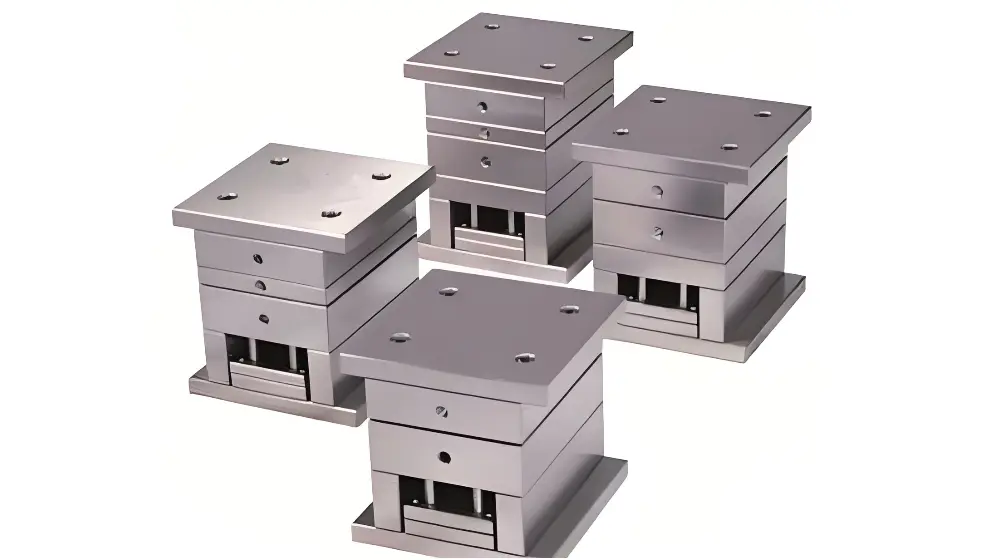
The mold is the largest upfront cost in most injection molding projects. It is a one-time capital investment — once the mold is built and validated, it runs for its entire production life without another tooling payment, provided it is maintained.
Three mould material tiers:
- 3D-printed resin molds ($100–$2,000): Useful for design validation and low quantities under 500 parts. Cannot produce production-quality surfaces; resin wears quickly. Ideal for concept verification before committing to metal tooling.
- Machined aluminium molds ($2,000–$25,000): Best for prototype runs of 1,000–50,000 parts. Faster to machine than steel, lower raw material cost, and good dimensional accuracy. Aluminium molds wear faster than steel — not suitable for glass-filled resins.
- Hardened steel molds ($15,000–$100,000+): The production standard. H13 or P20 HH steel with surface hardness HRC 48–52 delivers mold life of 500,000 to 1,000,000+ shots. Higher upfront cost, but the amortized tooling cost per part at high volume is negligible.
Features that increase tooling cost: side-actions, lifters, mirror-polish optical surfaces, additional cavities, hot runner systems.
2. Material Cost
Resin is the largest ongoing (variable) cost in injection molding. It scales directly with production volume — every additional part requires additional material. Two levers control material cost: resin selection and part weight.
Part weight matters more than most buyers expect. A 10% reduction in part weight (through wall section optimization or hollow features) reduces material cost by 10% on every part produced — for the life of the product.
Runner waste — the plastic that fills the gate, sprue, and runner channels but does not become finished part — adds 5–15% to material consumption for cold runner molds. Hot runner systems eliminate this waste, justifying their cost on programs above approximately 50,000 parts.
→ Resin selection guide: Fecision materials library
3. Machine Time and Labor
Machine time is charged at an hourly rate determined by press tonnage and automation level — typically $30–$120/hr for the machine itself. The number of parts produced per hour depends on cycle time, which is primarily controlled by wall thickness, resin, and cooling channel design.
Cycle time = injection time + packing time + cooling time + ejection time. For a 2mm ABS wall, total cycle time is typically 20–35 seconds. Cooling time alone accounts for 50–70% of cycle time — which is why conformal cooling channels that follow the cavity contour can cut cooling time by 15–25% and meaningfully reduce machine cost per part.
Setup charges cover the time to mount the mould, load resin, set process parameters, and run qualification shots. These are fixed per run — not per part. Longer, less-frequent production runs amortise setup charges across more parts, reducing their per-part impact.
4. Secondary Operations
Secondary operations are any steps required after the part exits the mold: degating (removing the gate stub), trimming flash, pad printing, painting, assembly, ultrasonic welding, and packaging. These are often overlooked in early cost estimates and can add $0.05–$2.00 per part depending on complexity.
Design decisions that eliminate secondary operations are among the most valuable DFM outcomes. Submarine (tunnel) gates that self-shear during ejection eliminate manual degating entirely. Designing parts for direct-mount assembly eliminates painting and secondary bonding steps. The most expensive secondary operation to discover late is a dimensional correction — caused by inadequate design review before tooling was cut.
Variables That Drive Injection Molding Cost
There are many factors that can impact the final price of your injection molded parts, and being aware of them will help you make good choices in the design and production stages.
Part Size
Larger parts require more resin per shot, larger injection machines (more expensive to run), and larger mould steel — all of which increase cost. Beyond a certain size, press tonnage requirements increase non-linearly with projected part area.
Always evaluate whether functional partitioning makes sense: splitting one large complex part into two simpler parts can sometimes reduce total tooling cost, even though it adds an assembly step. The key question is where the break-even lies when mold cost savings are compared against assembly cost additions.
Part Design Complexity
Design complexity is the primary driver of tooling cost beyond mold steel type. Undercuts, thin walls below 1mm, very tight tolerances (< ±0.1mm), textured surfaces, and highly polished optical faces all require additional mold engineering and machining time.
Thin walls deserve specific attention: walls below 1.5mm require high-injection-pressure fill profiles, shorter cooling channels for faster cycle times, and gates positioned to prevent premature freeze-off. Each of these requirements adds tooling and process engineering cost. For most non-precision enclosures, a 2.0–3.0mm wall is the cost-optimal range.
Number of Cavities
A 4-cavity mold produces four parts per injection cycle instead of one. At a 30-second cycle time on a $60/hr machine, the single-cavity tool produces 120 parts/hr; the 4-cavity tool produces 480 parts/hr. The cost difference: $0.50/part (single cavity) vs $0.125/part (4-cavity) — a 75% reduction in machine time cost.
The 4-cavity mold costs more to build (typically +60–80% above a single-cavity tool) and requires higher clamp tonnage. The break-even versus single-cavity tooling is typically around 15,000–20,000 parts — above that volume, the 4-cavity investment consistently delivers a lower total program cost.
→ Related: What is a mold cavity? A complete guide
Production Volume — The Break-Even Model
The relationship between volume and per-part cost is not linear — it follows a curve that drops sharply in the 1,000–20,000 part range and flattens above 100,000 parts. This is because the large fixed tooling cost is being spread across a growing denominator.
Planning production volume over the full product lifecycle — not just the first order — produces the most accurate cost analysis. A product expected to sell 50,000 units over three years justifies 4-cavity steel tooling on day one, even if the first order is only 5,000 units.
Six Proven Strategies to Reduce Injection Molding Costs
Cost reduction in injection moulding is primarily a design and planning exercise — not a supplier negotiation exercise. The decisions with the largest cost impact are made in the design phase, before any steel is cut.
1. DFM Review Before Tooling Commitment
Design for Manufacturability (DFM) review identifies high-cost features before tooling investment. Common findings: unnecessary undercuts that require costly sliders; abrupt wall thickness changes that cause sink marks and extend cooling time; gate locations that produce weld lines in cosmetically critical areas.
Studies of DFM-reviewed programs consistently show 15–20% total cost reduction compared to programs that proceed without design review.
2. Uniform Wall Thickness
Uniform walls cool evenly, reducing the maximum cooling time required. A part with 2mm walls throughout cools in approximately 12–18 seconds; a part with the same 2mm walls but a 6mm thick boss section must cool for 40+ seconds until the thick section solidifies — tripling cycle time and tripling machine cost per part.
Corrective design: core out thick sections to produce a nominally hollow structure with 2–3mm walls. A solid 6mm boss can be cored to a 2mm shell — reducing cooling time by 10–25% and eliminating the sink mark on the cosmetic face opposite the boss.
3. Right-Size the Resin
Resin selection directly multiplies through every part produced. If optical clarity is not required, PP is approximately 60% less expensive than PC. If the operating temperature is below 80°C, PA66 is approximately 70% less expensive than PEEK. The question is not ‘what is the best material?’ — it is ‘what is the minimum specification the application genuinely requires?’
4. Consolidate Parts
Two separately molded parts that are then assembled can often be combined into a single injection-molded component using snap fits, living hinges, or integral design features. Eliminating an assembly step removes material (fasteners), labor (assembly time), and quality risk (assembly error rate).
Snap fits replace screws: a part designed with integral snap features eliminates M3 screws, nuts, and assembly time. For a product assembled 100,000 times per year at $0.15 per fastener pair plus $0.10 assembly labor, that is $25,000/year in avoidable cost.
The snap feature adds design complexity to the mold — typically $300–$600 for a lifter mechanism — paying back in fewer than two production months.
5. Hot Runner for Volume Programs
Cold runner molds produce waste plastic in every cycle — the sprue, runner, and gate that must be removed or reground. Runner waste typically adds 5–15% to material consumption. For a PA66 program running 500,000 parts/year with 10g of runner waste per shot at $1.80/lb, that is approximately $3,970/year in avoidable material cost.
A hot runner can reduce cold-runner waste, but sub-runners may remain in a hybrid layout. Calculate payback from the quoted investment, actual cavities and shots, resin use, startup losses, cycle time and maintenance. A universal payback period is not reliable; see the runner-layout comparison.
6. Plan Production in Annual Batches
Setup charges are fixed regardless of batch size. A program placing 12 monthly orders of 1,000 parts pays 12 setup charges; the same annual volume in 4 quarterly orders pays 4 setup charges — saving $800–$4,000 per year.
Larger batch orders also qualify for volume resin pricing: resin suppliers typically offer 5–15% price breaks at 500kg quantities. Consolidating resin orders and production runs captures both savings simultaneously. The trade-off is increased inventory holding cost — worth evaluating against the direct cost savings before committing to a batch schedule.
Sliders and Lifters — How Undercut Mechanisms Affect Cost
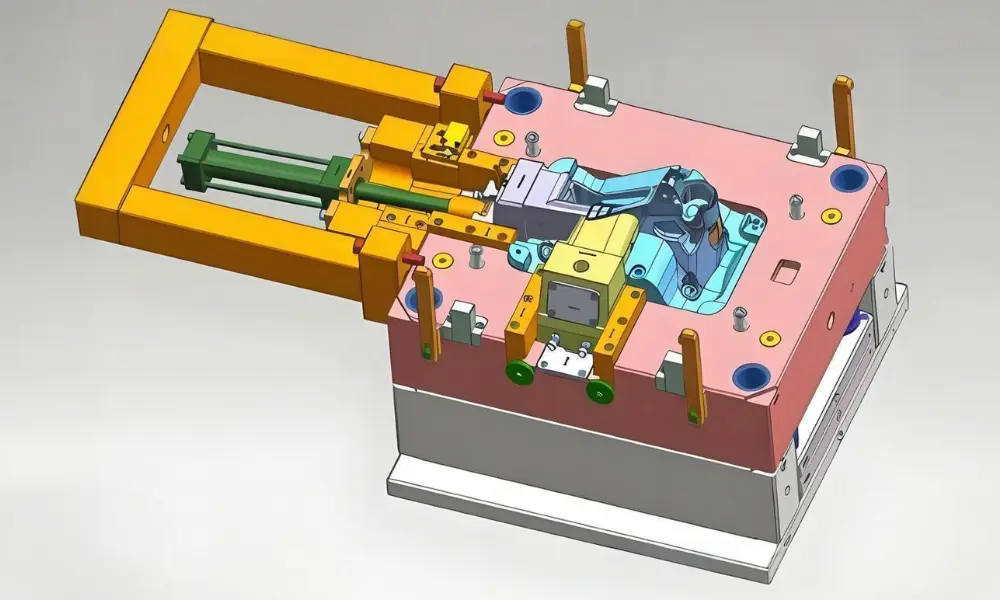
When a part design includes features that prevent straight pull-out from the mold — internal snap hooks, side holes, threads, or deep side cavities — specialized mold mechanisms are required to release the part during ejection. These mechanisms add directly to tooling cost and mold lead time.
| Factor | Lifters | Sliders |
| Mechanism | Moves at an angle on the mould core; releases features inside the part cavity | Moves laterally; creates and releases external side features |
| Best for | Internal undercuts — snap hooks, internal clips, undercut threads | External undercuts — side holes, side ribs, threaded exterior features |
| Cost addition | $300–$1,500 per lifter unit (simpler mechanism) | $500–$2,500 per slider unit (higher complexity, more components) |
| Lead time impact | Shorter — fewer components, integrated into core | Longer — precise alignment and fit required between slider and mold body |
| Maintenance | Lower frequency; integrated design has fewer wear points | More frequent; parting surfaces and wear inserts need periodic inspection |
| Design tip | Lifter angle 5–15° — steeper angles increase side force on the part during ejection | Always consider whether a part re-orientation can eliminate the slider entirely |
The most cost-effective approach: discuss undercuts with the mold engineer at the DFM stage. A simple geometry modification — angling a snap hook to face inward rather than sideways, or replacing a side hole with a slot accessible from the parting line — can eliminate a slider entirely, saving $500–$2,500 and mold lead time.
Steel removal rule: mold cavities are cheaper to enlarge (remove steel) than to shrink (add steel via welding and re-machining). Design all features with generous tolerances on the first tool iteration, then remove steel to tighten dimensions after first-article measurement. This ‘steel-safe’ approach avoids the most expensive category of tooling rework.
Frequently Asked Questions
What is the minimum order quantity for injection molding?
Minimum order quantity and economic batch size depend on the part, mold, resin, setup and inspection requirements. Compare the complete project cost at the quantities you actually expect to order; there is no universal break-even volume for every steel tool.
How long does injection molding tooling take to build?
Production steel molds: 4–8 weeks for standard geometries; 8–14 weeks for complex multi-cavity tools with hot runner systems. Adding slides or lifters typically adds 1–2 weeks. DFM-approved designs progress faster — unresolved design issues cause iterative rework that extends timelines unpredictably.
How much does mold maintenance add to total cost?
Budget maintenance from the tool specification, expected cycles, resin abrasiveness, condition monitoring and the agreed maintenance scope. Ask what the quote includes and how replacement components are handled rather than assuming one annual percentage applies to every mold.
Can I own the mold if I order from Fecision?
Mold ownership, storage, maintenance, transfer conditions and documentation must be agreed in the project contract. Confirm the scope and release requirements before placing the tooling order; do not assume an unconditional transfer entitlement from a general article.
What information does Fecision need to provide an accurate quote?
A 3D CAD file (STEP or IGES preferred), annual production volume, required resin or material type, surface finish requirement, and any critical dimensional tolerances.
Get Started With Injection Molding at Fecision
At Fecision, we provide primarily cost-effective, high-quality injection molding solutions, so your product launch can proceed in a timely manner to market. Our injection molding knowledge and experience will provide value every step of the way.
Our Services Include:
- Prototyping to Mass Production: From a few test parts to hundreds of thousands, we scale to your exact production needs.
- Competitive Injection Molding Costs: We optimize for efficiency and smart tooling, offering excellent value and keeping your costs low without sacrificing quality.
- Fast Turnaround with Durable Molds: Our rapid tooling ensures quick part delivery with molds built to last for your production volumes.
Ready to see how Fecision can help you? Contact Fecision for a personalized quote today, and let’s get your project started.