
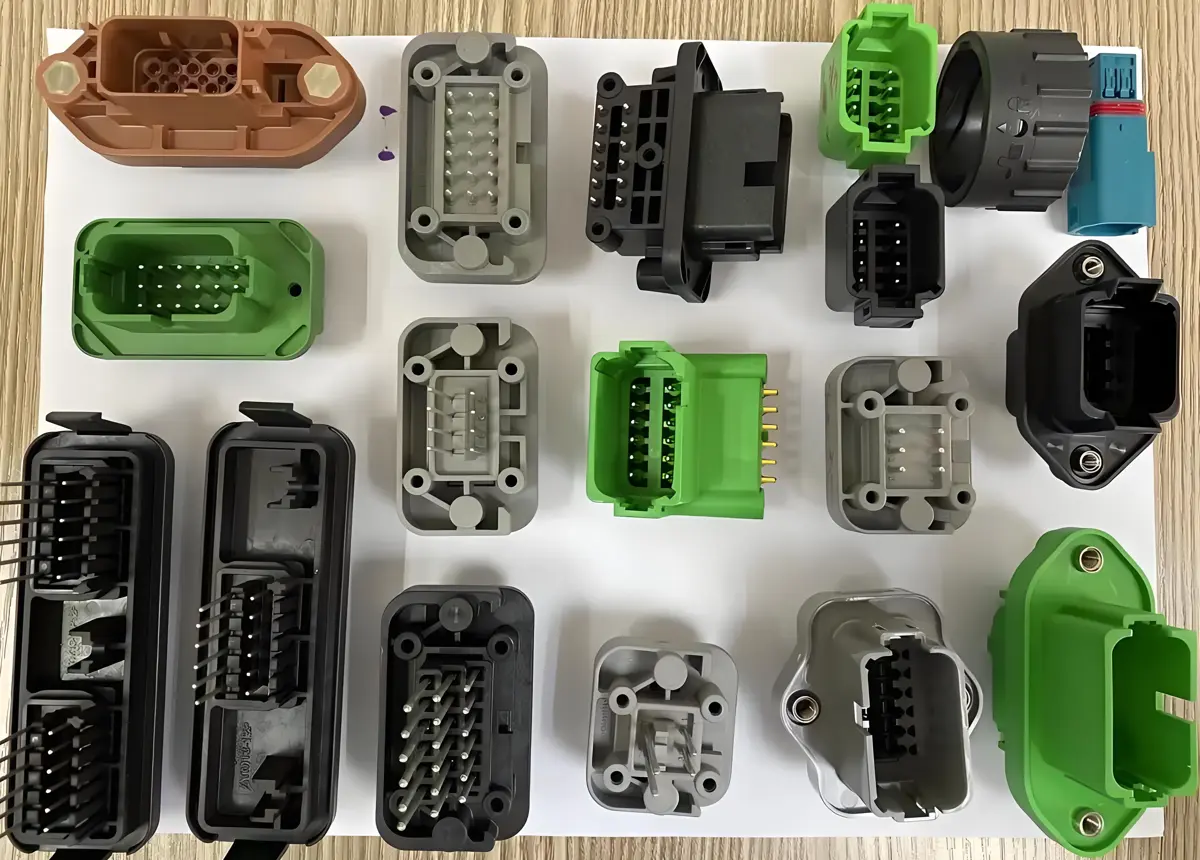
| Fecision manufactures precision connector injection molds and tooling to ±0.005 mm CNC and EDM tolerance — the dimensional range required for fine-pitch connector housings where pin position, wall section, and over-mold diameter directly determine signal integrity, press-fit compliance, and plating adhesion. Connector programs are supported from DFM simulation through first-article validation and volume production, in a single integrated facility in Shenzhen. |
Modern connector specifications leave no margin for tooling imprecision. A 0.3 mm pitch board-to-board connector housing requires pin pockets positioned within ±0.005 mm — a tolerance that standard general-purpose injection molding cannot achieve, and that only purpose-built high-precision tooling can hold across millions of production shots.
This article explains the specific precision requirements that drive connector mold manufacturing, the process challenges unique to connector resins, how Fecision addresses each challenge technically, and the performance evidence from four application sectors.
Why Dimensional Precision in the Mold Determines Connector Performance
Connector performance in the field traces directly back to decisions made in the mold engineering phase. Four functional properties of the finished connector are determined at the tooling stage — not correctable afterwards.
Signal Integrity Starts with Pin Position
In high-speed differential pair connectors (USB4, PCIe Gen 5, 100G Ethernet backplanes), pin-to-pin spacing is not merely a geometric specification. Positional variation between adjacent contact pockets adds mode conversion between differential and common mode — directly increasing crosstalk and raising the Bit Error Rate (BER) floor.
The tolerance requirement is not set by the connector designer — it is set by the channel loss budget for the system. At 112 Gbps PAM4 signalling, a BER above 10⁻⁴ before FEC is a system failure. Achieving the required BER margin starts with holding pin-pocket position to ±0.005 mm or better across the full connector array. [1]
Vibration and Thermal Fatigue Resistance
In automotive applications — EV battery harnesses in particular — connectors see continuous vibration from road inputs and temperature excursions from −40°C to 125°C in body electronics, extended to 150°C near the engine bay. [2]
A connector housing with inadequate rib geometry or insufficient wall section develops micro-motion at the mated interface under vibration. This micro-motion produces fretting wear on the plated contact surfaces, increasing contact resistance over time and eventually causing arcing in high-voltage applications.
The housing geometry that prevents fretting is established in the mold design — rib thickness, snap-beam stiffness, and housing wall uniformity.
Regulatory Compliance Built In
Standards like USCAR-2, IEC 60512, and MIL-DTL-38999 set maximum acceptable contact resistance drift after exposure to defined environmental stresses. Meeting these limits after environmental test depends on maintaining precise housing geometry throughout the test sequence.
Parts molded with inadequate precision fail compliance testing at the margins — requiring tool rework or design changes late in the qualification program. Parts molded with built-in precision margins pass comfortably, with documented CpK data that supports PPAP, customer qualification audits, and regulatory submission.
Assembly Throughput and UPH
SMT pick-and-place lines run at thousands of placements per hour. Connectors with tight true-position on housing datums can be placed without vision re-alignment — the feeder and nozzle geometry do the work.
The economic impact is direct: eliminating vision re-alignment on a connector placed 20 times per board, on a line running at 5,000 boards per day, saves approximately 2,000 minutes of machine time daily. At $0.50–$1.00 per machine minute, the UPH gain from tight housing tolerances alone can recover the tooling cost premium within months.
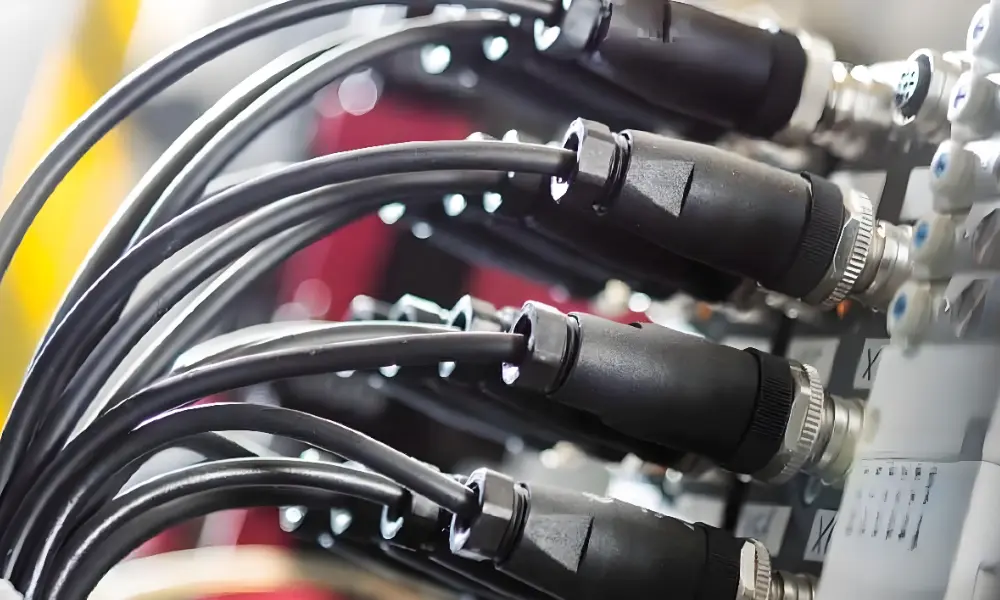
Six Characteristics of High-Precision Molded Connector Parts
The specifications below define the measurable properties that distinguish connector-grade precision moulding from general-purpose injection moulding. Each characteristic links directly to a functional consequence in the finished connector.
| Characteristic | Target Specification | Why It Matters in Production |
| Sub-µm dimensional accuracy | Pin-pocket position ≤ ±0.005 mm | Ensures coplanarity across high-way arrays (100+ contacts). Any pin misalignment beyond this range introduces crosstalk in differential pairs and raises Bit Error Rate (BER). Eliminates need for costly secondary machining after moulding. |
| Mirror-grade surface finish | Ra ≤ 0.4 µm on mating faces | Reduces insertion force for SMT pick-and-place automation. A smoother surface also reduces gold plating consumption on contact faces — meaningful cost saving at connector volumes above 500K units per year. |
| Ultra-tight over-mould diameter | ±0.01 mm on press-fit bores | Ensures press-fit compliance without distortion in the assembled housing. Critical for vertical connectors in PCB applications where bore tolerance directly controls contact normal force. |
| Multi-cavity Cpk consistency | Cpk ≥ 1.67 on pin-to-pin pitch | High Cpk on pin spacing across all cavities eliminates cavity-to-cavity sorting. Validated using on-press laser micrometers — providing real-time feedback rather than end-of-run measurement. |
| Long-term dimensional stability | < 0.02% shrink post-annealing | Post-mould annealing locks crystallinity so parts do not drift during SMT reflow (peak ~260°C for SAC305 solder). Tooling must be steel-safe compensated for the annealed state, not the as-moulded state. |
| Material integrity | Weld-line location controlled via simulation | Gate and runner layout positions any weld lines away from high-stress snap features and RF contact areas. Dielectric constant variation across a GHz-range sweep must be minimal — weld lines are the primary source of local Dk variation. |
Connector Resin Capability: LCP, PPS, PEEK, PBT, and PEI
Connector housings require materials that maintain tight dimensions at elevated service temperatures, process cleanly without flash or short shots at fine features, and meet UL 94 V-0 flammability requirements without external flame-retardant additives.
All five resins below are in current production at Fecision. Each requires specific mould design decisions — hot runner temperature zoning, gate sizing for the resin’s viscosity, and cooling channel placement — that differ from commodity thermoplastic practice.
| Resin | Barrel Temp | Shrinkage | Connector Application Notes |
| LCP (Liquid Crystal Polymer) | 300–330°C | < 0.1% shrinkage | Ultra-thin walls to 0.2 mm, pitch to 0.3 mm. Rapid solidification requires optimised gating and flow lengths < 150 mm. Ideal for micro-pitch SMT and board-to-board connectors. |
| PPS (Polyphenylene Sulfide) | 310–340°C | 0.5–0.7% (GF grade) | Continuous service to 220°C, excellent chemical resistance, UL 94 V-0. Glass-filled grades require careful shrinkage compensation — anisotropic behaviour must be modelled before tooling. |
| PBT (Polybutylene Terephthalate) | 230–260°C | 1.5–2.5% (unfilled) | Broadest qualified connector resin. Low moisture absorption (< 0.08%), excellent dimensional stability under USCAR-2 thermal shock cycles. GF30 grade recommended for tight-tolerance housings. |
| PEEK | 360–400°C | 1.0–1.3% | Highest continuous service temperature (250°C), FDA-compatible grades available for medical connectors. Very high melt temperature demands specialised mould heating and hot runner selection. |
| PEI (Ultem) | 340–380°C | 0.5–0.7% | UL 94 V-0 without additives, high strength at 180°C, sterilisation-compatible. Used in reusable medical and aerospace connector housings. |
A note on LCP processing: LCP’s very low melt viscosity allows it to fill wall sections below 0.2 mm, but its rapid solidification at the flow front means that gates must be positioned within 150 mm of the furthest cavity extremity and flow paths must be balanced to ± 5% by weight to prevent weld lines at contact positions.
Manufacturing Challenges in Connector Molding — and Fecision’s Solutions
The five challenges below are specific to connector molding. They are not problems that general injection molding process discipline resolves — each requires design-stage interventions before tooling is cut.
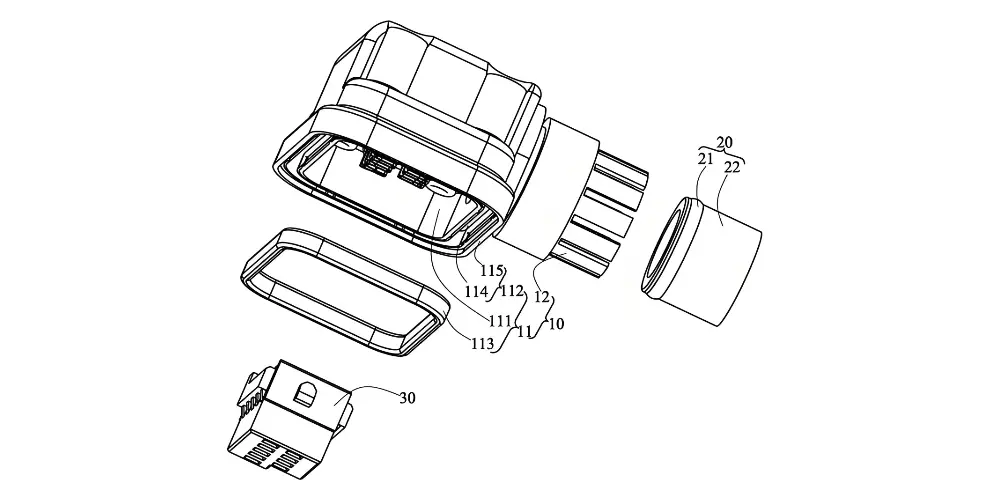
Micro-shrink variability in semi-crystalline resins
Semi-crystalline resins (LCP, PPS, PBT) shrink differently in flow and cross-flow directions. Without pre-production mould flow simulation, cavities fall out of spec after steel is cut. Fecision runs Moldex3D simulation on every new connector program. Cavity dimensions are steel-safe compensated based on simulation output, not historical rules of thumb.
Thin-wall fill and short shots
At wall sections below 0.3 mm, the melt front freezes before fill is complete. Conventional injection units stall. Fecision uses high-speed servo-driven injection systems capable of fill times below 0.1 seconds for thin-section LCP parts, combined with optimized gate sizing and resin drying protocols (LCP: 4h at 150°C, PPS: 3h at 150°C). SEM inspection on first articles verifies knit-line integrity.
Core shift and pin float in high-cavitation tools
Cavity pressure during fill (up to 1,400 bar for thin LCP sections) deflects slender core pins, enlarging through-holes beyond plated-through yield tolerance. Fecision uses supported core pin designs with hardened guide bushings and validates pin diameter and position on CMM for the first 30 shots of every production run before releasing full cavitation.
Gold-plate adhesion failure over molded surfaces
Residual mold release agent hydrocarbons migrate into LCP surface pores. When gold flash is applied later, blistering occurs under thermal cycling — an invisible defect that produces field failures in RF connectors. Fecision specifies release-agent-free mould operation for all connector programmes with post-mould plating, using conformal cooling and optimised draft angles to achieve clean demould without release spray.
Dimensional drift during SMT reflow
SAC305 solder reflow peaks at 250–260°C. Some resins re-crystallize in this range, shifting datums by up to ±0.03 mm. The tool must be compensated for the post-reflow state, not the as-molded state. Fecision runs thermal cycles at peak reflow temperature on first-article samples before finalizing cavity dimensions, quantifying any reflow-induced shift and adjusting steel accordingly.
Fecision’s Connector Mold Manufacturing Capabilities
Fecision delivers excellence by combining strict quality systems with cutting-edge technology. We focus on controlling every variable in the process, from the steel we select to the final validation report, to solve your precision connector mold challenges—from design to production:
Ultra-Tight Tolerance Machining
CNC machining to ±0.005 mm and slow-wire EDM to ±0.003 mm on cavity and core features. Core pin diameters as small as 0.3 mm are produced with guided support to prevent deflection under cavity pressure. All cavity dimensions are CMM-verified against the nominal geometry and the simulation-predicted shrinkage compensation before any production shots are run.
DFM and Mold Flow Simulation Up Front
Geometry review, runner balance analysis, and shrinkage compensation are completed before any tooling investment is committed. Moldex3D simulation outputs for every new connector program include fill pattern, weld-line locations, warpage prediction, and pressure maps at injection gate sizing.
The commercial benefit of early simulation: a gate location change identified in simulation costs nothing. The same change after steel is cut costs $2,000–$10,000 and delays T1 samples by 2–4 weeks.
Complex Geometry in a Single Shot
Slides, lifters, collapsible cores, and unscrewing mechanisms enable locking clips, snap beams, micro-vent channels, and thread forms to be released from the mold in a single cycle — no secondary operations. Insert molding and two-shot solutions are available for multi-material connector assemblies.
Conformal Cooling for Dimensional Stability
Conformal cooling channels — machined to follow the contour of the cavity surface rather than running as straight-line drilled circuits — maintain mold surface temperature uniformity within ±2°C across the cavity area. This uniformity is the primary mechanism for achieving consistent Cpk on dimensional features without process-window restriction.
Conformal cooling also reduces cycle time by 15–30% on thin-wall LCP and PPS parts compared to conventional straight-bore cooling — a throughput benefit that compounds at production volumes above 500K units per year.
Rigorous Quality and Validation
Every mold core and cavity receives a CMM inspection report against the design print before assembly. T1 trial samples are measured on CMM with a minimum of 30 consecutive shots per cavity, generating per-cavity Cpk data that validates balance and consistency before full cavitation is released.
Quality-system and documentation scope: Review the selected manufacturing partner's applicable certificates against the connector program. Agree the required DFM report, flow study, mold-trial records and dimensional inspection deliverables in the project specification; the documentation package depends on the scope ordered.
Rapid Prototype-to-Production Pathway
Steel-safe cavity compensation strategy allows T1 design tweaks using soft-tool inserts without scrapping base tooling. Pilot inserts in aluminium or pre-hardened P20 can be produced in 2–3 weeks for initial DFM validation, with the permanent hardened-steel production insert following after design approval.
All stages — design, machining, mold assembly, validation trials, dimensional reporting — are handled internally. No vendor hand-offs means no communication delays between steps.
→ Full connector mold capability detail: fecision.com/mold-tooling/precision-connector-mold-manufacturing/
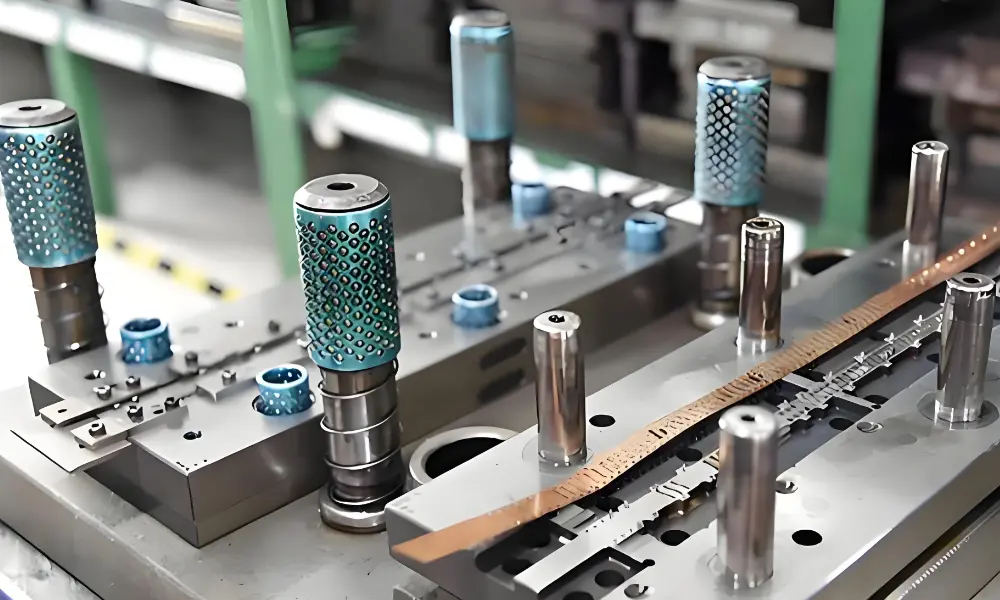
Industry-Specific Performance: Four Application Sectors
The true test of precision molding is how the parts perform in extreme real-world applications.
Automotive — xEV High-Voltage Connectors
LCP positioning fingers in high-voltage interlock (HVIL) connectors require true-position held to ±0.01 mm through USCAR-2 thermal shock cycles (−40°C to 125°C, 500 cycles). Fecision’s conformal-cooled LCP tooling achieves this by controlling mold surface temperature within ±2°C — eliminating differential shrinkage between cycles that produces the positional drift that causes fretting at the high-voltage contact interface.
Telecom / Data Centre — High-Speed Backplane Connectors
Skew-matched twinax pockets for 112 Gbps PAM4 differential pairs require pair-to-pair length matching within ±0.02 mm across a 64-way backplane connector. At 112 Gbps, 0.02 mm of twinax length mismatch introduces approximately 0.3 ps of skew — consuming 30% of the skew budget in a 1 ps allocation.
Fecision achieves this by mapping cavity-to-cavity dimensional variation during T1 trials and adjusting individual cavity shims before production release — a verification step that takes two additional days but eliminates the signal integrity margin loss that would otherwise require redesign.
Aerospace and Defence — MIL Circular Connectors
Composite over-mould rear shells for MIL-DTL-38999 Series III connectors require shell concentricity within ±0.025 mm to pass MIL-DTL-38999 vibration and salt-fog qualification. The PEI composite material re-mould must fully encapsulate the metal insert without bleed-out or void, verified by cross-section analysis on qualification samples. [3]
Medical — Disposable Ultrasound Catheter Connectors
Micro-connectors for disposable ultrasound catheters require pin planarity within ±0.01 mm for reliable flex-circuit bonding at the transducer array. Pin coplanarity error beyond this range produces cold solder joints that fail during the first thermal cycle, causing image artefacts or total loss of individual array elements.
For disposable medical connectors, FECISION coordinates the material grade, lot traceability and required documentation with an appropriate manufacturing partner. The applicable ISO 13485 certificate, its scope and product-specific biological evaluation requirements are reviewed for the assigned production site.
Frequently Asked Questions
What tolerance can Fecision hold on connector mold features?
CNC machining to ±0.005 mm and slow-wire EDM to ±0.003 mm on cavity and core features. Pin-pocket position in LCP or PPS housings is validated at Cpk ≥ 1.67 on first-article CMM measurement across 30 consecutive shots per cavity.
What is the typical lead time from DFM approval to T1 samples?
For a standard single-material connector housing in P20 or H13 steel: 5–7 weeks from DFM sign-off to T1. LCP programmes with hot runner and conformal cooling typically take 7–9 weeks. Pilot soft-tool inserts for DFM validation are available in 2–3 weeks.
What quality certifications apply to connector mold programs at Fecision?
Quality-system requirements depend on the connector application and customer specification. FECISION coordinates the applicable manufacturing-site certificates, material traceability, mold-trial records and dimensional inspection deliverables before production is placed.
Conclusion
Precision connector mold manufacturing is no longer a luxury in the highly competitive connector industry—it is the absolute price of admission. From achieving your 5G latency budgets to meeting strict EV safety mandates, every micron saved in the mold manufacturing stage echoes through decades of field reliability for your products.
FECISION coordinates precision connector mold development and injection molding, including DFM, resin selection and dimensional inspection planning. Quality-system requirements are matched to the selected manufacturing partner and the application; tolerances and validation deliverables are agreed from the drawing.
Contact our team for a DFM review on your high-precision part today!
References & Authoritative Sources
Accessed May 2026.
[1] IEC 60512-26-100:2013. Connectors for electronic equipment — Tests and measurements. https://webstore.iec.ch/publication/2282
[2] USCAR-2 Rev 6. Performance Requirements for Automotive Electrical Connector Systems. https://www.uscar.org/guest/standards/1/USCAR-2
[3] MIL-DTL-38999 Series III. Detail Specification. https://lmipubs.lmi.org/