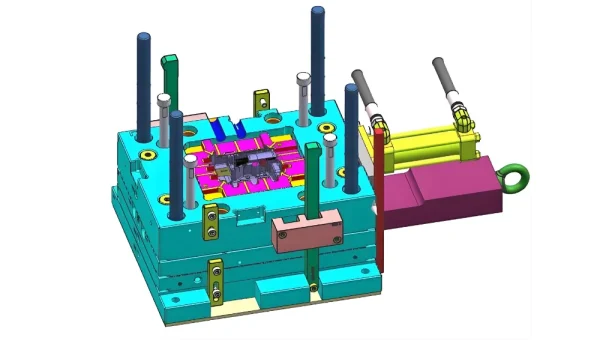
| Side action in injection molding refers to lateral mold inserts — slides, lifters, unscrewing actions, and collapsible cores — that retract perpendicular to the main mold opening direction before part ejection. They form undercuts, internal threads, side holes, and snap features that are geometrically impossible in a straight-pull mold. |
This guide explains what is side action in injection molding, how cam-driven mechanisms work, and compares various injection molding types of side actions. You will also find essential design rules to help you create reliable, high-quality, and cost-effective tooling for your next project.
What Is Side Action in Injection Molding?
A standard injection mold opens in one direction — straight up or straight apart. Any feature on the part that is perpendicular to that direction, or that faces sideways, gets trapped when the mold tries to open. These features are called undercuts.
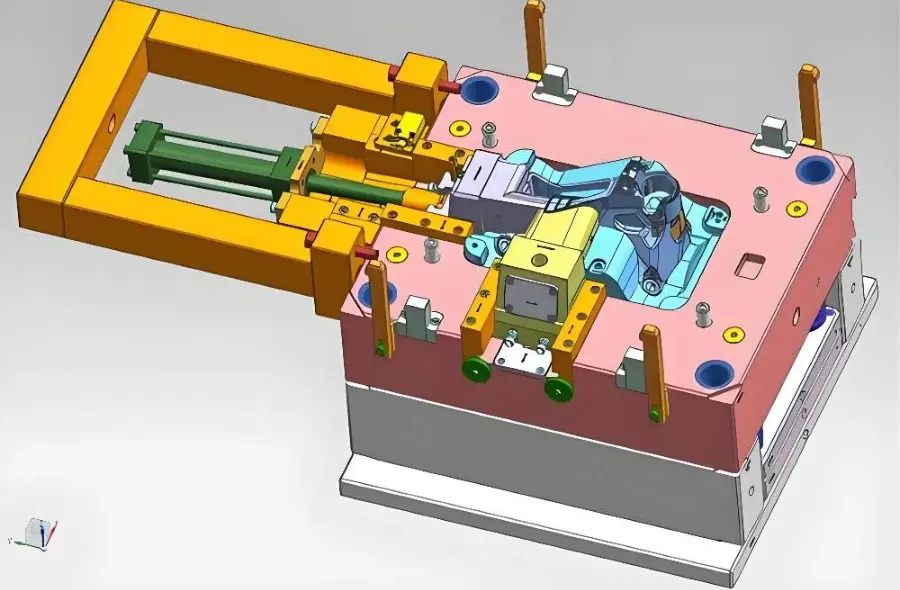
Side actions solve this by adding mold inserts that move laterally — in a direction perpendicular to the main opening stroke. These inserts are programmed to retract via mechanical cams, hydraulics, or pneumatics before the part is ejected. Without side actions, undercuts can only be formed by splitting the part into separate components and assembling them post-production.
This matters economically: a single molded part with an integral snap feature, threaded boss, or side port eliminates a separate component, a bond, an assembly step, and the tolerance stack-up that comes with assembled interfaces.
The Four-Stage Side Action Cycle
Side actions follow the same mold cycle as standard injection molding, but with two additional movements — engagement on close and retraction on open. The sequence must be timed precisely: a slide that retracts a fraction of a second late can deform the part; one that engages a fraction too early can crash into the cavity.
Stage 1 — Mold Closure: Engagement
As the mold closes, angle pins or cams drive the side action insert into the cavity position. Precision guidance gibs and wear plates ensure the insert seats at the exact location required to form the undercut. The geometry of the part’s undercut is fully defined at this stage — before any plastic enters the tool.
Stage 2 — Injection: Holding Under Pressure
The closed side action is locked in position by a heel block that absorbs the lateral injection force. Without this locking feature, injection pressure — which can reach 10,000–20,000 psi in the cavity — would push the slide back and create flash at the parting line. Molten plastic flows around the insert, forming the undercut geometry.
Stage 3 — Mold Opening: Retraction
As the mold begins to open, cam reversal or hydraulic actuation retracts the side action laterally. The insert must clear the undercut completely before the part moves in the ejection direction. Interlock sensors confirm full retraction before the ejection plate is permitted to advance — preventing tool crashes that can damage both the part and the slide mechanism.
Stage 4 — Ejection: Release
With the side action clear, standard ejector pins push the part from the cavity. Because the undercut geometry has already been released by the lateral retraction, the part ejects cleanly with no tearing, deformation, or dragging of the undercut features.
Five Types of Side Actions
The correct mechanism depends on the location of the undercut (external vs. internal vs. threaded), the required production volume, and the part geometry. The table below maps all five types; the explanations below expand on when each is the right choice.
| Type | Undercut Location | Actuation | Cost Level | Best Application |
| Slides | External | Cam pin or hydraulic cylinder | Medium — H13 heel block | High-volume production; any external undercut feature |
| Lifters | Internal | Ejector plate travel | Low-Medium — angled pin | Tabs, bosses, and internal snaps with limited space |
| Unscrewing actions | Threaded | Motor or hand-crank rotation | High — rotation drive system | Bottle caps, connectors, precision internal threads |
| Collapsible cores | Circular internal | Mechanical collapse mechanism | High — complex segment design | 360° undercuts: caps, closures, deep circular pockets |
| Hand-loaded cores | Any | Manual operator load/unload | Low — no actuation system | Prototypes and low-volume runs under ~1,000 units |
Slides — External Undercuts
Slides are the most common side action mechanism and the default choice for any external feature — side holes, side ports, snap tabs, and external threads. They travel in a straight line perpendicular to the main opening direction, driven by cam pins at 15–25° angle or by hydraulic cylinders for higher-force applications.
A heel block locks the slide in place during injection, allowing it to withstand cavity pressure without lateral deflection.
Lifters — Internal Undercuts
Lifters form internal features — internal tabs, bosses, and snap hooks — by traveling at an angle as the ejector plate advances. The angled travel simultaneously releases the internal undercut and advances the part toward ejection.
The travel angle must be precisely calculated: too shallow and the lifter doesn’t clear the feature; too steep and the lifter’s side load damages the part surface.
Unscrewing Actions — Threaded Features
Internal and external threads require unscrewing actions — motor-driven or hand-cranked mechanisms that rotate a threaded core out of the finished part. The rotation is synchronized with the mold opening stroke to prevent stripping the plastic threads.
For precision applications like bottle caps and technical connectors, unscrewing actions produce thread quality — pitch accuracy and surface finish — that no other side action mechanism can match.
Collapsible Cores — Circular Internal Features
Collapsible cores consist of segmented steel pieces that collapse inward during mold opening, releasing 360-degree internal undercuts — deep threads in caps and closures, for example. No other mechanism can form a full-circumference internal undercut in a single shot.
The tooling investment of collapsible cores is the highest of all side action types, but cycle time remains equivalent to standard molding — unlike unscrewing actions, which add rotation time.
Hand-Loaded Cores — Low-Volume Alternative
For prototypes or small production runs under approximately 1,000 units, loose metal inserts can be manually loaded into the mold before each cycle and removed after the part is ejected. This eliminates all actuation hardware from the tool, reducing upfront mold cost substantially. The per-part labor cost and extended cycle time make hand-loaded cores uneconomical above prototype volumes.
Advantages of Side Action Injection Molding
Side actions are more than just moving parts; they are strategic tools that improve your product quality and reduce your total manufacturing expenses.
Design Freedom for Complex Geometries
Side actions unlock part features that are geometrically impossible in a straight-pull mold: side holes, perpendicular ports, external threads, lateral snap features, and internal bosses without draft. Engineers can design for function — not for mold constraints — and avoid the compromises that straight-pull geometry requires.
Elimination of Secondary Assembly
A part that exits the mold with all its functional features already formed eliminates downstream assembly operations. This removes parts from the BOM, prevents tolerance stack-up at assembled interfaces, and reduces the labor and handling risk that secondary operations introduce.
Tighter Tolerances than Post-Mold Machining
Features formed directly by a precision side action maintain tighter dimensional tolerances than the same features produced by post-mold machining. Mold-formed features inherit the accuracy of the tool steel — typically ±0.01 mm on slide pockets — whereas machined features introduce additional fixturing and setup variation.
Lower Per-Part Cost at Production Volume
The 15–40% tooling cost premium for side action molds is fixed. It is amortized across every unit produced, while the per-part savings from eliminated secondary operations are realized on every unit. For production runs above approximately 10,000 units, side actions are almost always more economical than the combination of a simpler mold plus post-mold machining or assembly.
Design Guidelines for Side Action Molds
To get the most out of your tooling, specific design rules need to be followed to ensure that the side actions operate reliably over time.
Minimize Undercut Depth
Shallower undercuts require shorter slide travel and smaller cam angles — reducing mechanical stress on the angle pins, extending mold life, and lowering maintenance frequency. When part function allows, substitute shallow slots or bypass features for deep undercuts; these can often achieve the same assembly function at a fraction of the tooling complexity.
Place Parting Lines Away from Cosmetic Surfaces
Where a slide meets the main mold, a parting line mark will appear on the plastic part surface. Position this intersection on non-visible or non-functional surfaces during DFM — away from high-stress areas, mating interfaces, and Class-A surfaces where the mark would be unacceptable.
Integrate Cooling Channels Directly in Slide Bodies
Slide bodies create thick steel sections adjacent to the cavity that trap heat and cause sink marks or warpage if not actively cooled. Dedicated cooling channels within the slide body — or BeCu inserts in high-heat zones — equalize the cooling rate between slide areas and the surrounding cavity.
In simulation studies using topology-optimized conformal cooling, researchers have recorded temperature deviation reductions of up to 43% and cooling time reductions up to 70% compared to straight-drilled channels. [1]
Design for Accessible Wear Components
Slides, cam pins, and heel blocks are wear components — they will eventually need replacement. Designing with accessible wear plates and standardized replaceable inserts means a worn slide can be swapped in minutes rather than requiring mold disassembly and re-machining. This design choice is the single most effective way to reduce unplanned production downtime over a mold’s service life.
Synchronize All Movements with Interlock Controls
A side action that retracts too late or an ejector that fires too early can deform the part or crash the tool. Sequence valves, interlock controls, and position sensors ensure every movement completes before the next one begins.
Thin-film sensors combined with machine learning can now capture mold-state data in real time, predicting dimensional drift before it produces out-of-tolerance parts. [2]
How Side Action Molds Are Built
The creation of side action tools requires a high level of expertise and precision at every stage of the manufacturing process.
Design Validation
Before any steel is cut, CAD simulation of the cam kinematics checks for interference between the slide travel path and the part geometry. Mold flow analysis predicts weld line formation and air trap locations at the slide-cavity interface. These digital checks resolve the majority of design problems at zero rework cost.
Material Selection
Slides and cam pins are manufactured from H13 or S7 tool steel, heat-treated to 48–52 HRC. Wear plates on sliding surfaces are typically bronze-graphite alloy — self-lubricating to reduce friction and prevent metal-to-metal galling over long production runs. BeCu inserts are used where high thermal conductivity is required in the slide body to equalize cooling rates. [3]
Precision Machining
Slide pockets are CNC-milled to ±0.01 mm accuracy. Fine detail features — cam profiles, heel block contact surfaces — are cut by wire EDM, which achieves tolerances below ±0.005 mm on complex profiles. Ground mating surfaces ensure the slide seals completely under injection pressure, eliminating flash at the slide-cavity interface.
Surface Engineering
Vacuum hardening strengthens the steel while minimizing distortion. PVD (Physical Vapor Deposition) coatings are applied to sliding surfaces — TiN or TiCN coatings at 2–4 µm thickness reduce friction and prevent surface galling where cam pins contact the slide body. This surface treatment extends cam pin life 3–5× compared to uncoated steel at equivalent production volumes.
Assembly and Testing
After assembly, the mold is tested on a press with controlled injection pressure to verify slide engagement, retraction timing, and part release. Real-time monitoring using thin-film sensors confirms that each slide reaches full retraction before ejection, and that cavity pressure at the slide interface remains within specification across the first production shots. [2]
Side Action Injection Molding at Fecision
As an expert injection molding manufacturer, Fecision designs and manufactures side action molds for slides, lifters, unscrewing actions, and collapsible core programs. CNC and EDM machining holds slide pocket tolerances to ±0.01 mm as standard; H13 hardened steel at 48–52 HRC is the production baseline for all side action mechanisms.
- Mechanisms in production: cam-pin slides, hydraulic slides, angled lifters, motor-driven unscrewing actions, and collapsible cores.
- Tolerance capability: ±0.01 mm on slide pockets; ±0.005 mm on cam profiles via wire EDM.
- Surface engineering: PVD TiN/TiCN coatings on all sliding surfaces as standard. BeCu inserts available for high-heat gate and slide areas.
- DFM review: cam kinematics simulation, mold flow analysis for weld line and air trap prediction at slide interfaces — included with every quote at no charge.
- Quality: ISO 9001:2015 certified. First-article inspection. In-process monitoring with position sensors on hydraulic slides.
Conclusion
Side action in injection molding converts geometric constraints into design opportunities. Features that would require secondary machining or assembly in a straight-pull mold are produced directly in the mold cycle — at the accuracy of the tool steel, with no additional handling, no tolerance stack-up at assembled interfaces, and no added labor per part.
The five mechanism types — slides, lifters, unscrewing actions, collapsible cores, and hand-loaded cores — each address a distinct undercut geometry and production volume profile. Selecting the right one at the DFM stage prevents tooling rework and determines the per-part economics across the production run.
Contact Fecision today to get a quote and professional DFM feedback for your next complex project.
References
Accessed May 2026.
[1] Fernandes, C. et al. ‘Topology Optimization of Conformal Cooling Channels in Injection Molds.’ Structural and Multidisciplinary Optimization, 2025. https://link.springer.com/article/10.1007/s00158-025-04067-y
[2] Fraunhofer Institute for Surface Engineering and Thin Films (IST). ‘Innovative Thin-Film Sensor Technology Enables Automated Real-Time Quality Control in Plastic Injection Molding.’ https://www.ist.fraunhofer.de/en/press-media/2025/innovative-thin-film-sensor-technology-enables-automated-real-time-quality-control-in-plastic-injection-molding.html
[3] Rosato, D.V. & Rosato, M.G. Injection Molding Handbook, 3rd Edition. Kluwer Academic Publishers, 2000.