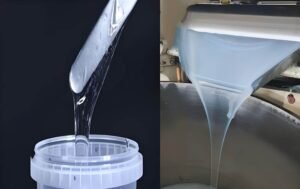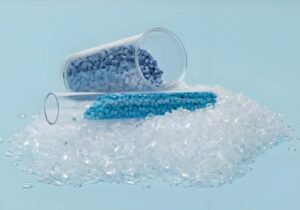
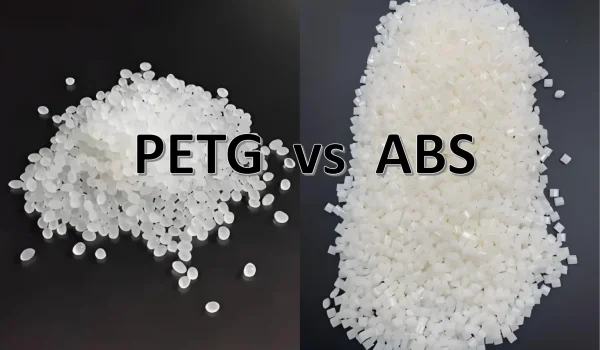
| ABS and PETG are both amorphous thermoplastics suited to injection molding, but they serve different applications. ABS delivers superior heat resistance (HDT 80–100°C), excellent surface quality for painting and electroplating, and a wide processing window. PETG offers inherent transparency, better chemical resistance, and FDA food-contact compliance — but a lower heat deflection temperature (65–80°C) and significantly higher moisture sensitivity during molding. |
The decision between them is not primarily about which material is ‘better’ — it is about which property profile matches the engineering requirements of the specific part. This guide covers both materials from an injection molding standpoint: material structure, quantified engineering properties, processing parameters for each, and a decision framework for nine common application scenarios.
What Are ABS and PETG?
ABS — Acrylonitrile-Butadiene-Styrene
ABS is an amorphous terpolymer in which three monomers each contribute a distinct functional property. Acrylonitrile provides chemical resistance, stiffness, and heat resistance through its polar nitrile groups. Butadiene rubber micro-domains dispersed in the matrix absorb impact energy. Styrene provides rigidity, surface gloss, and processability.
Because ABS is amorphous, it has no sharp melting point — it softens gradually above its glass transition temperature (Tg ~95–105°C). This gives it a wide, forgiving processing window for injection molding. Its low shrinkage (0.4–0.7%) and near-isotropic shrinkage behavior are its most important injection molding advantages.
- Key production grades: SABIC Cycolac™ MG94 (general-purpose), Cycolac™ FR15U (UL 94 V-0 flame-retardant), and Cycolac™ electroplating grades. Toray Cycoloy™ PC/ABS blends extend heat performance above standard ABS. [1]
PETG — Glycol-Modified Polyethylene Terephthalate
PETG is polyethylene terephthalate (PET) modified with a glycol co-monomer during polymerisation. The glycol modification disrupts the regular chain packing that allows standard PET to crystallise — making PETG amorphous rather than semi-crystalline. This is the structural change that gives PETG its transparency, lower processing temperatures, and reduced shrinkage compared to standard PET.
The amorphous structure also makes PETG more sensitive to moisture than PET. When molded with residual moisture above 0.02%, ester bonds in the PETG backbone undergo hydrolysis — irreversibly reducing molecular weight, producing brittle parts, and releasing acetaldehyde (a food-safety concern for food-contact applications). This moisture sensitivity is PETG’s most important injection molding processing risk.
- Key production grades: Eastman Tritan™ copolyester (food-contact compliant, BPA-free, dishwasher-safe), Eastman PETG 6763 (general-purpose injection molding and thermoforming grade), SK Chemicals S2008. [2]
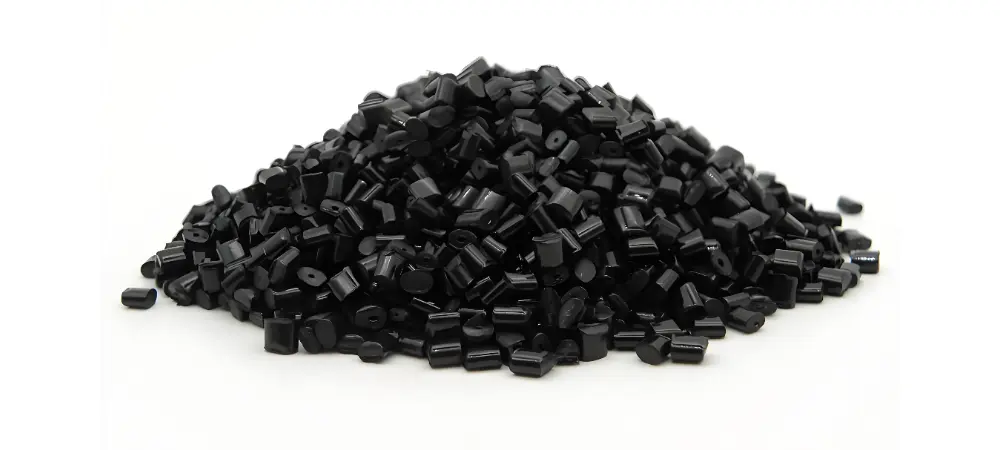
PETG vs ABS: Full Engineering Properties Comparison
The table below covers key engineering properties relevant to production. Data represents typical ranges for standard unfilled commercial grades from major producers.
| Property | ABS | PETG |
| Density | 1.02–1.06 g/cm³ | 1.27–1.28 g/cm³ (denser — heavier part weight) |
| Tensile strength | 40–50 MPa | 48–55 MPa (slightly higher) |
| Flexural modulus | 2.0–2.8 GPa | 2.1–2.4 GPa |
| Heat deflection temp (1.82 MPa / 264 psi) | 80–100°C — suits most consumer and industrial enclosures High-heat ABS grades: up to 110°C | 65–80°C — lower than ABS; limiting for heat-exposed applications PETG deforms under sustained load above ~70°C continuous |
| Vicat softening point | 90–110°C | 78–86°C |
| Injection molding shrinkage | 0.4–0.7% (unfilled) Isotropic, predictable — tight tolerances achievable | 0.2–0.5% (nominally lower) Highly moisture-sensitive: undried PETG can shift to 0.7–1.2% from hydrolysis |
| Water absorption (24h) | 0.2–0.4% — pre-dry required | 0.1–0.2% — pre-dry mandatory PETG hydrolyses if moulded wet — molecular weight loss = brittle parts |
| Chemical resistance | Good vs weak acids, alkalis Attacked by ketones, esters, chlorinated solvents, concentrated acids | Excellent vs dilute acids, alkalis, alcohols, most aqueous solutions Food-contact compliant per FDA 21 CFR 177.1630 (virgin material) |
| UV resistance | Poor — yellows and embrittles; requires UV-stabiliser additive for outdoor use | Better than ABS inherently; UV-stabilised grades for prolonged outdoor use |
| Optical clarity | Opaque (standard); transparent grades via special formulation | Naturally transparent (80–90% visible light transmission) — a key material differentiator |
| Surface finish quality | Excellent — accepts SPI A-1 mirror polish, painting, electroplating Acetone smoothing possible (soluble in acetone) | Good surface quality; glossy finish naturally Not soluble in acetone — harder to bond and paint; requires specialised adhesive |
| Flame performance | UL 94 V-0 to HB grades available (SABIC Cycolac™ FR series) | HB standard; V-0 grades available but less common than for ABS |
| Recyclability | Resin code #7 — limited consumer collection; industrial recycling available | Resin code #1 (PET family) — better-developed recycling infrastructure than ABS |
The single most important insight from the comparison
PETG’s nominally lower shrinkage (0.2–0.5%) is misleading without context. This figure is only achieved with properly dried material processed within the correct temperature window. Undried or overheated PETG produces parts with shrinkage of 0.7–1.2% — higher than ABS — due to molecular weight reduction from hydrolysis.
For precision programs, ABS’s predictable 0.4–0.7% is often more reliable in practice than PETG’s theoretical 0.2–0.5%.
Key Differences in Depth
Both materials have unique characteristics that make them suitable for different applications.
Heat Resistance — ABS’s Primary Advantage Over PETG
ABS’s heat deflection temperature is consistently 15–25°C higher than PETG’s. This margin is the deciding factor for any application where the part will sustain mechanical load at elevated temperatures — enclosures near motors, electronics housings in warm environments, components in automotive interiors.
PETG begins to deform under sustained load above approximately 65–70°C. ABS in the same application maintains its dimensional and structural integrity reliably. High-heat ABS grades (SABIC Cycolac™ X15 series) extend HDT to ~110°C for the most demanding applications.
Transparency — PETG’s Unique Advantage
PETG is naturally transparent, transmitting 80–90% of visible light. Standard ABS is opaque. Transparent ABS grades exist but require special formulation and sacrifice some of the impact performance that makes ABS valuable.
For any application requiring optical clarity — diagnostic cartridge windows, medical packaging where devices must be visible inside the sterile barrier, transparent protective covers — PETG is the direct injection-mouldable choice of the two.
PETG’s transparency also makes it the standard material for thermoformed medical device packaging trays, where visual inspection of the contained device is a packaging validation requirement. This specific application drives significant PETG demand in the medical supply chain.
Chemical Resistance — PETG’s Advantage for Liquid Contact
PETG resists dilute acids, dilute alkalis, alcohols, and the aqueous cleaning and disinfecting agents used in medical and food processing environments. ABS is attacked by ketones (acetone — the same property that enables acetone vapor smoothing in 3D printing), esters, and chlorinated solvents.
In medical device applications, this distinction matters. Hospital cleaning protocols are a critical design constraint for device housing material selection — and PETG’s chemical compatibility with common disinfectants is a direct advantage in this context.
Surface Finishing — ABS’s Comprehensive Post-Processing Advantage
ABS can be electroplated, painted, sanded, acetone-smoothed, and bonded with common adhesives without surface treatment. This comprehensive post-processability is why ABS dominates consumer electronics housings, automotive interior trim, and any product where the moulded surface must be decorated or functionalised after moulding.
PETG’s post-processing options are substantially more limited. It is not soluble in acetone and does not etch for electroplating. Paint adhesion requires surface preparation (sanding plus specialised PETG primer). Bonding PETG requires cyanoacrylate or two-part epoxy rather than solvent-based adhesives. For high-throughput decorated parts, ABS is the engineering-correct choice.
Strength and Durability — Each with Their Own Advantages
When it comes to strength and durability, both PETG and ABS have their advantages. ABS is known for its high strength and resistance to impact, making it suitable for applications where parts are subjected to mechanical stress.
PETG, on the other hand, offers a balance between strength and flexibility, providing durability without being too brittle. The strength of a material is critical in determining its suitability for various applications, from consumer products to industrial components.
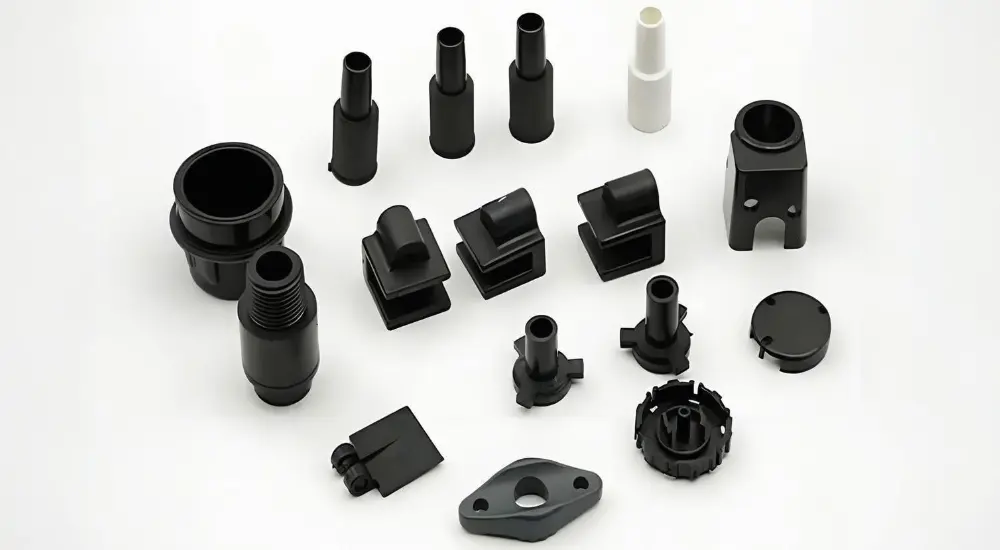
Injection Molding ABS: Processing Guide
ABS is one of the most process-friendly injection molding materials. Its wide processing window, low and isotropic shrinkage, and excellent surface quality make it the dominant material for consumer electronics housings, instrument panels, and any application requiring painting, plating, or acetone-based smoothing.
| Parameter | ABS Specification | Engineering Notes |
| Pre-drying | 80°C for 2–4 h Target: < 0.1% moisture | ABS is hygroscopic. Moisture above 0.1% produces silver splay streaks, surface haze, and reduced impact strength in the molded part. Do not leave dried ABS exposed to ambient air for more than 30 minutes before molding. |
| Barrel temp | Rear: 180–200°C Middle: 200–220°C Front/nozzle: 210–230°C Melt: 200–240°C | Keep below 250°C — thermal degradation produces butadiene off-gas and discolouration. Short residence time is preferred. |
| Mold temp | 40–80°C (60–80°C for plated/painted parts) | Higher mould temperature (60–80°C) reduces internal stress, improves surface gloss, and reduces risk of weld-line visibility — critical for electroplated parts. Lower temperature (40–50°C) is acceptable for structural parts where aesthetics are secondary. |
| Injection pressure | 70–110 MPa fill 30–50 MPa hold | ABS has low, predictable shrinkage. Primary risk is overpacking at hold pressure — excess hold pressure induces residual stress that causes post-mold distortion and stress cracking when the part contacts ketone or ester solvents. |
| Shrinkage | 0.4–0.7% Nearly isotropic | ABS’s low, isotropic shrinkage is its most important injection moulding advantage. Tolerances of ±0.1 mm on standard features are routinely achievable. Electroplating-grade ABS requires mold polished to SPI A-1 — plating reveals every surface defect. |
| Gate sizing | 0.8–1.5 mm diameter preferred | Sub-gate (tunnel) or fan gate on non-cosmetic surfaces for cosmetically critical parts. Avoid direct sprue gates on visible faces. Gate vestige on ABS can be blended by acetone if needed. |
| Post-molding | Anneal at 70–80°C for 2–4 h if stress cracking risk exists | Annealing before electroplating is strongly recommended — it reduces stress blistering during the chrome plating acid etch step. |
→ Fecision ABS injection molding services: fecision.com/materials/abs-injection-molding/
Injection Molding PETG: Processing Guide
PETG injection molding requires more careful moisture management than ABS — and a tighter processing temperature ceiling. The rewards of correct processing are a naturally transparent, chemically resistant part with excellent dimensional stability. The penalty for incorrect processing is irreversible material degradation that no downstream operation can repair.
| Parameter | PETG Specification | Engineering Notes |
| Pre-drying | 70–80°C for 4–6 h Target: < 0.02% moisture | PETG hydrolyses in the melt when moisture is present — ester bonds break, reducing molecular weight and producing brittle, discoloured parts. This damage is irreversible. Pre-drying is extremely important. |
| Barrel temp | Rear: 200–220°C Middle: 220–240°C Front/nozzle: 230–250°C Melt: 220–260°C Do NOT exceed 270°C | PETG’s processing window is narrower than ABS. Above 270°C, PETG degrades rapidly, generating acetaldehyde — a contaminant for food-contact applications. Set barrel temperatures conservatively. |
| Mold temp | 15–30°C (for optical clarity) 50–80°C (for dimensional stability) | Cold mold (15–30°C) maximizes transparency by preventing crystallisation — essential for optical windows and transparent housings. Warm mold (50–80°C) improves dimensional consistency and reduces internal stress in structural parts where clarity is secondary. |
| Injection pressure | 80–120 MPa fill 30–50 MPa hold | PETG tends to string at the gate — ensure gate freeze. Anti-drool nozzle (self-locking shut-off) is recommended to prevent drool between shots, which causes black specks. |
| Shrinkage | 0.2–0.5% (dry, properly processed) 0.7–1.2% (if undried/degraded) | The nominally low shrinkage of PETG is only achieved with properly dried material. Undried PETG can exhibit double or triple the expected shrinkage due to molecular weight reduction from hydrolysis. |
| Gate sizing | 1.0–1.5 mm diameter preferred Larger gates than ABS recommended | Larger gates are needed because PETG is more prone to gate freeze-off and stringing than ABS. Undersized gates cause shear stress and surface imperfections. |
| Post-molding | Annealing: 60–70°C for 30–60 min reduces internal stress Do not anneal food-contact parts above 65°C | PETG cannot be bonded or smoothed with acetone. For painting, surface preparation is required. PETG is inherently harder to decorate than ABS. |
Industrial Applications
Where ABS Dominates
Consumer electronics enclosures: Laptop shells, keyboard housings, monitor bezels, and set-top box panels are produced in ABS for its combination of dimensional accuracy, surface quality, UL 94 flame-rated grades, and paintability.
Automotive interior components: Dashboard panels, door trim, console covers, and switch bezels use ABS or PC/ABS blends. The requirement for Class-A surface paint finish — requiring a distortion-free, high-gloss paintable surface — directly selects for ABS’s post-processing capability.
Medical device housings: Diagnostic instrument enclosures, infusion pump bodies, and portable monitoring device housings use UL 94-rated, ISO 10993-biocompatible ABS grades.
Where PETG Is Preferred
Medical packaging: Injection-molded PETG blister trays, kit organizers, and sterilisation packaging inserts are standard in the medical supply chain. FDA 21 CFR 177.1630 compliance enables food and drug contact. The transparency requirement — devices must be visible through the packaging — makes PETG the only viable choice. [3]
Food-contact containers and equipment components: Food storage, beverage handling components, and food processing equipment parts use PETG for its FDA compliance, chemical resistance to cleaning agents, and optical clarity for product inspection.
Laboratory and diagnostic device components: Reagent storage containers, specimen transport tubes, and diagnostic cartridge transparent covers use PETG for its combination of chemical resistance, transparency, and FDA compliance. Chemical resistance to the buffer solutions and reagents used in IVD diagnostics is a design prerequisite.
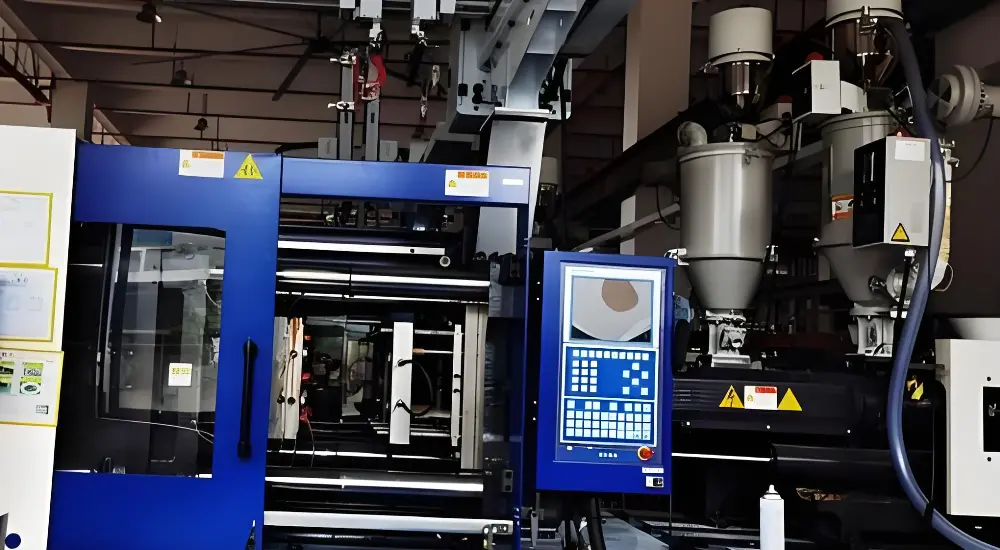
Injection Molding ABS and PETG at Fecision
Fecision molds both ABS and PETG across consumer, medical, electronics, and industrial programs. Process capability covers the full parameter ranges documented in the molding guides above, with dedicated desiccant drying, validated processing windows, and CMM first-article inspection for both materials.
- ABS grades in production: General-purpose, UL 94 V-0 flame-retardant, electroplating-grade, and ISO 10993-biocompatible ABS. PC/ABS blends for elevated heat performance.
- PETG grades in production: Standard PETG 6763, Eastman Tritan™ food-contact copolyester, medical packaging grades with ISO 10993 biocompatibility data.
- Material handling: Dedicated desiccant hopper dryers per material. PETG dried to < 0.02% moisture (verified). ABS dried to < 0.1% moisture. Gravimetric dosing for color and additive consistency.
- Quality: ISO 9001:2015 certified. CMM first-article inspection. Cpk ≥ 1.33 on critical dimensions. Material CoA with every production lot.
Contact Fecision for material selection advice and DFM review at fecision.com/contact-us.
Frequently Asked Questions
Which has better heat resistance for injection molded parts — PETG or ABS?
ABS has higher heat deflection temperature (HDT 80–100°C at 1.82 MPa) versus PETG (65–80°C) — a consistent 15–25°C advantage. For parts that will sustain mechanical load near heat sources, motors, or in warm enclosed environments, ABS is the correct choice.
Is PETG food-contact safe for injection molded components?
Yes — virgin PETG is FDA 21 CFR 177.1630 compliant for food contact. Food-contact compliance applies only to virgin (unrecycled, uncontaminated) material molded without food-incompatible additives or colorants. ABS has no equivalent food-contact regulatory clearance.
Can PETG be electroplated like ABS?
No — PETG cannot be chrome-electroplated by the standard acid-etch process used for ABS. ABS electroplating works because the butadiene rubber phase in ABS is selectively etched by chromic acid, creating micro-pores that the metal layers anchor into. PETG has no equivalent etchable phase.
What injection molding tolerance can Fecision achieve in ABS and PETG?
- For ABS: ±0.1 mm on standard features, ±0.05 mm on precision features, ±0.005 mm on critical dimensions with validated tooling.
- For PETG: similar capability when material is properly dried. Undried or degraded PETG produces dimensional variability that exceeds the tolerance budget of precision parts.
Fecision includes CMM first-article inspection with Cpk ≥ 1.33 as standard for both materials
Which material is better for transparent injection molded parts — PETG or ABS?
PETG. Standard ABS is opaque. Transparent ABS grades exist but are specialty formulations that sacrifice impact performance. PETG in its standard form is naturally transparent at 80–90% visible light transmission, making it the straightforward choice for clear enclosures, packaging windows, and optical covers.
References & Authoritative Sources
Accessed May 2026.
[1] SABIC. CYCOLAC™ ABS Resin — Technical Documentation and Grade Portfolio. https://www.sabic.com/en/products/polymers/acrylonitrile-butadiene-styrene-abs-resin/cycolac-resin
[2] Eastman Chemical Company. Eastman PETG Copolyester 6763 — Technical Data Sheet; Eastman Tritan™ Copolyester — Processing Guide. https://www.eastman.com/en/products/product-families/specialty-copolyesters/tritan-copolyester
[3] U.S. Food and Drug Administration. 21 CFR Section 177.1630 — Polyethylene Phthalate Polymers. https://www.ecfr.gov/current/title-21/chapter-I/subchapter-B/part-177/subpart-B/section-177.1630