
The choice of injection mold can significantly impact the success of your plastic manufacturing project. With the right mold classification, you can ensure production efficiency, part quality, and optimal tooling costs.
The Society of the Plastics Industry developed the SPI Mold Classifications to provide a standardized framework for categorizing injection molds based on production volume, durability, and quality specifications. This system helps manufacturers and product developers select the appropriate mold type for their specific project requirements.
Understanding the Importance of Mold Classification
To achieve optimal results in injection molding, it’s essential to comprehend the importance of mold classification. Mold classification serves as a foundation to make informed decisions about the production processes.
What Is SPI Mold Classification?
SPI Mold Classification is a standardized system developed by the Society of the Plastics Industry (SPI) to categorize injection molds based on their design, materials, and expected lifespan. This classification system helps establish clear expectations between mold makers and customers regarding tool performance, lifespan, and cost. By understanding SPI Mold Classification, you can better navigate the complexities of injection molding and ensure that your project meets its quality and budget requirements.
How Classification Impacts Production Quality and Costs
The classification of your mold directly impacts the quality of the parts produced, as well as the overall production costs. Different classifications are suited for various production volumes and material types, influencing factors such as dimensional stability, surface finish consistency, and tool lifespan. By selecting the appropriate mold classification for your project, you can balance production volume requirements against tooling investment, ensuring the most cost-effective approach for your specific needs.

The Society of the Plastics Industry (SPI) Mold Standards
The Society of the Plastics Industry (SPI) has established mold standards to bring uniformity to the mold quotation process. These standards are crucial for both mold makers and customers, as they provide a common framework for understanding the quality, lifespan, and application of molds used in injection molding.
History and Purpose of SPI Standards
The SPI developed these standards to eliminate confusion between mold makers and customers by creating a uniform mold quotation process. The standards establish clear guidelines for mold construction quality, expected lifespan, and appropriate applications for each classification level, ensuring that all stakeholders are on the same page.
Key Components of SPI Mold Building Standards
The SPI mold building standards outline specific requirements for mold design, construction, and materials. This includes the need for adequate cooling channels to ensure consistent part quality and proper material identification, such as steel type and Rockwell hardness markings, to guarantee the durability and performance of the mold.
General Specifications for All Mold Classifications
Across all mold classifications, the SPI standards specify that customers must approve the mold design before construction begins. Additionally, all molds must have adequate temperature control channels, be properly marked with material information, and include provisions for safe handling, such as eyebolt holes and prybar slots, to prevent damage during installation and removal.
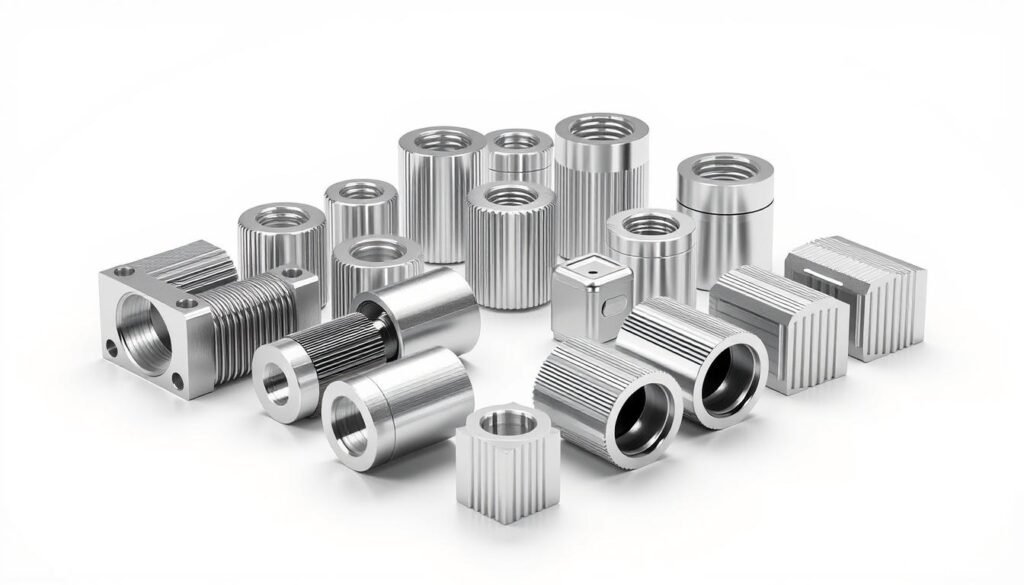
The 5 SPI Mold Classifications Explained
Manufacturers rely on the SPI mold classification system to select the most suitable mold for their specific production needs. This system categorizes molds into five distinct classifications based on their production volume, material requirements, and lifespan.
Class 101: Extremely High Volume Production
Class 101 molds are designed for extremely high production volumes exceeding one million cycles. These premium molds feature hardened tool steel (minimum 48 Rc) for cavities and cores, guided ejection systems, and comprehensive temperature control. They are constructed with the highest quality materials to withstand abrasive plastics and maintain tight tolerances throughout their extended lifespan.
Class 102: High Volume Production
Class 102 molds support medium to high production volumes up to one million cycles. While they maintain many of the quality features of Class 101, some components are optional based on production requirements and budget considerations. This classification offers a balance between quality and cost-effectiveness for high-volume production runs.
Class 103: Medium Volume Production
Class 103 represents the most common mold classification for medium production runs (up to 500,000 cycles). It features a minimum hardness of 28 Rc for cavities and cores, striking a balance between durability and cost-effectiveness. This makes it suitable for many standard production applications.
Class 104: Low Volume Production
Class 104 molds are designed for low production volumes under 100,000 cycles. Typically constructed with mild steel or aluminum components, they offer a more economical solution for limited runs with non-abrasive materials.
Class 105: Prototype Only
Class 105 represents prototype-only tooling limited to 500 cycles or fewer. Constructed in the most economical manner possible using aluminum, epoxy, or other soft materials, these molds produce a minimal quantity of prototype parts for testing and validation.
Each SPI mold classification features specific requirements for material hardness, cooling system design, ejection mechanisms, and overall construction quality that directly correlates with its intended production volume and lifespan. By understanding these classifications, manufacturers can select the appropriate mold type based on their specific production volume, material requirements, tolerance needs, and budget constraints.
Selecting the Right Mold Classification for Your Project
The key to a successful injection molding project lies in understanding and selecting the right SPI mold classification. Several factors dictate the type of mold or tool that is best suited for producing complex injection molded plastic parts.
Production Volume Requirements
Production volume is the primary consideration when selecting a mold classification, as it directly determines the required durability and construction quality of your tooling investment. For projects exceeding one million parts, Class 101 molds are the only viable option.
Material Considerations and Abrasiveness
Material abrasiveness significantly impacts mold selection. Glass-filled or mineral-filled resins require hardened tool steel, such as Classes 101-102, to prevent premature wear and maintain part quality throughout production.
Tolerance and Quality Requirements
Dimensional tolerance requirements must be carefully evaluated, as tighter tolerances generally necessitate higher classification molds with superior construction and temperature control capabilities.
Budget Constraints and ROI Analysis
Budget constraints must be balanced against long-term production needs. ROI analysis should consider the complete production lifecycle, including maintenance costs, potential downtime, scrap rates, and part quality consistency when determining the most cost-effective mold classification.
Partnering with Fecision for Your Injection Molding Needs
Fecision is your trusted partner for all your injection molding needs, offering expertise across various SPI mold classifications. With extensive experience and technical know-how, our engineering team can help guide you through the unique parameters for each classification to select the best mold type to meet your quality, production, and cost objectives.
We offer comprehensive injection molding services, providing customized solutions based on your specific production requirements and budget constraints. Our team works closely with you to evaluate production volumes, material specifications, tolerance requirements, and budget parameters to recommend the optimal mold classification for each project.
- Fecision provides detailed design consultation to ensure your mold specifications align with your production goals.
- Our technical expertise extends beyond mold construction to include material selection guidance, process optimization, and quality control systems.
- We offer ongoing support throughout the production lifecycle, including preventative maintenance recommendations and performance monitoring.
- Fecision’s commitment to quality ensures that each mold we produce meets or exceeds SPI standards for its classification.
Contact our team today to discuss your injection molding project requirements and discover how our expertise in SPI mold classifications can help you achieve optimal results with maximum cost-efficiency.