The demand for miniaturized electronic devices has led to a significant surge in the need for precision-stamped connector parts. As devices shrink, the connectors within them must also decrease in size while maintaining or even increasing their functionality.
You might learn that even microscopic imperfections in connector manufacturing can lead to device failure. Precision stamping techniques are crucial for meeting the stringent requirements of the connector industry, including minimal burrs and the ability to produce connector parts with tight tolerances and complex geometries.
The Critical Role of Precision Stamping in Connector Manufacturing
Connector manufacturing depends on precision stamping to achieve the tight tolerances and complex geometries required for high-performance applications. As you explore the industry of connectors, you’ll find that precision stamping is crucial for producing high-quality components that ensure reliable connections in a wide range of electronic devices.
Evolution of Connector Component Requirements
The evolution of connector components has also been influenced by the miniaturization of electronic devices, which demands connectors that are not only smaller but also more reliable. As a result, precision stamping has become an essential process in connector manufacturing, enabling the production of complex geometries and tight tolerances that are critical for modern electronic applications.
Why Precision Matters in Interconnected World
In today’s interconnected world, the reliability of electronic devices depends critically on the quality of their electrical connections. You rely on connectors to transmit power and signals between different components, and any failure in these connections can have significant consequences. Precision-stamped connector components play a crucial role in ensuring the reliability of these connections, enabling everything from consumer electronics to medical devices, automotive systems, and aerospace applications.
By achieving tight tolerances and complex geometries through precision stamping, you can ensure the quality and reliability of your connector components, which is critical for maintaining signal integrity and power transmission in modern electronic devices.
The Technical Challenges of Connector Component Stamping
The production of connector components via stamping presents several technical challenges. As connectors become increasingly complex and miniaturized, the demands on their manufacturing processes grow.
Balancing Miniaturization with Functionality
One of the primary challenges in connector component stamping is balancing the trend towards miniaturization with the need for maintaining functionality. As connectors shrink, their components must be stamped with increasingly precise tolerances to ensure proper fit and performance. You must consider how to achieve these tight tolerances without compromising the structural integrity of the connectors. Advanced stamping techniques and tooling are crucial in this regard, enabling the production of complex geometries while maintaining the
Common Failure Points in Connector Manufacturing
Understanding common failure modes in connector manufacturing is essential for designing effective stamping processes. The majority of connector failures result in intermittent connections or open contacts, with failure modes including open circuit (61%), poor contact (23%), and short circuit (16%). You should analyze how stamping defects can lead to these failure modes and implement precision stamping techniques to mitigate these risks.
Achieving Complex Geometries Through Advanced Stamping
Advanced stamping techniques are revolutionizing the production of complex connector geometries. These advancements enable the creation of intricate shapes and precise features that are critical for modern connector applications.
Design Considerations for Intricate Connector Shapes
When designing intricate connector shapes, several factors must be considered, including the material properties and the capabilities of the stamping tools. The choice of material significantly influences the achievable complexity in stamped connector components. For instance, certain materials may be more prone to deformation or may require specific handling to achieve the desired geometry.
The design process involves careful analysis of the material and the stamping process to ensure that the final product meets the required specifications.
Overcoming Geometric Complexity Challenges
Overcoming geometric complexity challenges in connector stamping often involves the use of advanced stamping techniques such as progressive die stamping, fine blanking, and compound die stamping. These techniques enable the production of complex connector shapes through a series of carefully sequenced operations.
Fecision has developed proprietary processes to overcome geometric complexity challenges in connector stamping, allowing for the creation of intricate features and complex geometries that meet the precise requirements of modern connectors.
The Science of Burr Minimization in Precision Stamping
Minimizing burrs in precision stamping is essential for maintaining the integrity and performance of connectors. Burrs, the unwanted material protrusions formed during the stamping process, can significantly impact the quality and functionality of connector components. Effective burr minimization requires a comprehensive approach that encompasses tool design, precision stamping process control, and post-stamping management techniques.
How Burrs Affect Connector Performance and Assembly
Burrs can compromise the performance and assembly of connectors in several ways. They can cause misalignments during assembly, lead to electrical shorts, and even affect the mechanical strength of the connector. Moreover, burrs can complicate the inspection process, potentially allowing defective parts to pass through quality control undetected.
The formation of burrs is influenced by various factors, including die design, material properties, and stamping process parameters. By controlling these factors, manufacturers can significantly reduce burr formation.
Advanced Techniques for Burr Reduction and Management
Several advanced techniques and precision stamping process optimizations can be employed to minimize burrs. These include fine blanking and compound action dies, which are designed to produce lower burr heights. Additionally, optimizing process parameters such as press speed, lubrication, and material condition can also help in reducing burr formation. Implementing a robust control system to monitor and adjust these parameters in real-time is key to achieving consistent burr minimization.
Material Selection for Optimal Stamping Results
The choice of material significantly impacts the performance, durability, and overall quality of the final product. When selecting materials for connector stamping, several factors must be considered, including mechanical properties, corrosion resistance, and conductivity.
Copper Alloys and Their Stamping Properties
Copper alloys are widely used in connector manufacturing due to their favorable mechanical properties and good conductivity. However, they can be challenging to solder and are prone to corrosion. To mitigate these issues, copper pins are often coated with inert metals like gold, enhancing their surface properties and ensuring reliable performance in various applications.
Specialty Metals for High-Performance Applications
For high-performance connectors, specialty metals such as beryllium copper or phosphor bronze may be used. These materials offer enhanced strength, conductivity, and resistance to corrosion. The selection of these materials depends on the specific requirements of the connector application, including environmental conditions and performance expectations.
Material Coating Considerations
Material coatings play a crucial role in connector performance, providing enhanced conductivity, corrosion resistance, and solderability. Common connector coatings include gold, silver, tin, and nickel, each with specific performance characteristics. The thickness and uniformity of these coatings significantly affect connector performance and durability, particularly in harsh environments. Precision stamping techniques must be designed to accommodate subsequent coating operations without compromising component quality.
Precision Stamping Equipment and Tooling Requirements
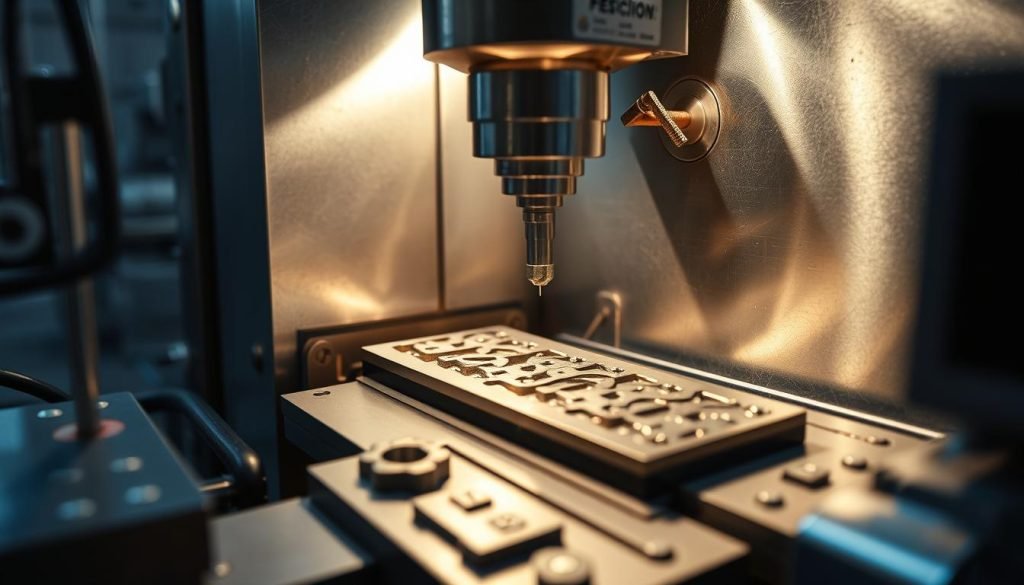
The effectiveness of precision stamping for connectors heavily relies on the quality of equipment and tooling used. To achieve the tight tolerances and complex geometries required in modern connector manufacturing, manufacturers must invest in advanced stamping equipment and sophisticated tooling.
High-Precision Press Technology
High-precision press technology is at the heart of effective precision stamping. Modern presses are designed to deliver high accuracy and repeatability, crucial for producing connector components with tight tolerances. These presses often feature advanced servo-drive systems, allowing for precise control over the stamping process.
The use of high-precision presses enables manufacturers to achieve consistent quality across large production runs. This consistency is critical in the connector industry, where even minor deviations can lead to significant performance issues.
Tool Design and Maintenance for Consistent Quality
Tool design and maintenance are fundamental to achieving and maintaining tight tolerances in connector stamping. Progressive die design principles play a crucial role in this process, involving careful consideration of station layout, material flow control, and pilot positioning.
- Analysis of progressive die design principles for connector stamping.
- Discussion of advanced tool materials like carbide, powdered metal, and specialty steels.
- Examination of critical tool maintenance practices, including sharpening schedules and wear monitoring.
- Exploration of how integrated tool design and maintenance programs ensure consistent quality.
By focusing on these aspects, manufacturers can ensure the production of high-quality connector components that meet the stringent requirements of the industry.
Quality Control Processes for Precision-Stamped Connector Components
Robust quality control processes are essential for ensuring that the components meet the required specifications and perform reliably in their intended applications.
Inspection Technologies and Methodologies
Advanced inspection technologies play a critical role in maintaining the quality of precision-stamped connector components. You can utilize various inspection methodologies, including optical inspection systems and coordinate measuring machines (CMM), to detect defects and verify dimensions. These technologies enable you to identify even minor deviations from the specified tolerances, ensuring that only components that meet the required standards are passed on to the next stage of production.
Statistical Process Control in Connector Manufacturing
Statistical Process Control (SPC) is a vital tool for maintaining consistent quality in high-volume connector component production. By applying SPC principles, you can monitor and control critical dimensions in stamped connector components, ensuring that the production process remains within specified limits. Capability indices like Cp and Cpk are used to evaluate process stability, and real-time SPC implementation enables immediate corrective action when process drift is detected. Advanced SPC techniques, such as multivariate analysis, help identify complex interactions between process parameters and connector quality, allowing for further optimization of the manufacturing process.
Addressing Specific Connector Industry Challenges
The connector industry faces a multitude of challenges that require specialized stamping approaches. As technology advances, the demands on connector components are becoming increasingly complex, necessitating innovative solutions to meet specific industry requirements.
Power Connector Stamping Requirements
Power connectors are critical in low-cost consumer electronics, often utilizing bulky AC wall adaptors. The current rating of a connector, measured in amps per circuit, is crucial in ensuring that it meets the power requirements of your application. Factors such as contact material, thermal management, and environmental conditions influence this rating. You must select a connector that can safely handle the maximum current required by your device.
Data Transmission Connector Precision Needs
Data transmission connectors require high precision to maintain signal integrity. The stamping process for these connectors must achieve tight tolerances to ensure reliable data transfer. You need to consider factors such as contact geometry, material selection, and surface finish to optimize connector performance.
Specialized Industry Applications
Different industries have unique connector requirements. For instance, the automotive industry demands connectors that can withstand vibration, temperature extremes, and harsh chemicals. In contrast, medical applications require connectors with biocompatibility, sterilization resistance, and absolute reliability. You must tailor your stamping processes to meet these diverse industry specifications and standards.
Innovations in Die Design for Complex Connector Geometries
The connector industry is witnessing a significant shift towards more complex geometries, driven by advancements in die design technology. As connectors become increasingly sophisticated, the need for innovative die design solutions has become paramount.
Progressive Die Stamping Advantages
Progressive die stamping is a highly efficient process that offers numerous advantages for connector manufacturing. This technology enables the production of complex connector components with high precision and consistency.
Some key benefits of progressive die stamping include improved production capabilities, enhanced manufacturing precision, and reduced production costs. By leveraging progressive die stamping, manufacturers can achieve complex shapes and geometries that would be challenging or impossible with traditional stamping methods.
Multi-Slide Technology for Complex Shapes
Multi-slide technology is another significant innovation in die design, particularly suited for forming complex connector shapes. This technology utilizes multiple tools that approach from different directions to form intricate three-dimensional connector components.
The advantages of multi-slide technology are particularly evident when producing connectors with complex bends and forms. By combining multi-slide technology with progressive die stamping, manufacturers can create connector components that feature both complex forms and precise cutouts, thereby expanding the range of connector geometries that can be manufactured cost-effectively.
Conclusion: Partnering with Experts for Superior Connector Components
Achieving excellence in connector component manufacturing requires a deep understanding of precision stamping. As you’ve seen throughout this article, the challenges in connector component stamping are multifaceted, involving tight tolerances, complex geometries, and burr minimization.
Fecision’s specialized capabilities address these challenges through advanced tooling, process control, and quality assurance. Let’s partner with Fecision for superior connector components.