
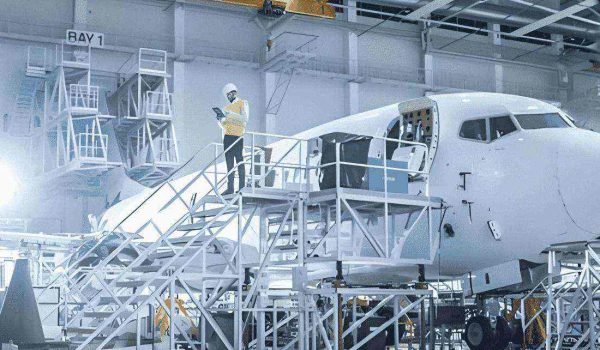
A single micro-deviation can cause a multi-million-dollar jet to be grounded, which is why aerospace CNC machining must be the invisible guardian of every safe take-off and landing. This level of precision is not merely preferred; it’s a fundamental, non-negotiable requirement for every flight component.
This complete guide will help you understand the core concepts of this specialized field. You’ll learn exactly what aerospace CNC machining is, several weight-saving and safety-critical benefits, key materials used, and major high-value industry applications.
What Is Aerospace CNC Machining?
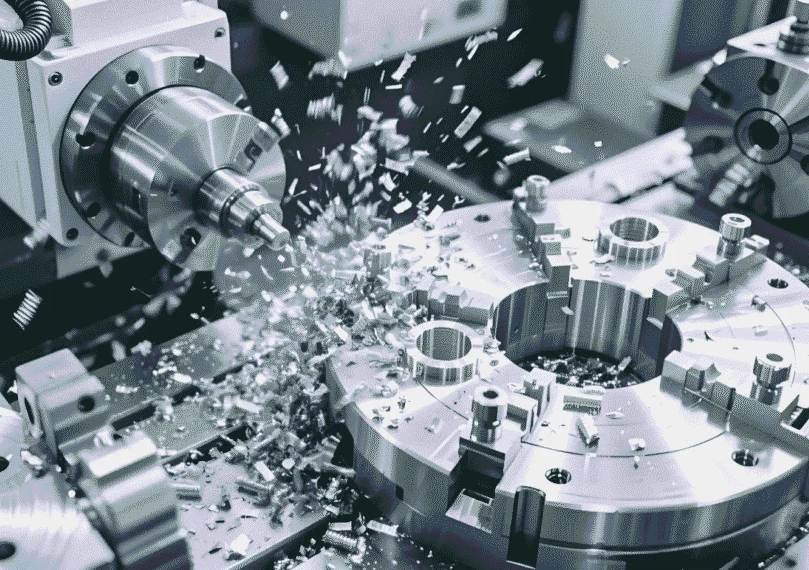
Aerospace CNC machining is a specialized subtractive process controlled by computers. You remove material from a raw form (billet or forging) until the part achieves aerospace-grade tolerances. These precision requirements are often several times tighter than general manufacturing tolerances.
To ensure safety in flight, the CNC machining aerospace parts must pass strict tolerances defined in quality standards like AS9100 and NADCAP. This includes meticulous tracking. Every single machined part comes with an FAI (First Article Inspection) package, a mandatory set of documentation that verifies compliance and travels with the component for its service life.
This specialized machining uses techniques beyond the standard. You’ll find vacuum work-holding to prevent any part distortion and advanced coolant systems to stop chip recutting. Most crucially, 5-axis simultaneous motion is used to complete complex aerospace CNC machined parts in one setup, eliminating critical error sources.
Benefits of Using CNC Machining for Aerospace Parts
The aerospace industry utilizes CNC technology based on its outstanding performance characteristics. Let’s look closely at eight specific and vital ways it delivers unparalleled safety and efficiency benefits.
Micro-Level Precision
Modern 5-axis machines can hold positional accuracy of mere microns. This micro-level control is absolutely vital for parts like turbine blade roots. It ensures they mate perfectly with the disk slots, which is the exact fit needed to prevent dangerous, destabilizing mid-flight vibration in the engine.
Repeatability Across Low-Volume Runs
Once the aerospace parts CNC machining manufacturing program has been proven and validated, the same digital code will produce identical aerospace parts every time. This remarkable repeatability holds true whether your batch is a single prototype or several hundred units. This consistent process saves weeks during the crucial prototype-to-production transition.
Weight-Optimized Geometry
CNC machining allows for complex cuts that enable high-speed micro-milling. This can create lattice structures inside aluminum brackets, for instance. This dramatically cuts overall mass while surprisingly exceeding the original stiffness. This mass reduction is absolutely critical for meeting current fuel-burn reduction targets.
Rapid Design Iteration
Imagine uploading a revised CAD file in the morning. An engineer could then hold a physical aerospace part by the afternoon and validate it in a wind tunnel the same day. This rapid design iteration is only possible with CNC machining. It’s simply impossible to achieve with slow, costly hard tooling.
One-Piece Multi-Axis Solution
5-axis machining can mill, drill, and thread a complex hydraulic manifold all in one continuous cycle. This innovative process transforms multiple formerly brazed tubes into one strong, monolithic titanium block. The resulting single part is guaranteed never to leak, even when subjected to extremely high internal pressure.
Cost Control via Scrap Reduction
Aerospace CNC machining uses sophisticated systems for material reclamation. Titanium chip conveyors and coolant recycling systems reclaim the majority of the metal swarf. This is essential, as it helps offset raw-material price spikes. It’s a key factor in keeping aerospace CNC machining services truly competitive.
Seamless Documentation
On-machine probing is now able to capture all dimensional data automatically. It populates essential forms like PPAP and AS9102 in real time. This feature provides audit-ready paperwork instantly. This documentation is a mandatory requirement that all reputable aircraft and aerospace CNC machining suppliers must always provide.
Speed to Market
Combining high-speed spindles with clever pallet pools significantly slashes the cycle time on components like aluminum avionics housings. This accelerated manufacturing pace helps original equipment manufacturers (OEMs) hit their demanding first-flight deadlines and rollouts.
Fecision Aerospace CNC Machining Capabilities
Ready for best in class? Fecision is one of the best AS9100-certified aircraft & aerospace CNC machining suppliers that guarantees the highest aerospace quality standards. We provide precision CNC machining of aerospace-grade materials with titanium, aluminum, and Inconel. Our ability to meet competitive lead times and value-engineered solutions makes us the best choice for your aerospace schedules.
Common Materials Used in Aerospace CNC Machining
The ultimate performance of any aerospace part relies completely on the material it is composed of. Let’s look at the important metals and high-performance plastics that make modern flight truly possible.
Aluminum Alloys
The aerospace industry employs many different alloys of aluminum, and each has its specific job. 6061-T6 is a general-purpose strength option that has great corrosion resistance; for this reason, it is ideal for support brackets.
For applications that need maximum strength, the most used aluminum alloy is 7075-T7351 for components under significant stress, such as wing ribs. Machining this zinc-rich alloy demands a high spindle RPM and flood coolant application to meticulously prevent those unwanted edge burrs.
Titanium Grades
Titanium is recognized for its remarkable strength-to-weight ratios, particularly for airframes. The common, ductile Grade 2 is used for hydraulic tubing to provide flexibility. You must run this material at controlled surface speeds to avoid problematic work-hardening.
As a workhorse material, Ti-6Al-4V Grade 5 can be found throughout many contemporary aircraft. Its low thermal conductivity means high-pressure coolant must be delivered right through the cutting tool to manage heat build-up quickly.
Nickel-Based Superalloys
For parts that will experience extreme heat—particularly, inside a jet engine—engineers decide on superalloys. Inconel 718 has given excellent creep resistance, making this a good material for critical components such as turbine afterburner flaps.
With respect to this material, keep in mind that the cutting speeds you can use are limited significantly by tool life. Therefore, you need precise tool-cost planning to create an accurate manufacturing quote for these highly critical CNC machining aerospace parts.
Magnesium Alloys
Magnesium is a critical material to use when minimizing mass is necessary. AZ31B-F has a distinct mass advantage over aluminum, allowing it to be used in aircraft seat frames and other interior structural parts.
Due to the combustibility of magnesium chips, strictly adhering to safety measures is necessary – sharp tools and strict dust collection systems are needed to eliminate the risk of ignition when machining magnesium.
Engineering Plastics
High-performance engineering plastics have become increasingly important from both a safety and a functional standpoint. PEEK has high levels of continuous-use temperature for parts like bearing cages in landing gear or radiolucent antenna housings.
Another important plastic is Ultem 2300, a glass-reinforced, flame-retardant polymer. This material is used almost exclusively for interior clips and other similar small parts to allow aircraft to meet safety certification standards while minimizing total emissions of the flight.
Metal-Matrix Composites
For advanced thermal and electronic applications, it often calls for metal-matrix composites (MMCs). Al-SiC is used for electronic cold plates because it dissipates heat much more efficiently than standard metals.
Unfortunately, the nature of the silicon carbide (SiC) particles is abrasive. Therefore, to machine these materials, you need special tooling. Use diamond-coated end mills—they hold up better and keep your cuts accurate.
Key Material Selection Criteria
| Material | Key Properties | Common Applications | Machining Consideration |
| Aluminum Alloys | High Strength-to-Weight, Corrosion Resistance | Support Brackets, Wing Ribs | High RPM, Flood Coolant |
| Titanium Grades | Superior Strength-to-Weight, Heat Resistance | Airframes, Hydraulic Tubing | Controlled Speed, High-Pressure Coolant |
| Nickel-Based Superalloys | Exceptional Creep Resistance, High-Temp Strength | Turbine Blades, Afterburner Flaps | Limited Tool Life, High Cost |
| Magnesium Alloys | Extreme Lightweight | Seat Frames, Interior Structures | Sharp Tools, Dust Extraction |
| Engineering Plastics | High-Temp Resistance, Flame Retardant | Bearing Cages, Cabin Interiors | Standard Machining |
| Metal-Matrix Composites | Advanced Thermal Conductivity | Electronic Cold Plates | Diamond-Coated Tools |
Applications of Aerospace CNC Machining
So, where do all these high-precision parts go? CNC machining aerospace is the primary technology that drives several significant high-value aerospace applications, enabling both aircraft and spacecraft to operate within acceptable tolerances.
Turbine Engine Components
Critical components, such as the blade roots, disks, and stator vanes, are machined from tough materials like Inconel 718. These components are engineered for reliable performance in extreme temperatures and intense RPM ranges within the engine.
Engineers utilize 5-axis flank-milling to manufacture intricate aerodynamic profiles with exceptional precision. This micron-level precision is directly responsible for improving the airflow and overall fuel-burning efficiency.
Structural Airframe Fittings
This vital category includes safety-critical parts such as fuselage shear ties and wing ribs. They are often milled from high-strength 7075-T7351 aluminum to form the aircraft’s skeletal structure.
CNC machining carefully mills weight-reduction pockets to a minimal wall thickness. These lightweight parts then face long-cycle fatigue tests. This confirms the airframe will handle decades of daily stress.
Landing-Gear Parts
The landing gear must safely endure immense impact forces at every single touchdown. Components like titanium axles and steering collars are initially processed through CNC turning for shaping.
This is followed by precise deep-hole boring to ensure high concentricity. This sequence is necessary to prevent dangerous brake shimmy and unwanted vibration, which keeps the aircraft stable upon landing.
Spacecraft Propulsion Modules
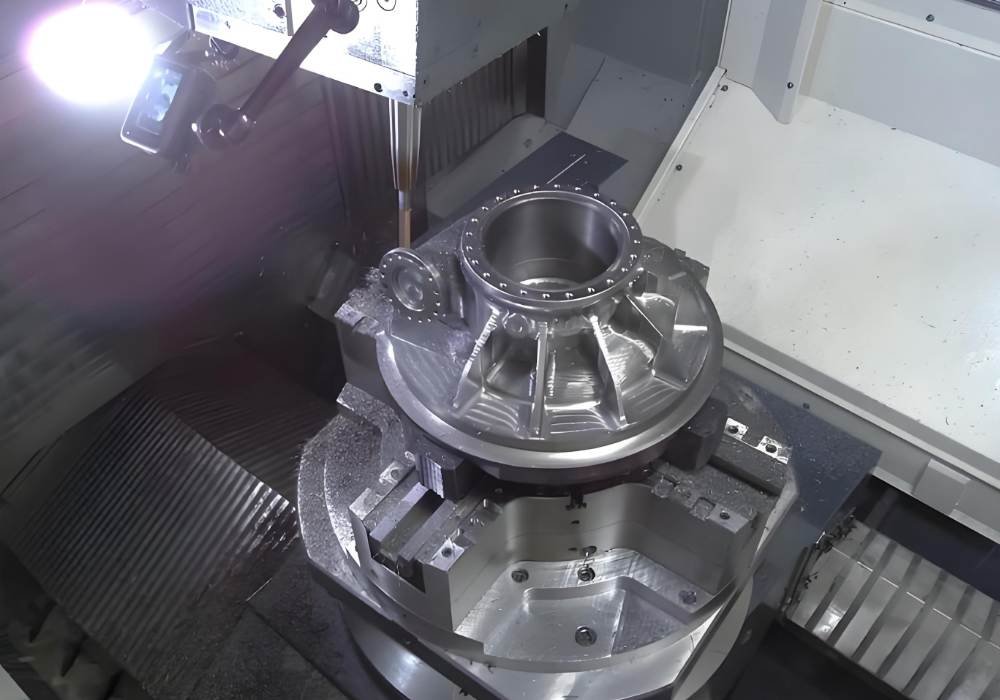
For deep space, CNC machining is used to create complex throttle-valve bodies from Ti-6Al-4V. These often feature internal curved flow paths that would be impossible to manufacture using casting methods.
5-axis simultaneous machining achieves micron-range tolerances on these aerospace CNC machined parts. This precision is essential for ensuring completely leak-free and reliable operation in the harsh, demanding vacuum of space.
Satellite RF Hardware
Satellite communication relies on absolutely flawless signal transmission performance. Waveguides and antenna arrays are typically machined from 6061-T6 aluminum and finished with conductive gold plating after the milling is complete.
The positional accuracy of the internal features is extremely critical for functionality. This exacting precision directly ensures Ka-band signal integrity and optimal performance at the very high frequencies required for satellite communication.
Cabin Interiors & Seating
Even the passenger experience benefits from CNC precision and safety. Examples include aluminum 6061 seat spreaders and durable PEEK food-tray rollers found throughout the cabin.
CNC machining ensures these parts meet strict flammability standards before installation. It also delivers the high-quality, passenger-visible A-surface finish that is expected in a comfortable and modern aircraft environment.
Conclusion
Aerospace CNC machining is the core technology that converts exotic alloys and plastics into safety-critical, weight-saving components. It consistently delivers micron-level accuracy and full regulatory traceability, meeting the absolute highest demands for modern aviation and space programs.
At Fecision, we provide comprehensive manufacturing solutions across the entire aerospace supply chain, from commercial aircraft components to spacecraft systems. Our capabilities extend beyond standard CNC machining to include precision mold tooling, injection molding for lightweight plastic parts, and the production of metal parts. We support your project from initial prototyping through to efficient mass-production runs.
Why Choose Fecision for Aerospace?
- Extensive industry experience in manufacturing aerospace components.
- A rigorous AS9100 certified quality management system.
- Specialized technical expertise in complex aerospace materials.
- Manufacturing flexibility with multiple process capabilities.
- Value-engineered solutions provide cost-effective results.
- Full supply chain service: manufacturing, finishing, logistics.
Are you excited to move forward with the aerospace-grade precision needed to complete your project? Contact Fecision today to assess your specific aerospace parts CNC machining manufacturing requirements and receive a quote for your next critical flight component!